Please note the PCA CN Report is calling on you to disagree with the Westminster Standards. While the PCA has not bothered to amend the Standards to fit their views.
The #PCA CN report says:
“ An officer who advocates for the magistrate’s duty to suppress heresies is in tension with the Standards.” 2731, lines 30-31
How does this square with WLC 108, which is also part of the PCA standards?
WLC 108 says it is the duty of all (including magistrates) to not only detest, disapprove and suppress false religion, but actively remove it, and all monuments of idolatry.
“And he said, Hear now my words: If there be a prophet among you, I the Lord will make myself known unto him in a vision, and will speak unto him in a dream. My servant Moses is not so, who is faithful in all mine house. With him will I speak mouth to mouth, even apparently, and not in dark speeches; and the similitude of the Lord shall he behold: wherefore then were ye not afraid to speak against my servant Moses?”
Numbers 12:6-8
“who was faithful to him that appointed him, as also Moses was faithful in all his house. And Moses verily was faithful in all his house as a servant, for a testimony of those things which were to be spoken after;”
Hebrews 3:2, 5
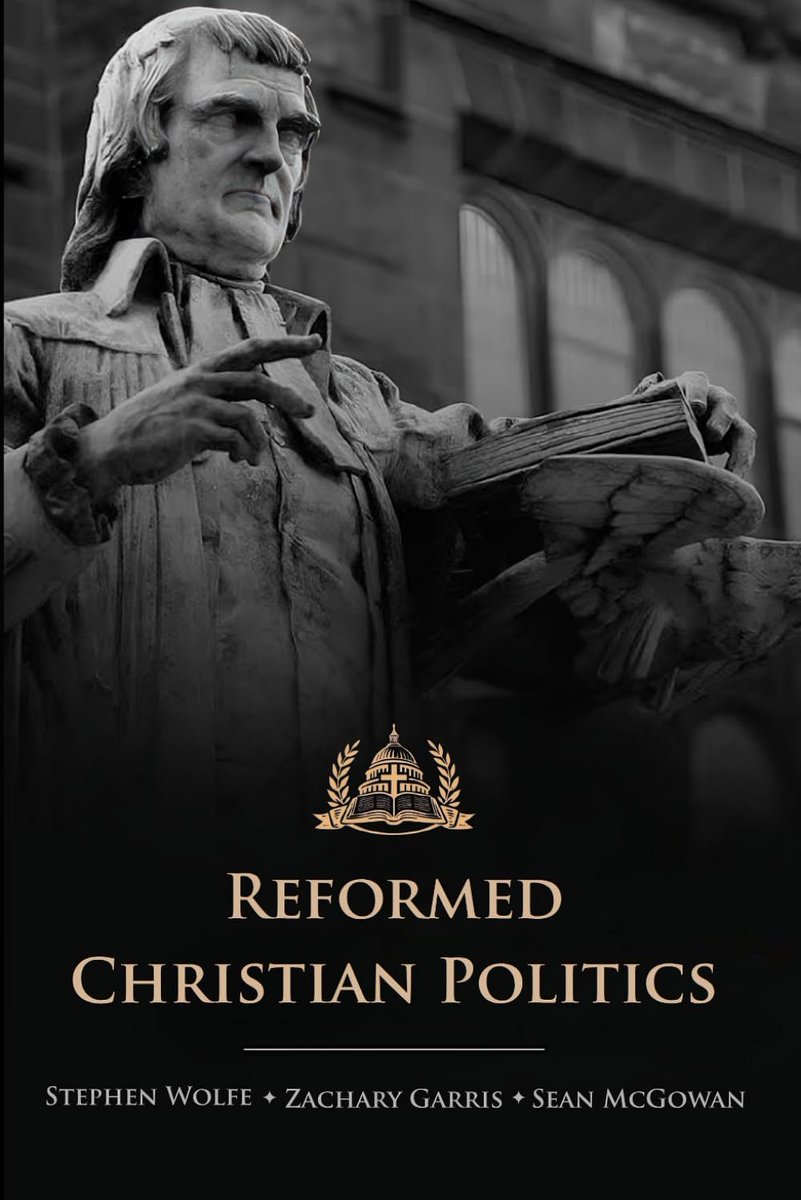
The 90th overture for consideration by the 53rd #PCAGA has been received. The overture comes from the session of Grace Presbyterian Church and proposes to “Append Reformed Christian Politics to AIC Report on Christian Nationalism." https://t.co/PwaA8B83yw
We know why seminaries take female students ($$$).
But why do women want to go to seminary?
(1) Some want credentials to become formal teachers in the church (feminism).
(2) Others just want to learn more about the Bible—and all they get is fluff from their pastors.
“It becomes those who profess the gospel to strive for it, to use a holy violence in taking the kingdom of heaven. The faith of the gospel is the doctrine of faith, or the religion of the gospel. There is that in the faith of the gospel which is worth striving for. If religion is worth any thing, it is worth every thing. There is much opposition, and there is need of striving. A man may sleep and go to hell; but he who will go to heaven must look about him and be diligent.”
—Matthew Henry (Commentary on Philippians 1:27)
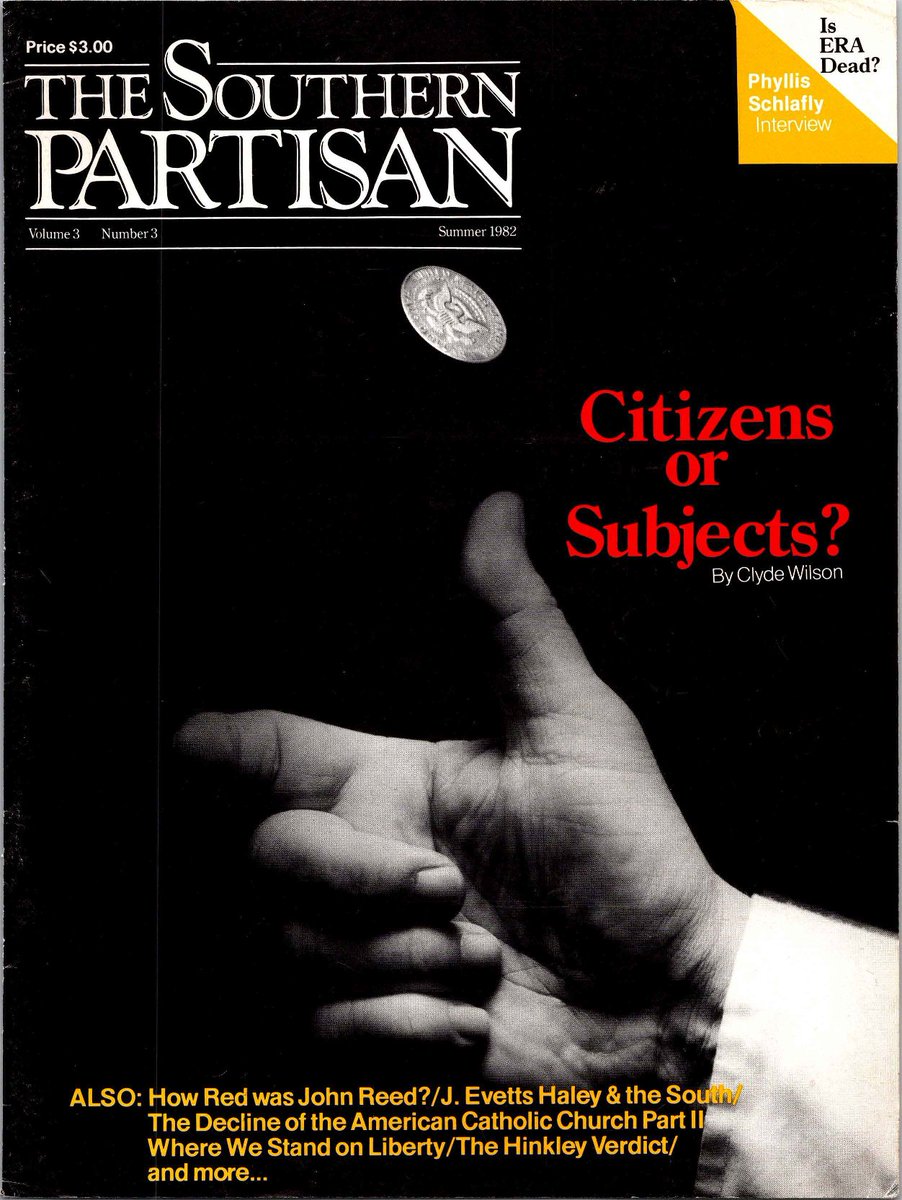
From Southern Partisan 02.3, 1982:
The cream of Southern writers and thinkers gathered this spring at Converse College in Spartanburg, South Carolina, for a literary reunion. Present were Andrew Lytle, Cleanth Brooks, George Garrett, Peter Taylor, and Eudora Welty, who regaled a large and enthusiastic audience of students and townspeople with readings from their works and informal discussions of Southern literature.
The highlight of the two-day gathering was a roundtable discussion between all of the principals except Miss Welty, on the South. Peter Taylor, one of America's greatest short-story writers recalled how William Faulkner's Absalom Absalom, considered by many today as the American novel, was first received by New York critics: it was officially opined that the book had been written by a crazy man.
Taylor went on to describe what he feels Southern literature is all about: it is a struggle to humanize modern life by understanding it and reconciling it with the Christian tradition of the West. No small task, but one which Southern writers have mastered.
Cleanth Brooks, one of America's greatest literary scholars, commented on today's culture. The students of today are, he fears, outside Western civilization. They are equally cut off from both the old traditional oral culture of the West and from the written high culture. According to Brooks, the three bastard America muses hold sway in literature.
These are Sentimentality, Propaganda, and Pornography, the latter a billion dollar industry predicated upon the unwillingness or inability of Americans "to see reality as a whole." And only the writers of the South still have the cultural base to see the present situation for what it is, rather than to be a part of it.
The key to Southern literature, Andrew Lytle (perhaps the greatest living practitioner of Southern literature) told the assembled audience, is that it is still Christian and still has a Christian grasp of the reality of evil. The Southern tradition is squarely at odds with the Puritan or Northern tradition. The Puritan puts evil in the object---whiskey, a gun, a bad environment, etc.---rather than in the human heart. Once evil is projected into the object, the Puritan is able to justify to himself his right to attack and reform others in the name of his own sanctity. This reduces to a disguised form of a will to power. What the Puritan wants is not salvation but power. He is, in the final analysis, a minion of the Devil.
George Garrett, poet and novelist, described with some relish the economic and cultural decay of the once powerful Northeast and declared his belief that, judging from the youngest writers just coming on the scene, Southern literature is still great and still Southern and will continue to be for a long time.
Benjamin Franklin, the “deist”, at the Constitutional Convention:
“All of us who were engaged in the struggle must have observed frequent instances of a Superintending providence in our favor. To that kind providence we owe this happy opportunity of consulting in peace on the means of establishing our future national felicity. And have we now forgotten that powerful friend? I have lived, Sir, a long time, and the longer I live, the more convincing proofs I see of this truth- that God governs in the affairs of men. And if a sparrow cannot fall to the ground without his notice, is it probable that an empire can rise without his aid? We have been assured, Sir, in the sacred writings, that ‘except the Lord build the House they labour in vain that build it.’ I firmly believe this; and I also believe that without his concurring aid we shall succeed in this political building no better than the Builders of Babel: We shall be divided by our little partial local interests; our projects will be confounded, and we ourselves shall become a reproach and byword down to future ages. And what is worse, mankind may hereafter from this unfortunate instance, despair of establishing Governments be Human Wisdom and leave it to chance, war and conquest.
I therefore beg leave to move, that henceforth prayers imploring the assistance of Heaven, and its blessings on our deliberations, be held in this Assembly every morning before we proceed to business, and that one or more of the Clergy of the City be requested to officiate in that service.”
Another point about RTS advertising to women.
We’ve witnessed the demise of men-only (& women-only) spaces.
If we can’t even keep women out of seminary (which is to train male pastors), then we really can’t have anywhere just for men.
@ZacharyGarris This would make a lot of people mad, but the NT definitely gives the impression that women can get all the theological training they need from their pastors at church (Titus 1:9), or their husbands at home (1 Cor 14:35), or older godly women at church (Titus 2:3-5)
“A proper conception of the grandeur and depth of the word of God will lead the prudent minister to use every possible aid in striving to reach its fullest meaning.”
Thomas Murphy
Seminaries were founded in the early 1800s to train ministers.
They are not merely graduate schools of theology.
But encouraging women to enter seminary treats them as such—and this does not serve the church well.