I am the USA’s first Black female theoretical astrophysicist. Importantly, I am also the first scientist to successfully work out the Penrose mechanism to extract energy-momentum from a Kerr (rotating) black hole using the Theory of Relativity. The following (somewhat long but thorough and informative) Thread shows scientific details along with receipts of how a specific group of white male scientists stole my research, took credit for my work over many years, and destroyed my academic career. I deserve justice and to be recompensed! Upon reading, I am sure you will agree. 😊
To the Scientific Community and Interested Others: Setting the Record Straight on Astrophysical Rotating Black Holes and their Energy Extraction Mechanism:
(Part 1/4) (19,329 characters = 6 pages):
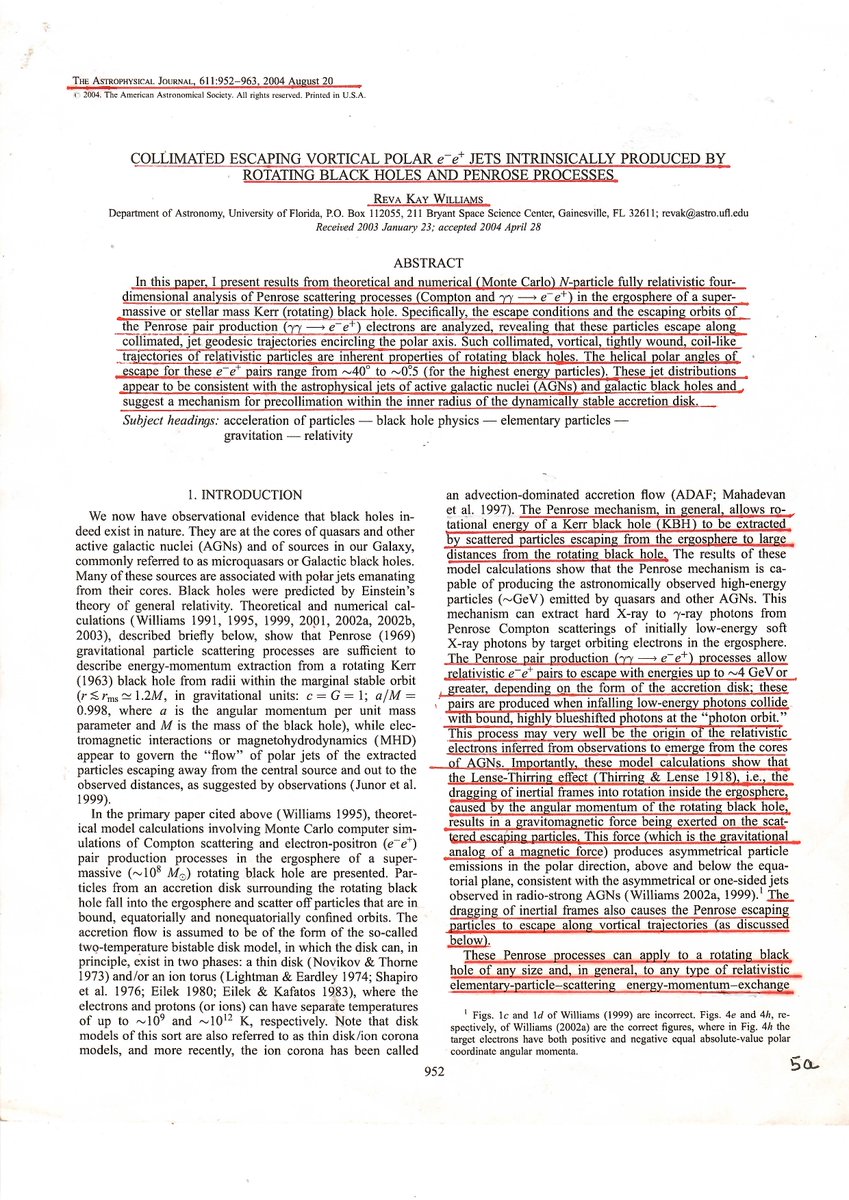
As many of you know, I am a theoretical astrophysicist. I am the first astrophysicist to research and use the Kerr metric in a practical, 4D, astrophysical context, to become the first person to successfully work out the Penrose mechanism to extract energy (and momentum) from a Kerr (rotating) black hole (KBH) using Einstein’s Theory of Special and General Relativity. See R. K. Williams, Physical Review D (PRD) 51, No. 10, 5387 (1995) (https://t.co/qxrm15SNHK); the content of this 41-page relativistic-astrophysics paper was based on my 1991 PhD dissertation (https://t.co/FawaRTFj4q ). This paper not only taught the astrophysical community how to extract energy from a KBH that is consistent with observations but provided the solutions to the trajectories and velocities of particles (or bodies) infalling or accreted onto the KBH, falling toward the event horizon in 4D [(3 space positions, time) or (3 space momenta, energy)]. Note that I could not have done this work without the contributions of those scientists who came before me. In other words, I stood “on the shoulders of giants.”
The KBH nonequatorially confined constants of motion analytical equations that solved the 4-momentum of infalling matter, presented in Appendix A of my above 1995 PRD paper, allowed accretion disk theorists: Charles Gammie of UIUC, Julian Krolik of JHU, David Meier of Caltech and JPL, Shinji Koide of Japan, some collaborators, and their instructed graduate students/postdocs to create general relativistic (GR) magnetohydrodynamic (GRMHD) numerical models in 4D spacetime (for the first time) to show how matter is accreted (or flows) on to the KBH, yet my 1995 PRD paper was not appropriately cited; acts of plagiarism. Then, subsequently, the GRMHD numerical simulations began to show that particle plasma escapes in the form of bipolar jets (sometimes referred to as polar jets), which I had already demonstrated in a thorough, detailed steady-state theoretical, analytical, and Monte Carlo numerical computer simulation (Williams 1995, PRD; 2004, ApJ), which they were using but still no citation of my work.
The accretion-disk theorists mentioned above merely duplicated my model results numerically over the years, since January 1999, after I submitted a research proposal to the National Science Foundation (NSF). Importantly, when models of Gammie and Krolik went from a GRMHD accretion flow (an ideal MHD fluid which excitingly confirmed the prediction by prior accretion disk theorists that funnels would form about the polar axis due to a centrifugal barrier, causing this region to be void of particles) to a relativistic radiative transfer model, which involves relativistic scattering processes inside the ergosphere (loosely referred to as the “plunging region” by Krolik et al. to call it by another name), is when they began using the Penrose mechanism that I became the first to successfully work out to extract the energy-momentum 4-vector of escaping particles from a KBH in the form of steady-state polar jets, and presented this analysis in my breakthrough GR KBH research 1995 PRD paper. Gammie admitted on at least two occasions in his talks that the GRMHD simulations did not produce jets until they began radiative transfer (Monte Carlo simulations) and that radiative transfer (i.e., the Penrose mechanism) was needed to compare with the Event Horizon Telescope (EHT) observations. In other words, the Penrose-Williams (PW) model calculation was required to predict and compare it with EHT observations, and it worked! Confirming the PW mechanism. But instead of Gammie et al. revealing this truth to the public and scientific community, they continued plagiarizing and taking credit for my work.
My breakthrough GR KBH research that included Monte Carlo “inverse” Compton scattering inside the ergosphere, that Gammie [“grmonty: A Monte Carlo Code for Relativistic Radiative Transport,” 2009, Astrophysical Journal Supplement Series (ApJS), 184, 387] and Krolik (“A Monte Carlo Code for Relativist Radiation Transport Around Kerr Black Holes,” 2013, ApJ, 777, 11) are plagiarizing, was presented in my 1991 dissertation and my 1995 PRD paper (see embedded image). In my detailed analysis of the Penrose mechanism, I found that the particles (X-rays, gamma rays, and relativistic electrons) escape in the form of vortical swirling (or spiraling) collimated bipolar jets due to inertial spacetime frame dragging by the angular momentum of the rotating KBH [see also Williams 2004, ApJ (https://t.co/tnXXmFs8sw )]. Importantly, I found that relativistic electron-positron (e- e+) pairs escape from the photon orbit through Penrose pair production (γ γ →e- e+). This pair plasma's associated intrinsic magnetic field will produce the synchrotron radiation observed by the EHT, coming from the photon orbit!
However, Gammie and his allies are continuing to perpetuate a lie: the false narrative of a group of scientists (ten of whom I can readily identify, including Gammie, as having some part in the January 1999 conspiracy to steal my research, after an NSF peer-review panel evaluation of my submitted November 1998 research grant proposal: requesting funds to do a dynamical evolution of my Penrose scattered escaping jet particle plasma). Gammie et al. are continuing to falsely attribute my successful model results to that of the Blandford-Znajek model (BZ) and/or the highly speculated “MHD Penrose process,” which has been shown not to operate (Komissarov 2005) or, more recently, the magnetically arrested disk (MAD) model, which I will discuss further below. Gammie et al. are perpetuating this false narrative to take credit for my original work, work that they are using to create the large library of GRMHD simulations of models for the accretion flow and synthetic images produced by general relativistic radiative transfer (GRRT) calculations and GR ray-tracing (GRRT) computer graphics technique (EHT Collaboration 2019). This Image Library of GRMHD simulations varies uncertain parameters (once mass M of KBH is given) such as the angular momentum (spin) of the KBH (-1 ≤ a/M ≤ 1), the magnetic field flux or strength across the event horizon, the polarity, the highly uncertain relativistic electron distribution, and the observing angle from zero to 180° from the polar axis to compare with the EHT observations. Moreover, it is stated by Gammie et al. that GRMHD models provided the absolute velocity field of the plasma flow. However, this “absolute” velocity field could only be determined from the exact conserved energy E and azimuthal angular momentum L of the nonequatorially confined 4-momenta of infalling test particles I derived and presented in Appendix A of my 1995 PRD paper. Yet, there was never a citation of my paper, why? Because Gammie et al. are plagiarizing my work, as I explain further.
[Note, the PW mechanism astrophysical model I presented in my important submitted (but rejected under false and unjust referee reporting) 1999 ApJ follow-up paper (https://t.co/M4ARLCdGi5) to explain the high-energy spectra of quasars 3C 279 and 3C 273 is self-consistent: from the creation of a GR thin disk/ion coronal, two-temperature (between protons and electrons) analytical accretion model computer simulation (see Table 1 of above paper) to the PW produced escaping X-rays, γ-rays, and e- e+ pairs, escaping in the form of vortical spiraling helical-like bipolar relativistic jets. In this PW model, it is found that the relativistic electron distributions are pair produced at the photon orbit by highly blue-shifted ingoing prior Penrose Compton scattered photons that satisfy conditions to populate as targets at the photon orbit (Williams 1995, PRD; 2004, ApJ). These targets subsequently interact with low energy infalling photons from the accretion disk to produce e- e+ relativistic electron distributions, like that inferred by the EHT. Particularly, the PW model derived analytically calculates energy-momentum 4-vectors of the escaping Penrose Compton scattered photons and the Penrose pair produced electrons and will allow variation of parameters such as the mass M of the KBH; the spin (a/M ≤ 1); the observing angle from zero to 180° from the polar axis; and variation of disk model consistent distributions of infall incident photons and target particles, which produce escaping relativistic electrons from the photon orbit and escaping X-rays and γ-rays from the region between the radii of marginally stable and marginally bound orbits, without uncertainty, save the little associated with the Monte Carlo method. Now, since the magnetic field of the accretion disk is not needed in the PW mechanism to extract particle energy-momentum, it could be any value allowed by accretion disk theory in its important role in magnetorotational instability (MRI) that releases orbiting particle angular momentum for infall. In the model accretion disk simulation of my creation mentioned above, I considered the ratio of the magnetic field pressure to the sum of the gas and radiation pressures through the viscosity parameter (0 < α ≤ 1).]
The MAD model is a combination of the BZ model and the magnetic (B-) field of the accretion disk; it assumes that the accretion disk inflowing particles carry the B-field inward until the B-field stress and pressure build up to a maximum and stops (or arrest) the accretion flow. The B-field anchors to the event horizon to induce an electric field, causing a Poynting flux of electromagnetic energy, like the BZ model, that performs work on charged particles in the field, producing the polar jets. However, the main problem with the MAD model, as well as the BZ model, is that the event horizon must be a vacuum, i.e., void of particles (to prevent charge cancellation of the electric field); a vacuum would indeed be the case since the particles would plunge directly into the KBH, inward the photon orbit, having no orbital or appreciable interaction with the event horizon. This means that the charged particles, to be accelerated by the electric field, must be produced in the Poynting flux jets of BZ and MAD models inside the funnel region near the event horizon. But for this to happen, the B-field strength must be at least > 10,000 gauss up to the strength of a neutron star ( ~ trillion gauss). The EHT observations measure a B-field strength of only 10-30 gauss, which rules out the operation of both BZ and MAD models. These models suffer from the age-old problem of converting electromagnetic energy to particle energy near the event horizon, as shown by Komissarov (2005). Komissarov found what I have said in my papers that the BZ model might be important away from the event horizon, with the Penrose particle processes being dominant near the event horizon, where gravity is dominant and at its finest. A BZ-type model would need particles produced by the PW mechanism to work near the event horizon, at the base of the jet, where the PW relativistic particles can escape inside the funnel region not subject to the accretion disk centrifugal barrier (Williams 2004, ApJ). [For completion, the standard and normal evolution (SANE) disks of the GRMHD models have low, normal B-field strength crossing the event horizon. SANE models are compared with the large, abnormal B-field strength MAD models and both to EHT observations.]
Presently, Gammie et al. are faced with a dilemma: the GRMHD simulations (plagiaristically duplicating my model calculations) are producing polar jets that they cannot explain without revealing the truth that the PW mechanism of inertial frame dragging is making the jets. So, Gammie, the accretion disk theorist leading the GRMHD simulations, who is directly part of the EHT Collaboration, is suggesting highly speculative processes that violate GR KBH physics such as assuming that the KBH operates like a neutron star (which has a physical electromagnetic surface that generates B-fields of the order of a trillion gauss), in his falsely claiming that it is the BZ mechanism being observed by the EHT, perpetuating the lie told beginning in January 1999 (when they conspired to steal my research). The lie told was that my successful results of working out the Penrose mechanism were those of the BZ model, and they hid from the public that they were my breakthrough model results, therefore taking credit for my work. In reality, the GRMHD numerical simulations are confirming my GR theoretical model calculations; this is because the GRMHD simulations of Gammie et al. duplicated my theoretical Penrose model calculations, and the consistency of the GRMHD simulations with EHT observations means that the EHT observations are confirming what was predicted uniquely by my theoretical model calculations. (see the Twitter X thread: for further details).
Moreover, my 1995 PRD paper also made possible the derivation of the physics needed to describe the in-spiraling of black holes and neutron stars, enabling the detection of gravitational waves (predicted by GR) for the first time, which led to Kip Thorne winning the 2017 Nobel Prize in physics. Specifically, the derived exact conserved energy E and azimuthal angular momentum L analytical equations of nonequatorially confined test particles (or objects) being accreted onto a KBH, as measured by an observer at infinity (far away), made it possible. These analytic equations [being long sought-out solutions to the four-momentum/velocity equations of Bardeen et al. (1972)] were derived in Appendix A of my 1995 PRD paper and 1991 PhD dissertation.
So, in summary, and importantly, when Gammie and Krolik et al. decided to add ray tracing/radiative transfer (or transport) to the so-called high-accuracy relativistic magnetohydrodynamics (HARM) “series” of codes, this addition to HARM [“HARM: a numerical scheme for general relativistic magnetohydrodynamics,” C. F. Gammie, J. C. McKinney, G. Tóth 2003, ApJ, 589 (1), 444] caused vortical bipolar particle steady-state jets to form, like those predicted by my analysis of the Penrose mechanism [aka Penrose-Williams (PW) mechanism]. This is to be expected since Gammie and Krolik have been using my GR theoretical, 4D, analytical, and numerical energy extraction model as a “blueprint” to duplicate numerically. The relativistic radiative transfer involves scattering processes inside the ergosphere, within the marginally stable orbit, which is where I successfully worked out the Penrose mechanism to extract energy from the KBH in the form of relativistic bipolar jets, due to inertial spacetime frame dragging, independent of the magnetic field of the accretion disk. Also, as I have described in my papers, the PW escaping relativistic plasma particle expected to generate its own intrinsic B-field would give rise to the observed synchrotron radiation. Therefore, from the description above, it should be clear whose model is being confirmed by the EHT: the PW mechanism. However, they (the thieves and their allies) see the truth staring them in the face, but they still want to perpetuate the lie that it is the BZ model when Gammie, Krolik, et al. know the truth. Yet, it is my duty not to let them take credit for my years of hard work and research to being the first person to successfully extract energy-momentum from a rotating black hole that is consistent with observations, including the EHT observations. God gave this knowledge to me, and if I do not speak up, Gammie et al. will continue to take credit for my theoretical model of explaining the energy source of quasars and other active galactic nuclei.
I realize (though it happens rarely) that two or more scientists can independently come up with the same breakthrough physical concept, but to come up with an exact blueprint of my theoretical (researched, proposed, created, and it worked) model, which involved General and Special Relativity of gravity, relativistic motion in 4D, my unique insight, my God-given talent to research and figure things out, and the many different physics researched areas, is highly impossible. Back around 2002, after I realized that Gammie et al. were plagiarizing research from my breakthrough 1995 PRD paper, after the January 1999 NSF panel review of my research grant proposal, and with he and Krolik claiming in their 1999 ApJ publications that they had extracted energy from a KBH as if they were the first to do so, I followed protocol and contacted Gammie concerning the issue. Therefore, he cannot say he was unaware of my research. Yet, he continued not to cite my paper, which is misconduct in itself, i.e., knowingly not to cite a researcher’s paper when that researcher did it first. But that is nothing like stealing and using my whole theoretical model presented in my 1991 dissertation and my 1995 PRD paper! This is exactly what Gammie et al. have been doing over the years. Gammie, in particular, who got his PhD around the same time (December 1991) as mine, made his whole academic career off plagiarized material from my 1995 PRD paper: from the GRMHD accretion flow numerical simulations that used the 4D conserved energy E and azimuthal momentum L, I derived in Appendix A, to the GRRT simulations that duplicated my Penrose mechanism analysis that successfully extracted energy, I presented in the paper body. Just compare my papers (1995 PRD; 1999 ApJ submission above) with his theoretical model descriptions (including papers with his grad students/postdocs and collaborators) over the years since 1995, and you will see this truth. The truth is that Gammie et al. added to my theoretical model a relatively unimportant disk B-field (save in the case of MRI), along with the lie that my successful PW energy-momentum-extraction-model results are those of the BZ model, taking credit for my work. We cannot let Gammie and fellow conspirators get away with this falsehood and deception in relativistic astrophysics. It must be stopped.
Note, I do not fault the grad students/postdocs of the GRMHD numerical simulations because they were doing what they were instructed to do by their advisors, who happened to be thieves. Nevertheless, I commend these grad students/postdocs for their first-class general relativistic numerical simulations concerning the EHT observations of the first image of a black hole. So, I say to the grad students/postdocs, if your name comes up in this discussion, it is because you are a receipt or proof of your advisors’ misconduct, as they spread my research around to cover up their thievery and for their academic gain. This also goes for collaborators who were unaware of the stolen research they were being given. This is not to devalue your work in any way. Keep up your good work on KBH physics, and now that you are aware of my GR contributions, start appropriately citing my pioneer 1995 PRD paper as well as my follow-up 2004 ApJ paper describing the generated vortical swirling coil-like, helical-like bipolar jets of relativistic particles. 😊
(Part 2/4) (21,735 characters = 6 pages):
This 1998 article (https://t.co/kkECUIxFZd) is a glimpse of where my life and career were going before January 1999: when a specific group of white male scientists conspired to steal my general relativistic astrophysics research work on Kerr (rotating) black hole (KBH) physics and energy extraction using the Penrose (1969) mechanism after I submitted a research grant proposal to the National Science Foundation (NSF; see Twitter Thread of April 2022 https://t.co/n7QsVlWeE4 for details).
As you can see from this 1998 article, I had a promising career. I was following all the rules to take part in the American Dream. But this dream was cut short or stifled by racism, bigotry, greed, and a false sense of entitlement of this group. I am making this known to the world so that it will not ever happen to another Black person who has made a groundbreaking or breakthrough contribution to the field of science. Thou shall not steal. It is a sin. After all that Black Americans have gone through in our fight for civil rights and equal protection under the law, in this day and age, this group of white scientists (see April 2022 Twitter Thread referenced above for specific names) should be held accountable and shamed for their evil deeds. They need to pay me for their prosperous careers off my work after the January 1999 infamous NSF peer review panel meeting of my submitted proposal in which a group of them on the anonymous panel conspired to steal my research. (They know who they are, evidence points to who they are, and now the world knows who they are; they left an excellent literal paper trail that led right to them.) This thievery happened after I had begun to gain international recognition for successfully extracting energy(-momentum) from a rotating black hole [see embedded images of peer review reports from NASA ATP (1997) and the NSF (1999) validating the significance of my work].
But I was robbed, when all they had to do was cite or reference my 1995 PRD pioneering paper. Then, we all could have prospered. Yet, instead, they prospered at the expense of destroying my academic career. It would not have been so bad if they had not cited my paper(s) and left me alone so that I could prosper from my own work despite their thievery. Instead, this group used the peer review process of government-funded agencies to hold me back by continuing to steal my research ideas from my many submitted and rejected papers, and many submitted and denied research grant proposals over two decades, destroying my academic career. However, they were at the same time spreading my researched work around as projects for their white graduate students/postdocs, providing them with prosperous academic careers while attempting to make my hard work be in vain as they silently walked away with the fruit of my labor.
But God said, not so! Hallelujah! I thank God for the Internet and social media, which have allowed me to expose them for who they are and what they are. I am sure 25 years ago, they did not expect such technological advancements, which would reveal what they had tried to conceal: The theft of my groundbreaking KBH research of extracting energy-momentum and the breakthrough advancements it has led us to in General Relativity (GR).
The importance of my research is that it taught the astrophysics community how to apply the Kerr metric (derived from Einstein’s Theory of General Relativity) to astrophysical phenomena in 3D and 4D. Such phenomena are (1) the successful extraction of energy from a black hole using the Penrose mechanism, which is consistent with observations of quasars and other active galactic nuclei; (2) the creation of realistic accretion disk models [general relativistic magnetohydrodynamic (GRMHD) models] by Gammie and Krolik et al.; (3) the in-spiraling of black holes and neutron stars that give off gravitational waves, observed by LIGO of Kip Thorne. Yes, as I mentioned in my letter paper of 2004 [(“A Word from a Black Female Relativistic Astrophysicist: Setting the Record Straight on Black Holes” (https://t.co/bCEOT88wYY )], I stood on the “shoulders” of giants, using their prior contributions, however, giving them appropriate citations. But I researched and put it all together, adding my contributions, which worked it all out, and I should be awarded for that and not have my academic career destroyed because a Black female scientist did it first. The biggest lie that they told, which is still hurting me today as I salvage my career, is that in 1999, when they started stealing my research, they falsely claimed that it was the Blandford-Znajek (BZ; 1977) model (of white male scientists) that had worked out the so-called MHD Penrose mechanism and attributed my successful results to those of the BZ model. This was the origin of the BZ mechanism's renewed popularity after it had laid dormant for many years because of a lack of available evidence to prove the model’s claims.
Now, years later, after they (Gammie and Krolik et al. of GRMHD models) have duplicated my successful 4D analytical and Monte Carlo numerical model calculation and generated the jets by the Penrose-Williams (PW) mechanism, which is consistent with the Event Horizon Telescope (EHT) observations, they are falsely claiming that it is the BZ model generating the jets, thus, continuing to take credit for my work. Instead of telling the truth that it is the Penrose mechanism creating the particle jets, which can be acted upon by a BZ-type Poynting flux, they say they do not know the details of how the jets are launched. But strangely, they claim that the magnetic field of the accretion disk and the BZ model is at work, and no other, to the point of propaganda. Well, I must add that the PW mechanism presented in my papers shows the details of how the jets are launched, and the EHT polarization measurements of the B-field strength confirm that the details are not those of the BZ model. Gammie and Krolik et al. are trying to cover up the fact that the PW model shows how the jets are being produced in detail. But these white scientists would rather keep the scientific community or public at large deceived, overall holding us back, than give credit where credit is due to a Black woman scientist so that we may move forward in truth. It has been shown by Russian scientist Komissarov (2005) that the BZ model cannot work at the event horizon, and their made-up and highly speculative “MHD Penrose process” does not operate, as I mentioned earlier.
In essence, there was a paradigm shift in the way we study astrophysical black holes with the publication of my 1995 Physical Review D (PRD) paper, entitled, “Extracting X rays, γ rays, and Relativistic e- e+ Pairs from Supermassive Kerr Black Holes Using the Penrose Mechanism” [R. K. Williams, Phys. Rev. D (PRD) 51, No. 10, 5387 (1995)] based on my 1991 dissertation. This shift of fundamental change in basic assumptions in accretion disk theory, and this GR understanding or awakening, occurred about two and a half decades ago, around the year 2000 or, to be exact, January 1999, at the infamous NSF panel review of my submitted research grant proposal. Astrophysicists today talk of this newly found 4D, GR knowledge, particularly the accretion disk theorists, whose physics, without this knowledge, was confined to the equatorial plane and at radii r > 3times the gravitational radius (grr), which is outside the ergosphere (located at r = 2 x grr), where grr= M, in gravitational units (c = G = 1). But no one says where this knowledge came from as if it just came about out of thin air. Well, I am here to tell the world where it came from: Dr. Reva Kay (Revach in Hebrew) Williams, my years of research, studying general relativistic astrophysics, hard work, and much prayer.
Moreover, because my theoretical model computer simulations use exact analytical (i.e., mathematical) equations derived in the GR spacetime of the Kerr metric, without approximations, there is little uncertainty in my calculations, only mildly of the Monte Carlo method random number sampling of the cross-section scattering angles. My analysis of the Penrose mechanism that successfully extracted energy-momentum in the form of polar jets, as shown by analytically derived expressions for the 4-momentum vectors of the escaping particles, gives resulting energy and momentum spectral distributions of the escaping relativistic electrons from the photon orbit, due to Penrose e- e+ pair production, and of the escaping X-rays and γ-rays from and within the marginally stable and marginally bound orbits, due to Penrose Compton scattering. These 4-momentum expressions were presented in my published and submitted/rejected papers, PRD 1995 and PRD 1999, respectively. So, Gammie, Krolik, et al. had access to these energy-momentum 4-vectors, which were no small task in 4D relativistic spacetime for me to derive for the PW particles escaping in the form of relativistic bipolar jets as observed in quasars and other active galactic nuclei (AGNs). This task involved learning and teaching myself the Special and General Relativity to a high level to perform such a task. Importantly, I needed to research and learn what needed to be done and what was already known in the field. So, in grad school, over the years, I taught myself from books such as Steven Weinberg’s “Gravitation and Cosmology: Principles and Application of the GR Theory of Relativity,” Chandrasekhar’s “The Mathematical Theory of Black Holes,” and many others. I studied countless research journal papers on accretion disk theory, magnetic fields in astrophysical objects, astrophysical black holes, proposed models to extract energy, etc. It took many years of research and hard work to complete the task of not only successfully working out the Penrose mechanism to extract the energy-momentum 4-vector of escaping particles but also deriving GR analytical expressions to be used by accretion disk theorists to significantly further their understanding of matter being accreted onto a rotating black hole, as discussed below.
As mentioned earlier, accretion disk theorists Gammie and Krolik et al. plagiarized the expressions for my derived GR conserved energy E and azimuthal angular momentum L of nonequatorially confined particle orbits (or geodesics) about a KBH, presented in Appendix A of my 1995 PRD paper. However, despite not citing my paper, importantly, they used E and L to evolve a magnetized inflow of particles, treated as fluid elements, in 4D, with no radiative transfer (i.e., Penrose processes), inward to the event horizon and did not find the existence of astrophysical polar jets, even though a B-field, assuming to be that of the accretion disk, existed in the polar region of their GRMHD models. This implies that no BZ mechanism is operating, and the reason is that no particles exist in the vacuum region at the event horizon inside the funnel region. So even if, say, a Poynting flux of electromagnetic energy (not radiation) was present, there would be no particles available for the induced electric field to accelerate into polar jets. That is because, as described above, the B-field strength must be at least > 10,000 gauss to create particle energy in this region for the BZ model to operate. The B-field strength needed is greater than that allowed by accretion disk theory and also much greater than the strength measured by the EHT (1-30 gauss). This lack of particle creation was the same problem I ran into in grad school when I tried to get the BZ model to work analytically. That was my reason for deciding to work on the Penrose mechanism as a possible way to extract particle energy (i.e., particles).
[My original plan was to get the particle energy from the Penrose mechanism. Then, I would return to the BZ model to generate the jets. But after studying closely my resulting 4-momenta of the Penrose escaping relativistic particles and my discussions with Relativist Fernando de Felice (1997) of the vortical jets of escaping geodesics produced by the geometry of the Kerr metric, I realized that my particles were escaping along these vortical (spiraling/swirling) orbits, concentric the polar axis, in the form of bipolar jets, accelerated by the inertial frame dragging and its accompanying “gravitomagnetic” (GM) force field: the GR Coriolis-like force associated with rotating mass, which acts on the momentum of the Penrose scattered particles. The GM force is the gravitational analog of a magnetic field. Unlike the electromagnetic B-field, the GM field acts on both massless and material particles irrespective of their electrical charge, and it accelerates the particles naturally into vortical bipolar jets. Note that the longtime prediction of the existence of the vortical escaping orbits by de Felice et al. (2000, 1997, 1992, 1972) was confirmed by the PW mechanism. So, what this meant is that I did not have to use the BZ model to launch the jets because the KBH itself and the Penrose mechanism were launching bipolar jets as energy-momentum was being extracted, independent of the BZ model as well as the B-field of the accretion disk.]
So, as mentioned earlier, when Gammie, Krolik, et al. decided to include radiative transfer inside the ergosphere of their GRMHD models, this required the application of the Penrose process. Now, since I had already successfully worked out the Penrose process and derived steady-state analytic expressions for the 4-momenta of the escaping relativistic particles in 4D, and because they were already stealing my research and knew that my computer simulations produced polar jets, no doubt, they eventually incorporated my analytical escaping relativistic e- e+ particle 4-momenta into their GRMHD numerical simulations and, of course, produced the relativistic steady-state particle jets from the PW mechanism via spacetime frame dragging, independent of the accretion disk B-field. But they are falsely claiming that it is the BZ model “Poynting dominated” jets escaping from the photon orbit instead of telling the truth: It is the PW mechanism operating. The questions that they cannot answer without revealing the truth are, “How are Poynting-dominated particle jets formed by the BZ mechanism at the photon orbit?” and “What is the local frame physics of GRMHD radiative transport or transfer theoretical model at the photon orbit to create escaping relativistic e- e+ pairs in 3D?” So, Gammie and Krolik et al. say that they do not understand the details except that it is B-fields and the BZ mechanism, as if no one would notice the deception. Of course, I would notice they are plagiarizing the PW theoretical model calculation of Compton scattering, and e- e+ pair production at the photon orbit, to generate particle polar jets. Yet, the PW mechanism is fraudulently called by other names to take credit for my work and to cover up their thievery.
Added for completion, in the PW mechanism, the escaping particle plasma, in the form of polar jets, is expected to have local magnetic fields, generating synchrotron radiation, that follows the vortical coil-like escaping e- e+ pair plasma, collimated and spiraling along the polar axis; and the global structure of the intrinsic B-field, as the plasma orbits concentric the polar axis, will be a generated solenoid-like B-field directed along the polar axis (Williams 2004, ApJ). The above scenario of the Penrose process escaping particle jets is consistent with the EHT observations and Faraday rotation polarization measurements of M 87 and Sag A*. Moreover, this global intrinsic solenoid-like B-field could plausibly anchor to the KBH event horizon near the polar region, inducing an electric field, and, thus, a Poynting flux of electromagnetic energy like the BZ-type model to possibly further accelerate and collimate the escaping PW particle plasma polar jets. The Penrose process would then be the primary energy-momentum particle extraction mechanism, and, subsequently, the global intrinsic induced polar B-field of the escaping vortical orbiting relativistic particle plasma could initiate a secondary process like the BZ-type mechanism that extracts electromagnetic energy. In this plausible scenario, the GRMHD numerical simulations must be investigated openly using the PW model analytical 4-momenta of the escaping particles to fill in the uncertainties that cannot be determined by the GRMHD models, such as the highly uncertain distribution function of relativistic electrons.
Gammie claims, without proof, the electrons are heated by the Poynting flux to produce thermal or non-thermal electrons; this is just “hand waving” to account for the polar jets truly created by the PW relativistic non-thermal e- e+ pair distributions, escaping from the photon orbit in 4D, described by the analytical 4-momentum vectors, I derived (1991, 1995 PRD) and, subsequently, calculated the high energy spectra for quasars 3C 279 and 3C 273 [Williams 1999, submitted to ApJ (https://t.co/M4ARLCd8sx)]. Gammie secretly uses my derived energy-momentum 4-vectors to compare with EHT observations, including the 3-space momentum components of spiraling geodesics of escaping PW-produced electrons (e- e+) from the photon orbit. Gammie et al. continue to follow the blueprint of the PW mechanism while falsely claiming that it is the BZ mechanism being observed by the EHT. More recently, even though the small strength B-field (1 to 30 gauss) measured by the EHT rules out the BZ-type models such as the MAD, which requires a much larger B-field strength [as described above in part (1/4) of this Thread], Gammie et al. in a GRMHD/general relativistic radiative transfer (GRRT) paper [“κmony: a Monte Carlo Compton Scattering Code Including Nonthermal Electrons,” Davelaar, J. et al., MNRAS 526, 5326 (2023)] are now using relativistic electron distribution functions to statistically represent electrons accelerated in a B-field. Since it is not known, because of complexity, how much acceleration is given to the electrons, say, due to synchrotron radiation, magnetic reconnection, MHD turbulence, Poynting flux, e- e+ pair cascades, etc., it is assumed that this acceleration depends on the strength of the B-field, ranging up to > 10 billion gauss for charge-gap cascades (like those cascades speculated to exist in the BZ model at the event horizon). This assumption is applied by varying kappa “κ” in the thermal-nonthermal relativistic electron distribution function to produce more or less relativistic electrons in their GRMHD/GRRT Monte Carlo method 2023 paper referenced above. These combined statistical distribution functions are used to imitate the relativistic electron pairs produced at the photon orbit as predicted by the PW mechanism (1991, 1995, 1999) and subsequently observed by the EHT (“First M87 Event Horizon Telescope Results. I. The Shadow of the Supermassive Black Hole,” EHT Collaboration, ApJL, 875, L1 (2019).
Gammie et al. include this κ dual thermal-nonthermal electron distribution (used for a variety of “hot” space particle plasmas) or a power-law distribution to account for the details they cannot explain when falsely claiming that the results of both the EHT observations as well as the GRMHD numerical simulations are those of the BZ mechanism. They follow the same method I described in my 1999 submitted ApJ paper: to calculate the PW model continuum spectra (luminosity vs. frequency) for the escaping relativistic e- e+ pair distributions from the photon orbit. They used inverse Compton scattering events of this κ relativistic electron distribution of particle plasma to up-scatter lower (soft) energy disk/jet photons to higher energies in the hope of duplicating the observed high-energy spectra of AGNs. [The ultimate goal of Gammie et al. was the successful duplication of my PW energy-momentum extraction model spectral distribution, and not to give me credit for doing it first and for providing GR detailed knowledge (i.e., a blueprint) to perform the duplication.] Their calculated high energy spectra are consistent statistically with observations and with the PW model calculated continuum luminosity spectra of the observed high energy regime that I calculated for quasars 3C 279 and 3C 273 as prototypes twenty-five years ago (that the thieves hid from the scientific community and the general public). My Penrose mechanism analysis provided for the first time (ever) high-energy γ-ray spectra for AGNs that had been theoretically modeled and calculated from consistent radiative scattering processes occurring inside and escaping from the ergosphere of a KBH in the form of polar jets. By consistency, I mean for particle distributions from real 4D scattering events that exchanged conserved energy-momentum in curved, inertial frame dragged Kerr metric spacetime, and not from statistical or artificially injected electron particle distribution function. I reported this important AGN luminosity spectral finding in the above 1999 submitted ApJ paper. The ApJ’s, then, Science Editor Ethan Vishniac wrongfully rejected it. At the same time, his fellow conspirators, colleague Krolik at JHU, Gammie, and the rest were allowed to publish many papers in the ApJ, plagiarizing my black hole physics research and taking credit for my work. (The result of my reporting this misconduct to a person of authority at the ApJ ended in coverups, which enabled the thieves to continue this bad behavior when this person of authority could have stopped it.)
{continue on next tweet [part (3/4)] of this Thread}
Happy Black History Month!😊My theoretical model calculations to extract energy-momentum from a rotating black hole were the first to successfully work out the Penrose mechanism using Einstein’s General Theory of Relativity. Importantly, my model also predicted observations of active galactic nuclei and has been confirmed by the Event Horizon Telescope observations. My model has also been confirmed by X-ray and gamma-ray observations of quasars 3C 273 and 3C 279. Give credit where credit is due, and give honor where honor is due.
Please share.
#BlackHistoryMonth #BlackHistoryMonth2026 #AmericanHistory #BlackTwitter #Astrophysicists #Astrophysics #Astronomy #BlackHistory #Quasars #QuasarScience #BlackHoles #BlacksInSTEM #GeneralRelativity #Science #KerrBlackHoles #RotatingBlackHoles #BlackScientists #SupermassiveBlackHoles #EventHorizonTelescope #ActiveGalacticNuclei #STEM #Scientists #PenroseProcess #PenroseMechanism #WomenScientists #BlackWomensHistory #WomensHistory #BlackCommunity #BlackRoleModels #BlackRoleModel #BlackAmericanHistory #BlackAmerican #BlackAmericans #AfricanAmericans #Plagiarism #AmericanHistory #PlagiarismIsACrime #TheftOfIntellectualProperty #rolandmartinunfiltered #BenCrump #WillieDLIVE @WillieDLive


![RevaKayAstro's tweet photo. (Part 2/4) (21,735 characters = 6 pages):
This 1998 article (https://t.co/kkECUIxFZd) is a glimpse of where my life and career were going before January 1999: when a specific group of white male scientists conspired to steal my general relativistic astrophysics research work on Kerr (rotating) black hole (KBH) physics and energy extraction using the Penrose (1969) mechanism after I submitted a research grant proposal to the National Science Foundation (NSF; see Twitter Thread of April 2022 https://t.co/n7QsVlWeE4 for details).
As you can see from this 1998 article, I had a promising career. I was following all the rules to take part in the American Dream. But this dream was cut short or stifled by racism, bigotry, greed, and a false sense of entitlement of this group. I am making this known to the world so that it will not ever happen to another Black person who has made a groundbreaking or breakthrough contribution to the field of science. Thou shall not steal. It is a sin. After all that Black Americans have gone through in our fight for civil rights and equal protection under the law, in this day and age, this group of white scientists (see April 2022 Twitter Thread referenced above for specific names) should be held accountable and shamed for their evil deeds. They need to pay me for their prosperous careers off my work after the January 1999 infamous NSF peer review panel meeting of my submitted proposal in which a group of them on the anonymous panel conspired to steal my research. (They know who they are, evidence points to who they are, and now the world knows who they are; they left an excellent literal paper trail that led right to them.) This thievery happened after I had begun to gain international recognition for successfully extracting energy(-momentum) from a rotating black hole [see embedded images of peer review reports from NASA ATP (1997) and the NSF (1999) validating the significance of my work].
But I was robbed, when all they had to do was cite or reference my 1995 PRD pioneering paper. Then, we all could have prospered. Yet, instead, they prospered at the expense of destroying my academic career. It would not have been so bad if they had not cited my paper(s) and left me alone so that I could prosper from my own work despite their thievery. Instead, this group used the peer review process of government-funded agencies to hold me back by continuing to steal my research ideas from my many submitted and rejected papers, and many submitted and denied research grant proposals over two decades, destroying my academic career. However, they were at the same time spreading my researched work around as projects for their white graduate students/postdocs, providing them with prosperous academic careers while attempting to make my hard work be in vain as they silently walked away with the fruit of my labor.
But God said, not so! Hallelujah! I thank God for the Internet and social media, which have allowed me to expose them for who they are and what they are. I am sure 25 years ago, they did not expect such technological advancements, which would reveal what they had tried to conceal: The theft of my groundbreaking KBH research of extracting energy-momentum and the breakthrough advancements it has led us to in General Relativity (GR).
The importance of my research is that it taught the astrophysics community how to apply the Kerr metric (derived from Einstein’s Theory of General Relativity) to astrophysical phenomena in 3D and 4D. Such phenomena are (1) the successful extraction of energy from a black hole using the Penrose mechanism, which is consistent with observations of quasars and other active galactic nuclei; (2) the creation of realistic accretion disk models [general relativistic magnetohydrodynamic (GRMHD) models] by Gammie and Krolik et al.; (3) the in-spiraling of black holes and neutron stars that give off gravitational waves, observed by LIGO of Kip Thorne. Yes, as I mentioned in my letter paper of 2004 [(“A Word from a Black Female Relativistic Astrophysicist: Setting the Record Straight on Black Holes” (https://t.co/bCEOT88wYY )], I stood on the “shoulders” of giants, using their prior contributions, however, giving them appropriate citations. But I researched and put it all together, adding my contributions, which worked it all out, and I should be awarded for that and not have my academic career destroyed because a Black female scientist did it first. The biggest lie that they told, which is still hurting me today as I salvage my career, is that in 1999, when they started stealing my research, they falsely claimed that it was the Blandford-Znajek (BZ; 1977) model (of white male scientists) that had worked out the so-called MHD Penrose mechanism and attributed my successful results to those of the BZ model. This was the origin of the BZ mechanism's renewed popularity after it had laid dormant for many years because of a lack of available evidence to prove the model’s claims.
Now, years later, after they (Gammie and Krolik et al. of GRMHD models) have duplicated my successful 4D analytical and Monte Carlo numerical model calculation and generated the jets by the Penrose-Williams (PW) mechanism, which is consistent with the Event Horizon Telescope (EHT) observations, they are falsely claiming that it is the BZ model generating the jets, thus, continuing to take credit for my work. Instead of telling the truth that it is the Penrose mechanism creating the particle jets, which can be acted upon by a BZ-type Poynting flux, they say they do not know the details of how the jets are launched. But strangely, they claim that the magnetic field of the accretion disk and the BZ model is at work, and no other, to the point of propaganda. Well, I must add that the PW mechanism presented in my papers shows the details of how the jets are launched, and the EHT polarization measurements of the B-field strength confirm that the details are not those of the BZ model. Gammie and Krolik et al. are trying to cover up the fact that the PW model shows how the jets are being produced in detail. But these white scientists would rather keep the scientific community or public at large deceived, overall holding us back, than give credit where credit is due to a Black woman scientist so that we may move forward in truth. It has been shown by Russian scientist Komissarov (2005) that the BZ model cannot work at the event horizon, and their made-up and highly speculative “MHD Penrose process” does not operate, as I mentioned earlier.
In essence, there was a paradigm shift in the way we study astrophysical black holes with the publication of my 1995 Physical Review D (PRD) paper, entitled, “Extracting X rays, γ rays, and Relativistic e- e+ Pairs from Supermassive Kerr Black Holes Using the Penrose Mechanism” [R. K. Williams, Phys. Rev. D (PRD) 51, No. 10, 5387 (1995)] based on my 1991 dissertation. This shift of fundamental change in basic assumptions in accretion disk theory, and this GR understanding or awakening, occurred about two and a half decades ago, around the year 2000 or, to be exact, January 1999, at the infamous NSF panel review of my submitted research grant proposal. Astrophysicists today talk of this newly found 4D, GR knowledge, particularly the accretion disk theorists, whose physics, without this knowledge, was confined to the equatorial plane and at radii r > 3times the gravitational radius (grr), which is outside the ergosphere (located at r = 2 x grr), where grr= M, in gravitational units (c = G = 1). But no one says where this knowledge came from as if it just came about out of thin air. Well, I am here to tell the world where it came from: Dr. Reva Kay (Revach in Hebrew) Williams, my years of research, studying general relativistic astrophysics, hard work, and much prayer.
Moreover, because my theoretical model computer simulations use exact analytical (i.e., mathematical) equations derived in the GR spacetime of the Kerr metric, without approximations, there is little uncertainty in my calculations, only mildly of the Monte Carlo method random number sampling of the cross-section scattering angles. My analysis of the Penrose mechanism that successfully extracted energy-momentum in the form of polar jets, as shown by analytically derived expressions for the 4-momentum vectors of the escaping particles, gives resulting energy and momentum spectral distributions of the escaping relativistic electrons from the photon orbit, due to Penrose e- e+ pair production, and of the escaping X-rays and γ-rays from and within the marginally stable and marginally bound orbits, due to Penrose Compton scattering. These 4-momentum expressions were presented in my published and submitted/rejected papers, PRD 1995 and PRD 1999, respectively. So, Gammie, Krolik, et al. had access to these energy-momentum 4-vectors, which were no small task in 4D relativistic spacetime for me to derive for the PW particles escaping in the form of relativistic bipolar jets as observed in quasars and other active galactic nuclei (AGNs). This task involved learning and teaching myself the Special and General Relativity to a high level to perform such a task. Importantly, I needed to research and learn what needed to be done and what was already known in the field. So, in grad school, over the years, I taught myself from books such as Steven Weinberg’s “Gravitation and Cosmology: Principles and Application of the GR Theory of Relativity,” Chandrasekhar’s “The Mathematical Theory of Black Holes,” and many others. I studied countless research journal papers on accretion disk theory, magnetic fields in astrophysical objects, astrophysical black holes, proposed models to extract energy, etc. It took many years of research and hard work to complete the task of not only successfully working out the Penrose mechanism to extract the energy-momentum 4-vector of escaping particles but also deriving GR analytical expressions to be used by accretion disk theorists to significantly further their understanding of matter being accreted onto a rotating black hole, as discussed below.
As mentioned earlier, accretion disk theorists Gammie and Krolik et al. plagiarized the expressions for my derived GR conserved energy E and azimuthal angular momentum L of nonequatorially confined particle orbits (or geodesics) about a KBH, presented in Appendix A of my 1995 PRD paper. However, despite not citing my paper, importantly, they used E and L to evolve a magnetized inflow of particles, treated as fluid elements, in 4D, with no radiative transfer (i.e., Penrose processes), inward to the event horizon and did not find the existence of astrophysical polar jets, even though a B-field, assuming to be that of the accretion disk, existed in the polar region of their GRMHD models. This implies that no BZ mechanism is operating, and the reason is that no particles exist in the vacuum region at the event horizon inside the funnel region. So even if, say, a Poynting flux of electromagnetic energy (not radiation) was present, there would be no particles available for the induced electric field to accelerate into polar jets. That is because, as described above, the B-field strength must be at least > 10,000 gauss to create particle energy in this region for the BZ model to operate. The B-field strength needed is greater than that allowed by accretion disk theory and also much greater than the strength measured by the EHT (1-30 gauss). This lack of particle creation was the same problem I ran into in grad school when I tried to get the BZ model to work analytically. That was my reason for deciding to work on the Penrose mechanism as a possible way to extract particle energy (i.e., particles).
[My original plan was to get the particle energy from the Penrose mechanism. Then, I would return to the BZ model to generate the jets. But after studying closely my resulting 4-momenta of the Penrose escaping relativistic particles and my discussions with Relativist Fernando de Felice (1997) of the vortical jets of escaping geodesics produced by the geometry of the Kerr metric, I realized that my particles were escaping along these vortical (spiraling/swirling) orbits, concentric the polar axis, in the form of bipolar jets, accelerated by the inertial frame dragging and its accompanying “gravitomagnetic” (GM) force field: the GR Coriolis-like force associated with rotating mass, which acts on the momentum of the Penrose scattered particles. The GM force is the gravitational analog of a magnetic field. Unlike the electromagnetic B-field, the GM field acts on both massless and material particles irrespective of their electrical charge, and it accelerates the particles naturally into vortical bipolar jets. Note that the longtime prediction of the existence of the vortical escaping orbits by de Felice et al. (2000, 1997, 1992, 1972) was confirmed by the PW mechanism. So, what this meant is that I did not have to use the BZ model to launch the jets because the KBH itself and the Penrose mechanism were launching bipolar jets as energy-momentum was being extracted, independent of the BZ model as well as the B-field of the accretion disk.]
So, as mentioned earlier, when Gammie, Krolik, et al. decided to include radiative transfer inside the ergosphere of their GRMHD models, this required the application of the Penrose process. Now, since I had already successfully worked out the Penrose process and derived steady-state analytic expressions for the 4-momenta of the escaping relativistic particles in 4D, and because they were already stealing my research and knew that my computer simulations produced polar jets, no doubt, they eventually incorporated my analytical escaping relativistic e- e+ particle 4-momenta into their GRMHD numerical simulations and, of course, produced the relativistic steady-state particle jets from the PW mechanism via spacetime frame dragging, independent of the accretion disk B-field. But they are falsely claiming that it is the BZ model “Poynting dominated” jets escaping from the photon orbit instead of telling the truth: It is the PW mechanism operating. The questions that they cannot answer without revealing the truth are, “How are Poynting-dominated particle jets formed by the BZ mechanism at the photon orbit?” and “What is the local frame physics of GRMHD radiative transport or transfer theoretical model at the photon orbit to create escaping relativistic e- e+ pairs in 3D?” So, Gammie and Krolik et al. say that they do not understand the details except that it is B-fields and the BZ mechanism, as if no one would notice the deception. Of course, I would notice they are plagiarizing the PW theoretical model calculation of Compton scattering, and e- e+ pair production at the photon orbit, to generate particle polar jets. Yet, the PW mechanism is fraudulently called by other names to take credit for my work and to cover up their thievery.
Added for completion, in the PW mechanism, the escaping particle plasma, in the form of polar jets, is expected to have local magnetic fields, generating synchrotron radiation, that follows the vortical coil-like escaping e- e+ pair plasma, collimated and spiraling along the polar axis; and the global structure of the intrinsic B-field, as the plasma orbits concentric the polar axis, will be a generated solenoid-like B-field directed along the polar axis (Williams 2004, ApJ). The above scenario of the Penrose process escaping particle jets is consistent with the EHT observations and Faraday rotation polarization measurements of M 87 and Sag A*. Moreover, this global intrinsic solenoid-like B-field could plausibly anchor to the KBH event horizon near the polar region, inducing an electric field, and, thus, a Poynting flux of electromagnetic energy like the BZ-type model to possibly further accelerate and collimate the escaping PW particle plasma polar jets. The Penrose process would then be the primary energy-momentum particle extraction mechanism, and, subsequently, the global intrinsic induced polar B-field of the escaping vortical orbiting relativistic particle plasma could initiate a secondary process like the BZ-type mechanism that extracts electromagnetic energy. In this plausible scenario, the GRMHD numerical simulations must be investigated openly using the PW model analytical 4-momenta of the escaping particles to fill in the uncertainties that cannot be determined by the GRMHD models, such as the highly uncertain distribution function of relativistic electrons.
Gammie claims, without proof, the electrons are heated by the Poynting flux to produce thermal or non-thermal electrons; this is just “hand waving” to account for the polar jets truly created by the PW relativistic non-thermal e- e+ pair distributions, escaping from the photon orbit in 4D, described by the analytical 4-momentum vectors, I derived (1991, 1995 PRD) and, subsequently, calculated the high energy spectra for quasars 3C 279 and 3C 273 [Williams 1999, submitted to ApJ (https://t.co/M4ARLCd8sx)]. Gammie secretly uses my derived energy-momentum 4-vectors to compare with EHT observations, including the 3-space momentum components of spiraling geodesics of escaping PW-produced electrons (e- e+) from the photon orbit. Gammie et al. continue to follow the blueprint of the PW mechanism while falsely claiming that it is the BZ mechanism being observed by the EHT. More recently, even though the small strength B-field (1 to 30 gauss) measured by the EHT rules out the BZ-type models such as the MAD, which requires a much larger B-field strength [as described above in part (1/4) of this Thread], Gammie et al. in a GRMHD/general relativistic radiative transfer (GRRT) paper [“κmony: a Monte Carlo Compton Scattering Code Including Nonthermal Electrons,” Davelaar, J. et al., MNRAS 526, 5326 (2023)] are now using relativistic electron distribution functions to statistically represent electrons accelerated in a B-field. Since it is not known, because of complexity, how much acceleration is given to the electrons, say, due to synchrotron radiation, magnetic reconnection, MHD turbulence, Poynting flux, e- e+ pair cascades, etc., it is assumed that this acceleration depends on the strength of the B-field, ranging up to > 10 billion gauss for charge-gap cascades (like those cascades speculated to exist in the BZ model at the event horizon). This assumption is applied by varying kappa “κ” in the thermal-nonthermal relativistic electron distribution function to produce more or less relativistic electrons in their GRMHD/GRRT Monte Carlo method 2023 paper referenced above. These combined statistical distribution functions are used to imitate the relativistic electron pairs produced at the photon orbit as predicted by the PW mechanism (1991, 1995, 1999) and subsequently observed by the EHT (“First M87 Event Horizon Telescope Results. I. The Shadow of the Supermassive Black Hole,” EHT Collaboration, ApJL, 875, L1 (2019).
Gammie et al. include this κ dual thermal-nonthermal electron distribution (used for a variety of “hot” space particle plasmas) or a power-law distribution to account for the details they cannot explain when falsely claiming that the results of both the EHT observations as well as the GRMHD numerical simulations are those of the BZ mechanism. They follow the same method I described in my 1999 submitted ApJ paper: to calculate the PW model continuum spectra (luminosity vs. frequency) for the escaping relativistic e- e+ pair distributions from the photon orbit. They used inverse Compton scattering events of this κ relativistic electron distribution of particle plasma to up-scatter lower (soft) energy disk/jet photons to higher energies in the hope of duplicating the observed high-energy spectra of AGNs. [The ultimate goal of Gammie et al. was the successful duplication of my PW energy-momentum extraction model spectral distribution, and not to give me credit for doing it first and for providing GR detailed knowledge (i.e., a blueprint) to perform the duplication.] Their calculated high energy spectra are consistent statistically with observations and with the PW model calculated continuum luminosity spectra of the observed high energy regime that I calculated for quasars 3C 279 and 3C 273 as prototypes twenty-five years ago (that the thieves hid from the scientific community and the general public). My Penrose mechanism analysis provided for the first time (ever) high-energy γ-ray spectra for AGNs that had been theoretically modeled and calculated from consistent radiative scattering processes occurring inside and escaping from the ergosphere of a KBH in the form of polar jets. By consistency, I mean for particle distributions from real 4D scattering events that exchanged conserved energy-momentum in curved, inertial frame dragged Kerr metric spacetime, and not from statistical or artificially injected electron particle distribution function. I reported this important AGN luminosity spectral finding in the above 1999 submitted ApJ paper. The ApJ’s, then, Science Editor Ethan Vishniac wrongfully rejected it. At the same time, his fellow conspirators, colleague Krolik at JHU, Gammie, and the rest were allowed to publish many papers in the ApJ, plagiarizing my black hole physics research and taking credit for my work. (The result of my reporting this misconduct to a person of authority at the ApJ ended in coverups, which enabled the thieves to continue this bad behavior when this person of authority could have stopped it.)
{continue on next tweet [part (3/4)] of this Thread}](https://pbs.twimg.com/media/GkL6iGdXQAAydX6.jpg)
![RevaKayAstro's tweet photo. (Part 2/4) (21,735 characters = 6 pages):
This 1998 article (https://t.co/kkECUIxFZd) is a glimpse of where my life and career were going before January 1999: when a specific group of white male scientists conspired to steal my general relativistic astrophysics research work on Kerr (rotating) black hole (KBH) physics and energy extraction using the Penrose (1969) mechanism after I submitted a research grant proposal to the National Science Foundation (NSF; see Twitter Thread of April 2022 https://t.co/n7QsVlWeE4 for details).
As you can see from this 1998 article, I had a promising career. I was following all the rules to take part in the American Dream. But this dream was cut short or stifled by racism, bigotry, greed, and a false sense of entitlement of this group. I am making this known to the world so that it will not ever happen to another Black person who has made a groundbreaking or breakthrough contribution to the field of science. Thou shall not steal. It is a sin. After all that Black Americans have gone through in our fight for civil rights and equal protection under the law, in this day and age, this group of white scientists (see April 2022 Twitter Thread referenced above for specific names) should be held accountable and shamed for their evil deeds. They need to pay me for their prosperous careers off my work after the January 1999 infamous NSF peer review panel meeting of my submitted proposal in which a group of them on the anonymous panel conspired to steal my research. (They know who they are, evidence points to who they are, and now the world knows who they are; they left an excellent literal paper trail that led right to them.) This thievery happened after I had begun to gain international recognition for successfully extracting energy(-momentum) from a rotating black hole [see embedded images of peer review reports from NASA ATP (1997) and the NSF (1999) validating the significance of my work].
But I was robbed, when all they had to do was cite or reference my 1995 PRD pioneering paper. Then, we all could have prospered. Yet, instead, they prospered at the expense of destroying my academic career. It would not have been so bad if they had not cited my paper(s) and left me alone so that I could prosper from my own work despite their thievery. Instead, this group used the peer review process of government-funded agencies to hold me back by continuing to steal my research ideas from my many submitted and rejected papers, and many submitted and denied research grant proposals over two decades, destroying my academic career. However, they were at the same time spreading my researched work around as projects for their white graduate students/postdocs, providing them with prosperous academic careers while attempting to make my hard work be in vain as they silently walked away with the fruit of my labor.
But God said, not so! Hallelujah! I thank God for the Internet and social media, which have allowed me to expose them for who they are and what they are. I am sure 25 years ago, they did not expect such technological advancements, which would reveal what they had tried to conceal: The theft of my groundbreaking KBH research of extracting energy-momentum and the breakthrough advancements it has led us to in General Relativity (GR).
The importance of my research is that it taught the astrophysics community how to apply the Kerr metric (derived from Einstein’s Theory of General Relativity) to astrophysical phenomena in 3D and 4D. Such phenomena are (1) the successful extraction of energy from a black hole using the Penrose mechanism, which is consistent with observations of quasars and other active galactic nuclei; (2) the creation of realistic accretion disk models [general relativistic magnetohydrodynamic (GRMHD) models] by Gammie and Krolik et al.; (3) the in-spiraling of black holes and neutron stars that give off gravitational waves, observed by LIGO of Kip Thorne. Yes, as I mentioned in my letter paper of 2004 [(“A Word from a Black Female Relativistic Astrophysicist: Setting the Record Straight on Black Holes” (https://t.co/bCEOT88wYY )], I stood on the “shoulders” of giants, using their prior contributions, however, giving them appropriate citations. But I researched and put it all together, adding my contributions, which worked it all out, and I should be awarded for that and not have my academic career destroyed because a Black female scientist did it first. The biggest lie that they told, which is still hurting me today as I salvage my career, is that in 1999, when they started stealing my research, they falsely claimed that it was the Blandford-Znajek (BZ; 1977) model (of white male scientists) that had worked out the so-called MHD Penrose mechanism and attributed my successful results to those of the BZ model. This was the origin of the BZ mechanism's renewed popularity after it had laid dormant for many years because of a lack of available evidence to prove the model’s claims.
Now, years later, after they (Gammie and Krolik et al. of GRMHD models) have duplicated my successful 4D analytical and Monte Carlo numerical model calculation and generated the jets by the Penrose-Williams (PW) mechanism, which is consistent with the Event Horizon Telescope (EHT) observations, they are falsely claiming that it is the BZ model generating the jets, thus, continuing to take credit for my work. Instead of telling the truth that it is the Penrose mechanism creating the particle jets, which can be acted upon by a BZ-type Poynting flux, they say they do not know the details of how the jets are launched. But strangely, they claim that the magnetic field of the accretion disk and the BZ model is at work, and no other, to the point of propaganda. Well, I must add that the PW mechanism presented in my papers shows the details of how the jets are launched, and the EHT polarization measurements of the B-field strength confirm that the details are not those of the BZ model. Gammie and Krolik et al. are trying to cover up the fact that the PW model shows how the jets are being produced in detail. But these white scientists would rather keep the scientific community or public at large deceived, overall holding us back, than give credit where credit is due to a Black woman scientist so that we may move forward in truth. It has been shown by Russian scientist Komissarov (2005) that the BZ model cannot work at the event horizon, and their made-up and highly speculative “MHD Penrose process” does not operate, as I mentioned earlier.
In essence, there was a paradigm shift in the way we study astrophysical black holes with the publication of my 1995 Physical Review D (PRD) paper, entitled, “Extracting X rays, γ rays, and Relativistic e- e+ Pairs from Supermassive Kerr Black Holes Using the Penrose Mechanism” [R. K. Williams, Phys. Rev. D (PRD) 51, No. 10, 5387 (1995)] based on my 1991 dissertation. This shift of fundamental change in basic assumptions in accretion disk theory, and this GR understanding or awakening, occurred about two and a half decades ago, around the year 2000 or, to be exact, January 1999, at the infamous NSF panel review of my submitted research grant proposal. Astrophysicists today talk of this newly found 4D, GR knowledge, particularly the accretion disk theorists, whose physics, without this knowledge, was confined to the equatorial plane and at radii r > 3times the gravitational radius (grr), which is outside the ergosphere (located at r = 2 x grr), where grr= M, in gravitational units (c = G = 1). But no one says where this knowledge came from as if it just came about out of thin air. Well, I am here to tell the world where it came from: Dr. Reva Kay (Revach in Hebrew) Williams, my years of research, studying general relativistic astrophysics, hard work, and much prayer.
Moreover, because my theoretical model computer simulations use exact analytical (i.e., mathematical) equations derived in the GR spacetime of the Kerr metric, without approximations, there is little uncertainty in my calculations, only mildly of the Monte Carlo method random number sampling of the cross-section scattering angles. My analysis of the Penrose mechanism that successfully extracted energy-momentum in the form of polar jets, as shown by analytically derived expressions for the 4-momentum vectors of the escaping particles, gives resulting energy and momentum spectral distributions of the escaping relativistic electrons from the photon orbit, due to Penrose e- e+ pair production, and of the escaping X-rays and γ-rays from and within the marginally stable and marginally bound orbits, due to Penrose Compton scattering. These 4-momentum expressions were presented in my published and submitted/rejected papers, PRD 1995 and PRD 1999, respectively. So, Gammie, Krolik, et al. had access to these energy-momentum 4-vectors, which were no small task in 4D relativistic spacetime for me to derive for the PW particles escaping in the form of relativistic bipolar jets as observed in quasars and other active galactic nuclei (AGNs). This task involved learning and teaching myself the Special and General Relativity to a high level to perform such a task. Importantly, I needed to research and learn what needed to be done and what was already known in the field. So, in grad school, over the years, I taught myself from books such as Steven Weinberg’s “Gravitation and Cosmology: Principles and Application of the GR Theory of Relativity,” Chandrasekhar’s “The Mathematical Theory of Black Holes,” and many others. I studied countless research journal papers on accretion disk theory, magnetic fields in astrophysical objects, astrophysical black holes, proposed models to extract energy, etc. It took many years of research and hard work to complete the task of not only successfully working out the Penrose mechanism to extract the energy-momentum 4-vector of escaping particles but also deriving GR analytical expressions to be used by accretion disk theorists to significantly further their understanding of matter being accreted onto a rotating black hole, as discussed below.
As mentioned earlier, accretion disk theorists Gammie and Krolik et al. plagiarized the expressions for my derived GR conserved energy E and azimuthal angular momentum L of nonequatorially confined particle orbits (or geodesics) about a KBH, presented in Appendix A of my 1995 PRD paper. However, despite not citing my paper, importantly, they used E and L to evolve a magnetized inflow of particles, treated as fluid elements, in 4D, with no radiative transfer (i.e., Penrose processes), inward to the event horizon and did not find the existence of astrophysical polar jets, even though a B-field, assuming to be that of the accretion disk, existed in the polar region of their GRMHD models. This implies that no BZ mechanism is operating, and the reason is that no particles exist in the vacuum region at the event horizon inside the funnel region. So even if, say, a Poynting flux of electromagnetic energy (not radiation) was present, there would be no particles available for the induced electric field to accelerate into polar jets. That is because, as described above, the B-field strength must be at least > 10,000 gauss to create particle energy in this region for the BZ model to operate. The B-field strength needed is greater than that allowed by accretion disk theory and also much greater than the strength measured by the EHT (1-30 gauss). This lack of particle creation was the same problem I ran into in grad school when I tried to get the BZ model to work analytically. That was my reason for deciding to work on the Penrose mechanism as a possible way to extract particle energy (i.e., particles).
[My original plan was to get the particle energy from the Penrose mechanism. Then, I would return to the BZ model to generate the jets. But after studying closely my resulting 4-momenta of the Penrose escaping relativistic particles and my discussions with Relativist Fernando de Felice (1997) of the vortical jets of escaping geodesics produced by the geometry of the Kerr metric, I realized that my particles were escaping along these vortical (spiraling/swirling) orbits, concentric the polar axis, in the form of bipolar jets, accelerated by the inertial frame dragging and its accompanying “gravitomagnetic” (GM) force field: the GR Coriolis-like force associated with rotating mass, which acts on the momentum of the Penrose scattered particles. The GM force is the gravitational analog of a magnetic field. Unlike the electromagnetic B-field, the GM field acts on both massless and material particles irrespective of their electrical charge, and it accelerates the particles naturally into vortical bipolar jets. Note that the longtime prediction of the existence of the vortical escaping orbits by de Felice et al. (2000, 1997, 1992, 1972) was confirmed by the PW mechanism. So, what this meant is that I did not have to use the BZ model to launch the jets because the KBH itself and the Penrose mechanism were launching bipolar jets as energy-momentum was being extracted, independent of the BZ model as well as the B-field of the accretion disk.]
So, as mentioned earlier, when Gammie, Krolik, et al. decided to include radiative transfer inside the ergosphere of their GRMHD models, this required the application of the Penrose process. Now, since I had already successfully worked out the Penrose process and derived steady-state analytic expressions for the 4-momenta of the escaping relativistic particles in 4D, and because they were already stealing my research and knew that my computer simulations produced polar jets, no doubt, they eventually incorporated my analytical escaping relativistic e- e+ particle 4-momenta into their GRMHD numerical simulations and, of course, produced the relativistic steady-state particle jets from the PW mechanism via spacetime frame dragging, independent of the accretion disk B-field. But they are falsely claiming that it is the BZ model “Poynting dominated” jets escaping from the photon orbit instead of telling the truth: It is the PW mechanism operating. The questions that they cannot answer without revealing the truth are, “How are Poynting-dominated particle jets formed by the BZ mechanism at the photon orbit?” and “What is the local frame physics of GRMHD radiative transport or transfer theoretical model at the photon orbit to create escaping relativistic e- e+ pairs in 3D?” So, Gammie and Krolik et al. say that they do not understand the details except that it is B-fields and the BZ mechanism, as if no one would notice the deception. Of course, I would notice they are plagiarizing the PW theoretical model calculation of Compton scattering, and e- e+ pair production at the photon orbit, to generate particle polar jets. Yet, the PW mechanism is fraudulently called by other names to take credit for my work and to cover up their thievery.
Added for completion, in the PW mechanism, the escaping particle plasma, in the form of polar jets, is expected to have local magnetic fields, generating synchrotron radiation, that follows the vortical coil-like escaping e- e+ pair plasma, collimated and spiraling along the polar axis; and the global structure of the intrinsic B-field, as the plasma orbits concentric the polar axis, will be a generated solenoid-like B-field directed along the polar axis (Williams 2004, ApJ). The above scenario of the Penrose process escaping particle jets is consistent with the EHT observations and Faraday rotation polarization measurements of M 87 and Sag A*. Moreover, this global intrinsic solenoid-like B-field could plausibly anchor to the KBH event horizon near the polar region, inducing an electric field, and, thus, a Poynting flux of electromagnetic energy like the BZ-type model to possibly further accelerate and collimate the escaping PW particle plasma polar jets. The Penrose process would then be the primary energy-momentum particle extraction mechanism, and, subsequently, the global intrinsic induced polar B-field of the escaping vortical orbiting relativistic particle plasma could initiate a secondary process like the BZ-type mechanism that extracts electromagnetic energy. In this plausible scenario, the GRMHD numerical simulations must be investigated openly using the PW model analytical 4-momenta of the escaping particles to fill in the uncertainties that cannot be determined by the GRMHD models, such as the highly uncertain distribution function of relativistic electrons.
Gammie claims, without proof, the electrons are heated by the Poynting flux to produce thermal or non-thermal electrons; this is just “hand waving” to account for the polar jets truly created by the PW relativistic non-thermal e- e+ pair distributions, escaping from the photon orbit in 4D, described by the analytical 4-momentum vectors, I derived (1991, 1995 PRD) and, subsequently, calculated the high energy spectra for quasars 3C 279 and 3C 273 [Williams 1999, submitted to ApJ (https://t.co/M4ARLCd8sx)]. Gammie secretly uses my derived energy-momentum 4-vectors to compare with EHT observations, including the 3-space momentum components of spiraling geodesics of escaping PW-produced electrons (e- e+) from the photon orbit. Gammie et al. continue to follow the blueprint of the PW mechanism while falsely claiming that it is the BZ mechanism being observed by the EHT. More recently, even though the small strength B-field (1 to 30 gauss) measured by the EHT rules out the BZ-type models such as the MAD, which requires a much larger B-field strength [as described above in part (1/4) of this Thread], Gammie et al. in a GRMHD/general relativistic radiative transfer (GRRT) paper [“κmony: a Monte Carlo Compton Scattering Code Including Nonthermal Electrons,” Davelaar, J. et al., MNRAS 526, 5326 (2023)] are now using relativistic electron distribution functions to statistically represent electrons accelerated in a B-field. Since it is not known, because of complexity, how much acceleration is given to the electrons, say, due to synchrotron radiation, magnetic reconnection, MHD turbulence, Poynting flux, e- e+ pair cascades, etc., it is assumed that this acceleration depends on the strength of the B-field, ranging up to > 10 billion gauss for charge-gap cascades (like those cascades speculated to exist in the BZ model at the event horizon). This assumption is applied by varying kappa “κ” in the thermal-nonthermal relativistic electron distribution function to produce more or less relativistic electrons in their GRMHD/GRRT Monte Carlo method 2023 paper referenced above. These combined statistical distribution functions are used to imitate the relativistic electron pairs produced at the photon orbit as predicted by the PW mechanism (1991, 1995, 1999) and subsequently observed by the EHT (“First M87 Event Horizon Telescope Results. I. The Shadow of the Supermassive Black Hole,” EHT Collaboration, ApJL, 875, L1 (2019).
Gammie et al. include this κ dual thermal-nonthermal electron distribution (used for a variety of “hot” space particle plasmas) or a power-law distribution to account for the details they cannot explain when falsely claiming that the results of both the EHT observations as well as the GRMHD numerical simulations are those of the BZ mechanism. They follow the same method I described in my 1999 submitted ApJ paper: to calculate the PW model continuum spectra (luminosity vs. frequency) for the escaping relativistic e- e+ pair distributions from the photon orbit. They used inverse Compton scattering events of this κ relativistic electron distribution of particle plasma to up-scatter lower (soft) energy disk/jet photons to higher energies in the hope of duplicating the observed high-energy spectra of AGNs. [The ultimate goal of Gammie et al. was the successful duplication of my PW energy-momentum extraction model spectral distribution, and not to give me credit for doing it first and for providing GR detailed knowledge (i.e., a blueprint) to perform the duplication.] Their calculated high energy spectra are consistent statistically with observations and with the PW model calculated continuum luminosity spectra of the observed high energy regime that I calculated for quasars 3C 279 and 3C 273 as prototypes twenty-five years ago (that the thieves hid from the scientific community and the general public). My Penrose mechanism analysis provided for the first time (ever) high-energy γ-ray spectra for AGNs that had been theoretically modeled and calculated from consistent radiative scattering processes occurring inside and escaping from the ergosphere of a KBH in the form of polar jets. By consistency, I mean for particle distributions from real 4D scattering events that exchanged conserved energy-momentum in curved, inertial frame dragged Kerr metric spacetime, and not from statistical or artificially injected electron particle distribution function. I reported this important AGN luminosity spectral finding in the above 1999 submitted ApJ paper. The ApJ’s, then, Science Editor Ethan Vishniac wrongfully rejected it. At the same time, his fellow conspirators, colleague Krolik at JHU, Gammie, and the rest were allowed to publish many papers in the ApJ, plagiarizing my black hole physics research and taking credit for my work. (The result of my reporting this misconduct to a person of authority at the ApJ ended in coverups, which enabled the thieves to continue this bad behavior when this person of authority could have stopped it.)
{continue on next tweet [part (3/4)] of this Thread}](https://pbs.twimg.com/media/GkL6dcdX0AA4FfQ.jpg)
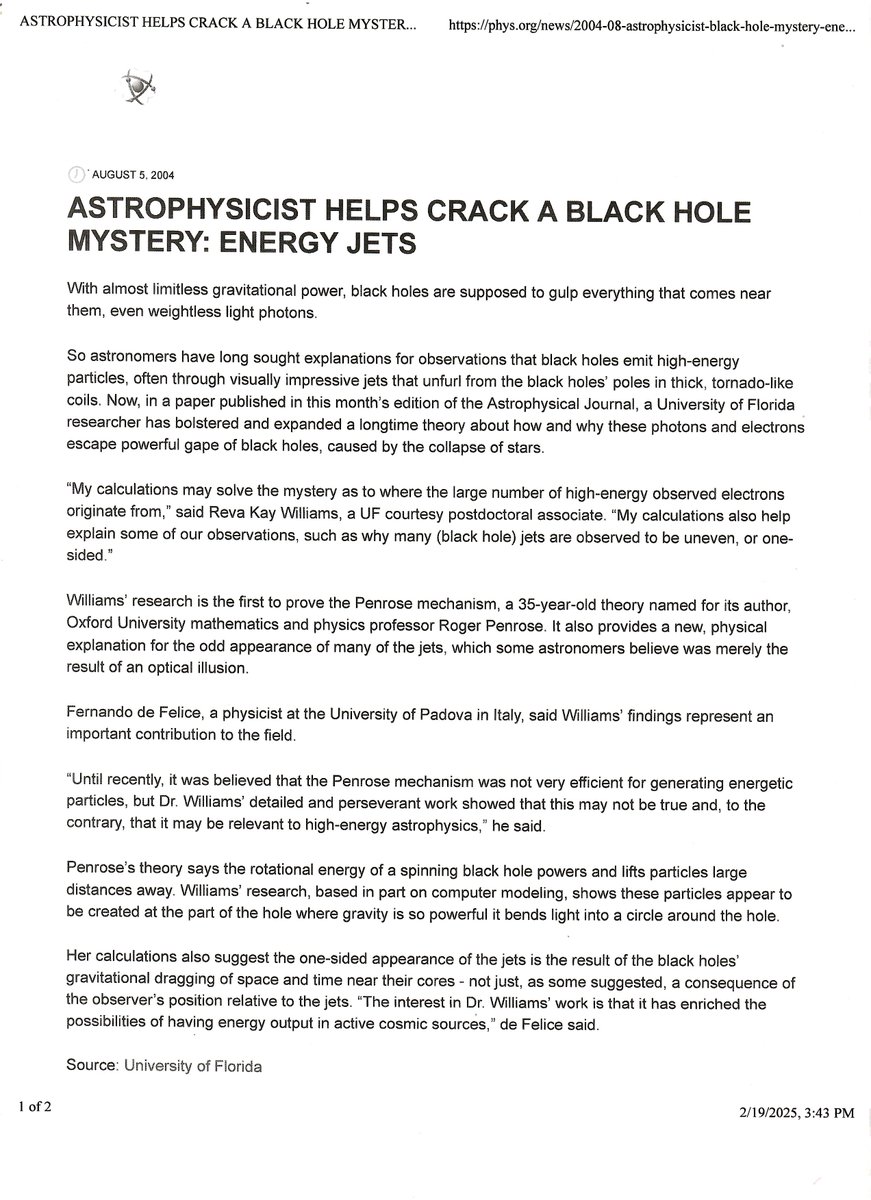







![RevaKayAstro's tweet photo. I am the USA’s first Black female theoretical astrophysicist. Importantly, I am also the first scientist to successfully work out the Penrose mechanism to extract energy-momentum from a Kerr (rotating) black hole using the Theory of Relativity. The following (somewhat long but thorough and informative) Thread shows scientific details along with receipts of how a specific group of white male scientists stole my research, took credit for my work over many years, and destroyed my academic career. I deserve justice and to be recompensed! Upon reading, I am sure you will agree. 😊
To the Scientific Community and Interested Others: Setting the Record Straight on Astrophysical Rotating Black Holes and their Energy Extraction Mechanism:
(Part 1/4) (19,329 characters = 6 pages):
As many of you know, I am a theoretical astrophysicist. I am the first astrophysicist to research and use the Kerr metric in a practical, 4D, astrophysical context, to become the first person to successfully work out the Penrose mechanism to extract energy (and momentum) from a Kerr (rotating) black hole (KBH) using Einstein’s Theory of Special and General Relativity. See R. K. Williams, Physical Review D (PRD) 51, No. 10, 5387 (1995) (https://t.co/qxrm15SNHK); the content of this 41-page relativistic-astrophysics paper was based on my 1991 PhD dissertation (https://t.co/FawaRTFj4q ). This paper not only taught the astrophysical community how to extract energy from a KBH that is consistent with observations but provided the solutions to the trajectories and velocities of particles (or bodies) infalling or accreted onto the KBH, falling toward the event horizon in 4D [(3 space positions, time) or (3 space momenta, energy)]. Note that I could not have done this work without the contributions of those scientists who came before me. In other words, I stood “on the shoulders of giants.”
The KBH nonequatorially confined constants of motion analytical equations that solved the 4-momentum of infalling matter, presented in Appendix A of my above 1995 PRD paper, allowed accretion disk theorists: Charles Gammie of UIUC, Julian Krolik of JHU, David Meier of Caltech and JPL, Shinji Koide of Japan, some collaborators, and their instructed graduate students/postdocs to create general relativistic (GR) magnetohydrodynamic (GRMHD) numerical models in 4D spacetime (for the first time) to show how matter is accreted (or flows) on to the KBH, yet my 1995 PRD paper was not appropriately cited; acts of plagiarism. Then, subsequently, the GRMHD numerical simulations began to show that particle plasma escapes in the form of bipolar jets (sometimes referred to as polar jets), which I had already demonstrated in a thorough, detailed steady-state theoretical, analytical, and Monte Carlo numerical computer simulation (Williams 1995, PRD; 2004, ApJ), which they were using but still no citation of my work.
The accretion-disk theorists mentioned above merely duplicated my model results numerically over the years, since January 1999, after I submitted a research proposal to the National Science Foundation (NSF). Importantly, when models of Gammie and Krolik went from a GRMHD accretion flow (an ideal MHD fluid which excitingly confirmed the prediction by prior accretion disk theorists that funnels would form about the polar axis due to a centrifugal barrier, causing this region to be void of particles) to a relativistic radiative transfer model, which involves relativistic scattering processes inside the ergosphere (loosely referred to as the “plunging region” by Krolik et al. to call it by another name), is when they began using the Penrose mechanism that I became the first to successfully work out to extract the energy-momentum 4-vector of escaping particles from a KBH in the form of steady-state polar jets, and presented this analysis in my breakthrough GR KBH research 1995 PRD paper. Gammie admitted on at least two occasions in his talks that the GRMHD simulations did not produce jets until they began radiative transfer (Monte Carlo simulations) and that radiative transfer (i.e., the Penrose mechanism) was needed to compare with the Event Horizon Telescope (EHT) observations. In other words, the Penrose-Williams (PW) model calculation was required to predict and compare it with EHT observations, and it worked! Confirming the PW mechanism. But instead of Gammie et al. revealing this truth to the public and scientific community, they continued plagiarizing and taking credit for my work.
My breakthrough GR KBH research that included Monte Carlo “inverse” Compton scattering inside the ergosphere, that Gammie [“grmonty: A Monte Carlo Code for Relativistic Radiative Transport,” 2009, Astrophysical Journal Supplement Series (ApJS), 184, 387] and Krolik (“A Monte Carlo Code for Relativist Radiation Transport Around Kerr Black Holes,” 2013, ApJ, 777, 11) are plagiarizing, was presented in my 1991 dissertation and my 1995 PRD paper (see embedded image). In my detailed analysis of the Penrose mechanism, I found that the particles (X-rays, gamma rays, and relativistic electrons) escape in the form of vortical swirling (or spiraling) collimated bipolar jets due to inertial spacetime frame dragging by the angular momentum of the rotating KBH [see also Williams 2004, ApJ (https://t.co/tnXXmFs8sw )]. Importantly, I found that relativistic electron-positron (e- e+) pairs escape from the photon orbit through Penrose pair production (γ γ →e- e+). This pair plasma's associated intrinsic magnetic field will produce the synchrotron radiation observed by the EHT, coming from the photon orbit!
However, Gammie and his allies are continuing to perpetuate a lie: the false narrative of a group of scientists (ten of whom I can readily identify, including Gammie, as having some part in the January 1999 conspiracy to steal my research, after an NSF peer-review panel evaluation of my submitted November 1998 research grant proposal: requesting funds to do a dynamical evolution of my Penrose scattered escaping jet particle plasma). Gammie et al. are continuing to falsely attribute my successful model results to that of the Blandford-Znajek model (BZ) and/or the highly speculated “MHD Penrose process,” which has been shown not to operate (Komissarov 2005) or, more recently, the magnetically arrested disk (MAD) model, which I will discuss further below. Gammie et al. are perpetuating this false narrative to take credit for my original work, work that they are using to create the large library of GRMHD simulations of models for the accretion flow and synthetic images produced by general relativistic radiative transfer (GRRT) calculations and GR ray-tracing (GRRT) computer graphics technique (EHT Collaboration 2019). This Image Library of GRMHD simulations varies uncertain parameters (once mass M of KBH is given) such as the angular momentum (spin) of the KBH (-1 ≤ a/M ≤ 1), the magnetic field flux or strength across the event horizon, the polarity, the highly uncertain relativistic electron distribution, and the observing angle from zero to 180° from the polar axis to compare with the EHT observations. Moreover, it is stated by Gammie et al. that GRMHD models provided the absolute velocity field of the plasma flow. However, this “absolute” velocity field could only be determined from the exact conserved energy E and azimuthal angular momentum L of the nonequatorially confined 4-momenta of infalling test particles I derived and presented in Appendix A of my 1995 PRD paper. Yet, there was never a citation of my paper, why? Because Gammie et al. are plagiarizing my work, as I explain further.
[Note, the PW mechanism astrophysical model I presented in my important submitted (but rejected under false and unjust referee reporting) 1999 ApJ follow-up paper (https://t.co/M4ARLCdGi5) to explain the high-energy spectra of quasars 3C 279 and 3C 273 is self-consistent: from the creation of a GR thin disk/ion coronal, two-temperature (between protons and electrons) analytical accretion model computer simulation (see Table 1 of above paper) to the PW produced escaping X-rays, γ-rays, and e- e+ pairs, escaping in the form of vortical spiraling helical-like bipolar relativistic jets. In this PW model, it is found that the relativistic electron distributions are pair produced at the photon orbit by highly blue-shifted ingoing prior Penrose Compton scattered photons that satisfy conditions to populate as targets at the photon orbit (Williams 1995, PRD; 2004, ApJ). These targets subsequently interact with low energy infalling photons from the accretion disk to produce e- e+ relativistic electron distributions, like that inferred by the EHT. Particularly, the PW model derived analytically calculates energy-momentum 4-vectors of the escaping Penrose Compton scattered photons and the Penrose pair produced electrons and will allow variation of parameters such as the mass M of the KBH; the spin (a/M ≤ 1); the observing angle from zero to 180° from the polar axis; and variation of disk model consistent distributions of infall incident photons and target particles, which produce escaping relativistic electrons from the photon orbit and escaping X-rays and γ-rays from the region between the radii of marginally stable and marginally bound orbits, without uncertainty, save the little associated with the Monte Carlo method. Now, since the magnetic field of the accretion disk is not needed in the PW mechanism to extract particle energy-momentum, it could be any value allowed by accretion disk theory in its important role in magnetorotational instability (MRI) that releases orbiting particle angular momentum for infall. In the model accretion disk simulation of my creation mentioned above, I considered the ratio of the magnetic field pressure to the sum of the gas and radiation pressures through the viscosity parameter (0 < α ≤ 1).]
The MAD model is a combination of the BZ model and the magnetic (B-) field of the accretion disk; it assumes that the accretion disk inflowing particles carry the B-field inward until the B-field stress and pressure build up to a maximum and stops (or arrest) the accretion flow. The B-field anchors to the event horizon to induce an electric field, causing a Poynting flux of electromagnetic energy, like the BZ model, that performs work on charged particles in the field, producing the polar jets. However, the main problem with the MAD model, as well as the BZ model, is that the event horizon must be a vacuum, i.e., void of particles (to prevent charge cancellation of the electric field); a vacuum would indeed be the case since the particles would plunge directly into the KBH, inward the photon orbit, having no orbital or appreciable interaction with the event horizon. This means that the charged particles, to be accelerated by the electric field, must be produced in the Poynting flux jets of BZ and MAD models inside the funnel region near the event horizon. But for this to happen, the B-field strength must be at least > 10,000 gauss up to the strength of a neutron star ( ~ trillion gauss). The EHT observations measure a B-field strength of only 10-30 gauss, which rules out the operation of both BZ and MAD models. These models suffer from the age-old problem of converting electromagnetic energy to particle energy near the event horizon, as shown by Komissarov (2005). Komissarov found what I have said in my papers that the BZ model might be important away from the event horizon, with the Penrose particle processes being dominant near the event horizon, where gravity is dominant and at its finest. A BZ-type model would need particles produced by the PW mechanism to work near the event horizon, at the base of the jet, where the PW relativistic particles can escape inside the funnel region not subject to the accretion disk centrifugal barrier (Williams 2004, ApJ). [For completion, the standard and normal evolution (SANE) disks of the GRMHD models have low, normal B-field strength crossing the event horizon. SANE models are compared with the large, abnormal B-field strength MAD models and both to EHT observations.]
Presently, Gammie et al. are faced with a dilemma: the GRMHD simulations (plagiaristically duplicating my model calculations) are producing polar jets that they cannot explain without revealing the truth that the PW mechanism of inertial frame dragging is making the jets. So, Gammie, the accretion disk theorist leading the GRMHD simulations, who is directly part of the EHT Collaboration, is suggesting highly speculative processes that violate GR KBH physics such as assuming that the KBH operates like a neutron star (which has a physical electromagnetic surface that generates B-fields of the order of a trillion gauss), in his falsely claiming that it is the BZ mechanism being observed by the EHT, perpetuating the lie told beginning in January 1999 (when they conspired to steal my research). The lie told was that my successful results of working out the Penrose mechanism were those of the BZ model, and they hid from the public that they were my breakthrough model results, therefore taking credit for my work. In reality, the GRMHD numerical simulations are confirming my GR theoretical model calculations; this is because the GRMHD simulations of Gammie et al. duplicated my theoretical Penrose model calculations, and the consistency of the GRMHD simulations with EHT observations means that the EHT observations are confirming what was predicted uniquely by my theoretical model calculations. (see the Twitter X thread: for further details).
Moreover, my 1995 PRD paper also made possible the derivation of the physics needed to describe the in-spiraling of black holes and neutron stars, enabling the detection of gravitational waves (predicted by GR) for the first time, which led to Kip Thorne winning the 2017 Nobel Prize in physics. Specifically, the derived exact conserved energy E and azimuthal angular momentum L analytical equations of nonequatorially confined test particles (or objects) being accreted onto a KBH, as measured by an observer at infinity (far away), made it possible. These analytic equations [being long sought-out solutions to the four-momentum/velocity equations of Bardeen et al. (1972)] were derived in Appendix A of my 1995 PRD paper and 1991 PhD dissertation.
So, in summary, and importantly, when Gammie and Krolik et al. decided to add ray tracing/radiative transfer (or transport) to the so-called high-accuracy relativistic magnetohydrodynamics (HARM) “series” of codes, this addition to HARM [“HARM: a numerical scheme for general relativistic magnetohydrodynamics,” C. F. Gammie, J. C. McKinney, G. Tóth 2003, ApJ, 589 (1), 444] caused vortical bipolar particle steady-state jets to form, like those predicted by my analysis of the Penrose mechanism [aka Penrose-Williams (PW) mechanism]. This is to be expected since Gammie and Krolik have been using my GR theoretical, 4D, analytical, and numerical energy extraction model as a “blueprint” to duplicate numerically. The relativistic radiative transfer involves scattering processes inside the ergosphere, within the marginally stable orbit, which is where I successfully worked out the Penrose mechanism to extract energy from the KBH in the form of relativistic bipolar jets, due to inertial spacetime frame dragging, independent of the magnetic field of the accretion disk. Also, as I have described in my papers, the PW escaping relativistic plasma particle expected to generate its own intrinsic B-field would give rise to the observed synchrotron radiation. Therefore, from the description above, it should be clear whose model is being confirmed by the EHT: the PW mechanism. However, they (the thieves and their allies) see the truth staring them in the face, but they still want to perpetuate the lie that it is the BZ model when Gammie, Krolik, et al. know the truth. Yet, it is my duty not to let them take credit for my years of hard work and research to being the first person to successfully extract energy-momentum from a rotating black hole that is consistent with observations, including the EHT observations. God gave this knowledge to me, and if I do not speak up, Gammie et al. will continue to take credit for my theoretical model of explaining the energy source of quasars and other active galactic nuclei.
I realize (though it happens rarely) that two or more scientists can independently come up with the same breakthrough physical concept, but to come up with an exact blueprint of my theoretical (researched, proposed, created, and it worked) model, which involved General and Special Relativity of gravity, relativistic motion in 4D, my unique insight, my God-given talent to research and figure things out, and the many different physics researched areas, is highly impossible. Back around 2002, after I realized that Gammie et al. were plagiarizing research from my breakthrough 1995 PRD paper, after the January 1999 NSF panel review of my research grant proposal, and with he and Krolik claiming in their 1999 ApJ publications that they had extracted energy from a KBH as if they were the first to do so, I followed protocol and contacted Gammie concerning the issue. Therefore, he cannot say he was unaware of my research. Yet, he continued not to cite my paper, which is misconduct in itself, i.e., knowingly not to cite a researcher’s paper when that researcher did it first. But that is nothing like stealing and using my whole theoretical model presented in my 1991 dissertation and my 1995 PRD paper! This is exactly what Gammie et al. have been doing over the years. Gammie, in particular, who got his PhD around the same time (December 1991) as mine, made his whole academic career off plagiarized material from my 1995 PRD paper: from the GRMHD accretion flow numerical simulations that used the 4D conserved energy E and azimuthal momentum L, I derived in Appendix A, to the GRRT simulations that duplicated my Penrose mechanism analysis that successfully extracted energy, I presented in the paper body. Just compare my papers (1995 PRD; 1999 ApJ submission above) with his theoretical model descriptions (including papers with his grad students/postdocs and collaborators) over the years since 1995, and you will see this truth. The truth is that Gammie et al. added to my theoretical model a relatively unimportant disk B-field (save in the case of MRI), along with the lie that my successful PW energy-momentum-extraction-model results are those of the BZ model, taking credit for my work. We cannot let Gammie and fellow conspirators get away with this falsehood and deception in relativistic astrophysics. It must be stopped.
Note, I do not fault the grad students/postdocs of the GRMHD numerical simulations because they were doing what they were instructed to do by their advisors, who happened to be thieves. Nevertheless, I commend these grad students/postdocs for their first-class general relativistic numerical simulations concerning the EHT observations of the first image of a black hole. So, I say to the grad students/postdocs, if your name comes up in this discussion, it is because you are a receipt or proof of your advisors’ misconduct, as they spread my research around to cover up their thievery and for their academic gain. This also goes for collaborators who were unaware of the stolen research they were being given. This is not to devalue your work in any way. Keep up your good work on KBH physics, and now that you are aware of my GR contributions, start appropriately citing my pioneer 1995 PRD paper as well as my follow-up 2004 ApJ paper describing the generated vortical swirling coil-like, helical-like bipolar jets of relativistic particles. 😊](https://pbs.twimg.com/media/GkMD-I1WIAArNWn.jpg)
![RevaKayAstro's tweet photo. (Part 2/4) (21,735 characters = 6 pages):
This 1998 article (https://t.co/kkECUIxFZd) is a glimpse of where my life and career were going before January 1999: when a specific group of white male scientists conspired to steal my general relativistic astrophysics research work on Kerr (rotating) black hole (KBH) physics and energy extraction using the Penrose (1969) mechanism after I submitted a research grant proposal to the National Science Foundation (NSF; see Twitter Thread of April 2022 https://t.co/n7QsVlWeE4 for details).
As you can see from this 1998 article, I had a promising career. I was following all the rules to take part in the American Dream. But this dream was cut short or stifled by racism, bigotry, greed, and a false sense of entitlement of this group. I am making this known to the world so that it will not ever happen to another Black person who has made a groundbreaking or breakthrough contribution to the field of science. Thou shall not steal. It is a sin. After all that Black Americans have gone through in our fight for civil rights and equal protection under the law, in this day and age, this group of white scientists (see April 2022 Twitter Thread referenced above for specific names) should be held accountable and shamed for their evil deeds. They need to pay me for their prosperous careers off my work after the January 1999 infamous NSF peer review panel meeting of my submitted proposal in which a group of them on the anonymous panel conspired to steal my research. (They know who they are, evidence points to who they are, and now the world knows who they are; they left an excellent literal paper trail that led right to them.) This thievery happened after I had begun to gain international recognition for successfully extracting energy(-momentum) from a rotating black hole [see embedded images of peer review reports from NASA ATP (1997) and the NSF (1999) validating the significance of my work].
But I was robbed, when all they had to do was cite or reference my 1995 PRD pioneering paper. Then, we all could have prospered. Yet, instead, they prospered at the expense of destroying my academic career. It would not have been so bad if they had not cited my paper(s) and left me alone so that I could prosper from my own work despite their thievery. Instead, this group used the peer review process of government-funded agencies to hold me back by continuing to steal my research ideas from my many submitted and rejected papers, and many submitted and denied research grant proposals over two decades, destroying my academic career. However, they were at the same time spreading my researched work around as projects for their white graduate students/postdocs, providing them with prosperous academic careers while attempting to make my hard work be in vain as they silently walked away with the fruit of my labor.
But God said, not so! Hallelujah! I thank God for the Internet and social media, which have allowed me to expose them for who they are and what they are. I am sure 25 years ago, they did not expect such technological advancements, which would reveal what they had tried to conceal: The theft of my groundbreaking KBH research of extracting energy-momentum and the breakthrough advancements it has led us to in General Relativity (GR).
The importance of my research is that it taught the astrophysics community how to apply the Kerr metric (derived from Einstein’s Theory of General Relativity) to astrophysical phenomena in 3D and 4D. Such phenomena are (1) the successful extraction of energy from a black hole using the Penrose mechanism, which is consistent with observations of quasars and other active galactic nuclei; (2) the creation of realistic accretion disk models [general relativistic magnetohydrodynamic (GRMHD) models] by Gammie and Krolik et al.; (3) the in-spiraling of black holes and neutron stars that give off gravitational waves, observed by LIGO of Kip Thorne. Yes, as I mentioned in my letter paper of 2004 [(“A Word from a Black Female Relativistic Astrophysicist: Setting the Record Straight on Black Holes” (https://t.co/bCEOT88wYY )], I stood on the “shoulders” of giants, using their prior contributions, however, giving them appropriate citations. But I researched and put it all together, adding my contributions, which worked it all out, and I should be awarded for that and not have my academic career destroyed because a Black female scientist did it first. The biggest lie that they told, which is still hurting me today as I salvage my career, is that in 1999, when they started stealing my research, they falsely claimed that it was the Blandford-Znajek (BZ; 1977) model (of white male scientists) that had worked out the so-called MHD Penrose mechanism and attributed my successful results to those of the BZ model. This was the origin of the BZ mechanism's renewed popularity after it had laid dormant for many years because of a lack of available evidence to prove the model’s claims.
Now, years later, after they (Gammie and Krolik et al. of GRMHD models) have duplicated my successful 4D analytical and Monte Carlo numerical model calculation and generated the jets by the Penrose-Williams (PW) mechanism, which is consistent with the Event Horizon Telescope (EHT) observations, they are falsely claiming that it is the BZ model generating the jets, thus, continuing to take credit for my work. Instead of telling the truth that it is the Penrose mechanism creating the particle jets, which can be acted upon by a BZ-type Poynting flux, they say they do not know the details of how the jets are launched. But strangely, they claim that the magnetic field of the accretion disk and the BZ model is at work, and no other, to the point of propaganda. Well, I must add that the PW mechanism presented in my papers shows the details of how the jets are launched, and the EHT polarization measurements of the B-field strength confirm that the details are not those of the BZ model. Gammie and Krolik et al. are trying to cover up the fact that the PW model shows how the jets are being produced in detail. But these white scientists would rather keep the scientific community or public at large deceived, overall holding us back, than give credit where credit is due to a Black woman scientist so that we may move forward in truth. It has been shown by Russian scientist Komissarov (2005) that the BZ model cannot work at the event horizon, and their made-up and highly speculative “MHD Penrose process” does not operate, as I mentioned earlier.
In essence, there was a paradigm shift in the way we study astrophysical black holes with the publication of my 1995 Physical Review D (PRD) paper, entitled, “Extracting X rays, γ rays, and Relativistic e- e+ Pairs from Supermassive Kerr Black Holes Using the Penrose Mechanism” [R. K. Williams, Phys. Rev. D (PRD) 51, No. 10, 5387 (1995)] based on my 1991 dissertation. This shift of fundamental change in basic assumptions in accretion disk theory, and this GR understanding or awakening, occurred about two and a half decades ago, around the year 2000 or, to be exact, January 1999, at the infamous NSF panel review of my submitted research grant proposal. Astrophysicists today talk of this newly found 4D, GR knowledge, particularly the accretion disk theorists, whose physics, without this knowledge, was confined to the equatorial plane and at radii r > 3times the gravitational radius (grr), which is outside the ergosphere (located at r = 2 x grr), where grr= M, in gravitational units (c = G = 1). But no one says where this knowledge came from as if it just came about out of thin air. Well, I am here to tell the world where it came from: Dr. Reva Kay (Revach in Hebrew) Williams, my years of research, studying general relativistic astrophysics, hard work, and much prayer.
Moreover, because my theoretical model computer simulations use exact analytical (i.e., mathematical) equations derived in the GR spacetime of the Kerr metric, without approximations, there is little uncertainty in my calculations, only mildly of the Monte Carlo method random number sampling of the cross-section scattering angles. My analysis of the Penrose mechanism that successfully extracted energy-momentum in the form of polar jets, as shown by analytically derived expressions for the 4-momentum vectors of the escaping particles, gives resulting energy and momentum spectral distributions of the escaping relativistic electrons from the photon orbit, due to Penrose e- e+ pair production, and of the escaping X-rays and γ-rays from and within the marginally stable and marginally bound orbits, due to Penrose Compton scattering. These 4-momentum expressions were presented in my published and submitted/rejected papers, PRD 1995 and PRD 1999, respectively. So, Gammie, Krolik, et al. had access to these energy-momentum 4-vectors, which were no small task in 4D relativistic spacetime for me to derive for the PW particles escaping in the form of relativistic bipolar jets as observed in quasars and other active galactic nuclei (AGNs). This task involved learning and teaching myself the Special and General Relativity to a high level to perform such a task. Importantly, I needed to research and learn what needed to be done and what was already known in the field. So, in grad school, over the years, I taught myself from books such as Steven Weinberg’s “Gravitation and Cosmology: Principles and Application of the GR Theory of Relativity,” Chandrasekhar’s “The Mathematical Theory of Black Holes,” and many others. I studied countless research journal papers on accretion disk theory, magnetic fields in astrophysical objects, astrophysical black holes, proposed models to extract energy, etc. It took many years of research and hard work to complete the task of not only successfully working out the Penrose mechanism to extract the energy-momentum 4-vector of escaping particles but also deriving GR analytical expressions to be used by accretion disk theorists to significantly further their understanding of matter being accreted onto a rotating black hole, as discussed below.
As mentioned earlier, accretion disk theorists Gammie and Krolik et al. plagiarized the expressions for my derived GR conserved energy E and azimuthal angular momentum L of nonequatorially confined particle orbits (or geodesics) about a KBH, presented in Appendix A of my 1995 PRD paper. However, despite not citing my paper, importantly, they used E and L to evolve a magnetized inflow of particles, treated as fluid elements, in 4D, with no radiative transfer (i.e., Penrose processes), inward to the event horizon and did not find the existence of astrophysical polar jets, even though a B-field, assuming to be that of the accretion disk, existed in the polar region of their GRMHD models. This implies that no BZ mechanism is operating, and the reason is that no particles exist in the vacuum region at the event horizon inside the funnel region. So even if, say, a Poynting flux of electromagnetic energy (not radiation) was present, there would be no particles available for the induced electric field to accelerate into polar jets. That is because, as described above, the B-field strength must be at least > 10,000 gauss to create particle energy in this region for the BZ model to operate. The B-field strength needed is greater than that allowed by accretion disk theory and also much greater than the strength measured by the EHT (1-30 gauss). This lack of particle creation was the same problem I ran into in grad school when I tried to get the BZ model to work analytically. That was my reason for deciding to work on the Penrose mechanism as a possible way to extract particle energy (i.e., particles).
[My original plan was to get the particle energy from the Penrose mechanism. Then, I would return to the BZ model to generate the jets. But after studying closely my resulting 4-momenta of the Penrose escaping relativistic particles and my discussions with Relativist Fernando de Felice (1997) of the vortical jets of escaping geodesics produced by the geometry of the Kerr metric, I realized that my particles were escaping along these vortical (spiraling/swirling) orbits, concentric the polar axis, in the form of bipolar jets, accelerated by the inertial frame dragging and its accompanying “gravitomagnetic” (GM) force field: the GR Coriolis-like force associated with rotating mass, which acts on the momentum of the Penrose scattered particles. The GM force is the gravitational analog of a magnetic field. Unlike the electromagnetic B-field, the GM field acts on both massless and material particles irrespective of their electrical charge, and it accelerates the particles naturally into vortical bipolar jets. Note that the longtime prediction of the existence of the vortical escaping orbits by de Felice et al. (2000, 1997, 1992, 1972) was confirmed by the PW mechanism. So, what this meant is that I did not have to use the BZ model to launch the jets because the KBH itself and the Penrose mechanism were launching bipolar jets as energy-momentum was being extracted, independent of the BZ model as well as the B-field of the accretion disk.]
So, as mentioned earlier, when Gammie, Krolik, et al. decided to include radiative transfer inside the ergosphere of their GRMHD models, this required the application of the Penrose process. Now, since I had already successfully worked out the Penrose process and derived steady-state analytic expressions for the 4-momenta of the escaping relativistic particles in 4D, and because they were already stealing my research and knew that my computer simulations produced polar jets, no doubt, they eventually incorporated my analytical escaping relativistic e- e+ particle 4-momenta into their GRMHD numerical simulations and, of course, produced the relativistic steady-state particle jets from the PW mechanism via spacetime frame dragging, independent of the accretion disk B-field. But they are falsely claiming that it is the BZ model “Poynting dominated” jets escaping from the photon orbit instead of telling the truth: It is the PW mechanism operating. The questions that they cannot answer without revealing the truth are, “How are Poynting-dominated particle jets formed by the BZ mechanism at the photon orbit?” and “What is the local frame physics of GRMHD radiative transport or transfer theoretical model at the photon orbit to create escaping relativistic e- e+ pairs in 3D?” So, Gammie and Krolik et al. say that they do not understand the details except that it is B-fields and the BZ mechanism, as if no one would notice the deception. Of course, I would notice they are plagiarizing the PW theoretical model calculation of Compton scattering, and e- e+ pair production at the photon orbit, to generate particle polar jets. Yet, the PW mechanism is fraudulently called by other names to take credit for my work and to cover up their thievery.
Added for completion, in the PW mechanism, the escaping particle plasma, in the form of polar jets, is expected to have local magnetic fields, generating synchrotron radiation, that follows the vortical coil-like escaping e- e+ pair plasma, collimated and spiraling along the polar axis; and the global structure of the intrinsic B-field, as the plasma orbits concentric the polar axis, will be a generated solenoid-like B-field directed along the polar axis (Williams 2004, ApJ). The above scenario of the Penrose process escaping particle jets is consistent with the EHT observations and Faraday rotation polarization measurements of M 87 and Sag A*. Moreover, this global intrinsic solenoid-like B-field could plausibly anchor to the KBH event horizon near the polar region, inducing an electric field, and, thus, a Poynting flux of electromagnetic energy like the BZ-type model to possibly further accelerate and collimate the escaping PW particle plasma polar jets. The Penrose process would then be the primary energy-momentum particle extraction mechanism, and, subsequently, the global intrinsic induced polar B-field of the escaping vortical orbiting relativistic particle plasma could initiate a secondary process like the BZ-type mechanism that extracts electromagnetic energy. In this plausible scenario, the GRMHD numerical simulations must be investigated openly using the PW model analytical 4-momenta of the escaping particles to fill in the uncertainties that cannot be determined by the GRMHD models, such as the highly uncertain distribution function of relativistic electrons.
Gammie claims, without proof, the electrons are heated by the Poynting flux to produce thermal or non-thermal electrons; this is just “hand waving” to account for the polar jets truly created by the PW relativistic non-thermal e- e+ pair distributions, escaping from the photon orbit in 4D, described by the analytical 4-momentum vectors, I derived (1991, 1995 PRD) and, subsequently, calculated the high energy spectra for quasars 3C 279 and 3C 273 [Williams 1999, submitted to ApJ (https://t.co/M4ARLCd8sx)]. Gammie secretly uses my derived energy-momentum 4-vectors to compare with EHT observations, including the 3-space momentum components of spiraling geodesics of escaping PW-produced electrons (e- e+) from the photon orbit. Gammie et al. continue to follow the blueprint of the PW mechanism while falsely claiming that it is the BZ mechanism being observed by the EHT. More recently, even though the small strength B-field (1 to 30 gauss) measured by the EHT rules out the BZ-type models such as the MAD, which requires a much larger B-field strength [as described above in part (1/4) of this Thread], Gammie et al. in a GRMHD/general relativistic radiative transfer (GRRT) paper [“κmony: a Monte Carlo Compton Scattering Code Including Nonthermal Electrons,” Davelaar, J. et al., MNRAS 526, 5326 (2023)] are now using relativistic electron distribution functions to statistically represent electrons accelerated in a B-field. Since it is not known, because of complexity, how much acceleration is given to the electrons, say, due to synchrotron radiation, magnetic reconnection, MHD turbulence, Poynting flux, e- e+ pair cascades, etc., it is assumed that this acceleration depends on the strength of the B-field, ranging up to > 10 billion gauss for charge-gap cascades (like those cascades speculated to exist in the BZ model at the event horizon). This assumption is applied by varying kappa “κ” in the thermal-nonthermal relativistic electron distribution function to produce more or less relativistic electrons in their GRMHD/GRRT Monte Carlo method 2023 paper referenced above. These combined statistical distribution functions are used to imitate the relativistic electron pairs produced at the photon orbit as predicted by the PW mechanism (1991, 1995, 1999) and subsequently observed by the EHT (“First M87 Event Horizon Telescope Results. I. The Shadow of the Supermassive Black Hole,” EHT Collaboration, ApJL, 875, L1 (2019).
Gammie et al. include this κ dual thermal-nonthermal electron distribution (used for a variety of “hot” space particle plasmas) or a power-law distribution to account for the details they cannot explain when falsely claiming that the results of both the EHT observations as well as the GRMHD numerical simulations are those of the BZ mechanism. They follow the same method I described in my 1999 submitted ApJ paper: to calculate the PW model continuum spectra (luminosity vs. frequency) for the escaping relativistic e- e+ pair distributions from the photon orbit. They used inverse Compton scattering events of this κ relativistic electron distribution of particle plasma to up-scatter lower (soft) energy disk/jet photons to higher energies in the hope of duplicating the observed high-energy spectra of AGNs. [The ultimate goal of Gammie et al. was the successful duplication of my PW energy-momentum extraction model spectral distribution, and not to give me credit for doing it first and for providing GR detailed knowledge (i.e., a blueprint) to perform the duplication.] Their calculated high energy spectra are consistent statistically with observations and with the PW model calculated continuum luminosity spectra of the observed high energy regime that I calculated for quasars 3C 279 and 3C 273 as prototypes twenty-five years ago (that the thieves hid from the scientific community and the general public). My Penrose mechanism analysis provided for the first time (ever) high-energy γ-ray spectra for AGNs that had been theoretically modeled and calculated from consistent radiative scattering processes occurring inside and escaping from the ergosphere of a KBH in the form of polar jets. By consistency, I mean for particle distributions from real 4D scattering events that exchanged conserved energy-momentum in curved, inertial frame dragged Kerr metric spacetime, and not from statistical or artificially injected electron particle distribution function. I reported this important AGN luminosity spectral finding in the above 1999 submitted ApJ paper. The ApJ’s, then, Science Editor Ethan Vishniac wrongfully rejected it. At the same time, his fellow conspirators, colleague Krolik at JHU, Gammie, and the rest were allowed to publish many papers in the ApJ, plagiarizing my black hole physics research and taking credit for my work. (The result of my reporting this misconduct to a person of authority at the ApJ ended in coverups, which enabled the thieves to continue this bad behavior when this person of authority could have stopped it.)
{continue on next tweet [part (3/4)] of this Thread}](https://pbs.twimg.com/media/GkL6oCqXwAAP2KN.jpg)