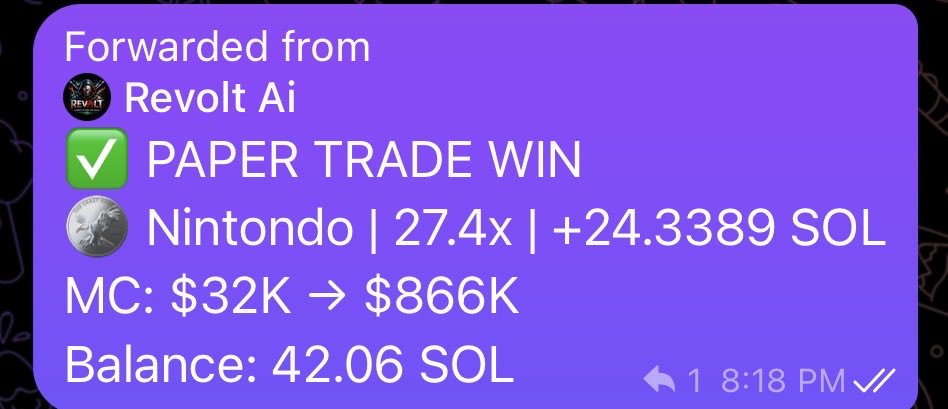
While they stare at a computer 18 hours a day. We check in when we want to see how the trades are going. Trading and living at the same time makes more sense
JARVIS is LIVE.
Revolt AI is now officially live in beta with the first active build of our trading network.
This is where the deeper value begins.
Jarvis is designed to assist users with questions, support trade research, track live data, monitor wallets, review market activity, and help explain why a setup matters.
The bot is not just scanning tokens — it is becoming an intelligent trading assistant.
Current beta focus:
• Jarvis live assistant
• Scanner systems
• Wallet tracking
• GMGN feed integration
• Harvesting token data
• Paper AI decisions
• Live balance monitoring
• Agent expansion
We are building toward a system where human callers, AI agents, and real-time market data work together.
Beta is live.
Jarvis is awake.
The grid is waking up.
INVESTOR UPDATE — PHASE 4 STRATEGY OPTIMIZATION
Period: May 12 – May 17, 2026
Status: Active (Paper Trading Environment)
Executive Summary
During the past week, we identified a material divergence in performance across our two trade-discovery channels. This led to a structural decision to isolate and validate the system’s highest-edge source.
This is the most data-driven strategy decision we have made to date.
Performance Attribution Analysis
Following 7 days of comprehensive review (916 closed trades, 22% aggregate win rate), the system’s performance bifurcates clearly:
Channel A (High-Conviction Signal Source):
286 trades/week
28% win rate
+7.39 SOL net profit
+0.026 SOL per-trade expectancy
Channel B (Broad Market Scanner):
630 trades/week
~22% win rate
-11.34 SOL net loss
-0.018 SOL per-trade expectancy
Combined System Result:
-3.95 SOL
Key Insight
The core system is generating a positive edge through high-conviction trades.
However, that edge is currently being offset — and ultimately negated — by lower-quality, broader-market execution.
Strategic Action
We have temporarily disabled Channel B auto-execution to isolate the performance of Channel A.
Channel A continues to operate without modification.
Implementation Characteristics
Configuration-level change only
Fully reversible within seconds
No code deployment or infrastructure changes
Zero exposure to live capital (paper mode)
System State During Experiment
Active:
Full data collection across both channels
Learning systems and model tuning (Agent 6)
Risk management framework (TP/SL/trailing stop)
Position monitoring and controls
Signal relay infrastructure
Paused:
Channel B trade execution
Scanner-driven entries
Expected Impact (5-Day Window)
Reduced trade frequency (~80 → ~30–40 per day)
Increased win rate (24% → 28%+)
Positive per-trade expectancy (+0.025 SOL target)
Weekly net PnL shift (-3.95 → +5 to +7 SOL range)
Reduced exposure to low-quality/rug trades
Decrease in infrastructure costs (~30%)
Decision Framework (May 17 Review)
We have defined clear, quantitative outcomes:
+5 SOL or higher:
Channel A validated as standalone strategy → scale and simplify system
+1 to +5 SOL:
Positive but moderate → increase position sizing cautiously
Break-even:
Channel A weaker in isolation → reintroduce Channel B with tighter controls
Negative performance:
Indicates broader structural issues → full system review
Strategic Significance
This is not a tactical adjustment.
It is a structural evaluation of whether a core component of the system should remain active.
Most trading optimizations occur at the margin.
This decision targets the primary source of negative contribution.
Risk Profile
This represents the lowest-risk experiment conducted to date:
No live capital exposure
Fully reversible configuration
High information yield relative to risk
Operational Discipline
For the duration of this experiment, we are maintaining strict control:
No additional strategy changes
No reaction to short-term variance
No overlapping experiments
The objective is clean attribution of results.
Broader Context
To date, we have:
Established a system capable of generating a positive edge
Identified the primary source of performance leakage
Designed a controlled test to isolate that leakage
Defined success using quantitative thresholds
This positions us one decision away from a materially improved system structure.
SYSTEM ROADMAP
May 6 → June 7
Infrastructure deployed
Phase A: small capital, internal
Phase B: scaled execution, internal
Then public rollout
This is a directional framework, not a fixed timeline.
We move based on performance, not dates.
If it is not ready, it does not go forward.
Execution over speed.
The publications are starting in Hong Kong 🇭🇰, do you think that pages with millions are not noticing it do not wait for the post to want to enter this is fomo and remember it has not yet reached Europe or America
Mirumi = summirumi
Weekly Focus / Operating Priorities
1. Strategy Expansion
Reassessing workflow from the Caller Scan system into larger-cap trading opportunities.
Evaluating how broader market structures can complement current microcap strategies.
2. Autonomous Bot Retooling
Integrating new external data inputs into the autonomous trading framework.
Reviewing whether additional signals improve decision quality, filtering, and execution.
3. Agent Audit & Systems Review
Full audit of all agents and workflow-chart assignments.
Stress-testing role separation, signal routing, and feedback loops across the agent stack.
Refining where responsibilities overlap or create inefficiencies.
4. Investor Materials
Drafting updated investor letter outlining payout structure, treasury mechanics, and incentive alignment.
Clarifying how caller rewards, treasury reserves, and autonomous trading distributions interact.
5. Testing Resumption
Resume structured testing with updated parameters.
Measure performance changes after data and workflow revisions before broader scaling.
Underlying Thesis:
Build → Audit → Retool → Test → Scale.
Most people look at trading bots like they’re some kind of 24-hour money glitch. That assumption is exactly why so many projects fail.
In reality, these systems operate in highly dynamic environments where outcomes are driven by dozens of interacting variables—liquidity, volume, volatility, market structure, wallet behavior, execution speed, and even the bot’s own footprint in the market.
Bot pressure itself becomes a variable. Entry size, timing, and clustering can influence price action, especially in low-cap environments. Without understanding that feedback loop, the system ends up trading against itself.
This isn’t something you “set and forget.”
It requires structured testing, controlled environments, and continuous data collection to identify what actually works under different conditions. The goal isn’t short-term profit—it’s building a model that understands probability, adapts to changing regimes, and executes with discipline.
That’s what separates a real system from noise.
Revolt is built as a performance-driven capital system.
Every trade of the token generates creator fees. Those fees feed the AI trading engine, increasing bot capital over time. More capital means the bot can trade larger. Larger trades create larger profit potential.
Monthly bot profits are allocated as follows:
40% → Bot reserve capital
20% → Treasury
10% → Development / operations
30% → Holder dividends paid in SOL
Dividends are only paid from real trading profits. If the bot has a losing month, no dividends are paid. If the bot balance falls below 20 SOL, no dividends are paid. The machine is protected first.
The holder model is tiered:
Tier 1: 2%+ of supply
Tier 2: 1%–1.99%
Tier 3: 0.5%–0.99%
Below 0.5%: no dividend eligibility
This model is intentionally designed to reward high-conviction holders and accelerate supply compression.
Creator fees feed the system.
The bot compounds capital.
Treasury strengthens the ecosystem.
Qualified holders receive performance-based SOL dividends.
Revolt is not built around hype.
It is built around capital flow, disciplined allocation, and long-term supply pressure.
Day 1 back from the weekend — systems online, learning active.
REVOLT Agent Hub (Paper Sim):
+102.7% P&L | +20.54 SOL
Today alone:
+26.32 SOL
108 bot trades processed
336 candidates evaluated
Key update:
Reduced max open trades to 3 and tightened parameter weighting. Focus shifted from volume → precision.
Result:
Fewer positions. Higher conviction. Stronger outcomes.
The system is doing exactly what it’s designed to do — test, adapt, refine.
We’re introducing a caller scan utility designed to fundamentally reshape how high-skill participants operate within trading communities.
For too long, experienced callers have been forced to navigate fragmented ecosystems—paying for access, competing with noise, and receiving little direct compensation for the time and precision required to identify real opportunities. That model is inefficient and unsustainable.
This system changes that.
Our caller scan utility is built to identify, validate, and elevate high-conviction trade ideas in real time—transforming raw signal into structured, actionable intelligence. It creates a direct pathway for skilled callers to monetize their edge, while simultaneously delivering value back to their communities.
The framework is simple:
• Skill is measured
• Performance is tracked
• Value is rewarded
No more dependency on private groups. No more dilution from low-quality noise. Just measurable output and aligned incentives.
This utility integrates directly with our learning-based autonomous trading system, where validated signals contribute to a continuously improving execution engine. As the system evolves, so does the efficiency of capital deployment and the quality of decision-making.
The result is a closed-loop environment:
Better data → stronger validation → improved execution → shared upside.
We’re not building another signal platform.
We’re building infrastructure for performance-based capital allocation.
Testing is going pretty good today this is a 48-72 hour block from the overhaul I made. After that will make adjustments. It’s going pretty good I feel. Loaded a sol of my own into the caller card will have it test it out as well. That will live trade today to see how it’s running. I’ll keep updates posted as they come in.
Weekend reset complete. Autonomous trading is back online — and learning in real time.
Agents have resumed execution, opening positions under a structured, adaptive framework:
• At 2x, trailing stop activates
• Dynamically tracks upside and protects gains
• Closes on a 20% pullback from peak
• Hard target remains at 5x
• If neither condition is met, default stop loss applies
Every trade feeds the system. Every outcome sharpens the model.
This isn’t static automation — it’s an evolving trading engine.
Introducing Revolt — The Autonomous AI Trading Network on Solana
In a market where opportunities disappear in minutes, most traders lose to hesitation, noise, and emotion. Revolt is built to remove all three.
We combine human insight with machine precision into a single, unified system.
Callers surface opportunities.
A network of 7 AI agents — Harvester, Wallet Analyst, Pattern Engine, Scanner, Confidence Engine, Learning Loop, and Chart Detector — validates, prioritizes, and continuously improves with every trade.
Execution is handled through the Key Bot Terminal:
• One-click entry
• Automated TP/SL
• Trailing protection
• Zero emotional interference
Accountability is built in.
The Caller Leaderboard ranks performance based on real results — not hype.
The Insider Wallet Engine tracks smart money clusters to identify high-conviction opportunities.
Every cycle compounds:
Better data → Smarter models → Stronger execution
System Status: Live
• Community + Leaderboard active
• Key Bot Terminal integrated with Jupiter
• 7 AI agents running 24/7 (paper trading)
• Learning Loop actively refining parameters
Revolt is not a signal group.
It is the foundation of an autonomous, system-driven trading network — built for Solana’s speed and scale.
Join the network: https://t.co/sun6lNVOo9
CA: 2bZSQPJRqNMtt19ChXZ72YYXeXE7KRtmJD7ur48Npump
The future of trading isn’t instinct.
It’s systems that learn, adapt, and execute with consistency.
What part of Revolt stands out most to you?