✝️ Christ is King! 👑Minima is the only Decentralized Blockchain that can run in full on CHIP 📱@Minima_Global 💎Working with the @Arm @Siemens @unisouthampton
$ARM just launched its first datacenter CPU built for agentic AI, co-developed with $META to coordinate accelerators, memory, and multi-agent workloads at rack scale.
The launch shows Arm’s move beyond licensing IP toward delivering its own hyperscale silicon as demand shifts toward orchestration layers inside next-generation AI infrastructure.
The South African rand weakened on Tuesday as a firm U.S. dollar outweighed data showing an expansion in economic activity signalled by the central bank's leading business cycle indicator.
Full brief available here: https://t.co/uyoa9iSq2Y
#mercurydailybrief#USD#EUR#GBP
"blockchain doesn't belong in the cloud."
read that again.
every L1 you know runs on servers. data centres. validator machines in a handful of locations controlled by a handful of people.
that is centralization with extra steps.
@Minima_Global said something different. they said blockchain belongs inside the machine.
let me break down what that means 🧵
What does it actually take to run a blockchain on a device with limited power, memory, and compute?
Not a server. Not the cloud.
An embedded system.
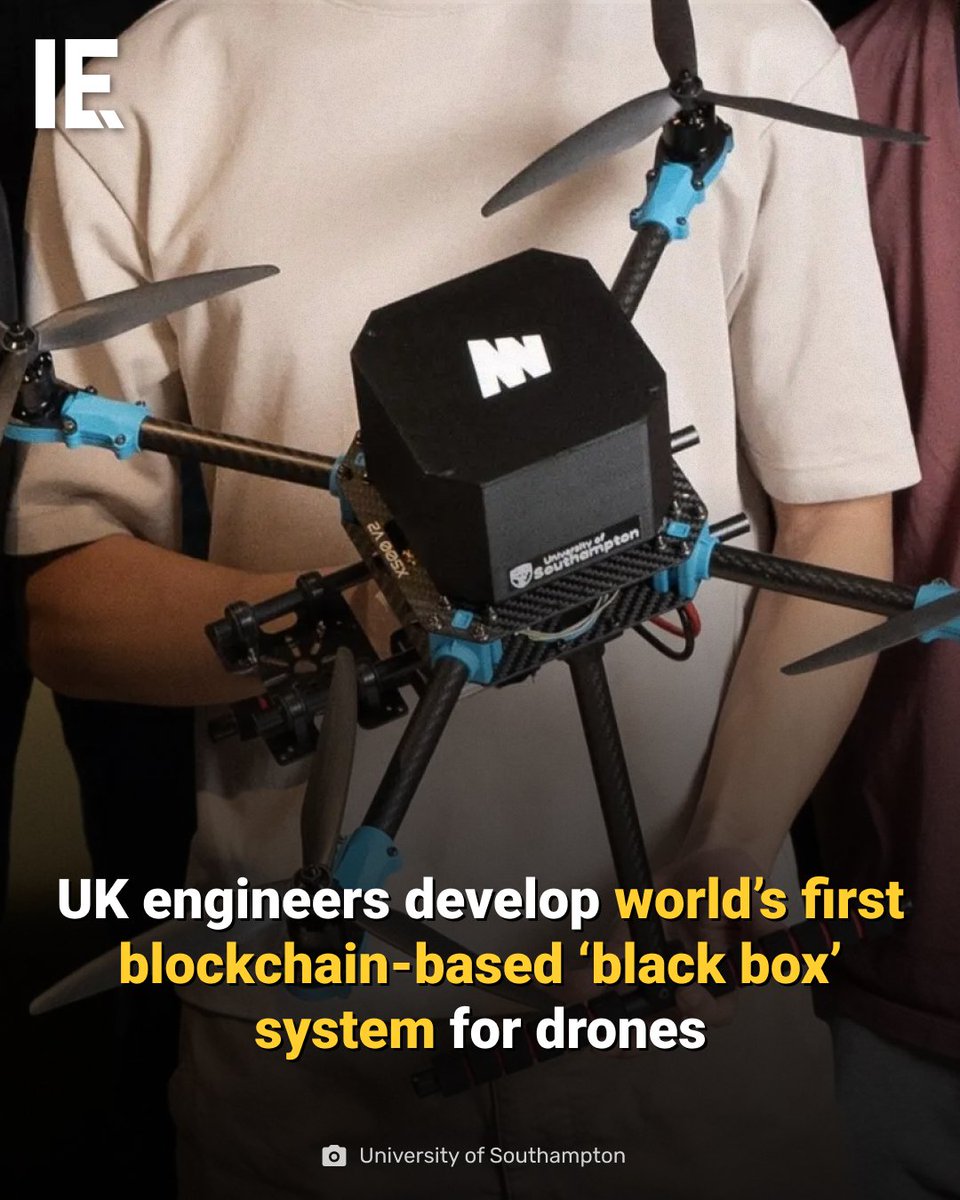
At the University of Southampton, students worked with Arm Holdings, Siemens, and @Minima_Global to explore exactly that.
This wasn’t theoretical.
They took a live protocol and forced it to operate under real constraints.
Here’s what that looked like:
• Porting the Minima node from Java → C++ to reduce overhead
• Deploying it directly on Arm-based embedded cores
• Integrating custom SHA3 hardware accelerators (via FPGA)
• Measuring hashing efficiency improvements at hardware level
• Running end-to-end validation — including drone telemetry on-chain
Now pause there.
This is where it gets interesting.
Running a full node on constrained hardware forces trade-offs most blockchains avoid:
→ Compute vs energy consumption
→ Software optimization vs hardware acceleration
→ Latency vs verification integrity
And instead of simplifying the problem…
They leaned into it.
This project cut across layers most engineers never touch in one system:
• Protocol-level behaviour
• Low-level performance tuning
• Cryptographic acceleration
• Hardware design (FPGA)
• System integration + validation
That’s not a student exercise.
That’s real systems engineering.
And Minima sits right at the center of it.
Because its architecture is built for this exact environment:
full nodes running at the edge, not just in data centers.
Why does that matter?
Because the next wave of systems won’t live in one place.
They’ll exist across:
• Edge devices
• Autonomous machines
• Physical AI systems
• Robotics networks
All needing local verification without relying on centralized infrastructure.
This is the kind of problem that defines the next decade.
And this project is an early signal of how it gets solved.
Not by scaling servers.
But by redesigning where computation happens.
$arm believed the dollar TAM for Arm IP, subsystems, and their AGI CPU is ~100b. That’s across customer dollars and agentic CPU dollars down their merchant solution.
We do believe the new CPU server TAM across scenarios range from $80-110b 2030 ish.
$META is partnering with $ARM to develop a new class of CPUs for data centers and large-scale AI workloads.
The two companies plan to build multiple generations together deepening Meta’s push into custom AI infrastructure silicon.
Data flowing through a Unified Namespace is only as useful as the context attached to it. Industrial connectivity platforms translate proprietary machine protocols into standardized, contextualized data that analytics and AI systems can work with directly.
That translation layer is where many smart factory projects succeed or stall.
https://t.co/0vPAc1GDAV #highbyte_iiot #IIoT
$arm CEO @renehaas237 emphasizing @arm now sells IP, complete subsystems, and now chips.
Tapping into a much larger revenue pool than just licensing should bring $$ upside faster than most have modeled.
$ARM is expanding from compute platform design into silicon products for the first time introducing its own Arm-designed data center CPU for agentic AI infrastructure.
The new Arm AGI CPU was developed with lead partner $META.
Arm, which made its name licensing technology to semiconductor makers, will begin selling its own chips for the first time, aiming to claim a bigger piece of the massive spending on AI gear.
Here's what CEO Rene Haas had to say https://t.co/dlSxq4h2zR