The US and China can collaborate and move innovation forward for everyone in healthcare, climate, AI safety and energy. Chips are a challenge!
My interview on CGTN America on the sidelines of the #Xi-Trump Summit in Washington, DC.
@silicondragon
https://t.co/qspfnMYT2a
burning the midnight oil in NYC while being interviewed by @SallyBundock on @BBC News, talking about the Trump-Xi meeting and US-China issues over AI safeguards, rare earths, supply chains, EVs and more! @silicondragon https://t.co/YOG4Pvqcv1
burning the midnight oil in NYC while being interviewed by @SallyBundock on @BBC News, talking about the Trump-Xi meeting and US-China issues over AI safeguards, rare earths, supply chains, EVs and more! @silicondragon https://t.co/YOG4Pvqcv1
Reposting @opcofamerica
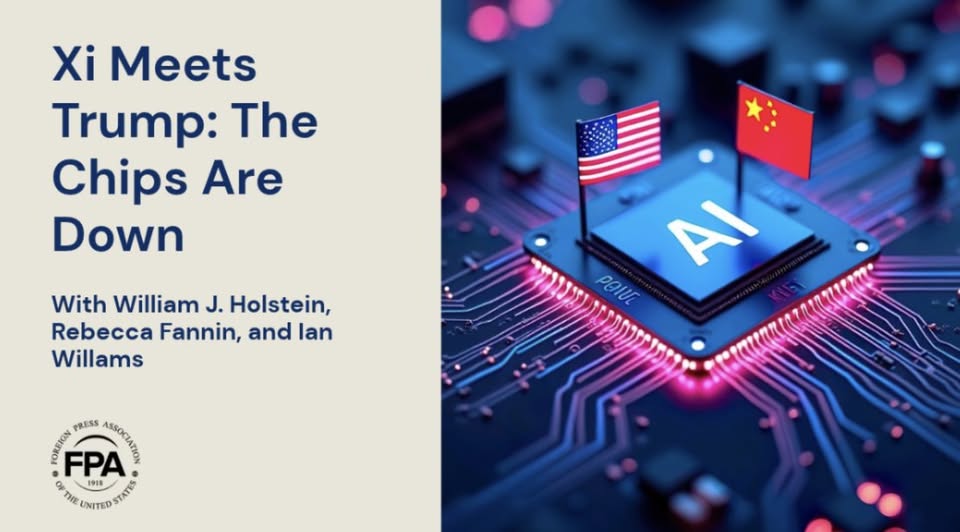
Xi Meets Trump: The Chips Are Down.
Join @FPANewYork Sept. 16 at 10:30 a.m. EDT for a webinar on China, AI and Xi’s upcoming visit. Featuring @HolsteinWJ, @rfannin@deadlinepundit
Register here: https://t.co/SyAHIDx5sp
Xi Meets Trump: The Chips Are Down
Join @FPANewYork Sept. 16 at 10:30 a.m. EDT for a webinar on China, AI and Xi’s upcoming visit. Featuring @HolsteinWJ , @rfannin & @deadlinepundit
Register here: https://t.co/wUmMtogrXp
Yang Zhilin decided against a career in the U.S. to create Moonshot AI, whose open-weight model is shaking up global markets... https://t.co/apisFzWVZn
Embracing the New Track of Physical AI: Manufacturing Foundation Empowers China’s AI Commercial Breakthrough
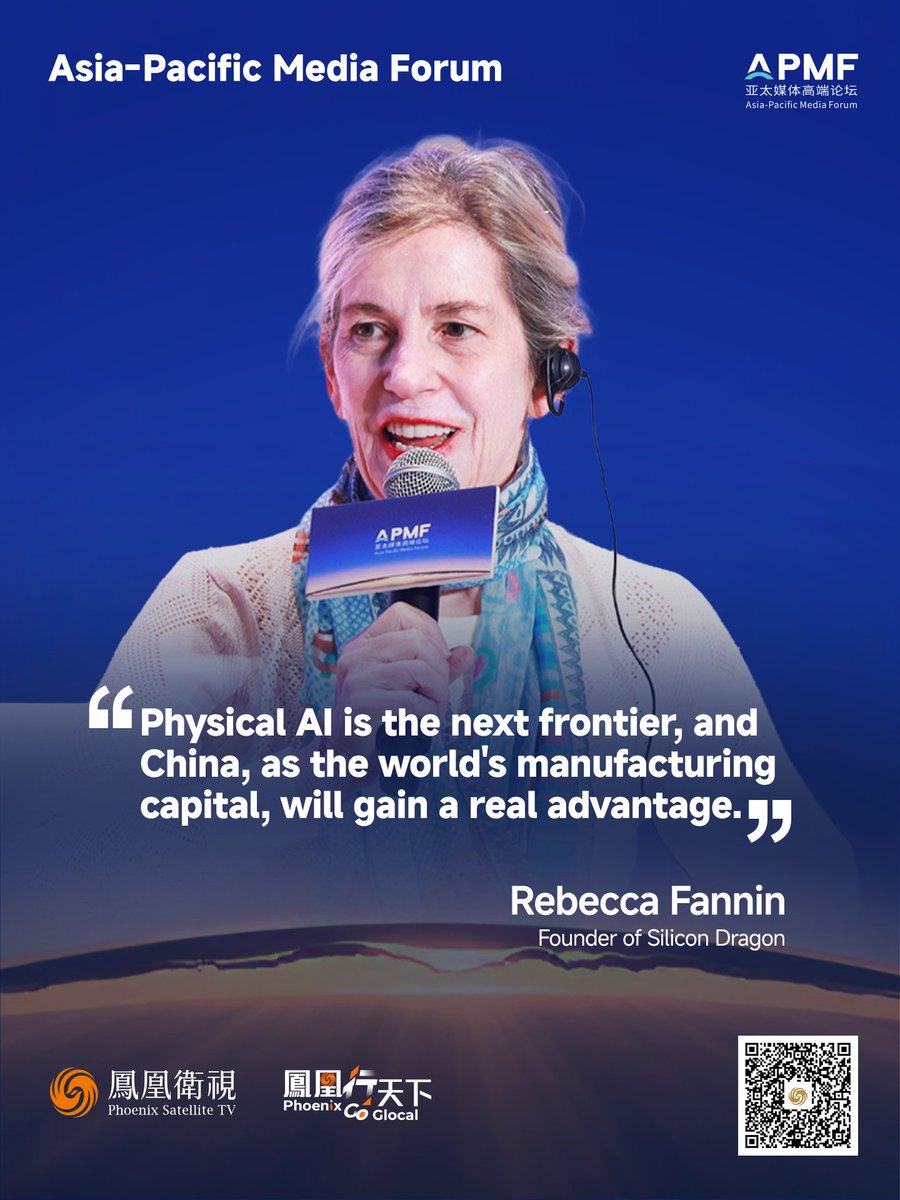
During the Dongguan Sub-forum of the Asia-Pacific Media Forum, Rebecca Fannin @rfannin, a senior Silicon Valley @SiliconDragon observer focusing on global technology industry research, shared cutting-edge insights.
Fannin notes that while Silicon Valley retains strengths in fundamental AI innovation, China is pursuing a differentiated path and making rapid headway in AI commercialization. AI has been deeply integrated into daily life, covering electric vehicles, robots, autonomous vehicles and facial recognition.
She highlights that Physical AI, embedding AI into physical hardware devices, marks the next frontier of artificial intelligence. Boasting South China as the world‑class manufacturing hub, China enjoys unique strengths in hardware innovation and smart physical devices. China’s open‑source AI features better accessibility and lower costs. China leads the world in generative AI patent filings, holding six out of the world’s top ten advanced AI patent applications. Home‑grown startup DeepSeek has achieved technological breakthroughs with relatively little capital, drawing global attention.
She also objectively points out that most experts acknowledge China’s rapid AI progress, yet gaps remain with the United States in fundamental innovation. The global AI landscape is being reshaped by commercial application, patent R&D and capital investment.
The main forum of 2026 Asia‑Pacific Media Forum will open on September 5 in Shenzhen, Guangdong Province. It brings together government officials, heads of mainstream media, think‑tank scholars, entrepreneurs and representatives of resident diplomatic institutions from APEC economies. Carrying forward the in‑depth exchange momentum built at previous sub‑forums in Guangzhou and Dongguan, participants will engage in thorough dialogues under the theme Building a Path to Shared Prosperity for the Asia‑Pacific Community: Media Consensus and Action. They will explore the role of media in digital transformation, AI innovation and inclusive regional development, advance practical cooperation among Asia‑Pacific media players, and deliver a series of forum outcomes.
China is gaining ground in AI commercialization, according to Rebecca Fannin @rfannin, founder of Silicon Dragon. Speaking at the Asia-Pacific Media Forum Dongguan Sub-forum, she noted that AI is increasingly woven into everyday life in China, from electric vehicles and robots to facial recognition.
As international journalists explore Guangdong, the tour offers a closer look at how AI is moving beyond the lab and into real-world applications.
Beijing isn't creating the wave of Chinese pop culture reaching U.S. audiences — it's amplifying one already underway.
That's the argument from Shaoyu Yuan (@shaoyu_yuan), who describes a "state amplification model": China's government builds the infrastructure, but the trends themselves, TikTok, EVs, and C-dramas among them, come from companies, creators, and platform algorithms.
Yuan is careful to note that liking Chinese apps or admiring Chinese tech isn't the same as political trust, a distinction that matters for how policymakers read this shift.
Journalist Rebecca Fannin (@rfannin) joins Yuan and moderator Michael Berry (@Bairuiwen) to unpack it. https://t.co/FdE9sr3H02
China is gaining ground in AI commercialization, according to Rebecca Fannin @rfannin, founder of Silicon Dragon. Speaking at the Asia-Pacific Media Forum Dongguan Sub-forum, she noted that AI is increasingly woven into everyday life in China, from electric vehicles and robots to facial recognition.
As international journalists explore Guangdong, the tour offers a closer look at how AI is moving beyond the lab and into real-world applications.
Chinese innovation is gaining “a new respect” in the West, according to Rebecca Fannin @rfannin, founder of Silicon Dragon. During a visit to Dongguan ahead of the Asia-Pacific Media Forum, she reflected on how DeepSeek’s rapid rise surprised many with its efficient and cost-effective large language model.
China was once widely viewed as a copycat, she noted, but perceptions are changing as Chinese companies continue to demonstrate their innovation capabilities.
Starting Sept. 2, media representatives from around the world gathered in the Greater Bay Area to explore new opportunities for media exchange and cooperation.
In an interview with Shenzhen TV, Rebecca Fannin, founder of U.S. venture capital research firm Silicon Dragon, compared Shenzhen — often dubbed China’s Silicon Valley — with Silicon Valley in the United States.
@rfannin@SiliconDragon@TaylorOgan@tphuang@ShangguanJiewen@Kanthan2030