A major part of our mission is to make medicine human again.
That means solving for 3 big healthcare challenges:
Doctors being overburdened
Patients getting too little time
The impact these have on patient outcomes and clinicians’ wellbeing (medical error, physician burnout, etc.)
Here's how we can make this mission a reality. ⬇️
AI won’t replace doctors. It will actually make healthcare more human.
Here's what we did at @RhazesAI:
1) Built tools that deliver real results.
2) Used clinicians' voices to actively shape our products.
3) Built trust with clinicians by meeting their needs from the start.
Who uses AI healthcare tools? Doctors.
Their requirements are simple:
Tools that fit their workflows, solve real problems, and deliver results.
That’s why they need to be involved in shaping these tools from the start.
What’s the easiest way to ensure AI adoption fails?
Don’t design systems for the clinicians who will actually use them.
That’s why Rhazes is built for clinicians, by clinicians and engineers.
We’ve lived these problems. And we know how to fix them.
AI adoption succeeds when systems are designed for clinicians.
When you include clinician input:
1. Tools integrate into different clinician workflows.
2. They solve clinicians’ real problems.
3. Fragmented systems are centralised.
4. Tools support with repetitive, mundane tasks.
The right design starts with asking the right questions.
In healthtech, that means talking to clinicians from the jump!
Read more in the latest post from our CEO @Zaidalfagih.
You don’t need perfect infrastructure to deploy AI.
You need to design for clinicians' realities:
Fragmented data systems, slow processes, limited resources, & outdated infrastructure.
Changing them takes time. Designing for them fast-tracks adoption.
Poor design will see your healthcare tool shelved and forgotten.
If you want to create something trusted and adopted by clinicians, you need to design around their needs.
Here’s why.
The biggest lesson I’ve learned as a healthtech founder?
Deploying AI in healthcare systems is complicated.
Each day brings a new challenge, from admin and integration to building trust with the very people who will use your tech: clinicians.
Keep watching below.
The first AI-native health systems may emerge in low-resource environments, not just the richest ones.
Less legacy drag. Bigger marginal gains. More room to build around AI from the outset.
My latest for Global Policy Journal: https://t.co/ORywpdOG7J
Our peer-reviewed study found agentic AI can:
↪ Meet clinic quality standards (98.4%)
↪ Improve ICD-10 coding accuracy
↪ Reduce admin without adding risk
Less paperwork. More patient time.
🔗 Read the research here: https://t.co/HR5Wq990e7
Clinician burnout isn't just about workload.
It can also be about how much time is lost to admin.
For every 1 hour with patients, doctors spend 2 on paperwork. AI can help, but only if it's accurate, grounded, and safe.
https://t.co/HR5Wq990e7
AI only works when it's deployed.
And the Gulf is taking AI healthcare from theory to practice.
In the GCC, business-friendly regulations enable healthtech companies to implement AI solutions fast and effectively, without compromising patient safety.
The results speak for themselves:
→ Time saved
→ Improved data quality
→ Reduced burnout
Real-world lessons, real impact.
Keep watching below.
The future of healthcare AI is being built in the Gulf.
↪ AI-first hospitals
↪ Centralised data systems
↪ Region-wide digitisation strategies
And tangible results driven by patient-focused care.
The Gulf isn't keeping up with global trends. It's setting them.
Diagnostic errors rarely come from “not knowing enough”. 🤨
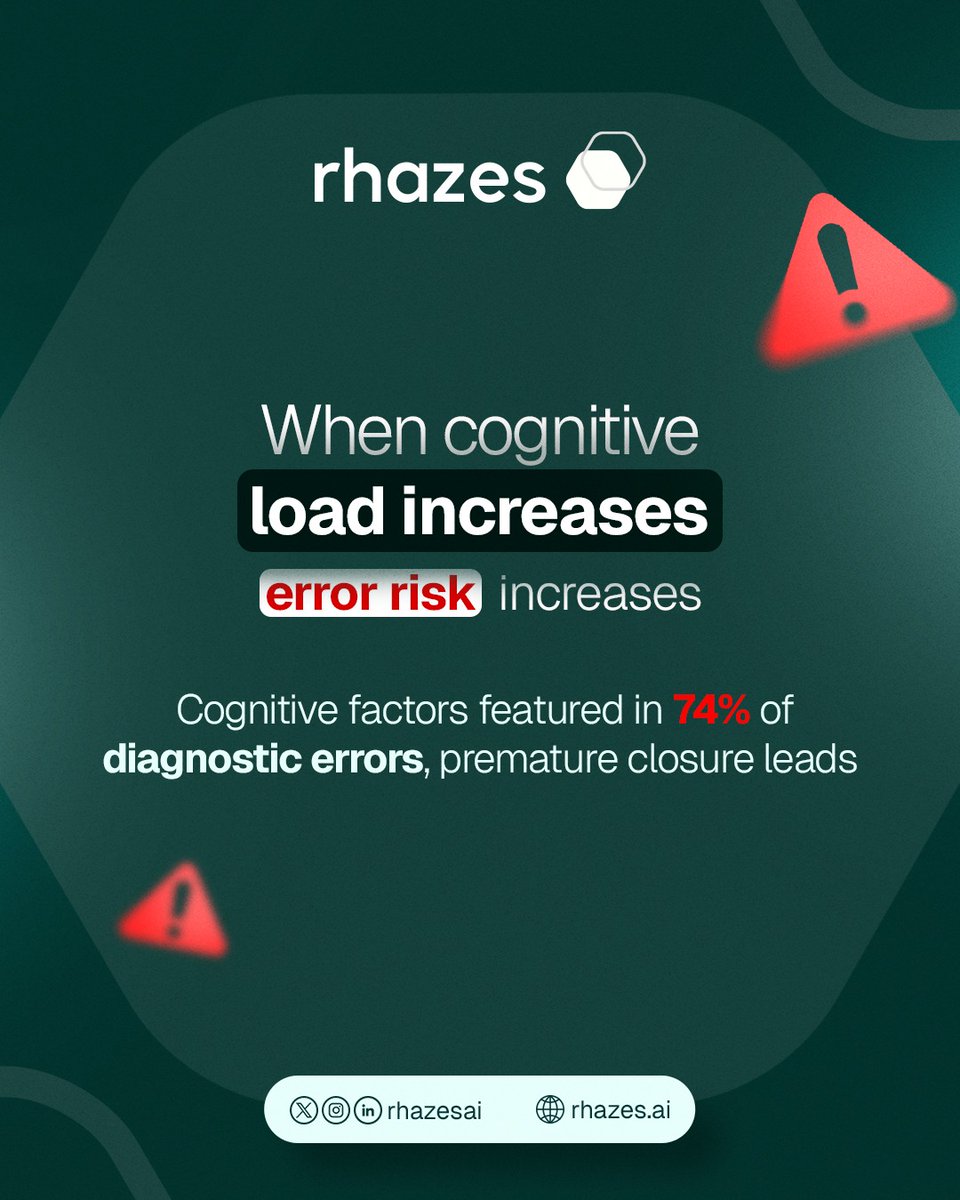
A classic Archives of Internal Medicine review of 100 real diagnostic error cases found harm in 90, including 33 deaths. In the 93 cases that were not “no fault”, investigators identified 548 contributing factors, about 6 per case. Cognitive factors featured in 74% of cases, and the most common thinking failure was faulty synthesis. Premature closure (stopping the diagnostic search too soon) was the single biggest contributor. ✨
Now add the modern reality: administrative overload, duplicated documentation, exploding evidence, and fragmented systems. All of it increases cognitive load, making those shortcuts more likely.
Reducing diagnostic error is not about telling clinicians to “try harder”. It is about designing systems that make the right thing the easy thing.
Rhazes is built for that: one coherent patient story, less noise, better prompts, and closed-loop follow-up. 👌
Which cognitive trap do you see most: premature closure, anchoring, confirmation bias, or availability bias?
AI’s most important test isn’t in a lab.
It’s in the real world.
Our AI pilot shows how AI can work where the need is greatest, from crushing patient loads and power cuts to paper records.
Thank you to @arabnews: https://t.co/wyGIPQipXt
We thought distribution was the hard part.
Healthcare taught us otherwise.
Our journey from product ideation to development to distribution revealed a much bigger challenge.
Keep watching to hear what it takes to build in the healthcare space. ⬇️
Is it bad luck, a careless clinician, or the system? 🙄
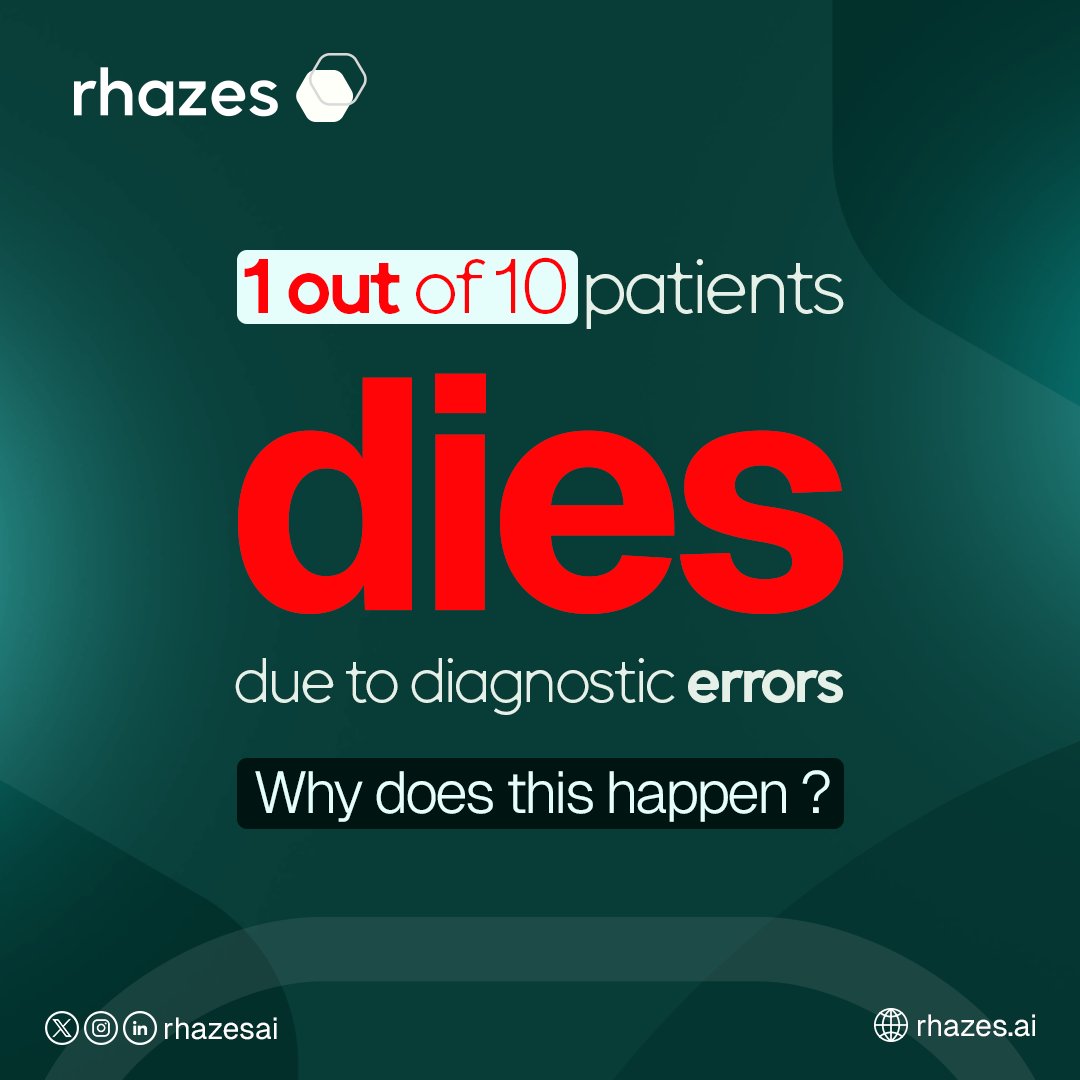
Actually, it's usually cognitive bias under pressure. In United States outpatient studies, diagnostic errors affect at least 1 in 20 adults each year, and postmortem research suggests they contribute to about 1 in 10 patient deaths. Researchers found a cognitive factor was involved in 74% of cases of diagnostic error and the single most common culprit was premature closure: stopping once an early diagnosis feels "good enough". Then anchoring, confirmation bias, availability bias, and diagnosis momentum do the rest.
It's rarely lack of knowledge. It's how humans think when the stakes are high.
That's where technology can be a helping hand and what Rhazes is built to counter. 👌
Our new website is now live. ✨
Discover how RHAZES unifies documentation, clinical decision support, EHR assistance, and coding within one intelligent, end-to-end AI workspace designed for clinicians. 👌
Explore the platform:
🔗 https://t.co/ibEv2YPhkN
Our goal at Rhazes? Make it easier for doctors to care for patients.
During development, we faced three main challenges:
1️⃣ Complex healthcare systems
2️⃣ Institutional bureaucracy
3️⃣ User experience
Our CEO @Zaidalfagih outlines our approach in the video below.
Diagnostic error kills 1 in 10 patients.
Overworked clinicians make the problem worse.
That’s the gap we focused on, to help clinicians:
➡️ Make more informed decisions
➡️ Access the latest medical knowledge
➡️ Diagnose more accurately
Learn more here: https://t.co/bJTur8NenB
The right name can help your business stand out (or leave it hidden in the shadows).
For us, it was important that our name pointed to a couple of things:
↪ Our medical roots
↪ Our focus on tech & innovation
↪ A sense of universality
Find out how we got our name below. ⬇️
We’ve just shipped one of our biggest Rhazes updates yet. A refined, more intuitive interface, a stronger chat engine, major transcription improvements, better accuracy across all tools and the brand-new Spaces feature.
Read the full update here:
https://t.co/crLoeWE9kz
Try it free at:
https://t.co/RFVBUzHYHx