Dear Lush (cc Chelmsford City Council),
As a woman who had half a breast removed last year due to cancer, I am writing to raise my concerns about your “Proud of My Stripes” window display.
I am also, on behalf of other women who have experienced breast cancer, respectfully requesting its removal.
Because mastectomies are not a fashion statement, an identity marker or something to be celebrated.
They are something women undergo because they are ill, because they are frightened, because they are trying to stay alive.
Around 59,000 women are diagnosed with breast cancer in the UK every year. Many will undergo surgery - a mastectomy, lumpectomy or other procedure.
Others choose preventive mastectomies because they carry a high-risk BRCA gene mutation.
If a woman chooses to have her breasts removed to affirm a gender identity, that is her personal choice.
I honestly don’t know the number of women who have elective mastectomies for this reason.
What I do know is that it is a tiny number compared with those for whom breast surgery is medically necessary and not something to be celebrated.
I think I speak for many women who have experienced breast cancer - and for their families - when I say this:
Breast removal surgery is not something I regard as cute, playful or empowering.
Nor is it something I believe retailers should be celebrating.
For that reason, I am requesting that the display be removed and that @ChelmsCouncil apologise for promoting it on social media.
Yours sincerely,
Janet Murray
Noah Eckstein's family spans Islam, Christianity, and Judaism.
His Muslim grandfather, Jewish grandfather, and Christian grandmother never gave up their beliefs.
But they never gave up on each other either.
Maybe understanding matters more than agreement.
Follow @buildersofmideast for more.
This picture has haunted me. The guns, the men, the violence against a woman fully covered in a blue burqa, a woman still resisting despite everything because not resisting is accepting the defeat. The Taliban colonized Afghan women’s bodies to the last inch of skin and they’re still not satisfied. And we all know how this story ends.
I’ve been informed by folks on this site that The Hobbit and now Jane Austen are too difficult for teens. I can’t stress enough how condescending this is to teenagers. You’re taking away all the things that might bring them joy and leaving them with no pastimes but scrolling.
Arsenal, one of England’s big football clubs, just donated a pile of their players’ old socks to a horse and donkey sanctuary, and the rescued animals are now wearing them.
It works because modern football socks are footless. Players wear separate grip socks on their feet, so the long sleeves get thrown out. That shape turns out to be perfect for sliding onto an animal’s leg, where they keep flies off sore skin, hold bandages in place, and cover the leg while hooves are trimmed.
The sanctuary, the biggest of its kind in Britain, says the bright red socks have already cut down on vet visits. The donkeys have also decided they make good toys, and have taken to pulling bananas out of them.
Teen daughter had sex education today where all pupils put a condom on a dildo.
One of the girls asked: ‘Why do girls need to learn this?’ And the teacher said: ‘Well, in case the man doesn’t know how to do it.’
Apparently my daughter then said: ‘Why the hell would we be with a man who doesn’t know how to put a condom on?’
I could not be more proud. 😂😂😂
In a theater performance of Romeo and Juliet in Russia, at the exact scene where Romeo is dying, Juliet was having an emotional moment by his side.
At that very moment, the theater’s cat entered the stage and went up to Romeo, pulling his hair. Then, looking at Juliete, the cat said: “Don’t be ridiculous, he’s alive, look,” trying to wake Romeo up.
This absurd moment completely broke the atmosphere of the scene. The audience, who had been crying just seconds before, suddenly burst into laughter.
From that point on, the story of Romeo and Juliet turned into something completely different because of the cat…
The cat, Romeo and Juliet became the story.
There is no sadder story in the world than “the cat, Romeo and Juliet” 😂
November 1971. Chiswick, West London.
Erin Pizzey is 32 years old. She is not a lawyer. Not a politician. Not a doctor.
She is a woman who talked Hounslow Council into lending her a cold, rundown building on Belmont Road — a former community hall — for almost nothing. Her original plan was modest. A warm room. A cup of tea. Somewhere for mothers with young children to simply get out of the house.
Then the door opened.
A woman stood in the entrance. She was covered, head to foot, in bruises. She was holding two small children. She was shaking.
She didn't want tea.
She needed somewhere to hide.
Erin let her in. She didn't turn her away. She didn't tell her to call the police.
Because Erin had already called the police. They told her the same thing they told every woman in Britain at the time: they could not enter a private home over a "domestic dispute." That was the law. The home was private. What happened inside it was a family matter.
When Erin contacted a female civil servant to report what she was seeing, the response was astonishing. The woman told her flatly: "There wasn't a problem of battered wives until you made one."
Erin put down the phone. Then she went back to her residents and made sure they were fed.
Within weeks, 40 mothers and children were sleeping in four tiny rooms. No funding. No staff. No legal authority.
She didn't stop.
By 1973, word had spread through quiet whisper networks — one woman telling another, "There is a place. Go to Chiswick. She won't turn you away." That same year, Erin hosted the first National Women's Aid Conference in the UK. Women from across Britain arrived, and they all recognized the same thing at once: what she had built needed to exist everywhere.
In 1974, the council set a maximum of 36 residents. At peak times, 150 women and children were living inside those walls — sleeping on floors, on chairs, in hallways. The building smelled of cooking, fear, and something else entirely: relief.
Erin was taken to court for overcrowding. She appealed all the way to the House of Lords.
She kept the doors open the entire time.
That same year, she wrote a book. Scream Quietly or the Neighbours Will Hear. It was the first published account of domestic violence in British history. It used real stories from real women inside the shelter. Overnight, a problem that had no official name was on front pages from London to New York.
The movement spread. Refuges opened across the UK. Then Australia. Then Canada. Then the United States. The pattern she created in four small rooms in West London — no blueprint, no permission, no funding — had been replicated in hundreds of shelters across the Western world.
MP Jack Ashley stood up in Parliament and said: "It was she who first identified the problem, who first recognised the seriousness of the situation and who first did something practical."
She was ranked 14th in a poll of the 100 women who shook the world. She was awarded the Italian Peace Prize. She received a CBE. The charity she founded — Chiswick Women's Aid, which became Refuge — grew into the largest domestic violence charity in the United Kingdom, with over 460 employees and an annual income of more than £33 million.
Erin Pizzey passed away on October 4, 2025, aged 86.
She never stopped.
It all began with one woman, one borrowed building, and an absolute refusal to say no.
Forty women and children showed up with nowhere to go.
She made room.
Share this if you believe one ordinary person, refusing to look away, can build a shelter that holds the whole world.
Follow us Lost in Yesterday
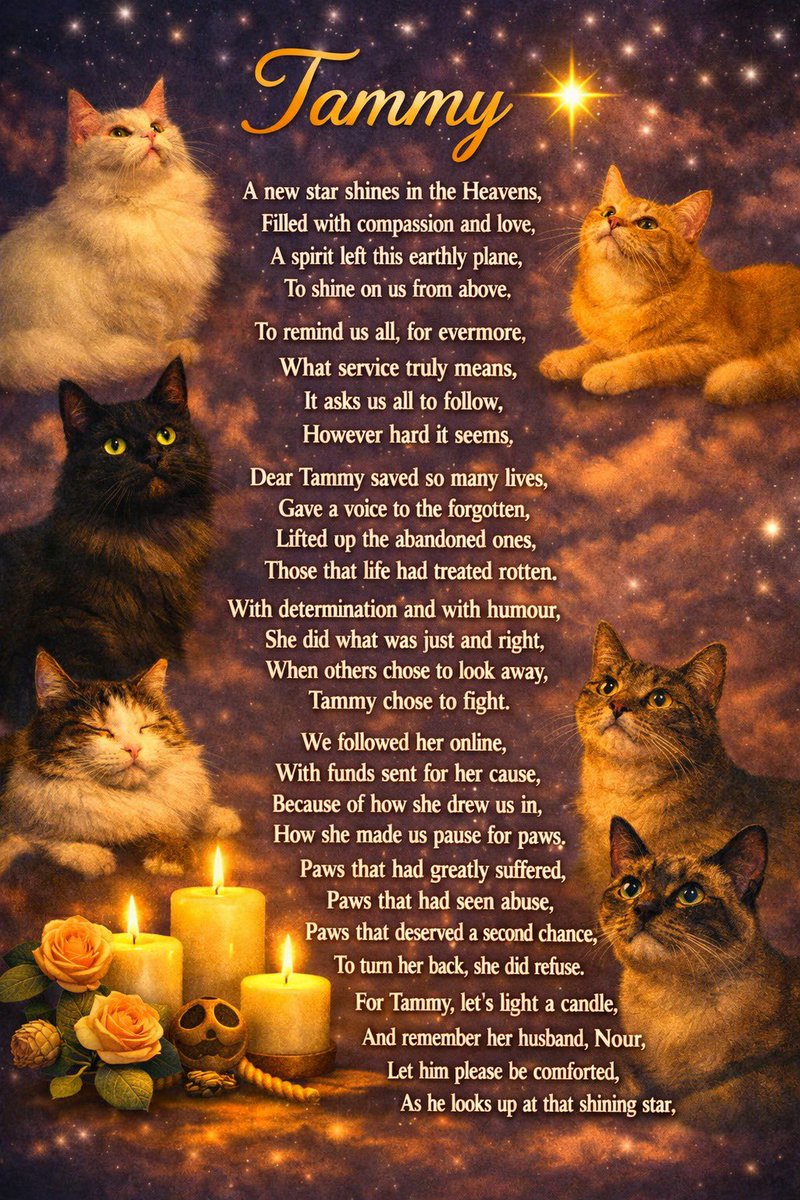
Thank you David @Uniquepoems4u for writing this beautiful poem for Tammy and Nour when I asked it’s so very touching like all your poems and something Tammy deserved ♥️♥️ Nour take ♥️we are thinking of you @catswithnohope 🐾♥️♥️♥️♥️
Due to escalating disruptive protests, I have decided to cancel the remainder of these lectures. This is deeply lamentable, but the disruption has undermined the academic nature of this series. Students shouldn't face bullying or harassment when attending academic events.
Tonight is my last night in Glasgow.
It is where I was born. It is where I spent my childhood, where I became a Bar Mitzvah, and where much of my understanding of myself was formed.
Mostly because of my parents, Scotland has always been the constant. No matter where I happened to be living, whether London, Hong Kong, or elsewhere, there was always an assumption that Scotland would be there. It was the place I returned to when life became complicated, uncertain, or challenging. My parents were here. It was familiar. It was home.
Tomorrow, I leave the UK and make Aliyah to Israel.
Over the past few years, I have spent a great deal of time writing, researching, and speaking about Jewish identity, Jewish peoplehood, Jewish indigeneity, and Jewish self-determination. In many ways, that journey led me here. Not because I stopped being British, but because I came to understand more deeply what it means to be Jewish.
Tomorrow I will become an Israeli citizen. I leave with great love for the life my parents gave me here and excitement about the chapter that lies ahead.
Scotland will always be where I am from.
But tomorrow, I go home.
After Spain's Alhambra Decree of 1492, tens of thousands of Jews were forced to convert to Christianity or face expulsion.
Many converted outwardly, but behind locked doors and in hidden basements, they kept lighting Shabbat candles, whispering Hebrew prayers and passing their faith to their children in silence, sometimes for five or six generations.
They were called Marranos, or Conversos and the Spanish Inquisition hunted them relentlessly. The mass trials, torture, executions and property confiscation did not end until 1818.
Their descendants became scattered all over the world and now, centuries later, many are discovering their Jewish origins.
They are ‘Bnei Anusim’ - the ‘descendants of the coerced ones’.
I’m deeply saddened to hear of the loss of Marjane Satrapi.
Marjane was a towering artist, a singular voice, and a steadfast advocate for the Iranian people. Beyond her remarkable achievements, I will remember a woman of extraordinary passion and heart.
We bonded over our shared love for Iran, our connection to Rasht, and a belief in the power of art to transcend politics.
When her beloved husband, Mattias, died last year, she spoke of a grief that had become a fire—one that grew larger, not smaller, with time. It was impossibles to read her words and not be moved by the depth of her love and loss.
The world knew her as the creator of Persepolis. I will remember her sharp wit, fearless candor, and unwavering love for our homeland.
Marjane leaves behind an extraordinary legacy—not only through her work, but through the authenticity with which she moved through the world.
Rest gently, dear Marjane.