I just unlocked a @BLAST_L2 Golden Ticket which earns me Points, Gold, Uncommon Hoodies, and Cybertrucks! Download the Blast App to earn $BLAST and Golden Tickets in Phase 2!
The wait is over! SynFutures’ path to decentralization, the Oyster Odyssey starts now! Register today and enjoy a 5% boost on all eligible O_O Points! @Blast_L2 https://t.co/AAM2zuIUxW
Why We Aren't (S)Topping
(for my first ever long X post, I'm releasing a note I sent early this this morning to Galaxy counterparties and clients)
The sun hasn’t yet risen in NYC, but I know it will. From Galaxy HQ north of Battery Park, the Hudson River looks like a sea of black but for the occasional glow of ferry lights appearing from or receding into the darkness. But Bitcoin is awake. If you want to sleep in this market, you better not wake up for a glass of water at 3am and look at the Bitcoin price, because you’re liable to be greeted with a fat green candle that makes returning to bed difficult. BTC is trading above $59k, and apparently traded as high as $59.5k in the early hours on the Eastern seaboard of the United States.
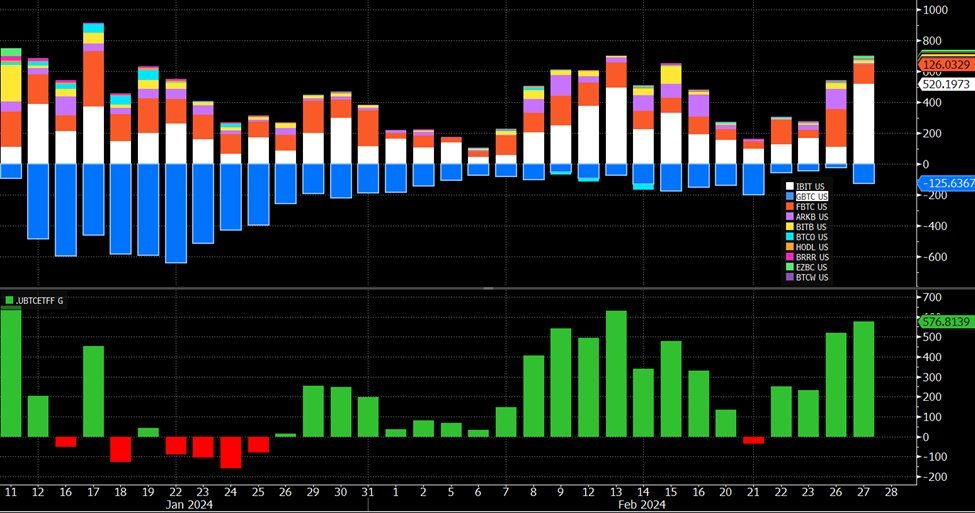
There are reasons – if you’re reading this you probably know a lot of them. The BTC ETFs took in a whopping net $576m of BTC yesterday (Tuesday Feb. 27), with BlackRock alone seeing $520m of inflows, its largest ever day. Saylor is still buying for MSTR; Reddit is going public and said it may continue to add BTC, ETH and MATIC to its balance sheet. Fidelity Canada (different from Fidelity Investments) is recommending a 1-3% allocation. Every day we see news that another RIA platform has added support for the ETFs. A wave of new demand is smashing against a programmatically scarce asset of which 75% is held by long-term holders, many of them diamond-handed zealots forged in the fire of several volatile market cycles.
One big question I’m hearing this week – where are we in the “cycle?” Notably, Bitcoin is trading just 12.16% below its prior all-time high. Bitcoin’s 4th halving will occur in about 52 days. At this point prior to the last two halvings, BTC was still down 60%+ from its previous all-time highs. Effectively, the bull runs of 2017 and 2020 hadn’t yet begun at this stage in Bitcoin’s supply schedule.
52 days before 2nd Halving (9-JUL-16)
BTCUSD $455.22 (-59.86% from ATH)
52 days before 3rd Halving (11-MAY-20)
BTCUSD $6,174 (-68.56% from ATH)
52 days before 4th Halving (20-APR-24)
BTCUSD $59,330 (-12.16% from ATH)
Although there have only been 3 halvings, and at 15 years old Bitcoin is still young by the standards of any asset class, some have raised worry that we may be speedrunning the “cycle” this time around. I suppose the notion is that the run we’ve seen over the last year might be the bull run, and that the normal course of post-halving bullish cycle may not occur. If we make a new ATH before the expected halving date of Apr. 20, 2024, that would further exacerbate this view, some say.
I’m here to say that I don’t believe that for a second. This time is different. The advent of Bitcoin ETFs in the United States is truly a monumental shift that will disrupt everything we know about Bitcoin price cycles, how to assess holder behavior, and intra-crypto rotational dynamics. But before I get into that, here’s a pile of data that suggests we are not yet topping.
Long & Short-Term Holders
Long-term holders are still mostly holding strong, currently possessing about 75% of all BTC supply. In just the last few days, we have seen a small decline – signifying a marginal transfer of coins from long to short term hands – the magnitude is nowhere near what we’ve seen in prior cycles.
MVRV Z-Score
Another way to visualize the cyclicality of Bitcoin price action is to examine the aggregate cost basis of the Bitcoin supply. While market value (market capitalization) is calculated by multiplying the current circulating supply by the last known price, realized value (realized capitalization) sums the value of coins at the time they last moved onchain. For example, if I bought a coin for $100 in 2012 and haven’t moved it since, that coin contributes $100 to the aggregate realized market cap. If we calculate a Z-score, the ratio between the difference of market cap and realized cap, and the standard deviation off market cap, we can evaluate whether Bitcoin is overvalued or undervalued.
Futures Open Interest
While BTC futures open interest is nearing all-time highs, so too is CME’s market share at more than 25% of all OI. Whereas prior peaks coincided with market tops, those futures markets were dominated by offshore crypto-collateralized exchanges, and market participants were much less institutional. They used volatile cryptoassets as collateral, sometimes an exchange’s native token (RIP FTT), and took on crazy amounts of leverage. Today, CME dominates and traders must post cash. And you have bigmarket players now – such as the authorized participants for the Bitcoin ETFs – that are using futures to hedge rather than for leverage.
Indeed, as @dylanleclair pointed out (https://t.co/7U8metYUXM), the futures complex is completely different to prior cycles. The percent of crypto-margined futures open interest is “down only.”
More on leverage – shout out to Hannah Burgess who flagged this chart from @cryptoquant_com for me. The leverage ratio across exchanges is lower than it was just 2 months ago, let alone last summer. By dividing futures exchanges’ open interest by their total BTC reserves (i.e., custodied assets), you can get an idea of what user leverage. Increasing values indicate more investors taking leverage risk, while decreasing values suggest lower risk. (Image omitted due to 4-image max on X, see subsequent tweet)
Retail Interest
There’s definitely some retail interest, as exhibited by ETF inflows (more on ETFs below), but some of the toppy metrics haven’t yet rebounded. Google Trend data shows still minimal search interest, app store rankings show the retail crypto apps are not peaking as they have during prior runs, Twitter mentions are well below prior peaks, etc. (Image omitted due to 4-image max on X, see subsequent tweet)
Bitcoin ETFs
The ETFs have added assets on a net-basis over 21 of the last 22 days – and incredible feat. Yesterday was the third largest day of net inflows, and Monday was the 4th largest day. Flows appear to be accelerating, not stagnating or subsiding.
Bloomberg Intelligence (@JSeyff)
Despite incredible volumes and flows, there’s plenty of reason to believe that the Bitcoin ETF story is still just getting started. As we wrote in our October 2023 report “Sizing the Market for the Bitcoin ETF,” (https://t.co/oLkKyhHiJ1) the primary net new accessible market for these vehicles are wealth managers and financial advisors, who have not had a real way to allocate client capital to Bitcoin exposure. While we are periodically seeing headlines of this or that RIA adding support for the ETFs, there is $40tn of AUM at banks and broker/dealers that has not yet turned on access. We are likely to see a constant drip of headlines over the next 3-18 months about these platforms adding access – and these won’t just be catalyzing headlines, they come with the chance of new inflows too!
US Wealth Management - By Platform Type
Broker-Dealer = $27.1tn
Bank = $11.9tn
Registered Investment Advisors = $9.3tn
Total US Wealth Management AUM = $48.3tn
Source: Galaxy Research; Data: Dakota (Oct. 2023)
In April, we will also get the first round of post-ETF-launch 13F filings, and (I’m just guessing here…) we are likely to see some huge names have allocated to Bitcoin. New platforms, new investments, and higher prices compound on each other, creating a feedback loop.
Declining Volatility
Over time, BTC’s volatility has declined, and it is likely to continue declining over time. ETF buyers, especially advisor-managed accounts, are much less likely to day trade than cryptocurrency exchange users. Said another way, if a large portion of BTC ends up inside ETFs, these assets will likely be stickier than BTC held on a crypto exchange. (Image omitted due to 4-image max on X, see subsequent tweet).
Intra-Crypto Cyclicality
That stickiness is also likely to dampen intra-crypto cyclicality. Long time crypto traders and observers will know that, historically, in bull runs BTC typically leads, then when it stagnates or tops money rotates further out the risk scale, culminating in an “altseason.” Bitcoin held on a crypto exchange can be easily swapped for Ether, and then for altcoins. But Bitcoin held in ETFs cannot be so easily swapped, nor are ETF holders – again if they are heavily comprised of advisor-managed accounts – likely to swap even if they could. The ascendancy of the Bitcoin ETFs will lower the likelihood of major intra-crypto capital rotations. And if Ether ETFs get approved, it will become increasingly difficult for other altcoins to see capital inflows relative to those two because, after all, BTC and ETH together comprise most of the capital and offer exposure to nearly all of the market narratives.
Bitcoin’s 4th Halving
Just a quick word on this. We all know that, historically, Bitcoin halvings have preceded major bull runs (usually by a few months). While the reduction from ~900 new coins to ~450 new coins per day is small in absolute terms (and relative to BTC’s daily float of $10-25bn over the past few months), nonetheless prices are set on the margin and there really aren’t many coins for sale at these prices. But beyond any supply impact – which again I believe is marginal– this will be the first halving in which major US asset managers have a marketing machine working to educate on Bitcoin, and there is no better Bitcoin education than learning about the halving. So it’s a narrative event first (a quadrennial marketing moment) and a supply event second, though I think both aspects will be impactful.
Can’t (s)top Won’t (s)top
All this is to say, my answer to that burning question – where are we in the cycle? – is that we haven’t even begun to reach the heights this is likely to go. The ETFs are genuinely a game changer and they are still just getting started. Given the flows we are seeing, both in the ETF complex and through our desk, I think it’s reasonable to see a new all-time high within a matter of weeks. We’re starting to hear Bitcoin spoken about alongside gold and treasuries as macro hedge assets – just this morning I heard a traditional finance research analyst suggesting Bitcoin is becoming a genuine “hedge to fiat debasement” on national television. Bitcoin is prime time now, and while it might be hard to believe, things are just starting to get exciting.
Alex Thorn
Head of Firmwide Research, Galaxy
New York City
🌈🌈🌈🌈🌈🌈🌈🌈🌈🌈🌈🌈🌈🌈🌈🌈🌈
I just had 365 Rainbow Points dropped into my wallet — everybody has at least 100 points waiting for them, but you might have more!
Claim your drop: https://t.co/map5zdxvfw
🌈🌈🌈🌈🌈🌈🌈🌈🌈🌈🌈🌈🌈🌈🌈🌈🌈