The Rhodes Center for International Economics and Finance @Watson_School explores how global politics, economics & finance shape the uncertain world we inhabit.
#RhodesCenter#podcast: The ties that bind, and the ties that blind: Central bankers in moments of crisis — @MkBlyth talks with Aditi Sahasrabuddhe about her book "Bankers' Trust," on how relationships among central bankers helped avert global financial collapse from the 1920s to 2008.
https://t.co/9VDLEjL5b1
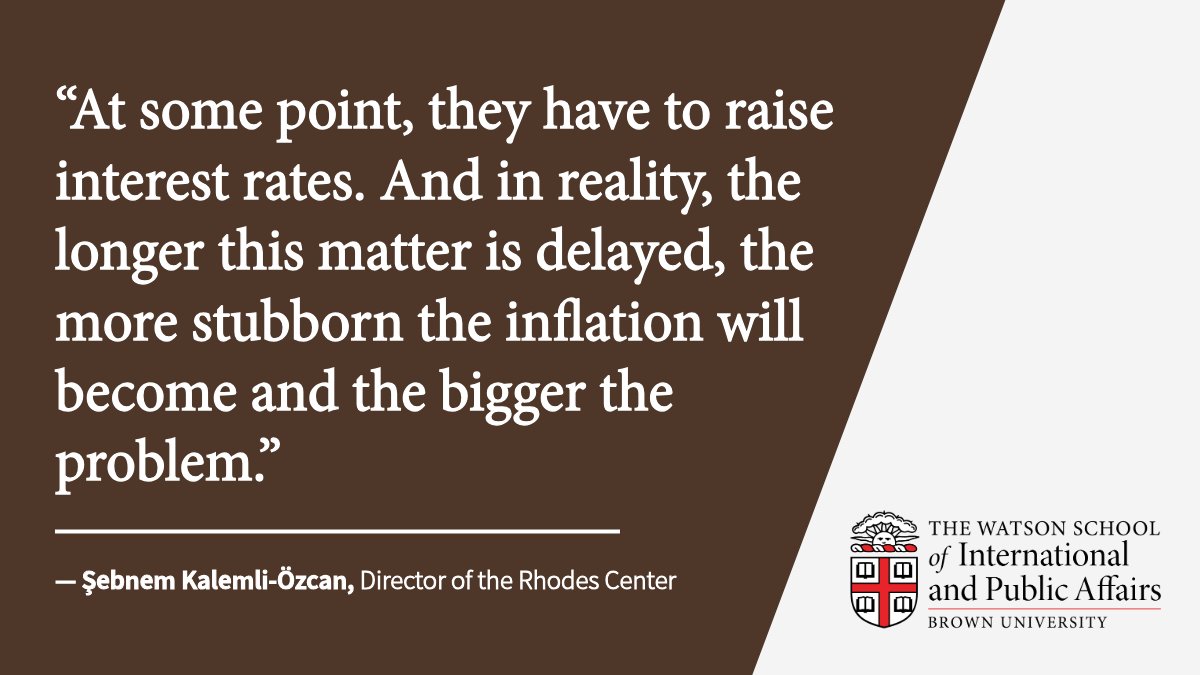
In @WebullGlobal, @skalemliozcan said the Federal Reserve must eventually raise rates, warning that delay will only make inflation more stubborn and harder to fix.
https://t.co/l0mJzbNKaA
The Fed hiked for the first time since 2023. Energy gets the headlines, but tariff passthrough is still in the inflation data.
Since Jan 2025 the U.S. aggregate price level has risen 0.3% more than its pre-2025 trend (headline CPI, FRED series CPIAUCSL).
Our Global Linkages Lab model (first draft March 2025: https://t.co/iIRZ0jtC4Y), w/ @soylu_can and Muhammed Yildirim, using actual implemented tariffs and excluding the Hormuz shock, implies a cumulative tariff effect on the price level of 0.3% over the same 7 quarters (0.35 in the long run).
Our numbers are conservative. Core goods prices are 1.8% higher than in Dec 2024, which is 1.8 to 2.9% above their flat to falling pre-2025 trend. With a 19% weight in the CPI basket, that is a 0.34 to 0.55 percentage point contribution to the aggregate price level, against the model's 0.3.
@Brown_Economics@RhodesCenter@Watson_School
https://t.co/PZr7icMDk7
More from the lab: https://t.co/KruH6Dlty5
Semester is in full swing at @BrownUniversity and I'm thrilled!
I joined @RhodesCenter for International Economics and Finance as a postdoc, continuing my work on how legal labor and export markets and their regulatory institutions shape armed group strategy in conflict.
Coffee?
🎙️ New episode out: @MarkBlyth talks with @BrownUniversity political scientist Aditi Sahasrabuddhe about her book "Bankers' Trust" on how personal ties among central bankers have helped stabilize the global financial system from the 1920s to 2008.
Listen: https://t.co/yiQpgY7wYG
For your listening pleasure - The Rhodes Center Podcast is back with Aditi Sahasrabuddhe on Central Bankers, Trust and what actually holds things together in moments of crisis: https://t.co/CRZIecrgaA
For the first time in +3 years, the U.S. Fed announced today that they will be raising interest rates to 3.75%-4%. Despite a unanimous vote today, as markets expected, the "family fight" that @skalemliozcan flagged before the vote is likely to continue: https://t.co/mkKQY7oJGn"
New year, new leadership at the Watson School. Six appointments across academic programs and research centers as the school continues to grow: Bryce Millett Steinberg (MPA), Andrew Schrank (Ph.D. and Postdoctoral Programs), Nicole Pangborn (Undergraduate Studies), @danybahar (online MPP), Wilmot James (Africa Initiative), and @skalemliozcan (Rhodes Center).
https://t.co/lzB1GI6YcY
Replay this @RhodesCenter#podcast: From competition to monopoly and back again: a political economist's tale — @MkBlyth talks with Erik Peinert about his new book on how the US and France have tackled monopoly power, and what it means for rising market concentration today.
https://t.co/YUq5TNkwWT
We are thrilled to welcome Şebnem Kalemli-Özcan as the new Director of the Rhodes Center, as of July! A leading scholar on global trade, finance, and economic growth, we are excited for the deep expertise she brings to the center's work 🌍@skalemliozcan
https://t.co/kn6BZyyLEJ
AI as a Social Technology — A @RhodesCenter conversation with Henry Farrell, covering democracy, digital politics, and the forces shaping today’s global economy. (VIDEO)
https://t.co/sjVe1kVEOG
The Watson School of International and Public Affairs celebrated a milestone on July 1: one year since its launch as @BrownUniversity's first new school in over a decade, with a bold vision to address the world's most pressing economic, political, social and policy challenges.
Learn more: https://t.co/8aAUQmFnFR
Looking for thoughtful discussions on today's most pressing global issues? Explore the Watson School's Distinguished Speaker Series, featuring prominent scholars, diplomats, and public intellectuals from around the world.
Explore the playlist on YouTube: https://t.co/WaAinPH5po
Central banking in an age of repeated supply shocks is complicated — especially alongside a capex-debt boom. My @ProSyn column below based on our research and my @BloombergTV interview from last week explain why inflation stays persistent under these conditions, and why markets may be mispricing what a look-through policy implies.
https://t.co/fj99Y5X4Yx
https://t.co/CEugBF9ws4
Europe is redefining security as fewer connections: de-risking, reshoring, buying European. Recent column by @SKalemliOzcan argues this gets the logic of resilience backwards. Bottom line: Europe will be safer with deeper relationships, not fewer of them.
https://t.co/KEWiwWyz0t
Replay this Trending Globally #podcast: Ten years after the Brexit vote, what has changed—and what can it teach us about nationalist populism today. @MkBlyth examines Brexit's lasting impact on Britain's economy, politics and society.
https://t.co/cg48ndipq8
Breaking Down the Fed's Plans to Tackle Inflation Risks — In a @Bloomberg interview, @RhodesCenter Director @skalemliozcan discussed how markets are interpreting the Federal Reserve's decision to hold interest rates steady and the risks of supply-driven inflation.
https://t.co/qTk9y3cFhg
Watch Rhodes Center Director @skalemliozcan on @BloombergTV as she breaks down how markets are interpreting the U.S. Federal Reserve's latest interest rate decision: https://t.co/w2ahE8tKvq
@Watson_School
A "family fight," the Chair says. But both sides of the family share the same assumption: that supply-driven inflation fades on its own. In a networked economy, supply shocks compound before they fade. My take @BloombergTV on yesterday's 9–3 hold @Brown_Economics@Watson_School: https://t.co/TnXT5mTswS
A "family fight," the Chair says. But both sides of the family share the same assumption: that supply-driven inflation fades on its own. In a networked economy, supply shocks compound before they fade. My take @BloombergTV on yesterday's 9–3 hold @Brown_Economics@Watson_School: https://t.co/TnXT5mTswS