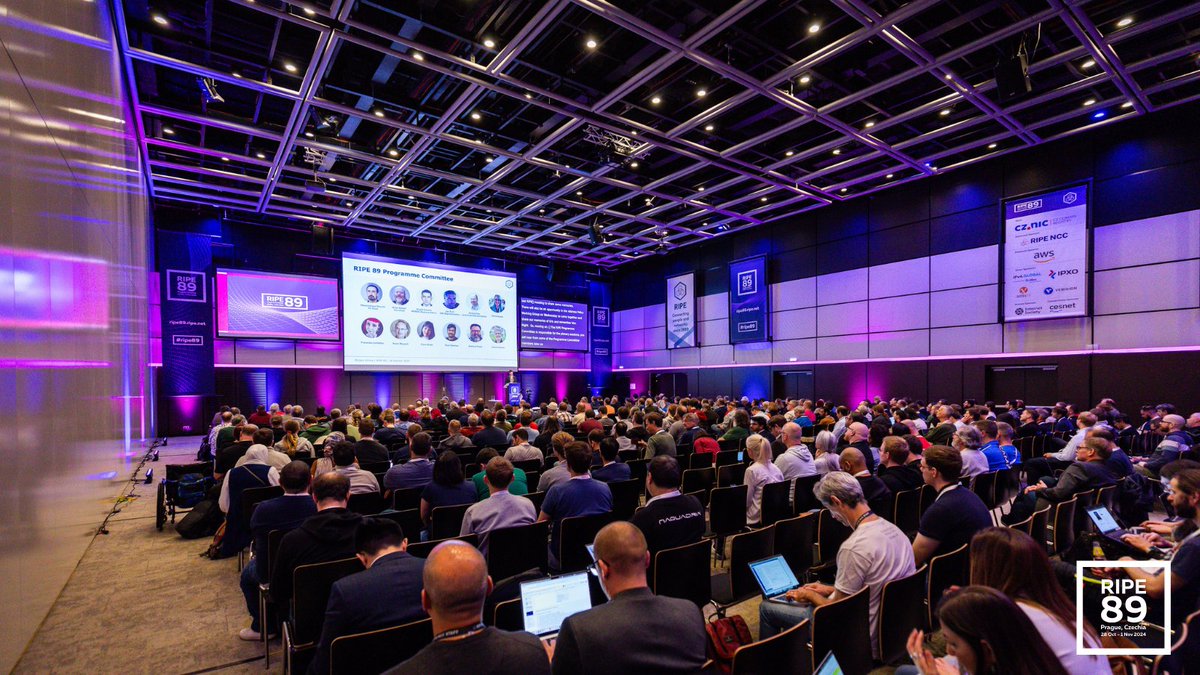
That's a wrap for Day 1 of #RIPE89! Today, we welcomed 540 participants onsite and 256 online. We look forward to seeing you for another exciting day tomorrow! And if you missed anything today, check out our Daily Meeting Blog on RIPE Labs: https://t.co/JIsMocaa9W
@staticyrro In their defence, they've just inherited the behaviour from OpenWRT's DHCPv6 client. Would be nice if we can get it fixed though! (Or even better, for Unifi to start supporting MAP-T)
#NetLdn 57 is next week, Thursday 10th of October. Talks start promptly at 1900hrs, upstairs at The Wheatsheaf, Fitzrovia, W1T 1JB
https://t.co/07Qsx17mj6
@jwbensley I'm almost ready to start considering SRv6, if I were doing a greenfield, once the CRH debacle settles down.
I'm just waiting to be convinced of its benefits over SR-MPLS. Bigger SID space is the obv one, countered with the inefficiency of non-CRH.
@jwbensley Yup, and that's because people perceived this to be an outstanding issue with SRv6. (you asked for reasons why people don't want to s/MPLS/SRv6/g , just giving examples)
Another proposal was a new ethertype to distinguish it from 0x86DD
@jwbensley 128bits introduces scaling challenges, hence why the IETF has been heavily working on (and arguing about), alternative compressed versions of the SRH
@jwbensley With SR your signalling is now part of your packet. SR-MPLS can't accidentally leak out of (or into) your network, with SRv6 it can if people mess up filtering.
It's #NetLdn this week, and we're looking for some lightning talks. If you've got something to talk about, please get in touch: https://t.co/ahGTCek38V