🚨 HOLY SMOKES. President Trump just OBLITERATED NATO, basically calling them freeloaders who barely deserve his presence if it weren't for Turkey
"ITALY turned us down. GERMANY turned us down. FRANCE turned us down."
"We WEREN'T TREATED WELL."
"I was VERY disappointed with NATO. Frankly? If it weren't held in Turkey...it's possible I would NOT have attended [NATO]. I felt I had to because [Erdogan] has gone all out."
"In a way, I was testing people!"
"Why are we spending hundreds of billions of dollars, they weren't there for us, we've been there for them."
"We protect European countries...you'd THINK they'd be very willing to do something to help us. And they REALLY WEREN'T."
WATCH: The Oval Office cracks up as President Trump jokes about nominating Ted Cruz to the Supreme Court, saying he'd get 100% of the votes because all of the lawmakers would "want to get him the hell out of the Senate."
Dem Chris Coons thought he had Rubio trapped…
Then Rubio dropped the receipts and stopped him cold. The facts don’t lie. 💥🇺🇸
Own goal or masterclass? Drop your take below!
#MarcoRubio#ChrisCoons#AmericaFirst#SenateHearing
On this day in 1779, the American Revolution was raging in the Caribbean, and the French handed the mighty Royal Navy one of its most humiliating beatings of the entire war, thousands of miles from a single American colonist. This is the war Americans forget was global.
The French admiral, the Count d'Estaing, had just captured the sugar-rich British island of Grenada. A British fleet under Admiral John Byron, nicknamed "Foul-Weather Jack," raced in to stop him and to retake the island. Byron thought he had the smaller force and attacked aggressively. He was wrong. D'Estaing actually had the bigger fleet, and the British sailed straight into a buzzsaw.
The French guns tore Byron's ships apart. Several British warships were so badly mauled and dismasted that they could barely limp away, and the Royal Navy, used to ruling the seas, took a beating it could not answer. It became one of the worst British naval defeats of the whole Revolutionary War.
Why did it matter to America? Because every ship and sailor Britain had to pour into defending its precious Caribbean sugar islands was a ship and sailor not available to crush the rebellion back on the mainland. Those islands were worth staggering amounts of money, and protecting them bled British strength away from the American coast at exactly the wrong time.
The Revolution wasn't just Bunker Hill and Valley Forge. It was fought in the Caribbean, in India, off the coast of Europe, wherever Britain's enemies could make the empire hurt. Grenada is proof that America won its freedom partly because the whole world lined up to take a swing at the same giant.
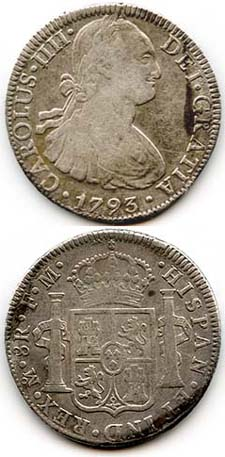
On July 6, 1785, Congress decided what American money would be called, and picked a name borrowed from the Spanish.
They chose the dollar. It came from the Spanish silver coins, the famous pieces of eight, that were already flowing through the colonies and that everyone actually trusted more than British or American paper.
But the truly revolutionary part wasn't the name. It was the math. America decided to break the dollar into 100 cents, a clean decimal system where everything divides by ten.
That sounds obvious now. It wasn't. Britain was still using a maddening system of pounds, shillings, and pence where the numbers didn't line up in any sane way.
America was the first country in the world to build its money on the simple decimal system. Nearly everyone else eventually copied it.
🦅 Dick Best — The Man Who Sank Two Carriers in One Day
June 4, 1942. Battle of Midway
Lieutenant Richard “Dick” Best, piloting his SBD Dauntless high above the Pacific, made a split-second decision that changed history. While others attacked one carrier, Best and his two wingmen broke off and dove on Admiral Nagumo’s flagship — the Akagi.
His bomb struck true. Explosions ripped through the hangar deck. Later that same day, Best pressed the attack again on the Hiryū, helping send a second Japanese carrier to the bottom.
One pilot. Two carriers. One pivotal day that helped turn the Pacific War.
Despite later suffering severe lung damage from a faulty oxygen mask, Best’s heroism never faded. A true American warrior who answered the call when it mattered most.
Respect to the legends who flew into hell and came back swinging. 🇺🇸
What’s your favorite Midway story?
#USNavy #BattleOfMidway
Christopher Hitchens: ”In 1786, when the United States was barely a country, it was having its sailors taken as slaves by the Barbary states, the states of the Ottoman Empire and North Africa. Tripoli, shores of Tripoli. Ships stopped, its crews carried off into slavery. We estimate 1.5 million European and American slaves taken between 1750 and 1815.
Jefferson and Adams went to their ambassador in London and said, why do you do this to us? The United States has never had a quarrel with the Muslim world of any kind. We weren't in the crusades. We weren't at war with Spain. Why do you do this to our people and our ships? Why do you plunder and enslave our people? The ambassador said very plainly, Mr. Abdul Rahman said, because the Quran gives us permission to do so, because you are infidels, and that's our answer. Jefferson said, well, in that case, I will send a navy which will crush your state, which he did.
Islamic fundamentalism is not created by American democracy. It's a lie to say so. It's a masochistic lie, and it excuses those who are the real criminals, and blames us for the attacks made upon us.”
Two air forces started the Pacific war.
One trained its pilots, then kept them fighting until they died. The other trained its pilots, then often pulled many of its experienced combat pilots out to teach everyone else.
This is one of the reasons America won the Pacific air war, let's dive in..
Japan's Elite Aviators
At the start of the war, Japan had some of the finest fighter pilots in the world.
The aviators who attacked Pearl Harbor were elite. Many had hundreds of hours in the cockpit and real combat experience from the fighting in China. Flying the nimble A6M Zero, they cut through Allied opposition in the early months of the war and earned a fearsome reputation.
But Japan made a fateful choice about these men. It kept them in combat, more or less indefinitely. Japanese pilots flew mission after mission with no real system to rotate them home. They fought until they were shot down, crippled, or killed.
It seemed ruthless and efficient. In reality, it was a slow-motion disaster.
The Difference in Philosophy
Because every time Japan lost one of those veterans, everything he knew died with him.
America did the opposite. It regularly rotated many of its experienced combat pilots back home once they had done their share of fighting. There, they became instructors, pouring everything they had learned in real air combat directly into the next generation of pilots.
So the two systems pulled in opposite directions. Japan's pool of skill drained away with every ace it buried. America's pool of skill grew, as each returning veteran multiplied his knowledge across hundreds of students.
One nation was teaching. The other was simply dying.
The Training Gap
The gap became a chasm, and it was made worse by sheer scale.
By 1944, the United States was training around 8,000 new aviators every month, each of them getting well over a year of instruction and hundreds of hours in the air before they ever saw combat.
Japan could not come close. As its veterans vanished, its training program collapsed, and it was crippled by something else, too. Fuel. Japan was running so short of it that many trainees could barely fly enough hours to learn their trade. By the later part of the war, Japanese pilots were being rushed into battle with barely 100 hours of flying time, and sometimes far less. They were teenagers with almost no training, being sent up against American veterans who had been taught by the best combat pilots in the fleet.
The outcome was no longer a contest. It was a slaughter.
The Great Marianas Turkey Shoot
Nowhere was that clearer than in the skies over the Mariana Islands in June 1944.
When the Japanese launched hundreds of aircraft against the American fleet, they flew into a wall of Hellcat fighters, guided by radar and expert fighter direction that positioned the Americans at the perfect height and moment to strike. The green Japanese pilots in their now outdated Zeros never had a chance.
In and around that battle, Japan lost nearly 480 aircraft, while the Americans lost only a few dozen. It was so one-sided that the American aviators nicknamed it the Great Marianas Turkey Shoot.
Japan's naval air power, once the terror of the Pacific, was broken in a matter of days.
Better Aircraft, Better Technology
It was not only the pilots. It was the machines too.
America kept producing better and better aircraft, like the tough, heavily armed F6F Hellcat, designed after studying a captured Zero and built to beat it. It could take punishment, out-dive and out-gun its opponent, and it was forgiving enough that even a less experienced pilot could survive his first fights and become a veteran. Over the war, Hellcat pilots claimed more than 5,000 enemy aircraft for a tiny fraction of that in losses.
Japan, meanwhile, kept sending men up in the aging Zero, a plane that had been revolutionary in 1941 but was now underpowered, fragile, and outclassed. It was fast and agile, but a single burst of American fire could tear it apart, because it had traded armor and protection for maneuverability.
Better pilots, in better planes, backed by better technology. The advantages stacked on top of one another.
The Spiral Ends
By the end, Japan had reached the final, desperate stage of the spiral.
With almost no trained pilots left, and no way to make more in time, it turned to the kamikaze. A pilot did not need 500 hours of training to crash his aircraft into a ship. He only needed to take off, aim, and die. It was the last resort of an air force that had run out of the one thing it could never mass produce. Experienced men.
America won the Pacific air war for many reasons. Its factories out-built the enemy. Its radar and intelligence gave it eyes the Japanese lacked. Its aircraft grew deadlier every year.
But underneath all of it was something simpler. America treated its best pilots as a resource to be protected and passed on. Japan treated them as fuel to be burned. One of those choices built an air force that kept getting stronger. The other burned brightly, and then burned out.
This was why America won the Pacific air war.
I post a story like this every single day. Most people never see them. Follow so you don't miss the next one.
On this day in 1777, the fortress Americans called impregnable was abandoned in the dark without a real fight, and the shock of it rang across two continents. Fort Ticonderoga was supposed to be the "Gibraltar of America," the iron gate guarding the route from Canada. Losing it felt like a catastrophe. It nearly was.
The British general John Burgoyne came south with a powerful army, and instead of throwing his men at the fort's walls, his officers looked up. Towering over Ticonderoga was a steep hill called Mount Defiance that the Americans had left undefended, sure that no one could ever haul cannon up such a slope. The British did exactly that. As one officer supposedly put it, "Where a goat can go, a man can go, and where a man can go, he can drag a gun."
When the American commander, Arthur St. Clair, woke to find British artillery staring down into his fort from above, he knew the game was over. Any bombardment from that height would slaughter his outnumbered garrison. So on the night of July 5 into the 6th, he made the agonizing call to evacuate, slipping his 3,000 men out under cover of darkness rather than see them destroyed. Burgoyne marched in the next morning without a real fight.
Americans were furious and humiliated. St. Clair was accused of cowardice and court-martialed, though later cleared. Across the ocean, King George III reportedly burst in on the Queen shouting, "I have beat them! I have beat all the Americans!"
Here's the twist history loves. Taking Ticonderoga lured Burgoyne deeper and deeper into the American wilderness, stretching his supply lines to the breaking point. A few months later that same overconfident army was surrounded and forced to surrender at Saratoga, the victory that convinced France to join the war. The "disaster" at Ticonderoga was the first step in one of the biggest American triumphs of all.
HOLY SH*T: In case you missed it: President Trump actually rang the NYSE and NASDAQ opening bell from the Oval Office celebrating Trump accounts
God Bless President Trump 🙏
🚨 After the SCOTUS decision, action is urgent. Add your name to DEMAND a Constitutional Amendment ending birthright citizenship for illegal invaders. Sign NOW.