@EmmaunelSax@TheDAOLabs Great breakdown of the V2 updates! The Wave Status and improved notifications sound like real game-changers for active contributors.
Thanks for sharing these details, @EmmaunelSax. Time to dive back into the marketplace and check out those reels. #SocialMining
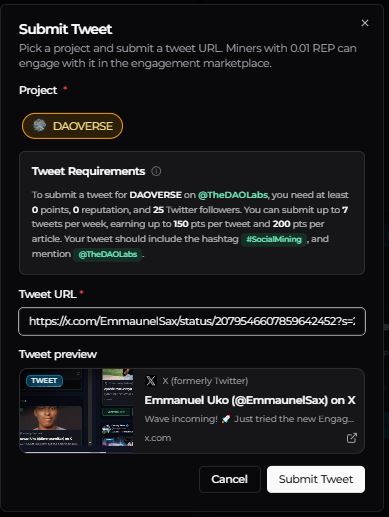
Wave incoming! 🚀 Just tried the new Engagement Marketplace upgrades from @TheDAOLabs
and the real-time Radar alerts + Wave signaling are game-changers for staying active and stacking rewards.
No more FOMO on validation tasks. This is how you build a high-signal DAOVERSE.
Who's waving with me?👋 #SocialMining
The latest Social Mining V2 update from @TheDAOLabs isn't just another UI refresh.
It's focused on making every contributor's work more visible, every action easier to manage, and every reward more transparent.
Here are the features I'm most excited about👇
🛒 Marketplace Gets Smarter
The Engagement Marketplace is becoming the true command center for Social Mining.
New additions include:
✅ Better navigation
✅ More flexible task management
✅ Cleaner contribution tracking
Result?
Less confusion. More productivity. Better rewards.
📡 Never Miss Activity Again
Three features work together:
🔔 Radar Pulse
🔴 Unread Marketplace Badge
📲 Marketplace Reel
Now you instantly know:
• when validations arrive
• when new work is available
• where to jump next
No more constantly refreshing the dashboard.
👋 Wave Status
One feature I really like is Wave.
Instead of wondering who's available, contributors can simply wave to signal they're active.
Simple...but incredibly useful for validators and community collaboration.
🎯 Better Quality Control
The new Wallchain score requirement protects the marketplace.
Instead of rewarding spam,
the system encourages genuine contributors with stronger reputations.
Quality > Quantity.
That's a healthier ecosystem for everyone.
🔄 Smarter Tweet Management
A few upgrades I found useful:
✔ Tweet reassignment to trusted connections
✔ High Wallchain users can fast-track tweet submissions
This gives experienced contributors more flexibility while keeping quality standards high.
📊 Better Insights Into Your Progress
Your dashboard now tells a much clearer story.
You can now view:
💰 Latest payouts
📈 Activity breakdowns
📋 Account summaries
Instead of wondering how you're performing...
you can actually measure it.
Opportunity Reels
The new reels help contributors stay ahead.
You'll now see:
⏳ Live campaign countdowns
📅 Scheduled admin tasks
📢 Upcoming opportunities
Everything becomes easier to plan instead of reacting at the last minute.
More Ways To Contribute
Sharing is now more flexible.
Instead of being limited, contributors can choose platforms like:
🐦 X
💻 GitHub
📧 Email
👽 Reddit
This makes campaigns much more adaptable for different communities.
📝 Better Surveys & Task Support
Small improvements often make the biggest difference.
Now we have:
✅ Survey step counters
✅ Per-connection reward tracking
✅ Reapply after rejection
✅ Admin editing for minor submission errors
These updates reduce unnecessary frustration while improving accuracy.
My biggest takeaway?
This update isn't about adding more buttons.
It's about giving contributors more control, clearer feedback, better visibility, and fairer rewards.
That's exactly how a mature Social Mining ecosystem should evolve.
If you're not part of the movement yet, now is a great time to explore what @TheDAOLabs is building.
#SocialMining
@EmmaunelSax Excellent breakdown @EmmaunelSax!
The migration to the new WhoTweets platform with a cleaner dashboard, better scoring, Reels feed, and safety measures is a big step forward for #SocialMining.
@TheDAOLabs making the experience more professional and rewarding.
Time to update
Social Mining has a new home.
DAO Labs has officially moved its main platform from https://t.co/ADF0wQmqrS to https://t.co/km9ZxfFrwY — but this is much more than a domain change.
It comes with a redesigned dashboard and major upgrades to how miners track, engage, validate, and earn.
@TheDAOLabs #WhoTweets #SocialMining
The new name makes sense.
X is where Social Miners research projects, create content, analyze conversations, and generate authentic engagement.
“WhoTweets” is shorter, easier to remember, and immediately connects the platform to the work contributors perform every day.
One of the biggest improvements is the redesigned dashboard.
The new interface is cleaner, faster, and makes it easier to monitor tasks, contributions, points, and activity without moving through a complicated workspace.
A better user experience means miners can focus more on creating value.
The enhanced X scoring system also stands out.
Instead of treating every account equally, the platform now considers credibility, authentic activity, consistent engagement, and verified accounts when calculating multipliers.
This could help reward genuine influence rather than empty activity.
Short-form video is also becoming part of the Social Mining experience.
With the new Reels and Shorts feed, contributors can discover, engage with, and recommend valuable video content directly to their connections.
That creates another way to educate, collaborate, and grow communities.
The Top 100 KOL delegation feature is another major addition.
Miners can reassign opportunities to trusted friends or ranked KOLs when they cannot complete them personally.
This helps important project content receive support while reducing excessive activity on one X account.
I also like the new engagement safety measures and Marketplace improvements.
Daily repost and quote limits can reduce spam, while the one-minute validation undo feature gives miners a chance to correct genuine mistakes.
Small protections like these can improve both quality and accountability.
Most importantly, existing miners are not starting again.
Profiles, login details, points, submissions, history, rankings, and rewards remain intact.
Only the platform address has changed.
For me, this upgrade shows that Social Mining is moving toward a more professional, safer, and easier-to-use digital workspace.
Visit https://t.co/km9ZxfFrwY, update your bookmarks, and explore the new platform.
@TheDAOLabs #WhoTweets #SocialMining
Spot on @EmmaunelSax. In a Web3 world drowning in bot activity and inflated metrics, DAOVERSE's Engagement Marketplace stands out by rewarding real human participation. As a Social Miner, I've seen how studying projects, crafting thoughtful replies, and driving cross-platform..
Can you turn attention into real impact across Web3?
Because today, visibility is easy to fake… But real engagement is rare.
And DAOVERSE is built to prove the difference.
📌 Most Web3 projects are fighting for attention.
A project can announce a launch, campaign, partnership, update, or community event…
but if nobody responds, the message dies fast.
That is why real community participation matters.
Not bots.
Not empty likes.
Not fake impressions.
Real people.
The DAOVERSE Engagement Marketplace helps solve this by connecting Web3 projects with active Social Miners who can support campaigns through meaningful engagement.
As a miner, I do not just “complete tasks.”
I study the project message, engage with the post, submit my activity, and track my performance.
That creates visibility the project can actually feel.
The process is simple:
1. Open the DAOVERSE Engagement Marketplace
2. Choose a task
3. Read the project instruction
4. Engage with the project content
5. Submit the interaction
6. Track validation, stats, points, or leaderboard activity
This turns community participation into measurable contribution.
What makes this powerful is that the engagement does not stay inside one platform.
A strong Social Miner can help push awareness across X, CoinMarketCap Community, LinkedIn, and other Web3 spaces.
That matters because each audience is different.
X brings fast conversation.
CoinMarketCap Community reaches crypto users looking for opportunities and updates.
LinkedIn reaches builders, founders, marketers, and potential partners.
This is why I believe Social Mining is becoming essential for Web3 growth.
Projects need people who can:
✔️explain clearly
✔️respond quickly
✔️give feedback
✔️amplify announcements
✔️educate new users
✔️create trust across communities
The future of Web3 marketing will not be built by bots.
It will be built by real contributors.
For me, the DAOVERSE Engagement Marketplace is not just a task board.
It is a community growth engine.
It helps projects gain visibility, feedback, and human participation when it matters most.
And it gives miners a way to turn consistency into value.
@TheDAOLabs
#SocialMining
SocialFi does not have an engagement problem.
It has a validation problem.
That was my biggest takeaway from @TheDAOLabs article on Proof of Work and Retainability in SocialFi.
Many platforms can generate activity, but not every activity creates value.
In Web3, it is easy to count comments, likes, shares, submissions, and task completions.
But the real question is:
1. Did that contribution actually help the project?
2. Did it educate someone?
3. Did it create useful feedback?
4. Did it support real community growth?
That is where validation matters.
I have experienced this personally as a Social Miner.
At first, it is easy to think completing tasks quickly is enough.
But with time, you realize that meaningful contribution requires more than showing up.
You need to read, understand, think, and create responses that add value.
This is why I like the difference between proof of activity and proof of work.
Proof of activity says: “I did the task.”
Proof of work asks: “Did my task produce value?”
That difference is what separates low-effort engagement from real contribution.
DAO Labs’ three-stage validation framework makes a lot of sense to me:
1. Peer-to-Peer Validation
2. Quality Validation
3. Results Validation
4. This means contribution is not judged only by whether it happened, but by whether it was useful, original, relevant, and impactful.
Validation may feel strict sometimes, but it protects genuine contributors.
Without validation, low-effort users, spam, bots, and repetitive content can look equal to the work of people who research, create, support, and stay consistent.
That would weaken the whole ecosystem.
Quality should matter more than simple activity because Web3 projects do not need empty noise.
They need real humans who understand the mission, give honest feedback, educate others, and help communities grow sustainably.
That is what Social Mining should reward.
For me, the future of SocialFi will not be won by platforms that produce the most activity.
It will be won by systems that can identify real value.
That is why validation is not just a feature.
It is the foundation of meaningful #SocialMining.
Article link: [https://t.co/nQXfVAksf6]
@EmmaunelSax Love how DAOVERSE turns vague 'community engagement' into a professional, trackable system. The task process (read → engage meaningfully → submit → track) ensures quality over quantity. Been stacking points across campaigns and the upgrades like article submissions and task.
My CMC Community post and LinkedIn post links are below:
CMC post: [https://t.co/aWuDnoDc49]
LinkedIn post: [https://t.co/CaHo7Vgkkm]
Please check them out and engage if you find them valuable.
Can you turn attention into real impact across Web3?
Because today, visibility is easy to fake… But real engagement is rare.
And DAOVERSE is built to prove the difference.
📌 Most Web3 projects are fighting for attention.
A project can announce a launch, campaign, partnership, update, or community event…
but if nobody responds, the message dies fast.
That is why real community participation matters.
Not bots.
Not empty likes.
Not fake impressions.
Real people.
The DAOVERSE Engagement Marketplace helps solve this by connecting Web3 projects with active Social Miners who can support campaigns through meaningful engagement.
As a miner, I do not just “complete tasks.”
I study the project message, engage with the post, submit my activity, and track my performance.
That creates visibility the project can actually feel.
The process is simple:
1. Open the DAOVERSE Engagement Marketplace
2. Choose a task
3. Read the project instruction
4. Engage with the project content
5. Submit the interaction
6. Track validation, stats, points, or leaderboard activity
This turns community participation into measurable contribution.
What makes this powerful is that the engagement does not stay inside one platform.
A strong Social Miner can help push awareness across X, CoinMarketCap Community, LinkedIn, and other Web3 spaces.
That matters because each audience is different.
X brings fast conversation.
CoinMarketCap Community reaches crypto users looking for opportunities and updates.
LinkedIn reaches builders, founders, marketers, and potential partners.
This is why I believe Social Mining is becoming essential for Web3 growth.
Projects need people who can:
✔️explain clearly
✔️respond quickly
✔️give feedback
✔️amplify announcements
✔️educate new users
✔️create trust across communities
The future of Web3 marketing will not be built by bots.
It will be built by real contributors.
For me, the DAOVERSE Engagement Marketplace is not just a task board.
It is a community growth engine.
It helps projects gain visibility, feedback, and human participation when it matters most.
And it gives miners a way to turn consistency into value.
@TheDAOLabs
#SocialMining
What’s coming to #SocialMining? 👀
From @TheDAOLabs’ latest announcement, it looks like we’re moving toward a more refined post-to-earn system — one that focuses on better tracking, clearer engagement signals, and stronger validation of real contributions. If done right, this could be a major shift from activity-based rewards to value-based rewards.
From my experience so far, Social Mining is not just about completing tasks or chasing rewards. It has pushed me to actually understand projects, do proper research, and create content that adds meaning instead of noise. Over time, you start to see the difference between posting for rewards and creating with intention.
That said, it hasn’t always been perfect.
One of the biggest challenges has been validation. When low-effort posts receive similar visibility or rewards as well-thought-out content, it can feel discouraging for genuine contributors. It creates a gap where effort isn’t always clearly recognized, and that can affect motivation.
This is why the upcoming improvements matter.
If validation becomes more accurate:
• Genuine contributors will finally feel seen and rewarded for quality work
• Low-effort engagement will naturally lose its advantage
• The overall content standard across the platform will improve
• Creators will be encouraged to focus on value, not just volume
That’s the kind of system Social Mining needs.
Despite the challenges, I would still recommend Social Mining to anyone eager to create and earn — especially those willing to learn and grow. It’s one of the few spaces where your consistency, creativity, and understanding can actually translate into measurable rewards.
You’re not just posting.
You’re building skills, developing your voice, connecting with a community, and learning how to create value in Web3.
If this next phase truly strengthens validation and transparency, then Social Mining could become a much more fair and rewarding ecosystem for serious contributors.
Let’s see what’s coming. 🚀
Not every Web3 project deserves community trust.
That was my biggest takeaway from DAO Labs’ article.
In crypto, projects can look strong on the surface: good branding, big narratives, investor decks, and exciting roadmaps.
But trust should never be given because of hype.
📌This is why DAO Labs’ Fair Launchpad Structure matters.
Before a project enters the Social Mining ecosystem, it must be investigated across valuation, token allocation, TGE unlocks, vesting, cliffs, and contract compliance.
That is community protection, not just onboarding.
📌 The Autonomys case is one of the strongest lessons.
A project can have technical potential, but if it violates agreed distribution terms or delays what was promised, accountability must follow.
In Web3, promises are not enough.
Contracts and timelines matter.
📌 I also like how the article explains Social Mining Hubs.
Hubs do not just create a crowd of airdrop hunters.
They build educated contributors who understand the project, support the ecosystem, test, give feedback, create content, and stay loyal beyond launch hype.
This is where DAO Labs differs from many traditional launchpad models.
A normal launchpad may focus on exposure and short-term attention.
DAO Labs focuses on investigation, community quality, long-term trust, and sustainable adoption.
That difference is important.
📌 For me, the message is simple:
✔️ Community quality matters more than community size.
✔️ Bots and low-effort users create noise.
But informed Social Miners create feedback, loyalty, adoption, and long-term value.
That is why rigorous evaluation is the backbone of #SocialMining.
@TheDAOLabs
For more information take a look at the Article link below 👇
Article: [https://t.co/jHoODYbpWq]
The Web3 space is filled with engagement platforms promising growth, visibility, and community participation.
At first glance, @zealy_io and the SMV2 Marketplace by @TheDAOLabs may look similar. Both connect users with Web3 projects. Both reward participation. Both have active communities and legitimate campaigns.
But after using both platforms firsthand, I realized something important:
They may appear to serve the same purpose, but they are not built for the same outcome.
My view is not based on outside opinion. I have participated on both platforms actively, and today I am a Social Mining contributor on SMV2, currently among the final 16 competitors in the DAOVERSE World Cup.
That experience gives me a practical foundation to compare both platforms across three key areas: organic engagement, real-time project feedback, and the quality of contributions.
This is not an attack on Zealy.
It is an evidence-based comparison of two different models and what they actually produce for Web3 projects.
So here is my honest breakdown from a contributor’s point of view.
Organic feed and engagement
On Zealy, most activities are structured as quests.
You complete a task, earn XP, climb the leaderboard, and wait for rewards or campaign results.
That is useful for community participation.
But SMV2 Marketplace feels more connected to live Web3 conversations.
When a project tweet needs attention, miners can engage directly through comments, quotes, reposts, and meaningful responses.
That means the project does not just get “task completion.”
It gets real social movement on X.
Why timing matters
In Web3, timing can decide whether an announcement gains attention or disappears.
A partnership post, campaign update, launch announcement, or community event needs early momentum.
This is where SMV2 has an edge.
The Marketplace helps direct miners toward active project tweets when engagement is needed most.
From my own use, the process is simple:
✔ Open Marketplace
✔ Choose a task
✔ Study the project tweet
✔ Engage with a real response
✔ Submit proof
✔ Track status, validation, and points
That creates faster feedback than passive quest completion.
Real-time data and feedback
For projects, engagement is not only about numbers.
It is about signals.
Are people understanding the message?
Are they asking questions?
Are they responding naturally?
Are contributors actually helping the campaign gain visibility?
SMV2 gives better visibility into this process because miners can track task participation, submitted interactions, validation, leaderboard activity, and points.
That makes contribution easier to measure.
Zealy shows participation through quests and XP, but SMV2 connects contribution more directly to public conversation and project visibility.
Quality of contribution
This is the biggest difference for me.
A completed quest can prove that a user followed instructions.
But a strong comment or quote on X can prove that a user understood the message.
That matters.
Because Web3 projects do not only need clicks.
They need people who can explain, defend, amplify, and humanize the project’s message.
SMV2 encourages this better because miners are not just completing tasks in silence.
They are participating where the market is watching.
My evidence
From my screenshots, I am showing:
• SMV2 Marketplace task flow
• My engagement process on X
• Submitted/completed activity
• Stats, validation, leaderboard, or points
• Zealy quest/XP comparison from my own account
I am not comparing with assumptions.
I am comparing based on real participation.
Final verdict
Zealy is useful for quests, XP, and structured community activity.
But for organic Web3 growth, fast-response engagement, real-time feedback, and measurable social contribution, SMV2 Marketplace gives projects something deeper:
• A living community engine.
• Not bots.
• Not empty hype.
• Not passive task farming.
✔ Real people.
✔ Real responses.
✔ Real contribution.
✔ Real visibility.
That is why I believe SMV2 Marketplace edges out the competition where it matters most.
@TheDAOLabs #SocialMining
The Web3 space is filled with engagement platforms promising growth, visibility, and community participation.
At first glance, @zealy_io and the SMV2 Marketplace by @TheDAOLabs may look similar. Both connect users with Web3 projects. Both reward participation. Both have active communities and legitimate campaigns.
But after using both platforms firsthand, I realized something important:
They may appear to serve the same purpose, but they are not built for the same outcome.
My view is not based on outside opinion. I have participated on both platforms actively, and today I am a Social Mining contributor on SMV2, currently among the final 16 competitors in the DAOVERSE World Cup.
That experience gives me a practical foundation to compare both platforms across three key areas: organic engagement, real-time project feedback, and the quality of contributions.
This is not an attack on Zealy.
It is an evidence-based comparison of two different models and what they actually produce for Web3 projects.
So here is my honest breakdown from a contributor’s point of view.
Organic feed and engagement
On Zealy, most activities are structured as quests.
You complete a task, earn XP, climb the leaderboard, and wait for rewards or campaign results.
That is useful for community participation.
But SMV2 Marketplace feels more connected to live Web3 conversations.
When a project tweet needs attention, miners can engage directly through comments, quotes, reposts, and meaningful responses.
That means the project does not just get “task completion.”
It gets real social movement on X.
Why timing matters
In Web3, timing can decide whether an announcement gains attention or disappears.
A partnership post, campaign update, launch announcement, or community event needs early momentum.
This is where SMV2 has an edge.
The Marketplace helps direct miners toward active project tweets when engagement is needed most.
From my own use, the process is simple:
✔ Open Marketplace
✔ Choose a task
✔ Study the project tweet
✔ Engage with a real response
✔ Submit proof
✔ Track status, validation, and points
That creates faster feedback than passive quest completion.
Real-time data and feedback
For projects, engagement is not only about numbers.
It is about signals.
Are people understanding the message?
Are they asking questions?
Are they responding naturally?
Are contributors actually helping the campaign gain visibility?
SMV2 gives better visibility into this process because miners can track task participation, submitted interactions, validation, leaderboard activity, and points.
That makes contribution easier to measure.
Zealy shows participation through quests and XP, but SMV2 connects contribution more directly to public conversation and project visibility.
Quality of contribution
This is the biggest difference for me.
A completed quest can prove that a user followed instructions.
But a strong comment or quote on X can prove that a user understood the message.
That matters.
Because Web3 projects do not only need clicks.
They need people who can explain, defend, amplify, and humanize the project’s message.
SMV2 encourages this better because miners are not just completing tasks in silence.
They are participating where the market is watching.
My evidence
From my screenshots, I am showing:
• SMV2 Marketplace task flow
• My engagement process on X
• Submitted/completed activity
• Stats, validation, leaderboard, or points
• Zealy quest/XP comparison from my own account
I am not comparing with assumptions.
I am comparing based on real participation.
Final verdict
Zealy is useful for quests, XP, and structured community activity.
But for organic Web3 growth, fast-response engagement, real-time feedback, and measurable social contribution, SMV2 Marketplace gives projects something deeper:
• A living community engine.
• Not bots.
• Not empty hype.
• Not passive task farming.
✔ Real people.
✔ Real responses.
✔ Real contribution.
✔ Real visibility.
That is why I believe SMV2 Marketplace edges out the competition where it matters most.
@TheDAOLabs #SocialMining
The Web3 space is filled with engagement platforms promising growth, visibility, and community participation.
At first glance, @zealy_io and the SMV2 Marketplace by @TheDAOLabs may look similar. Both connect users with Web3 projects. Both reward participation. Both have active communities and legitimate campaigns.
But after using both platforms firsthand, I realized something important:
They may appear to serve the same purpose, but they are not built for the same outcome.
My view is not based on outside opinion. I have participated on both platforms actively, and today I am a Social Mining contributor on SMV2, currently among the final 16 competitors in the DAOVERSE World Cup.
That experience gives me a practical foundation to compare both platforms across three key areas: organic engagement, real-time project feedback, and the quality of contributions.
This is not an attack on Zealy.
It is an evidence-based comparison of two different models and what they actually produce for Web3 projects.
So here is my honest breakdown from a contributor’s point of view.
Organic feed and engagement
On Zealy, most activities are structured as quests.
You complete a task, earn XP, climb the leaderboard, and wait for rewards or campaign results.
That is useful for community participation.
But SMV2 Marketplace feels more connected to live Web3 conversations.
When a project tweet needs attention, miners can engage directly through comments, quotes, reposts, and meaningful responses.
That means the project does not just get “task completion.”
It gets real social movement on X.
Why timing matters
In Web3, timing can decide whether an announcement gains attention or disappears.
A partnership post, campaign update, launch announcement, or community event needs early momentum.
This is where SMV2 has an edge.
The Marketplace helps direct miners toward active project tweets when engagement is needed most.
From my own use, the process is simple:
✔ Open Marketplace
✔ Choose a task
✔ Study the project tweet
✔ Engage with a real response
✔ Submit proof
✔ Track status, validation, and points
That creates faster feedback than passive quest completion.
Real-time data and feedback
For projects, engagement is not only about numbers.
It is about signals.
Are people understanding the message?
Are they asking questions?
Are they responding naturally?
Are contributors actually helping the campaign gain visibility?
SMV2 gives better visibility into this process because miners can track task participation, submitted interactions, validation, leaderboard activity, and points.
That makes contribution easier to measure.
Zealy shows participation through quests and XP, but SMV2 connects contribution more directly to public conversation and project visibility.
Quality of contribution
This is the biggest difference for me.
A completed quest can prove that a user followed instructions.
But a strong comment or quote on X can prove that a user understood the message.
That matters.
Because Web3 projects do not only need clicks.
They need people who can explain, defend, amplify, and humanize the project’s message.
SMV2 encourages this better because miners are not just completing tasks in silence.
They are participating where the market is watching.
My evidence
From my screenshots, I am showing:
• SMV2 Marketplace task flow
• My engagement process on X
• Submitted/completed activity
• Stats, validation, leaderboard, or points
• Zealy quest/XP comparison from my own account
I am not comparing with assumptions.
I am comparing based on real participation.
Final verdict
Zealy is useful for quests, XP, and structured community activity.
But for organic Web3 growth, fast-response engagement, real-time feedback, and measurable social contribution, SMV2 Marketplace gives projects something deeper:
• A living community engine.
• Not bots.
• Not empty hype.
• Not passive task farming.
✔ Real people.
✔ Real responses.
✔ Real contribution.
✔ Real visibility.
That is why I believe SMV2 Marketplace edges out the competition where it matters most.
@TheDAOLabs #SocialMining
The Web3 space is filled with engagement platforms promising growth, visibility, and community participation.
At first glance, @zealy_io and the SMV2 Marketplace by @TheDAOLabs may look similar. Both connect users with Web3 projects. Both reward participation. Both have active communities and legitimate campaigns.
But after using both platforms firsthand, I realized something important:
They may appear to serve the same purpose, but they are not built for the same outcome.
My view is not based on outside opinion. I have participated on both platforms actively, and today I am a Social Mining contributor on SMV2, currently among the final 16 competitors in the DAOVERSE World Cup.
That experience gives me a practical foundation to compare both platforms across three key areas: organic engagement, real-time project feedback, and the quality of contributions.
This is not an attack on Zealy.
It is an evidence-based comparison of two different models and what they actually produce for Web3 projects.
So here is my honest breakdown from a contributor’s point of view.
Organic feed and engagement
On Zealy, most activities are structured as quests.
You complete a task, earn XP, climb the leaderboard, and wait for rewards or campaign results.
That is useful for community participation.
But SMV2 Marketplace feels more connected to live Web3 conversations.
When a project tweet needs attention, miners can engage directly through comments, quotes, reposts, and meaningful responses.
That means the project does not just get “task completion.”
It gets real social movement on X.
Why timing matters
In Web3, timing can decide whether an announcement gains attention or disappears.
A partnership post, campaign update, launch announcement, or community event needs early momentum.
This is where SMV2 has an edge.
The Marketplace helps direct miners toward active project tweets when engagement is needed most.
From my own use, the process is simple:
✔ Open Marketplace
✔ Choose a task
✔ Study the project tweet
✔ Engage with a real response
✔ Submit proof
✔ Track status, validation, and points
That creates faster feedback than passive quest completion.
Real-time data and feedback
For projects, engagement is not only about numbers.
It is about signals.
Are people understanding the message?
Are they asking questions?
Are they responding naturally?
Are contributors actually helping the campaign gain visibility?
SMV2 gives better visibility into this process because miners can track task participation, submitted interactions, validation, leaderboard activity, and points.
That makes contribution easier to measure.
Zealy shows participation through quests and XP, but SMV2 connects contribution more directly to public conversation and project visibility.
Quality of contribution
This is the biggest difference for me.
A completed quest can prove that a user followed instructions.
But a strong comment or quote on X can prove that a user understood the message.
That matters.
Because Web3 projects do not only need clicks.
They need people who can explain, defend, amplify, and humanize the project’s message.
SMV2 encourages this better because miners are not just completing tasks in silence.
They are participating where the market is watching.
My evidence
From my screenshots, I am showing:
• SMV2 Marketplace task flow
• My engagement process on X
• Submitted/completed activity
• Stats, validation, leaderboard, or points
• Zealy quest/XP comparison from my own account
I am not comparing with assumptions.
I am comparing based on real participation.
Final verdict
Zealy is useful for quests, XP, and structured community activity.
But for organic Web3 growth, fast-response engagement, real-time feedback, and measurable social contribution, SMV2 Marketplace gives projects something deeper:
• A living community engine.
• Not bots.
• Not empty hype.
• Not passive task farming.
✔ Real people.
✔ Real responses.
✔ Real contribution.
✔ Real visibility.
That is why I believe SMV2 Marketplace edges out the competition where it matters most.
@TheDAOLabs #SocialMining
The Web3 space is filled with engagement platforms promising growth, visibility, and community participation.
At first glance, @zealy_io and the SMV2 Marketplace by @TheDAOLabs may look similar. Both connect users with Web3 projects. Both reward participation. Both have active communities and legitimate campaigns.
But after using both platforms firsthand, I realized something important:
They may appear to serve the same purpose, but they are not built for the same outcome.
My view is not based on outside opinion. I have participated on both platforms actively, and today I am a Social Mining contributor on SMV2, currently among the final 16 competitors in the DAOVERSE World Cup.
That experience gives me a practical foundation to compare both platforms across three key areas: organic engagement, real-time project feedback, and the quality of contributions.
This is not an attack on Zealy.
It is an evidence-based comparison of two different models and what they actually produce for Web3 projects.
So here is my honest breakdown from a contributor’s point of view.
Organic feed and engagement
On Zealy, most activities are structured as quests.
You complete a task, earn XP, climb the leaderboard, and wait for rewards or campaign results.
That is useful for community participation.
But SMV2 Marketplace feels more connected to live Web3 conversations.
When a project tweet needs attention, miners can engage directly through comments, quotes, reposts, and meaningful responses.
That means the project does not just get “task completion.”
It gets real social movement on X.
Why timing matters
In Web3, timing can decide whether an announcement gains attention or disappears.
A partnership post, campaign update, launch announcement, or community event needs early momentum.
This is where SMV2 has an edge.
The Marketplace helps direct miners toward active project tweets when engagement is needed most.
From my own use, the process is simple:
✔ Open Marketplace
✔ Choose a task
✔ Study the project tweet
✔ Engage with a real response
✔ Submit proof
✔ Track status, validation, and points
That creates faster feedback than passive quest completion.
Real-time data and feedback
For projects, engagement is not only about numbers.
It is about signals.
Are people understanding the message?
Are they asking questions?
Are they responding naturally?
Are contributors actually helping the campaign gain visibility?
SMV2 gives better visibility into this process because miners can track task participation, submitted interactions, validation, leaderboard activity, and points.
That makes contribution easier to measure.
Zealy shows participation through quests and XP, but SMV2 connects contribution more directly to public conversation and project visibility.
Quality of contribution
This is the biggest difference for me.
A completed quest can prove that a user followed instructions.
But a strong comment or quote on X can prove that a user understood the message.
That matters.
Because Web3 projects do not only need clicks.
They need people who can explain, defend, amplify, and humanize the project’s message.
SMV2 encourages this better because miners are not just completing tasks in silence.
They are participating where the market is watching.
My evidence
From my screenshots, I am showing:
• SMV2 Marketplace task flow
• My engagement process on X
• Submitted/completed activity
• Stats, validation, leaderboard, or points
• Zealy quest/XP comparison from my own account
I am not comparing with assumptions.
I am comparing based on real participation.
Final verdict
Zealy is useful for quests, XP, and structured community activity.
But for organic Web3 growth, fast-response engagement, real-time feedback, and measurable social contribution, SMV2 Marketplace gives projects something deeper:
• A living community engine.
• Not bots.
• Not empty hype.
• Not passive task farming.
✔ Real people.
✔ Real responses.
✔ Real contribution.
✔ Real visibility.
That is why I believe SMV2 Marketplace edges out the competition where it matters most.
@TheDAOLabs #SocialMining
The Web3 space is filled with engagement platforms promising growth, visibility, and community participation.
At first glance, @zealy_io and the SMV2 Marketplace by @TheDAOLabs may look similar. Both connect users with Web3 projects. Both reward participation. Both have active communities and legitimate campaigns.
But after using both platforms firsthand, I realized something important:
They may appear to serve the same purpose, but they are not built for the same outcome.
My view is not based on outside opinion. I have participated on both platforms actively, and today I am a Social Mining contributor on SMV2, currently among the final 16 competitors in the DAOVERSE World Cup.
That experience gives me a practical foundation to compare both platforms across three key areas: organic engagement, real-time project feedback, and the quality of contributions.
This is not an attack on Zealy.
It is an evidence-based comparison of two different models and what they actually produce for Web3 projects.
So here is my honest breakdown from a contributor’s point of view.
Organic feed and engagement
On Zealy, most activities are structured as quests.
You complete a task, earn XP, climb the leaderboard, and wait for rewards or campaign results.
That is useful for community participation.
But SMV2 Marketplace feels more connected to live Web3 conversations.
When a project tweet needs attention, miners can engage directly through comments, quotes, reposts, and meaningful responses.
That means the project does not just get “task completion.”
It gets real social movement on X.
Why timing matters
In Web3, timing can decide whether an announcement gains attention or disappears.
A partnership post, campaign update, launch announcement, or community event needs early momentum.
This is where SMV2 has an edge.
The Marketplace helps direct miners toward active project tweets when engagement is needed most.
From my own use, the process is simple:
✔ Open Marketplace
✔ Choose a task
✔ Study the project tweet
✔ Engage with a real response
✔ Submit proof
✔ Track status, validation, and points
That creates faster feedback than passive quest completion.
Real-time data and feedback
For projects, engagement is not only about numbers.
It is about signals.
Are people understanding the message?
Are they asking questions?
Are they responding naturally?
Are contributors actually helping the campaign gain visibility?
SMV2 gives better visibility into this process because miners can track task participation, submitted interactions, validation, leaderboard activity, and points.
That makes contribution easier to measure.
Zealy shows participation through quests and XP, but SMV2 connects contribution more directly to public conversation and project visibility.
Quality of contribution
This is the biggest difference for me.
A completed quest can prove that a user followed instructions.
But a strong comment or quote on X can prove that a user understood the message.
That matters.
Because Web3 projects do not only need clicks.
They need people who can explain, defend, amplify, and humanize the project’s message.
SMV2 encourages this better because miners are not just completing tasks in silence.
They are participating where the market is watching.
My evidence
From my screenshots, I am showing:
• SMV2 Marketplace task flow
• My engagement process on X
• Submitted/completed activity
• Stats, validation, leaderboard, or points
• Zealy quest/XP comparison from my own account
I am not comparing with assumptions.
I am comparing based on real participation.
Final verdict
Zealy is useful for quests, XP, and structured community activity.
But for organic Web3 growth, fast-response engagement, real-time feedback, and measurable social contribution, SMV2 Marketplace gives projects something deeper:
• A living community engine.
• Not bots.
• Not empty hype.
• Not passive task farming.
✔ Real people.
✔ Real responses.
✔ Real contribution.
✔ Real visibility.
That is why I believe SMV2 Marketplace edges out the competition where it matters most.
@TheDAOLabs #SocialMining
The Web3 space is filled with engagement platforms promising growth, visibility, and community participation.
At first glance, @zealy_io and the SMV2 Marketplace by @TheDAOLabs may look similar. Both connect users with Web3 projects. Both reward participation. Both have active communities and legitimate campaigns.
But after using both platforms firsthand, I realized something important:
They may appear to serve the same purpose, but they are not built for the same outcome.
My view is not based on outside opinion. I have participated on both platforms actively, and today I am a Social Mining contributor on SMV2, currently among the final 16 competitors in the DAOVERSE World Cup.
That experience gives me a practical foundation to compare both platforms across three key areas: organic engagement, real-time project feedback, and the quality of contributions.
This is not an attack on Zealy.
It is an evidence-based comparison of two different models and what they actually produce for Web3 projects.
So here is my honest breakdown from a contributor’s point of view.
Organic feed and engagement
On Zealy, most activities are structured as quests.
You complete a task, earn XP, climb the leaderboard, and wait for rewards or campaign results.
That is useful for community participation.
But SMV2 Marketplace feels more connected to live Web3 conversations.
When a project tweet needs attention, miners can engage directly through comments, quotes, reposts, and meaningful responses.
That means the project does not just get “task completion.”
It gets real social movement on X.
Why timing matters
In Web3, timing can decide whether an announcement gains attention or disappears.
A partnership post, campaign update, launch announcement, or community event needs early momentum.
This is where SMV2 has an edge.
The Marketplace helps direct miners toward active project tweets when engagement is needed most.
From my own use, the process is simple:
✔ Open Marketplace
✔ Choose a task
✔ Study the project tweet
✔ Engage with a real response
✔ Submit proof
✔ Track status, validation, and points
That creates faster feedback than passive quest completion.
Real-time data and feedback
For projects, engagement is not only about numbers.
It is about signals.
Are people understanding the message?
Are they asking questions?
Are they responding naturally?
Are contributors actually helping the campaign gain visibility?
SMV2 gives better visibility into this process because miners can track task participation, submitted interactions, validation, leaderboard activity, and points.
That makes contribution easier to measure.
Zealy shows participation through quests and XP, but SMV2 connects contribution more directly to public conversation and project visibility.
Quality of contribution
This is the biggest difference for me.
A completed quest can prove that a user followed instructions.
But a strong comment or quote on X can prove that a user understood the message.
That matters.
Because Web3 projects do not only need clicks.
They need people who can explain, defend, amplify, and humanize the project’s message.
SMV2 encourages this better because miners are not just completing tasks in silence.
They are participating where the market is watching.
My evidence
From my screenshots, I am showing:
• SMV2 Marketplace task flow
• My engagement process on X
• Submitted/completed activity
• Stats, validation, leaderboard, or points
• Zealy quest/XP comparison from my own account
I am not comparing with assumptions.
I am comparing based on real participation.
Final verdict
Zealy is useful for quests, XP, and structured community activity.
But for organic Web3 growth, fast-response engagement, real-time feedback, and measurable social contribution, SMV2 Marketplace gives projects something deeper:
• A living community engine.
• Not bots.
• Not empty hype.
• Not passive task farming.
✔ Real people.
✔ Real responses.
✔ Real contribution.
✔ Real visibility.
That is why I believe SMV2 Marketplace edges out the competition where it matters most.
@TheDAOLabs #SocialMining
The Web3 space is filled with engagement platforms promising growth, visibility, and community participation.
At first glance, @zealy_io and the SMV2 Marketplace by @TheDAOLabs may look similar. Both connect users with Web3 projects. Both reward participation. Both have active communities and legitimate campaigns.
But after using both platforms firsthand, I realized something important:
They may appear to serve the same purpose, but they are not built for the same outcome.
My view is not based on outside opinion. I have participated on both platforms actively, and today I am a Social Mining contributor on SMV2, currently among the final 16 competitors in the DAOVERSE World Cup.
That experience gives me a practical foundation to compare both platforms across three key areas: organic engagement, real-time project feedback, and the quality of contributions.
This is not an attack on Zealy.
It is an evidence-based comparison of two different models and what they actually produce for Web3 projects.
So here is my honest breakdown from a contributor’s point of view.
Organic feed and engagement
On Zealy, most activities are structured as quests.
You complete a task, earn XP, climb the leaderboard, and wait for rewards or campaign results.
That is useful for community participation.
But SMV2 Marketplace feels more connected to live Web3 conversations.
When a project tweet needs attention, miners can engage directly through comments, quotes, reposts, and meaningful responses.
That means the project does not just get “task completion.”
It gets real social movement on X.
Why timing matters
In Web3, timing can decide whether an announcement gains attention or disappears.
A partnership post, campaign update, launch announcement, or community event needs early momentum.
This is where SMV2 has an edge.
The Marketplace helps direct miners toward active project tweets when engagement is needed most.
From my own use, the process is simple:
✔ Open Marketplace
✔ Choose a task
✔ Study the project tweet
✔ Engage with a real response
✔ Submit proof
✔ Track status, validation, and points
That creates faster feedback than passive quest completion.
Real-time data and feedback
For projects, engagement is not only about numbers.
It is about signals.
Are people understanding the message?
Are they asking questions?
Are they responding naturally?
Are contributors actually helping the campaign gain visibility?
SMV2 gives better visibility into this process because miners can track task participation, submitted interactions, validation, leaderboard activity, and points.
That makes contribution easier to measure.
Zealy shows participation through quests and XP, but SMV2 connects contribution more directly to public conversation and project visibility.
Quality of contribution
This is the biggest difference for me.
A completed quest can prove that a user followed instructions.
But a strong comment or quote on X can prove that a user understood the message.
That matters.
Because Web3 projects do not only need clicks.
They need people who can explain, defend, amplify, and humanize the project’s message.
SMV2 encourages this better because miners are not just completing tasks in silence.
They are participating where the market is watching.
My evidence
From my screenshots, I am showing:
• SMV2 Marketplace task flow
• My engagement process on X
• Submitted/completed activity
• Stats, validation, leaderboard, or points
• Zealy quest/XP comparison from my own account
I am not comparing with assumptions.
I am comparing based on real participation.
Final verdict
Zealy is useful for quests, XP, and structured community activity.
But for organic Web3 growth, fast-response engagement, real-time feedback, and measurable social contribution, SMV2 Marketplace gives projects something deeper:
• A living community engine.
• Not bots.
• Not empty hype.
• Not passive task farming.
✔ Real people.
✔ Real responses.
✔ Real contribution.
✔ Real visibility.
That is why I believe SMV2 Marketplace edges out the competition where it matters most.
@TheDAOLabs #SocialMining






![EmmaunelSax's tweet photo. SocialFi does not have an engagement problem.
It has a validation problem.
That was my biggest takeaway from @TheDAOLabs article on Proof of Work and Retainability in SocialFi.
Many platforms can generate activity, but not every activity creates value.
In Web3, it is easy to count comments, likes, shares, submissions, and task completions.
But the real question is:
1. Did that contribution actually help the project?
2. Did it educate someone?
3. Did it create useful feedback?
4. Did it support real community growth?
That is where validation matters.
I have experienced this personally as a Social Miner.
At first, it is easy to think completing tasks quickly is enough.
But with time, you realize that meaningful contribution requires more than showing up.
You need to read, understand, think, and create responses that add value.
This is why I like the difference between proof of activity and proof of work.
Proof of activity says: “I did the task.”
Proof of work asks: “Did my task produce value?”
That difference is what separates low-effort engagement from real contribution.
DAO Labs’ three-stage validation framework makes a lot of sense to me:
1. Peer-to-Peer Validation
2. Quality Validation
3. Results Validation
4. This means contribution is not judged only by whether it happened, but by whether it was useful, original, relevant, and impactful.
Validation may feel strict sometimes, but it protects genuine contributors.
Without validation, low-effort users, spam, bots, and repetitive content can look equal to the work of people who research, create, support, and stay consistent.
That would weaken the whole ecosystem.
Quality should matter more than simple activity because Web3 projects do not need empty noise.
They need real humans who understand the mission, give honest feedback, educate others, and help communities grow sustainably.
That is what Social Mining should reward.
For me, the future of SocialFi will not be won by platforms that produce the most activity.
It will be won by systems that can identify real value.
That is why validation is not just a feature.
It is the foundation of meaningful #SocialMining.
Article link: [https://t.co/nQXfVAksf6]](https://pbs.twimg.com/media/HMD1GPbWwAAL7ue.jpg)

![EmmaunelSax's tweet photo. Not every Web3 project deserves community trust.
That was my biggest takeaway from DAO Labs’ article.
In crypto, projects can look strong on the surface: good branding, big narratives, investor decks, and exciting roadmaps.
But trust should never be given because of hype.
📌This is why DAO Labs’ Fair Launchpad Structure matters.
Before a project enters the Social Mining ecosystem, it must be investigated across valuation, token allocation, TGE unlocks, vesting, cliffs, and contract compliance.
That is community protection, not just onboarding.
📌 The Autonomys case is one of the strongest lessons.
A project can have technical potential, but if it violates agreed distribution terms or delays what was promised, accountability must follow.
In Web3, promises are not enough.
Contracts and timelines matter.
📌 I also like how the article explains Social Mining Hubs.
Hubs do not just create a crowd of airdrop hunters.
They build educated contributors who understand the project, support the ecosystem, test, give feedback, create content, and stay loyal beyond launch hype.
This is where DAO Labs differs from many traditional launchpad models.
A normal launchpad may focus on exposure and short-term attention.
DAO Labs focuses on investigation, community quality, long-term trust, and sustainable adoption.
That difference is important.
📌 For me, the message is simple:
✔️ Community quality matters more than community size.
✔️ Bots and low-effort users create noise.
But informed Social Miners create feedback, loyalty, adoption, and long-term value.
That is why rigorous evaluation is the backbone of #SocialMining.
@TheDAOLabs
For more information take a look at the Article link below 👇
Article: [https://t.co/jHoODYbpWq]](https://pbs.twimg.com/media/HLgU18gXQAAkG-r.jpg)


