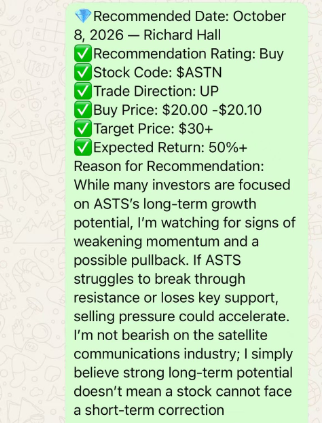
Let’s take a closer look at $ASTN , which I shared on October 8. 📊
💎 Reference entry price: $20.00–$20.10
🎯 Target price: $30+
📈 Expected gain: 50%+
My initial assessment was clear: I was monitoring its potential move toward $30 while keeping a close eye on momentum, resistance levels, and downside risk.
When a stock has strong growth potential, it’s easy to focus solely on the upside. But a compelling long-term outlook doesn’t guarantee a smooth ride for the stock price. Weakening momentum or a break below key support levels can quickly change the short-term trend.
I am not dismissing its potential as an investment opportunity. I remain focused on the signals conveyed by price movements and whether the initial investment thesis still holds.
A good trading plan involves more than just setting targets; it requires reassessing market conditions as they evolve and effectively managing risk throughout the process.
I will continue to monitor the future performance of $ASTN.
$TSLA — Buy the Pullback, Not the Hype. 📈
I’m watching Tesla for a potential dip-buying opportunity rather than chasing short-term momentum.
The key is confirmation: I want to see buyers step in, support hold, and price action stabilize before adding exposure.
With earnings coming on October 21, volatility could increase. A good entry matters just as much as the stock you choose.
Patience over FOMO. Risk management comes first.
Hot CPI, higher yields. Is the AI hardware trade losing momentum?
September CPI came in hotter than expected:
Headline CPI: 3.7% YoY vs. 3.6% expected
Core CPI: 2.6% YoY vs. 2.5% expected
Core CPI: +0.3% MoM vs. +0.2% expected
The immediate concern is not just inflation. It’s what higher Treasury yields could mean for expensive, capital-intensive AI stocks. Source: Reuters
Here’s what I’m watching:
AI hardware — $MU, $AAOI, $COHR, $SMCI
Don’t buy the first dip blindly. Watch whether selling pressure fades, key support holds, and yields stabilize. A sharp drop alone is not a buy signal.
AI infrastructure — $CRWV
CoreWeave is trading around the mid-$70s premarket. UBS has a $120 price target, but that is an analyst forecast—not a floor. The company’s growth opportunity comes with meaningful financing, profitability, and execution risks. I want to see price stabilization before treating this pullback as an entry. Analyst context
Software and platforms — $PANW, $SNOW, $MSFT, $META
These names may offer different exposure through recurring revenue or established cash flows, but software is not automatically a safe haven. Valuation and guidance still matter.
My plan: Reduce oversized positions if risk is too concentrated, keep cash available, and wait for confirmation rather than trying to call the exact bottom.
The key signals now: Treasury yields, price action after the open, and upcoming earnings guidance.
The goal isn’t to predict every move. It’s to manage risk well enough to take the next high-quality setup.
Three U.S. stocks on my radar today 👀
$FCEL — I’m watching for a potential entry below $14.50, with $13.50 as my risk-control level. No setup is worth forcing.
$AAOI — Selling pressure is building. A break below $93.50 could signal further downside, so I’m watching whether support holds or fails.
$HOOD — The consolidation may be nearing an end. A breakout with stronger volume would be the confirmation I want to see.
Given the current unfavorable market conditions, we can only engage in short-term trading to generate profits. Please manage your position sizes carefully. Will we continue today? Please contact me for more information.
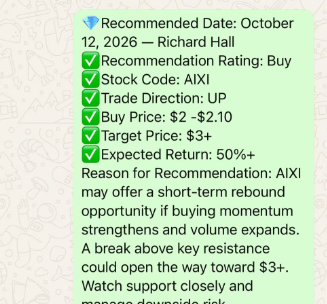
🎉 Congratulations to everyone who followed our $AIXI trading strategy!
💎 AIXI Trade Update
Yesterday, we shared an entry range of $2.00–$2.10. Today, AIXI surged to an intraday high of $3.99, representing a gain of over 89% from our entry range.
✅ Target exceeded
✅ Significant upside captured
✅ Time to consider taking profits and protecting gains
A great trade is about more than finding the right entry — it’s about managing risk and knowing when to secure profits.
One strategy completed. Stay disciplined, stay patient. More opportunities ahead. 👀
🎉 Congratulations to everyone who followed our $AIXI trading strategy!
💎 AIXI Trade Update
Yesterday, we shared an entry range of $2.00–$2.10. Today, AIXI surged to an intraday high of $3.99, representing a gain of over 89% from our entry range.
✅ Target exceeded
✅ Significant upside captured
✅ Time to consider taking profits and protecting gains
A great trade is about more than finding the right entry — it’s about managing risk and knowing when to secure profits.
One strategy completed. Stay disciplined, stay patient. More opportunities ahead. 👀
🔎 A new week. New trading opportunities.
After analyzing the market and evaluating potential trading opportunities, I’ll share a new trading strategy today.
I’ll focus on entry zones, key price levels, and risk management—not just upside potential.
If you’d like to participate or learn more, please contact me.
Stay disciplined. Wait for the right opportunity.
Two dip-buy setups I’m watching today: $MU and $TSLA.
$MU — $940 is my initial accumulation zone. I’d start with a small position and scale in gradually. The stock has faced renewed pressure from concerns over Chinese memory-chip competition, so I want to see selling pressure ease before adding aggressively.
$TSLA — $374 is my first dip-buy level. I’d start small and watch whether buyers defend the area. If support fails, I’ll wait for a better setup rather than average down blindly.
The key: A low open followed by a bounce and another selloff is not a confirmed reversal. Watch price action, volume, and support before committing more capital.
Patience first. Position size second.
Two semiconductor stocks. Two different setups. 👀
$INTC — No need to rush. I’m watching the area around $100 for a potential pullback entry. Any bounce could be temporary if selling pressure persists.
$MU — A relief rally toward $1,015–$1,030 is possible, but I’m not assuming it marks a trend reversal. If resistance holds, downside could resume.
My plan:
Let price come to the levels.
Watch volume and momentum for confirmation.
Define risk before entering.
A bounce is an opportunity to reassess — not proof the bottom is in.
Today, I’ll be sharing a new market analysis report covering key price levels, technical signals, and risk factors to watch.
In this volatile market environment, I remain focused on being well-prepared, strictly executing my trading strategy, and managing risk.
A new week brings new data. Let the market validate these trading opportunities.
If you’re interested in joining, please contact me as soon as possible.
🔎 A new week. New trading opportunities.
After analyzing the market and evaluating potential trading opportunities, I’ll share a new trading strategy today.
I’ll focus on entry zones, key price levels, and risk management—not just upside potential.
If you’d like to participate or learn more, please contact me.
Stay disciplined. Wait for the right opportunity.
$MU — I’m watching the $1,003 area for a potential entry.
Micron’s AI memory story remains compelling, but after a powerful rally, risk management matters.
Here’s my plan:
Entry zone: Around $1,003
Confirmation: Look for support to hold and buyers to step back in.
Risk control: If support fails, don’t force the trade.
The goal isn’t to catch every dip — it’s to find an entry where the risk/reward makes sense.
Patience first. Confirmation second.
$TSLA — Weak open. Rebound. Sharp selloff. Another rebound.
That’s a volatile tape, not a confirmed trend.
Here’s what I’m watching:
Support: Can buyers defend the intraday lows?
Resistance: Does the rebound break through overhead resistance, or get rejected again?
Volume: Are buyers gaining control, or are sellers still dominating each bounce?
My approach: don’t chase the first rebound. Wait for confirmation, define your risk, and let price action guide the next move.
In a choppy market, patience is a position.
@FabienVerlain Agreed — the $425K price point could be a meaningful competitive advantage if Proteus can deliver comparable performance. The key will be execution, adoption, and converting pre-orders into actual revenue. 2027 will be an important year to watch.
🎉 Congratulations to everyone who joined our $QSI trading strategy — we successfully reached our target!
💎 $QSI Trade Update
We shared our entry range of $1.30–$1.35 at the market open, and the trade has now delivered approximately 20% gains.
✅ Target reached
✅ Time to consider taking profits and securing gains
✅ This week’s trading strategies are officially complete
A good trade isn’t just about finding the right entry. It’s about knowing when to take profits and protect what you’ve earned.
Enjoy the weekend. Stay patient — I’ll be sharing another trading strategy next week. Stay tuned! 👀
A successful trade isn’t just about entering the market—it’s also about knowing when to take profits.
Congratulations to all traders who followed this week’s market trading strategy! We’ve achieved our weekly goal. ✅
Have a great weekend, everyone. Stay patient—I’ll share a new trading strategy next week. Stay tuned!
$INTC — Intel is worth watching; start looking for potential entry points.
As Intel’s transformation story moves from the promise phase to the execution phase, I’m beginning to monitor the company more closely.
Here are the key points:
18A process: Can Intel translate its manufacturing progress into a sustainable competitive advantage?
AI infrastructure: Synchronized growth in demand for CPUs and AI accelerators could create new opportunities for Intel.
Foundry Business: Key external clients and improving margins will lend greater credibility to the transformation.
Terafab: This opportunity warrants attention, but the scope of Intel’s actual role remains critical.
My Strategy: I’m focusing on potential entry points rather than chasing sharp price swings. I want to see the stock price stabilize, with strong buying volume, and confirmation that key support levels hold.
What is the biggest risk? Market expectations may be running ahead of actual execution. A convincing turnaround story still needs to deliver measurable, tangible results.
$INTC has been added to my watchlist. Future price movements should be supported by concrete evidence, not just headlines.
I’m bullish on $INTC — but not because I expect a quick bounce.
The real opportunity is in the turnaround.
Intel still has something the market can’t easily replace: massive manufacturing capacity, a U.S. semiconductor footprint, and the potential to become a serious foundry player.
The question is execution.
I’m watching three things closely:
Foundry progress and customer adoption
Manufacturing execution and cost discipline
Whether the investment cycle eventually translates into stronger margins and earnings
If Intel can execute, the market may eventually stop valuing it as a legacy semiconductor company and start pricing in the value of its manufacturing platform.
That transition won’t happen overnight.
But that’s exactly why I’m watching $INTC closely.
The next phase is about execution, not hype.
$TSLA — Short-term traders, don’t get greedy. Have a profit-taking plan.
When Tesla approaches an overhead moving average, I’m watching for resistance rather than assuming the rally will continue.
Here’s my short-term playbook:
Into resistance: Consider taking partial profits instead of waiting for the perfect top.
Watch the reaction: A clean break above the moving average could open the door to further upside.
Protect the trade: If momentum fades, don’t let a winning trade turn into a losing one.
The key is simple: trade the price action, not your emotions.
You don’t have to catch every dollar of a move to trade it well.
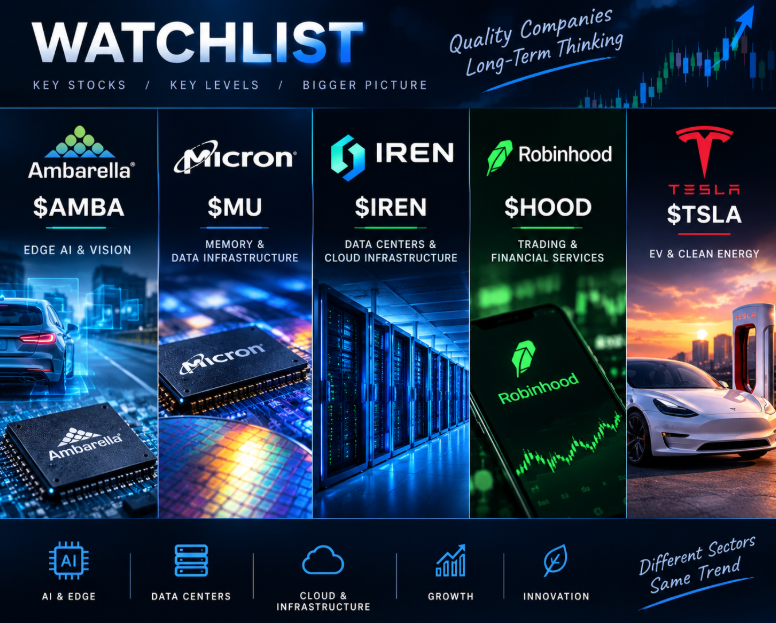
Here are a few stock prices I’m currently keeping a close eye on: $AMBA, $MU, $IREN, $HOOD, $TSLA
I don’t plan on chasing the rally. I’d rather wait for a specific price point where the risk-reward ratio is reasonable.
$AMBA — Around $63 is the entry range I’m considering. The edge AI theme remains worth watching, but I’d prefer to let price movements naturally create an entry opportunity rather than forcing an entry. Ambarella’s latest earnings report showed revenue growth and improved profitability, and management also raised its earnings guidance for the next quarter.
$MU — I’m monitoring the potential entry range around $900. Given that memory demand remains closely tied to the AI infrastructure cycle, a pullback in this stock could present an investment opportunity if the overall trend in the semiconductor industry remains positive.
$IREN — It’s gradually approaching my preferred entry zone. I still view the $38 level as a more important confirmation point, rather than chasing every bounce.
$HOOD — Still on my watchlist, continuing toward the $100 entry point. Given that the third-quarter earnings report is scheduled for October 27, the coming weeks could be crucial for market sentiment and position sizing.
$TSLA — The area around $375 yesterday was quite noteworthy. If you missed it, the $373 area remains a reasonable range for building positions in increments; rather than waiting for a perfect bottom, it’s better to gradually add to your position here.
The broader market is currently under pressure from rising oil prices and Treasury yields, so I’ll keep my position size in check and wait for prices to confirm key levels.
These are the price levels I’m monitoring—not set-in-stone predictions.
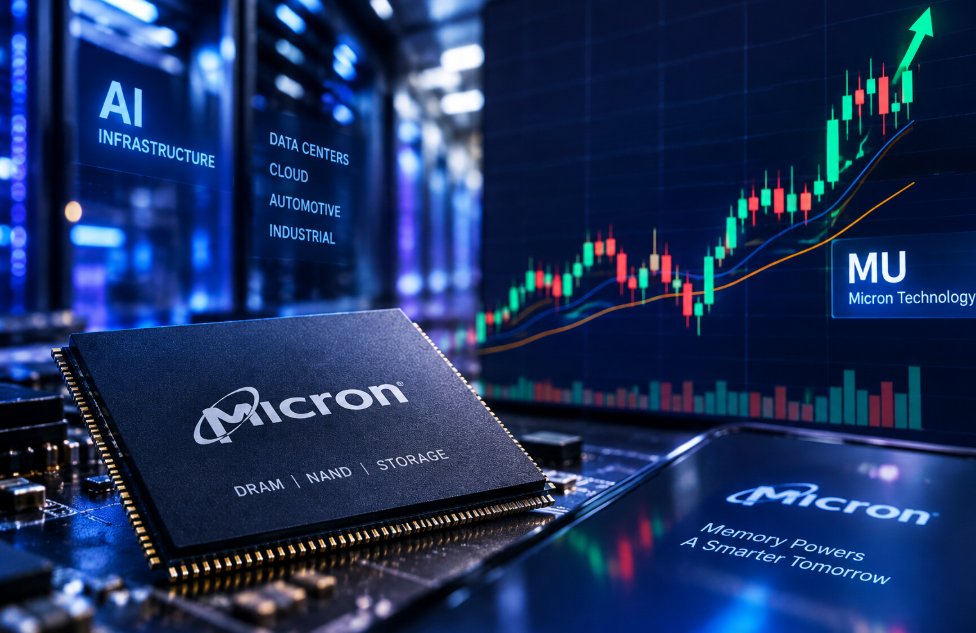
$MU — Looks familiar? This is exactly the setup I was talking about.
The market keeps focusing on the daily swings. I’m watching the bigger picture: AI is making high-performance memory a critical part of the infrastructure buildout, not just another chip-cycle story.
Micron’s own filings point to AI-driven demand outpacing the industry’s ability to expand supply. That’s the fundamental part of the thesis.
Here’s what matters from here:
→ Demand: Is AI and data-center memory demand holding up?
→ Supply: Does tight supply continue to support pricing?
→ Price action: Can $MU regain momentum and hold key levels after volatility?
My takeaway: the thesis matters more than any single green candle — but confirmation still matters.
The goal isn’t to predict every tick. It’s to recognize the setup before it becomes obvious.
Here are a few stock prices I’m currently keeping a close eye on: $AMBA, $MU, $IREN, $HOOD, $TSLA
I don’t plan on chasing the rally. I’d rather wait for a specific price point where the risk-reward ratio is reasonable.
$AMBA — Around $63 is the entry range I’m considering. The edge AI theme remains worth watching, but I’d prefer to let price movements naturally create an entry opportunity rather than forcing an entry. Ambarella’s latest earnings report showed revenue growth and improved profitability, and management also raised its earnings guidance for the next quarter.
$MU — I’m monitoring the potential entry range around $900. Given that memory demand remains closely tied to the AI infrastructure cycle, a pullback in this stock could present an investment opportunity if the overall trend in the semiconductor industry remains positive.
$IREN — It’s gradually approaching my preferred entry zone. I still view the $38 level as a more important confirmation point, rather than chasing every bounce.
$HOOD — Still on my watchlist, continuing toward the $100 entry point. Given that the third-quarter earnings report is scheduled for October 27, the coming weeks could be crucial for market sentiment and position sizing.
$TSLA — The area around $375 yesterday was quite noteworthy. If you missed it, the $373 area remains a reasonable range for building positions in increments; rather than waiting for a perfect bottom, it’s better to gradually add to your position here.
The broader market is currently under pressure from rising oil prices and Treasury yields, so I’ll keep my position size in check and wait for prices to confirm key levels.
These are the price levels I’m monitoring—not set-in-stone predictions.
Remember who was telling you to buy $TSLA on Wednesday and Thursday — even if it meant buying more — before the move higher?
The lesson isn’t to blindly follow a call. It’s to understand the setup before the crowd catches on.
When I evaluate a potential breakout, I watch three things:
Price action: Is the stock holding key support?
Risk/reward: Is there still room to the upside, or are you chasing?
Confirmation: Is momentum building, or is the move already exhausted?
The best opportunities often come when conviction is tested before the trend becomes obvious.
Here are a few stock prices I’m currently keeping a close eye on: $AMBA, $MU, $IREN, $HOOD, $TSLA
I don’t plan on chasing the rally. I’d rather wait for a specific price point where the risk-reward ratio is reasonable.
$AMBA — Around $63 is the entry range I’m considering. The edge AI theme remains worth watching, but I’d prefer to let price movements naturally create an entry opportunity rather than forcing an entry. Ambarella’s latest earnings report showed revenue growth and improved profitability, and management also raised its earnings guidance for the next quarter.
$MU — I’m monitoring the potential entry range around $900. Given that memory demand remains closely tied to the AI infrastructure cycle, a pullback in this stock could present an investment opportunity if the overall trend in the semiconductor industry remains positive.
$IREN — It’s gradually approaching my preferred entry zone. I still view the $38 level as a more important confirmation point, rather than chasing every bounce.
$HOOD — Still on my watchlist, continuing toward the $100 entry point. Given that the third-quarter earnings report is scheduled for October 27, the coming weeks could be crucial for market sentiment and position sizing.
$TSLA — The area around $375 yesterday was quite noteworthy. If you missed it, the $373 area remains a reasonable range for building positions in increments; rather than waiting for a perfect bottom, it’s better to gradually add to your position here.
The broader market is currently under pressure from rising oil prices and Treasury yields, so I’ll keep my position size in check and wait for prices to confirm key levels.
These are the price levels I’m monitoring—not set-in-stone predictions.