Really happy to receive the Plants Best PhD Thesis Award 2025! Thanks to @Plants_MDPI for the recognition. A big thank you to @RichardSmithLab and everyone who supported me along the way 🙏 Congratulations to the other winners!
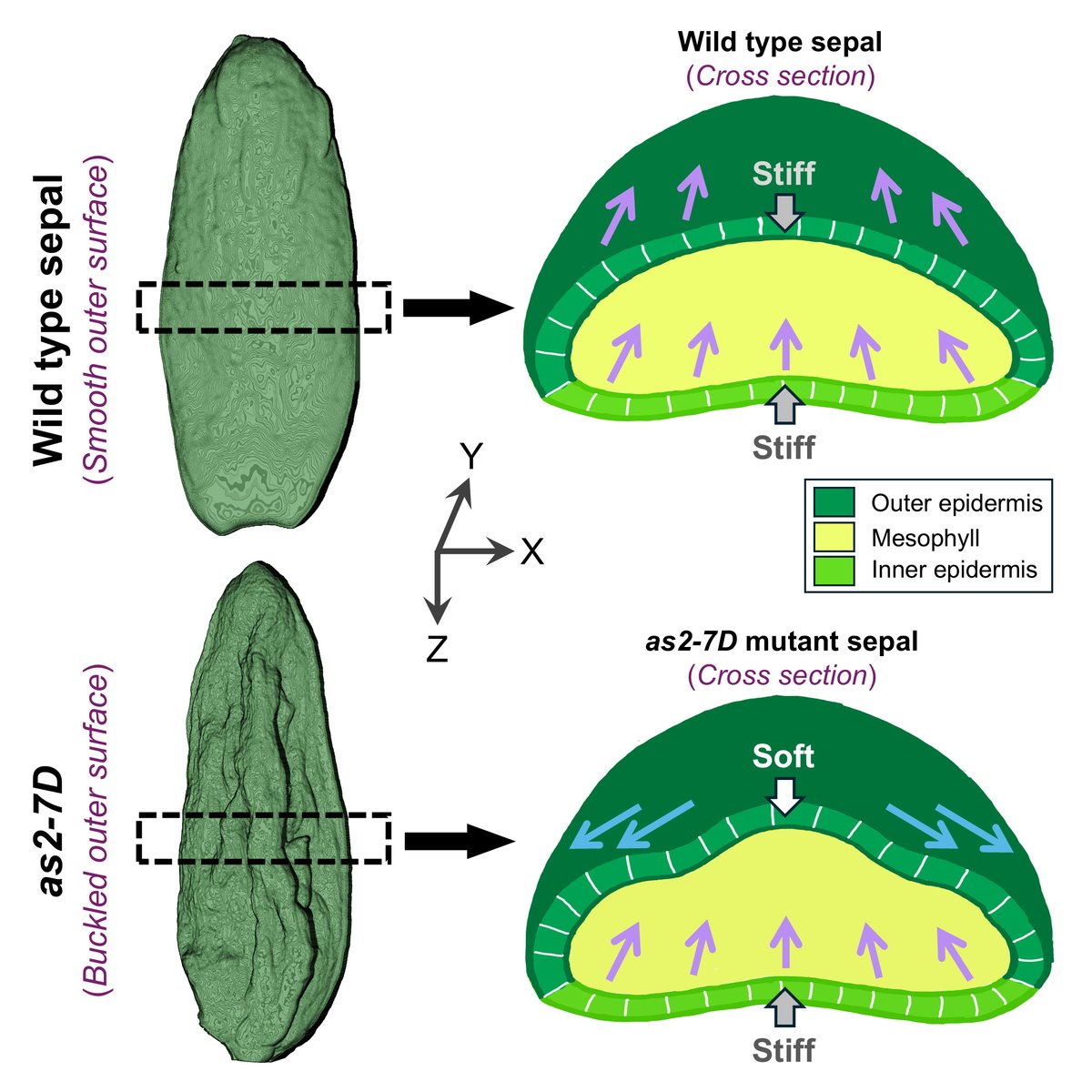
How do plant organs stay smooth—or become wrinkled? 🌱 Our paper in @CurrentBiology shows how coordinated growth direction and mechanical properties across cell layers determine whether Arabidopsis sepals remain smooth or buckle.
https://t.co/oD8DSnFZ3S
Check out our Insight on the beautiful work by Clark et al. 🌱
How can stochastic giant-cell fate lead to non-random epidermal patterns? Cell fate, endoreduplication, and growth all matter.
https://t.co/rE7VCLFWam
@RoederLab@PauFormosa@matmajda
Have you registered yet?
Don’t miss Introduction to 2D and 3D Segmentation with MorphoGraphX—the second workshop in the Plant Cell Atlas series!
Sign up now! https://t.co/bjiKPXs8dE
New group leader opportunity @JohnInnesCentre - We're looking for interests in (not limited to) growth and development, environmental/organismal interactions, physiology, signalling, cell biology, biochemical, and modelling approaches
https://t.co/VDiCGTpWwq
Don’t miss out! Last weeks left to register for the Plant Computational Biology Workshop 2025, sponsored by us here at @qpb_journal Deadline 31 July - https://t.co/q8EFFGsW06
#plantscience#modelling
Our new paper is out!
1/16
How does an organ rebuild its shape after injury? It's not just about making new cells, but aligning them in the right direction — like bricks shaping a structure.
https://t.co/oZ4zLCOVCm
The Camelot paper is now published. If you ever wanted to try biomechanics, Camelot is an inexpensive and easy way to get started.
@matmajda@N_Trozzi@RobertBellow
https://t.co/x3l0lllNS2