A look at #Bitcoin historical bottoming pattern using Fibonacci levels
2013 - 2017 - 2021 - Present
Fibonacci instant reversal zone has never failed to be the EXACT bottom.
Will this time be different?
$BTC has bottomed near 900 days in every cycle.
Day 775, this is what we learned:
Super cycle.❌
5-year cycle ❌
M2 Global Fractal ❌
Talking heads ❌
Business cycle ❌
Banana zone ❌
Saylor will never sell ❌
Jesse Olson Charts ✅
Buy The Right Dip 🤝
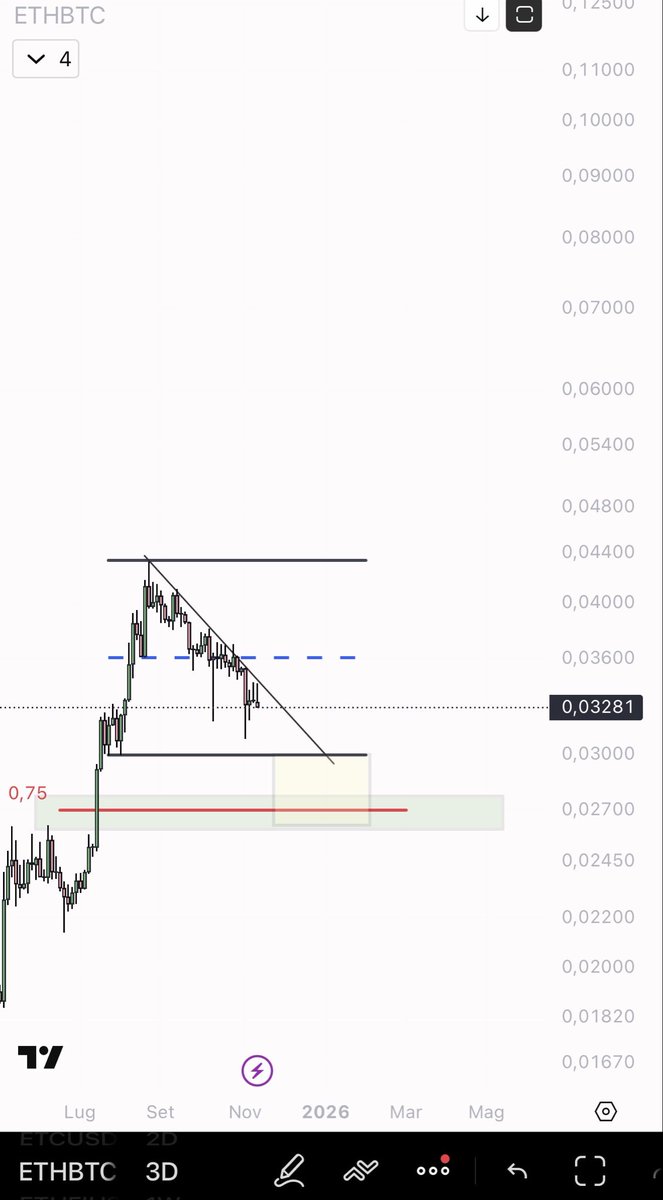
people get emotionally involved $ETH
nothing change
If I were to buy dip spots, I would do so on ETH and not on BTC.
Liquidity is needed, and it is right there at the bottom.
The market won't move until it collects what it needs: stops, panic sells, pending orders.
Until that area is touched or cleared, any movement above it will always be fragile, incomplete.
That's where the real structure starts, not where everyone hopes it will. First it takes what it needs, then it decides the direction.
I've sold 100% of my $BTC at $102k, after holding it for ~2 years
The question arises: What's next? I'm sure of 3 things:
1: Biggest altseason ever is close
2: Buyback $BTC only at $40k>
3: Bull cycle will end in Oct 2025
I spent ~20 hours researching all the data: Here is why I believe in this🧵👇
I started in crypto with $0.
Now, I'm sitting at $2.5 million.
Anyone can make it, all u need is knowledge. But many will charge you $1,000+ for paid groups and teach nothing.
Not me, I'll share all my secrets to make ur first million for FREE.
mega-thread 👇
Now is the most divided timeline I've ever seen
Bulls believe this is last dip before altszn
Bears think bull run is over
I spent 10+ hours analyzing all the data: here are all the possible scenarios and when market will turn around 🧵👇
Hans Teeuwen krijgt bezoek van 8 man (sterk) politie nadat hij een persiflage van Halalsema online had gezet waarbij een nep vuurwapen op zijn tafel was te zien verwijzend naar het verboden wapen bezit van de zoon van Halalsema die daar overigens nooit voor veroordeeld is...
TRANSCRIPTIE VAN HET INTERVIEW TUSSEN TUCKER CARLSON EN PRESIDENT PUTIN
TUCKER : Wat zou u de mensen die Amerika besturen vertellen?
PUTIN: Onze boodschap is dat Rusland niet jullie vijand is. Wij willen geen oorlog. Wij zijn klaar voor vrede. Jullie leiders zoeken conflicten. Dat is niet wat wij willen. Rusland staat voor zijn eigen volk. Wij willen niet wat niet van ons is.
TUCKER : Zou u Washington bezoeken?
PUTIN: Ja, natuurlijk. Ik ben al eerder in de Verenigde Staten geweest. Ik bezoek ze graag en heb elke president ontmoet behalve Joe Biden. Als ik zou worden uitgenodigd, zou ik gaan. Ja.
TUCKER: Wat is uw mening over president Biden?
PUTIN: We zijn ervan overtuigd dat hij het land niet leidt. Laten we zeggen dat we goede bronnen hebben die dat bevestigen, maar iedereen kan het zelf zien. De VS is nu een donkere periode ingegaan. Het heeft een onverantwoordelijk leiderschap.
TUCKER: Denkt u dat Joe Biden eerlijk gewonnen heeft?
PUTIN: Ik ga liever niet in op de binnenlandse Amerikaanse politiek, maar ik zal zeggen dat mijn ambassade aan uw zuidelijke grens beter werd geleid dan die verkiezing in 2020. (grinnikt)
TUCKER: Uit een peiling in Amerika blijkt dat u populairder bent dan Biden - enige reactie?
PUTIN: (lacht) Ik weet niet of dat serieus moet worden genomen, maar Russische idealen hebben steun. Wij geloven in traditionele waarden; het huwelijk is tussen een man en een vrouw: mannen zijn mannen en vrouwen zijn vrouwen.
TUCKER: Wie zou u graag als de volgende president van de Verenigde Staten zien?
PUTIN: Nogmaals, het is niet aan ons om dat te zeggen of ons daarmee te bemoeien. In tegenstelling tot oude beschuldigingen bemoeien wij ons niet met uw verkiezingen. Dat is ook niet nodig, want uiteindelijk zijn het toch dezelfde mensen die de lakens uitdelen.
TUCKER: Waarom bent u Oekraïne binnengevallen?
PUTIN: Zijn we binnengevallen of werden we binnengevallen? Kijk naar de geschiedenis. Kijk naar de mensen die daar wonen. Historisch gezien zijn wij die zijn binnengevallen en die nu gewoon terugvechten. Het land en de mensen zijn Russisch en wij zullen terugkrijgen wat altijd van ons is geweest.
TUCKER: Hoe zou u het vinden als Trump weer zou winnen?
PUTIN: We hadden goede betrekkingen toen meneer Trump president was. Er was geen oorlog. Onze betrekkingen waren op een hoogtepunt. Dat gezegd hebbende, niets is voorspelbaar of blijft hetzelfde. We zullen het moeten zien.
TUCKER: Wat vindt u van meneer Zelensky en wat zou uw boodschap aan hem zijn?
PUTIN: Ik herinner me dat ik om zijn grappen moest lachen toen hij een komiek was in Rusland. Laten we teruggaan naar het lachen.
TUCKER : Waarom ?
PUTIN: Er zijn sterke financiële entiteiten die er belang bij hebben om ons als tegenstanders te houden. Een van uw presidenten heeft daarvoor gewaarschuwd. Wij Russen hebben dat probleem niet.
TUCKER: Ziet u de Verenigde Staten als een vijand?
PUTIN: Nee. Absoluut niet. Wij waren bondgenoten in WO II. Russen hielpen met het vestigen van Alaska, Californië en we waren ook op Hawaï. Onze mensen zijn geen vijanden, maar die in DC zijn zeker niet onze vrienden.
TUCKER: Kunt u specifieker zijn en namen noemen?
PUTIN: Dat zou zinloos zijn. Het is niet aan ons om uw binnenlandse problemen op te lossen. Trouwens, ik weet zeker dat u de namen beter kent dan wij.
TUCKER: Dus u zegt dat uw tegenstander niet Joe Biden is, maar de mensen achter hem?
PUTIN: Precies. Joe Biden weet misschien niet eens wat er aan de hand is. Hij begrijpt misschien niet hoeveel sancties er tegen Rusland zijn ingesteld. Wie heeft die sancties in elkaar gezet? Dat zijn onze tegenstanders.
TUCKER: Is dat waarom u voorstander bent van de BRICS?
PUTIN: De BRICS zouden sowieso bestaan. Het is een natuurlijke reactie op het westerse handelsblok. Het is een tegenwicht. Wanneer de dollar als wapen tegen staten wordt gebruikt, zal er een natuurlijk alternatief voor zijn. Dat is wat wij willen.
TUCKER : Is dat de reden waarom u en Rusland het doelwit zijn?
PUTIN: Het is ingewikkelder dan dat, maar ik weet zeker dat het een groot deel van de reden is. Wanneer de dollar in gevaar komt, neemt de Verenigde Staten extreme maatregelen. Ze kunnen het zich niet veroorloven dat de dollar faalt.
TUCKER: Maar is Rusland economisch niet zwakker en kwetsbaarder dan de VS?
PUTIN: Als je naar de omvang van economieën kijkt, zijn wij klein. Maar weinig mensen houden rekening met onze enorme natuurlijke hulpbronnen. Rusland heeft meer dan 80 biljoen dollar in de grond. Geen enkel land komt ook maar bij ons in de buurt.
TUCKER: Wat is uw mening over president Biden?
PUTIN: Wij zijn ervan overtuigd dat hij het land niet leidt. Laten we zeggen dat we goede bronnen hebben die dat bevestigen, maar iedereen kan het zelf zien. De VS is nu een donkere periode ingegaan. Het heeft een onberekenbaar leiderschap.
TUCKER: OK. U heeft een goed punt, maar heeft u niet dezelfde problemen in Rusland?
PUTIN: Ja. Tot op zekere hoogte. Maar in Rusland zijn die belangen meer afgestemd op de denkwijze van de gemiddelde Russische man in de straat. In de Verenigde Staten is dat niet het geval. De elites hebben u in de steek gelaten.
TUCKER: Wie denkt u dan dat de VS bestuurt?
PUTIN: De krachten die het altijd hebben geleid. U kunt van president veranderen, maar u verandert niet degenen die de werkelijke macht hebben. Met hen hebben we te maken. Joe Biden is slechts een façade voor deze machtsstructuur.
TUCKER: Maar er zijn hardnekkige berichten dat u kanker hebt?
PUTIN: Ik verzeker u dat die geruchten niet waar zijn. als ik kanker had en het zou overwinnen, zou ik het goede nieuws en de genezing met de wereld delen.
TUCKER : Dank u dat u bij ons bent komen zitten. Hoe is het met uw gezondheid? Er zijn wat geruchten geweest...
PUTIN: Ik ben blij dat ik met u en via u met het Amerikaanse volk kan praten. Met mij gaat het goed. Ik voel me goed. Gezien mijn leeftijd ben ik in de beste gezondheid, maar vadertje tijd.
TUCKER: Wanneer u zegt dat sommigen bang voor hem zijn, zegt u dan dat Musk vijanden heeft?
PUTIN: Het is duidelijk te zien dat hij vijanden heeft in de Verenigde Staten - de manier waarop hem $50 miljard aan activa werd ontnomen - wij zouden dat een speciale behandeling noemen. Het is op het eerste gezicht oneerlijk.
TUCKER: Was u niet bang voor Musk toen hij begon met het leveren van Starlink uitrusting aan Oekraïne?
PUTIN: Als iemand serieus denkt dat een paar internetschotels de macht van Rusland kunnen verslaan - nou ja, wat kan ik zeggen. Maar nee, we waren niet bang voor meneer Musk en we hebben hem ook niets verweten. De regering gaf hem niet veel keus.
TUCKER : Er is veel veranderd in de wereld. Wat is uw mening over Elon Musk?
PUTIN: Wij zien meneer Musk als een zakenman - een zeer succesvolle. Hij heeft een groot fortuin opgebouwd en een enorme aanhang. Hij is een unieke denker met een sterke persoonlijkheid die niet gekocht kan worden. Sommigen zijn daar bang voor.
TUCKER : Heeft u enig advies voor Elon?
PUTIN: Ik zou zeggen: ga door. Laat u niet intimideren. Maar als het ooit te moeilijk wordt, dan is er nog Rusland. We openen graag onze deuren voor u. We hebben al eerder Amerikaanse zakenmensen verwelkomd en zouden iemand van het kaliber van meneer Musk waarderen.
TUCKER : Laten we het nu over Trump hebben. Vertelt u mij eerst hoe u denkt over de huidige situatie met de kans dat hij herkozen wordt?
PUTIN: Het zou een beetje vreemd en buiten de orde zijn, maar we zijn goed voorbereid. Hij heeft beloofd de gevechten in Oekraïne te beëindigen en wij steunen dat idee.
TUCKER: Hoe zou hij de oorlog zo snel kunnen beëindigen?
PUTIN: Ten eerste heeft hij ons nooit beledigd. Hij heeft veel respect voor Rusland. We zouden beginnen vanuit een positie van vriendschap en vertrouwen - dan zijn alle problemen oplosbaar. We zouden het voor elkaar kunnen krijgen. Vertrouw me.
TUCKER: Verwijst u naar het feit dat Biden u een moordenaar noemde?
PUTIN: We zijn de ontvangers geweest van talloze beledigingen en laster die teruggaan tot een paar generaties politici. Mr. Trump was daar een verfrissende onderbreking van. Hij is erg populair in Rusland. Misschien zal dat hem geen goed doen.
TUCKER: Bent u in gesprek met Trump?
PUTIN: Nee. Natuurlijk niet. Maar als hij opnieuw zou winnen, zouden onze communicatielijnen onmiddellijk opengaan, terwijl we op dit moment geen dialoog hebben met president Biden.
TUCKER: Dat is schokkend voor mij. Niemand van het Witte Huis heeft contact met u gehad?
PUTIN: Dat klopt. Niemand heeft gebeld sinds we meneer Biden hebben gefeliciteerd met zijn verkiezingsoverwinning. Het is voor ons een raadsel dat de communicatie nu kouder is dan tijdens de koude oorlog.
TUCKER: Hoe denkt u dat de verkiezingen in 2024 zullen verlopen?
PUTIN: We observeren gewoon. Het is onze verantwoordelijkheid om waakzaam te zijn omdat het de wereld zal beïnvloeden. We hopen dat de verkiezingen zo verlopen dat we de resultaten kunnen geloven. In Rusland hebben we geen stembiljetten per post.
TUCKER: Laten we over China hebben. Hoe is jullie relatie?
PUTIN: President Xi en ik zijn bijzonder close. Rusland en China onderhouden momenteel goede betrekkingen, wat voor ons een duidelijke troef is omdat zij een van onze grootste energiepartners zijn. We zullen vrienden blijven.
TUCKER: Er zijn beschuldigingen dat China u heeft geholpen in de oorlog in Oekraïne. Is dat waar?
PUTIN: Daar kan ik het niet over hebben. Laten we zeggen dat Rusland geen geïsoleerde macht is. De strategie is mislukt. We hebben nu meer bondgenoten en handelspartners dan voordat de oorlog begon.
TUCKER: Denkt u ooit aan een situatie waarin Rusland en China hun krachten zouden kunnen bundelen tegen de Verenigde Staten?
PUTIN: Bedoelt u economisch of militair? Ik zou zeggen dat we geen van beide willen. Het is niet in ons belang om met de VS te botsen omdat alle partijen in zo'n conflict zouden verliezen.
TUCKER: Over conflicten gesproken, wat is uw mening over de situatie in Gaza?
PUTIN: Het is echt jammer. De Palestijnen worden verwoest. Israël handelt op een onverantwoorde manier. Het laat de verschrikkelijke dubbele moraal in de wereld zien. Waar zijn de sancties tegen Israël?
TUCKER: Is Rusland op enige manier betrokken, vooral door uw alliantie met Iran?
PUTIN: Nee. Natuurlijk niet. Wij zijn niet tegen het bestaan van Israël, maar tegelijkertijd steunen wij het recht van de Palestijnen op zelfbeschikking. We willen op gelijke voet staan.
TUCKER: Volgt u wat er aan de zuidgrens van de VS gebeurt?
PUTIN: Eigenlijk wel, ja. Het maakt deel uit van mijn dagelijkse briefing. Wij Russen vinden het ironisch genoeg grappig dat uw Congres miljarden uitgeeft om buitenlandse grenzen te beschermen, maar zijn eigen grenzen verwaarloost. Het is lachwekkend maar dodelijk.
TUCKER: Dodelijk? Hoe bedoelt u dat?
PUTIN : Dodelijk ernstig natuurlijk. Dagelijks sterven er mensen die ongecontroleerd uw grens oversteken. Het is een free-for-all. De wereld heeft zoiets in de moderne tijd nog nooit gezien - roekeloos voor een land om zichzelf zo wijd open te gooien.
TUCKER: Maakt Rusland op enigerlei wijze misbruik van de grenssituatie?
PUTIN: Nee. Waarom zouden we? We hoeven niets te doen. Amerika is zichzelf aan het vernietigen. En zoals Napoleon zei: sta niet in de weg dat je vijand zichzelf vernietigt.
TUCKER: Dus u ziet Amerika als een vijand?
PUTIN: Dat was maar een gezegde, maar de huidige regering is zeker geen vriend.
TUCKER: Kan dat veranderd worden?
PUTIN: Daarom zijn er verkiezingen.
TUCKER: Nogmaals bedankt dat u met mij in gesprek blijft over zoveel verschillende onderwerpen. Kunnen we bij wijze van spreken nog interessanter worden?
PUTIN: Zeker. Ik sta open voor de meeste onderwerpen.
TUCKER: Laten we het even over klimaatverandering hebben. Het wordt nog steeds gepusht in de Verenigde Staten en Europa. Wat is uw standpunt?
PUTIN: De mensheid is niet eens een Type 1 beschaving op de schaal van Kardashev. Als we het energiepotentieel van de planeet niet kunnen benutten, hoe kunnen we dan het klimaat beheersen?
TUCKER: Bent u op zijn minst bezorgd?
PUTIN: Ik maak me meer zorgen over echte problemen. Klimaatverandering hoort daar niet bij. De aarde reguleert zichzelf vrij goed. En als Siberië een beetje warmer wordt, des te beter. Meer landbouwgrond voor Rusland.
TUCKER: Maar wat zou u tegen de ware gelovigen zeggen die ervan overtuigd zijn dat we op een ramp afstevenen?
PUTIN: Ik zou hen zeggen dat zorgen maken over klimaatverandering hetzelfde is als klagen over het weer. Als het klimaat je niet bevalt, verhuis dan. Als je je zorgen maakt over het weer, pak dan een paraplu.
TUCKER: Wat vindt u van de transgender beweging?
PUTIN: Het is interessant voor mij dat alle dingen die vroeger een doelwit van chantage waren, nu eretekens zijn. In Rusland zijn er geen wetten, maar we dwingen onze kinderen er zeker niet toe.
TUCKER: Rusland is bekritiseerd vanwege zijn antihomowetten en omdat het onvriendelijk is voor LGBTQ+.
PUTIN: Wij hebben wetten die onze kinderen beschermen. En we hullen onze ambassades niet in regenboogvlaggen. Dat klopt. Verder bemoeien we ons niet met het privéleven van volwassen burgers.
TUCKER: Volgt u Amerikaanse sporten? We hebben binnenkort de Super Bowl.
PUTIN: Eigenlijk wel, ja. Rusland is een grote sportnatie. We hebben onlangs de Olympische Winterspelen en de Wereldbeker gehouden. We houden van alle sporten.
TUCKER: Wat vindt u van American football?
PUTIN: Het is een interessante sport. Maar waarom noemen jullie het football als de bal bijna altijd met de handen wordt gespeeld? Het lijkt soms ook onnodig gewelddadig.
TUCKER: Dat is waar. Gaat u kijken?
PUTIN: De wedstrijd wordt niet in Rusland uitgezonden.
TUCKER: Dus u krijgt Taylor Swift ook niet te zien?
PUTIN: Nee. We hebben uitstel van executie gekregen.(lacht)
TUCKER: President Poetin, bedankt voor uw tijd.
https://t.co/xp7IubZ1uy
In light of today’s news, I thought I would try to take a step back and provide perspective on what this is really all about.
I first became concerned about @Harvard when 34 Harvard student organizations, early on the morning of October 8th before Israel had taken any military actions in Gaza, came out publicly in support of Hamas, a globally recognized terrorist organization, holding Israel ‘solely responsible’ for Hamas’ barbaric and heinous acts.
How could this be? I wondered.
When I saw President Gay’s initial statement about the massacre, it provided more context (!) for the student groups’ statement of support for terrorism. The protests began as pro-Palestine and then became anti-Israel. Shortly, thereafter, antisemitism exploded on campus as protesters who violated Harvard’s own codes of conduct were emboldened by the lack of enforcement of Harvard’s rules, and kept testing the limits on how aggressive, intimidating, and disruptive they could be to Jewish and Israeli students, and the student body at large. Sadly, antisemitism remains a simmering source of hate even at our best universities among a subset of students.
A few weeks later, I went up to campus to see things with my own eyes, and listen and learn from students and faculty. I met with 15 or so members of the faculty and a few hundred students in small and large settings, and a clearer picture began to emerge.
I ultimately concluded that antisemitism was not the core of the problem, it was simply a troubling warning sign – it was the “canary in the coal mine” – despite how destructive it was in impacting student life and learning on campus.
I came to learn that the root cause of antisemitism at Harvard was an ideology that had been promulgated on campus, an oppressor/oppressed framework, that provided the intellectual bulwark behind the protests, helping to generate anti-Israel and anti-Jewish hate speech and harassment.
Then I did more research. The more I learned, the more concerned I became, and the more ignorant I realized I had been about DEI, a powerful movement that has not only pervaded Harvard, but the educational system at large. I came to understand that Diversity, Equity, and Inclusion was not what I had naively thought these words meant.
I have always believed that diversity is an important feature of a successful organization, but by diversity I mean diversity in its broadest form: diversity of viewpoints, politics, ethnicity, race, age, religion, experience, socioeconomic background, sexual identity, gender, one’s upbringing, and more.
What I learned, however, was that DEI was not about diversity in its purest form, but rather DEI was a political advocacy movement on behalf of certain groups that are deemed oppressed under DEI’s own methodology.
Under DEI, one’s degree of oppression is determined based upon where one resides on a so-called intersectional pyramid of oppression where whites, Jews, and Asians are deemed oppressors, and a subset of people of color, LGBTQ people, and/or women are deemed to be oppressed. Under this ideology which is the philosophical underpinning of DEI as advanced by Ibram X. Kendi and others, one is either an anti-racist or a racist. There is no such thing as being “not racist.”
Under DEI’s ideology, any policy, program, educational system, economic system, grading system, admission policy, (and even climate change due its disparate impact on geographies and the people that live there), etc. that leads to unequal outcomes among people of different skin colors is deemed racist.
As a result, according to DEI, capitalism is racist, Advanced Placement exams are racist, IQ tests are racist, corporations are racist, or in other words, any merit-based program, system, or organization which has or generates outcomes for different races that are at variance with the proportion these different races represent in the population at large is by definition racist under DEI’s ideology.
In order to be deemed anti-racist, one must personally take action to reverse any unequal outcomes in society. The DEI movement, which has permeated many universities, corporations, and state, local and federal governments, is designed to be the anti-racist engine to transform society from its currently structurally racist state to an anti-racist one.
After the death of George Floyd, the already burgeoning DEI movement took off without any real challenge to its problematic ideology. Why, you might ask, was there so little pushback? The answer is that anyone who dared to raise a question which challenged DEI was deemed a racist, a label which could severely impact one’s employment, social status, reputation and more. Being called a racist got people cancelled, so those concerned about DEI and its societal and legal implications had no choice but to keep quiet in this new climate of fear.
The techniques that DEI has used to squelch the opposition are found in the Red Scares and McCarthyism of decades past. If you challenge DEI, “justice” will be swift, and you may find yourself unemployed, shunned by colleagues, cancelled, and/or you will otherwise put your career and acceptance in society at risk.
The DEI movement has also taken control of speech. Certain speech is no longer permitted. So-called “microaggressions” are treated like hate speech. “Trigger warnings” are required to protect students. “Safe spaces” are necessary to protect students from the trauma inflicted by words that are challenging to the students’ newly-acquired world views. Campus speakers and faculty with unapproved views are shouted down, shunned, and cancelled.
These speech codes have led to self-censorship by students and faculty of views privately held, but no longer shared. There is no commitment to free expression at Harvard other than for DEI-approved views. This has led to the quashing of conservative and other viewpoints from the Harvard campus and faculty, and contributed to Harvard’s having the lowest free speech ranking of 248 universities assessed by the Foundation of Individual Rights and Expression.
When one examines DEI and its ideological heritage, it does not take long to understand that the movement is inherently inconsistent with basic American values. Our country since its founding has been about creating and building a democracy with equality of opportunity for all. Millions of people have left behind socialism and communism to come to America to start again, as they have seen the destruction leveled by an equality of outcome society.
The E for “equity” in DEI is about equality of outcome, not equality of opportunity.
DEI is racist because reverse racism is racism, even if it is against white people (and it is remarkable that I even need to point this out). Racism against white people has become considered acceptable by many not to be racism, or alternatively, it is deemed acceptable racism. While this is, of course, absurd, it has become the prevailing view in many universities around the country.
You can say things about white people today in universities, in business or otherwise, that if you switched the word ‘white’ to ‘black,’ the consequences to you would be costly and severe.
To state what should otherwise be self-evident, whether or not a statement is racist should not depend upon whether the target of the racism is a group who currently represents a majority or minority of the country or those who have a lighter or darker skin color. Racism against whites is as reprehensible as it is against groups with darker skin colors.
Martin Luther King’s most famous words are instructive:
“I have a dream that my four little children will one day live in a nation where they will not be judged by the color of their skin but by the content of their character.”
But here we are in 2024, being asked and in some cases required to use skin color to effect outcomes in admissions (recently deemed illegal by the Supreme Court), in business (likely illegal yet it happens nonetheless) and in government (also I believe in most cases to be illegal, except apparently in government contracting), rather than the content of one’s character. As such, a meritocracy is an anathema to the DEI movement. DEI is inherently a racist and illegal movement in its implementation even if it purports to work on behalf of the so-called oppressed.
And DEI’s definition of oppressed is fundamentally flawed.
I have always believed that the most fortunate should help the least fortunate, and that our system should be designed in such a way as to maximize the size of the overall pie so that it will enable us to provide an economic system which can offer quality of life, education, housing, and healthcare for all.
America is a rich country and we have made massive progress over the decades toward achieving this goal, but we obviously have much more work to do. Steps taken on the path to socialism – another word for an equality of outcome system – will reverse this progress and ultimately impoverish us all. We have seen this movie many times.
Having a darker skin color, a less common sexual identity, and/or being a woman doesn’t make one necessarily oppressed or even disadvantaged. While slavery remains a permanent stain on our country’s history – a fact which is used by DEI to label white people as oppressors – it doesn’t therefore hold that all white people generations after the abolishment of slavery should be held responsible for its evils. Similarly, the fact that Columbus discovered America doesn’t make all modern-day Italians colonialists.
An ideology that portrays a bicameral world of oppressors and the oppressed based principally on race or sexual identity is a fundamentally racist ideology that will likely lead to more racism rather than less. A system where one obtains advantages by virtue of one’s skin color is a racist system, and one that will generate resentment and anger among the un-advantaged who will direct their anger at the favored groups.
The country has seen burgeoning resentment and anger grow materially over the last few years, and the DEI movement is an important contributor to our growing divisiveness. Resentment is one of the most important drivers of racism. And it is the lack of equity, i.e, fairness, in how DEI operates, that contributes to this resentment.
I was accused of being a racist from the President of the NAACP among others when I posted on @X that I had learned that the Harvard President search process excluded candidates that did not meet the DEI criteria. I didn’t say that former President Gay was hired because she was a black woman. I simply said that I had heard that the search process by its design excluded a large percentage of potential candidates due to the DEI limitations. My statement was not a racist one. It was simply the empirical truth about the Harvard search process that led to Gay’s hiring.
When former President Gay was hired, I knew little about her, but I was instinctually happy for Harvard and the black community. Every minority community likes to see their representatives recognized in important leadership positions, and it is therefore an important moment for celebration. I too celebrated this achievement. I am inspired and moved by others’ success, and I thought of Gay’s hiring at the pinnacle leadership position at perhaps our most important and iconic university as an important and significant milestone for the black community.
I have spent the majority of my life advocating on behalf of and supporting members of disadvantaged communities including by investing several hundreds of millions of dollars of philanthropic assets to help communities in need with economic development, sensible criminal justice reform, poverty reduction, healthcare, education, workforce housing, charter schools, and more.
I have done the same at Pershing Square Capital Management when, for example, we completed one of the largest IPOs ever with the substantive assistance of a number of minority-owned, women-owned, and Veteran-owned investment banks. Prior to the Pershing Square Tontine, Ltd. IPO, it was standard practice for big corporations occasionally to name a few minority-owned banks in their equity and bond offerings, have these banks do no work and sell only a de minimis amount of stock or bonds, and allocate to them only 1% or less of the underwriting fees so that the issuers could virtue signal that they were helping minority communities.
In our IPO, we invited the smaller banks into the deal from the beginning of the process so they could add real value. As a result, the Tontine IPO was one of the largest and most successful IPOs in history with $12 billion of demand for a $4 billion deal by the second day of the IPO, when we closed the books. The small banks earned their 20% share of the fees for delivering real and substantive value and for selling their share of the stock.
Compare this approach to the traditional one where the small banks do effectively nothing to earn their fees – they aren’t given that opportunity – yet, they get a cut of the deal, albeit a tiny one. The traditional approach does not create value for anyone. It only creates resentment, and an uncomfortable feeling from the small banks who get a tiny piece of the deal in a particularly bad form of affirmative action.
While I don’t think our approach to working with the smaller banks has yet achieved the significant traction it deserves, it will hopefully happen eventually as the smaller banks build their competencies and continue to earn their fees, and other issuers see the merit of this approach. We are going to need assistance with a large IPO soon so we are looking forward to working with our favored smaller banks.
I have always believed in giving disadvantaged groups a helping hand. I signed the Giving Pledge for this reason. My life plan by the time I was 18 was to be successful and then return the favor to those less fortunate. This always seemed to the right thing to do, in particular, for someone as fortunate as I am.
All of the above said, it is one thing to give disadvantaged people the opportunities and resources so that they can help themselves. It is another to select a candidate for admission or for a leadership role when they are not qualified to serve in that role.
This appears to have been the case with former President Gay’s selection. She did not possess the leadership skills to serve as Harvard’s president, putting aside any questions about her academic credentials. This became apparent shortly after October 7th, but there were many signs before then when she was Dean of the faculty.
The result was a disaster for Harvard and for Claudine Gay.
The Harvard board should not have run a search process which had a predetermined objective of only hiring a DEI-approved candidate. In any case, there are many incredibly talented black men and women who could have been selected by Harvard to serve as its president so why did the Harvard Corporation board choose Gay?
One can only speculate without knowing all of the facts, but it appears Gay’s leadership in the creation of Harvard’s Office of Diversity, Equity, Inclusion and Belonging and the penetration of the DEI ideology into the Corporation board room perhaps made Gay the favored candidate. The search was also done at a time when many other top universities had similar DEI-favored candidate searches underway for their presidents, reducing the number of potential candidates available in light of the increased competition for talent.
Unrelated to the DEI issue, as a side note, I would suggest that universities should broaden their searches to include capable business people for the role of president, as a university president requires more business skills than can be gleaned from even the most successful academic career with its hundreds of peer reviewed papers and many books. Universities have a Dean of the Faculty and a bureaucracy to oversee the faculty and academic environment of the university. It therefore does not make sense that the university president has to come through the ranks of academia, with a skill set unprepared for university management.
The president’s job – managing thousands of employees, overseeing a $50 billion endowment, raising money, managing expenses, capital allocation, real estate acquisition, disposition, and construction, and reputation management – are responsibilities that few career academics are capable of executing. Broadening the recruitment of candidates to include top business executives would also create more opportunities for diverse talent for the office of the university president.
Furthermore, Harvard is a massive business that has been mismanaged for a long time. The cost structure of the University is out of control due in large part to the fact that the administration has grown without bounds. Revenues are below what they should be because the endowment has generated a 4.5% annualized return for the last decade in one of the greatest bull markets in history, and that low return is not due to the endowment taking lower risks as the substantial majority of its assets are invested in illiquid and other high-risk assets.
The price of the product, a Harvard education, has risen at a rate well in excess of inflation for decades, (I believe it has grown about 7-8% per annum) and it is now about $320,000 for four years of a liberal arts education at Harvard College. As a result, the only students who can now afford Harvard come from rich families and poor ones. The middle class can’t get enough financial aid other than by borrowing a lot of money, and it is hard to make the economics work in life after college when you graduate with large loan balances, particularly if you also attend graduate school.
The best companies in the world grow at high rates over many decades. Harvard has grown at a de minimis rate. Since I graduated 35 years ago, the number of students in the Harvard class has grown by less than 20%. What other successful business do you know that has grown the number of customers it serves by less than 20% in 35 years, and where nearly all revenue growth has come from raising prices?
In summary, there is a lot more work to be done to fix Harvard than just replacing its president. That said, the selection of Harvard’s next president is a critically important task, and the individuals principally responsible for that decision do not have a good track record for doing so based on their recent history, nor have they done a good job managing the other problems which I have identified above.
The Corporation board led by Penny Pritzker selected the wrong president and did inadequate due diligence about her academic record despite Gay being in leadership roles at the University since 2015 when she became dean of the Social Studies department.
The Board failed to create a discrimination-free environment on campus exposing the University to tremendous reputational damage, to large legal and financial liabilities, Congressional investigations and scrutiny, and to the potential loss of Federal funding, all while damaging the learning environment for all students.
And when concerns were raised about plagiarism in Gay’s research, the Board said these claims were “demonstrably false” and it threatened the NY Post with “immense” liability if it published a story raising these issues.
It was only after getting the story cancelled that the Board secretly launched a cursory, short-form investigation outside of the proper process for evaluating a member of the faculty’s potential plagiarism. When the Board finally publicly acknowledged some of Gay’s plagiarism, it characterized the plagiarism as “unintentional” and invented new euphemisms, i.e., “duplicative language” to describe plagiarism, a belittling of academic integrity that has caused grave damage to Harvard’s academic standards and credibility.
The Board’s three-person panel of “political scientist experts” that to this day remain unnamed who evaluated Gay’s work failed to identify many examples of her plagiarism, leading to even greater reputational damage to the University and its reputation for academic integrity as the whistleblower and the media continued to identify additional problems with Gay’s work in the days and weeks thereafter.
According to the NY Post, the Board also apparently sought to identify the whistleblower and seek retribution against him or her in contravention to the University’s whistleblower protection policies.
Despite all of the above, the Board “unanimously” gave its full support for Gay during this nearly four-month crisis, until eventually being forced to accept her resignation earlier today, a grave and continuing reputational disaster to Harvard and to the Board.
In a normal corporate context with the above set of facts, the full board would resign immediately to be replaced by a group nominated by shareholders. In the case of Harvard, however, the Board nominates itself and its new members. There is no shareholder vote mechanism to replace them.
So what should happen?
The Corporation Board should not remain in their seats protected by the unusual governance structure which enabled them to obtain their seats.
The Board Chair, Penny Pritzker, should resign along with the other members of the board who led the campaign to keep Claudine Gay, orchestrated the strategy to threaten the media, bypassed the process for evaluating plagiarism, and otherwise greatly contributed to the damage that has been done. Then new Corporation board members should be identified who bring true diversity, viewpoint and otherwise, to the board.
The Board should not be principally comprised of individuals who share the same politics and views about DEI. The new board members should be chosen in a transparent process with the assistance of the 30-person Board of Overseers. There is no reason the Harvard board of 12 independent trustees cannot be comprised of the most impressive, high integrity, intellectually and politically diverse members of our country and globe. We have plenty of remarkable people to choose from, and the job of being a director just got much more interesting and important. It is no longer, nor should it ever have been, an honorary and highly political sinecure.
The ODEIB should be shut down, and the staff should be terminated. The ODEIB has already taken down much of the ideology and strategies that were on its website when I and others raised concerns about how the office operates and who it does and does not represent. Taking down portions of the website does not address the fundamentally flawed and racist ideology of this office, and calls into further question the ODEIB’s legitimacy.
Why would the ODEIB take down portions of its website when an alum questioned its legitimacy unless the office was doing something fundamentally wrong or indefensible?
Harvard must once again become a meritocratic institution which does not discriminate for or against faculty or students based on their skin color, and where diversity is understood in its broadest form so that students can learn in an environment which welcomes diverse viewpoints from faculty and students from truly diverse backgrounds and experiences.
Harvard must create an academic environment with real academic freedom and free speech, where self-censoring, speech codes, and cancel culture are forever banished from campus.
Harvard should become an environment where all students of all persuasions feel comfortable expressing their views and being themselves. In the business world, we call this creating a great corporate culture, which begins with new leadership and the right tone at the top. It does not require the creation of a massive administrative bureaucracy.
These are the minimum changes necessary to begin to repair the damage that has been done.
A number of faculty at the University of Pennsylvania have proposed a new constitution which can be found at https://t.co/Vggm1eomnI, which has been signed by more than 1,200 faculty from Penn, Harvard, and other universities. Harvard would do well to adopt Penn’s proposed new constitution or a similar one before seeking to hire its next president.
A condition of employment of the new Harvard president should be the requirement that the new president agrees to strictly abide by the new constitution. He or she should take an oath to that effect.
Today was an important step forward for the University. It is time we restore Veritas to Harvard and again be an exemplar that graduates well-informed, highly-educated leaders of exemplary moral standing and good judgment who can help bring our country together, advance our democracy, and identify the important new discoveries that will help save us from ourselves.
We have a lot more work to do. Let’s get at it.
Nederland - Een feest der herkenning
Nederland is als kind met je schepnetje de sloot leegvissen, of kikkers vangen met je blote handen, soms tot aan je oksels in de prut. Vervolgens dagenlang stinken naar sloot, maar who cares, want daar hadden alleen anderen last van. Hutten bouwen deed je in de bosjes. Hout en andere bouwmaterialen werden verzameld tijdens grofvuil en vakkundig met roestige spijkers en stukken touw omgetoverd tot jouw militaire bunker in de jungle. Jij en je vrienden waren het A-team, the crack commando unit that was sent to prison by a military court for a crime they didn't commit.
Het nieuwe gereedschap wat je vader ieder jaar kreeg met Sinterklaas en kerst, had hier alles mee te maken, want er raakte nog weleens wat zoek. Crossen deed je op je BMX. Tot grote ergernis van de buren de hele middag stoepje op, stoepje af. Maar ook op de crossbaan, in de blubber als het geregend had, je ging dan soms keihard op je bek. De diepe littekens van de getande stalen pedalen zijn een blijvende herinnering, want bescherming daar deden we niet aan, dat was voor mietjes, just walk it off.
Nederland is om vier uur ‘s ochtends laveloos thuiskomen als tiener, je hele bed onder kotsen om dan door je moeder in de douche gezet te worden terwijl zij het beddengoed verschoont. De preek die volgde over verantwoordelijk drinkgedrag ging het ene oor in en het andere oor weer uit, want de volgende keer deed je het gewoon weer. De eerste keer op de Wallen met een stel vrienden, hilarisch, prachtige half-naakte dames achter glas. Iedereen kijkt zijn ogen uit en heeft de grootste praatjes. Maar als zo’n dame, gekleed in pikante lingerie, nog verder geaccentueerd door de blacklightverlichting, dan de deur opendeed waren we opeens allemaal weer die kleine jongetjes van acht.
Nederland is studeren op kamers, je eigen verantwoordelijkheden, jouw regels, maar stiekem wel de was bij je moeder langsbrengen om de week op een zondag. Maar ook nachtenlang doorhalen met Doom multiplayer op het netwerk van de universiteit, tot je er vierkante ogen van kreeg. Lange avonden discussiëren met andere studenten, debat over politiek, economie, wetenschap en techniek. Je lulde je soms vast, probeerde wanhopig alsnog je punt te maken, maar ging dan kansloos ten onder, begeleid door bulderend gelach. Proofing grounds, dat waren het, want bullshit en ongefundeerde argumenten daar kom je niet mee weg.
Nederland is als volwassen vent in je onderbroek even snel de kliko aan de straat zetten om half acht ‘s ochtends omdat je de vuilniswagen al hoort aankomen verderop in de straat, zero f*cks given. Een half uur in de rij staan bij de snackbar voor een portie friet met mayonaise en niet kunnen kiezen tussen een frikandel speciaal of een kaassoufflé, gewoon omdat je trek hebt in een lekkere vette bek. In je blote kont over het strand van Ameland rennen, achter je vrouw aan, om dan in een duinpannetje, in de hete zon, gepassioneerd de liefde te bedrijven, het schurende zand neem je voor lief want de herinnering is wat telt.
Nederland is op de fiets naar je werk gaan en bewonderende blikken van collega's oogsten ondanks je totaal verwaaide en natgeregende uiterlijk of het feit dat je een half uur te laat bent, want je hebt g*dverdomme wel die storm getrotseerd. Het uit eten gaan met een stel vrienden en dan met tranen in je ogen en onder luid gejuich het huwelijksaanzoek tussen je twee nichterige homovrienden aanschouwen, tot groot vermaak van de andere gasten in het restaurant. Het hele land doorreizen met het openbaar vervoer, wetende dat je op elk moment iemand kan aanschieten voor hulp, of aanwijzingen, want je wilt wel héél Nederland gezien hebben tenslotte.
Nederland is een vergadercultuur, waar je met collega's vaak urenlang kan discussiëren over hoe iets aangepakt moet worden en de uiteindelijk gekozen aanpak een compromis vormt, een goed werkend compromis, dat dan weer wel. Waar je je mening kunt uiten, tegen je vrienden, tegen je familie, heel stoer op het internet, maar ook op straat, met een zelf geknutseld bord of spandoek. Ook al staat die mening haaks op hetgeen algemeen wordt geaccepteerd, want dat is Nederland ten voeten uit. Waar je tolerant en begripvol bent naar andersdenkenden en rekening houdt met hun gevoelens, geloof en cultuur, soms op het extreme af, wanneer je jezelf totaal wegcijfert voor een ander.
Nederland is patat met appelmoes, een broodje haring, appeltaart en slagroom gebak, drop en chocolademelk, boerenkool met worst en spruitjes, maar ook rode kool, bietjes en witlof met ham en kaas. En bier, in een paar honderd verschillende varianten. Met het hele gezin een lang weekend naar Centerparcs, het prikkende chloor van het zwembad en de doorgelegen matras neem je voor lief. Of naar het strand, Scheveningen en Zandvoort, hutjemutje op je handdoekje, zonnebrand bij de hand. Het is haast verstikkend heet in de zon, maar de zee is heerlijk koel.
Maar bovenal is Nederland een land van vrijheid, waar je kunt zeggen en doen wat je wilt en mits je er moeite voor wilt doen, kunt worden wie je wilt zijn.
#nederland #netherlands #patat #kikker #bier #cultuur #geloof #tolerantie
"Ze zeiden dat ze zich verweesd voelden; we schrapten hun buslijnen. Ze zeiden dat ze ontworteld raakten; we flexibiliseerden hun banen. Ze mompelden dat ze vereenzaamden; we verhoogden hun parkeertarieven, verkochten hun huisarts aan de hoogste bieder en verpatsten halve woonblokken aan BlackRock.
Ze zeiden dat ze hielden van de driekleur, wij trokken een vies gezicht. Ze draaiden de vlag wanhopig ondersteboven, we keken nog viezer. Ze zeiden dat ze terug wilden naar de tijd toen je nog een huis kon betalen; we noemden hun verlangen ‘nostalgisch’.
Ze zeiden dat hun kinderen naar school moesten met lege trommels; we troostten ze met een regenboogvlag. Ze vroegen om isolatie van hun tochtige huurhuizen; we gaven onszelf een gratis zonnepaneel.
We verminkten hun landschap met windmolens, datacenters, distributiedozen. We dwongen boeren hun kuddes te vermenigvuldigen; toen hun megastallen eenmaal klaar waren zeiden we: haal ze maar weer neer.
We noemden ze klimaatontkenners, maar we bleven zelf gewoon vliegen."
Arjen van Veelen is on fire:
https://t.co/jIhVN0KxOo
BREAKING:
Jihadi militias have murdered more than 800 black Africans from the Massalit tribe in Darfur, Sudan over the past few days.
In this video, the Hamas-allied Jihadis film themselves capturing black Africans.
Any protest march planned in London?