Given how pissed the old-time gangster grandpa is, there’s no way he wouldn’t storm Nigeria with a truckload of arms and ammunition if the Nigerian government ever legalized firearms like he demands.
There was a time in Nigeria when the man carrying a sewing machine on his shoulder was called Obioma.
Because almost all the artisanal tailors were Easterners of Igbo descent.
After the Civil War, many Easterners emerged from one of the most devastating chapters in Nigerian history with almost nothing but skill, mobility, discipline, and a survival instinct.
Some carried sewing machines from street to street, patching clothes, repairing trousers, adjusting school uniforms, and moving from compound to compound looking for work.
That image became so common that the name stuck.
Obioma.
A man with a sewing machine on his shoulder, moving under the sun and doing work many people looked down on.
But the same people who were once reduced in the public imagination to street tailoring slowly began to move.
From roadside tailoring to shops.
From shops to markets.
From markets to importation.
From importation to manufacturing.
From apprenticeship to industrial clusters.
From survival to ownership.
Go to Nnewi.
Go to Aba.
Go to Onitsha.
Go to Alaba.
Go to Ladipo.
Go to Ariaria.
You will still see poverty, struggle, disorder, bad roads, poor power supply, and all the normal Nigerian problems. Nobody is pretending the Southeast has become Singapore.
But you will also see something powerful.
You will see a people who took humiliation, displacement, and economic ruin and built a survival machine around trade, apprenticeship, mobility, and family capital.
And this is what makes my heart sink as a Northerner.
Today, the mai guard, mai ruwa, mai shayi, mai kaya, shoe repairer, the man pushing a wheelbarrow, carrying loads, shining shoes, patching clothes, riding okada, clearing construction sites, packing refuse, digging soakaway pits, hawking small goods, or sleeping beside a kiosk in Lagos, Abuja, Port Harcourt, Ibadan, Onitsha, and other cities is often called "Aboki."
That is the story we don't want to face.
One people moved from grass to grace.
Another moved from grace to grass.
This is not to take anything away from the Igbo people. I have nothing but admiration for them.
And it is not an insult to the Hausa people or to menial jobs. I am a proud son of Arewa, and in Arewa we do not look down on any vocation earned through halal means.
This is a history lesson.
Now look at us in the North.
We did not begin from the bottom.
Long before colonial Nigeria existed, Kano was already one of the great commercial cities of West Africa. Merchants from Tripoli, Fez, Agadez, Timbuktu, and Bornu passed through its markets. Caravans crossed the Sahara carrying leather goods, textiles, kola nuts, salt, and livestock. The city walls of Kano were not built around a village. They were built around a thriving urban economy that connected West Africa to North Africa.
We had cities that were centres of commerce when many parts of modern Nigeria were still organized around smaller local economies.
We had emirates that provided administration, taxation, courts, and political order across vast territories.
We had centres of Islamic scholarship that attracted students from across the region. In places like Kano, Katsina, Sokoto, and Borno, generations of scholars produced manuscripts and taught jurisprudence, theology, grammar, astronomy, and history. The reputation of northern scholarship travelled far beyond Nigeria's borders.
We had trade routes that linked us to the wider world. For centuries, merchants moved goods across the Sahara and across the savannah belt. Northern markets were not isolated local markets. They were part of international commercial networks.
We had cattle wealth on a scale few regions could match. Fulani pastoralists moved millions of cattle across grazing routes stretching from Senegal to Cameroon. Livestock was not merely food. It was wealth, trade, transport, status, and economic security.
We had one of the most respected leather industries in Africa. Kano leather was famous across the continent. Tanned hides from northern Nigeria found their way into trans-Saharan commerce and international markets. The famous red goatskin known as Morocco leather often originated from skins processed through West African leather networks in which Kano played a major role.
We had textile industries that employed thousands long before modern factories arrived. Hand-spun cotton was woven into cloth across northern towns. Entire communities depended on spinning, weaving, dyeing, trading, and transporting textiles.
We had the famous dye pits of Kano.
Not one or two pits.
Dozens of them.
For centuries, the Kofar Mata dye pits transformed locally woven cloth into richly coloured fabrics using indigo. Traders came from different parts of West Africa to buy these textiles. The dye pits became one of the oldest continuously operating industrial sites on the continent. They supported craftsmen, traders, transporters, farmers growing indigo, and entire commercial networks built around textile production.
We had the groundnut economy.
There was a time when the groundnut pyramids of Kano were not merely tourist attractions on postcards.
They were symbols of enormous agricultural wealth.
Thousands of farmers cultivated groundnuts across the North. Rail lines carried produce southward for export. Groundnut exports generated foreign exchange, supported industries, created jobs, and helped finance government revenues. The pyramids themselves represented mountains of produce waiting to enter global markets.
And if we move into the colonial and post-colonial era, the advantages become even harder to ignore.
We had numbers.
The North occupies roughly three-quarters of Nigeria's landmass. Depending on how one defines the region, the nineteen northern states account for well over half of Nigeria's population. Kano State alone has a population larger than many African countries.
We had manpower.
For decades, millions of young people entered the labour force every year. We were not a small minority struggling to find relevance. We were one of the largest demographic blocs in Africa.
We had land.
Hundreds of thousands of square kilometres of territory stretching across the Sudan and Sahel savannahs.
Land suitable for millet, sorghum, maize, rice, cotton, groundnuts, and livestock.
Land crossed by major river systems such as the Niger and Benue, and supported by irrigation projects in several states.
We had agricultural potential that many countries would envy.
We had political influence.
From independence onward, northern politicians, military officers, civil servants, traditional rulers, and power brokers occupied some of the most influential positions in the Nigerian state for long periods.
Prime ministers.
Heads of state.
Presidents.
Military rulers.
Senior ministers.
Powerful bureaucrats.
Influential legislators.
Whether one likes that fact or not, the North was never politically invisible.
We had religious authority.
The Sultanate of Sokoto remains one of the most influential Islamic institutions in Africa.
The emirates commanded legitimacy that extended beyond politics.
Mosques, Islamic schools, scholars, judges, and religious networks shaped social life across millions of households.
We had institutions.
Not perfect institutions.
But institutions nonetheless.
Emirate councils.
Traditional courts.
Islamic learning centres.
Agricultural boards.
Marketing boards.
Regional administrations.
Cooperative systems.
Educational establishments.
Commercial associations.
Structures that survived for generations.
We had a head start.
That is what makes the present situation so painful.
Because today, when millions of young Hausa and northern boys enter any big city, what work are many of them known for?
These boys are not lazy.
A lazy man does not leave Kano, Katsina, Zamfara, Sokoto, Jigawa, Bauchi, Kebbi, or Borno and sleep under a bridge in Lagos just to survive.
A lazy man does not push water from street to street.
A lazy man does not carry cement until his back bends.
A lazy man does not guard another man's house all night and still open a kiosk by morning.
The problem is not laziness.
The problem is that too many of our people enter the modern economy from the lowest possible point.
No certificate.
No skill that scales.
No capital.
No protection.
No formal training.
No strong educational foundation.
No industrial ladder waiting for them.
So they sell their bodies first.
Their backs.
Their hands.
Their legs.
Their sleep.
Their youth.
That is the real tragedy.
The Igbo Obioma story became a ladder because it was connected to apprenticeship, trade discipline, family networks, and commercial ambition.
The Hausa Aboki story too often becomes a trap because it is connected to poverty, broken schooling, rural collapse, insecurity, and survival migration.
One system turns a boy into a trader.
The other turns a boy into cheap labour or, worse, a recruitment ground for terrorism.
This is the painful contrast.
The Southeast came out of war and produced commercial networks.
The North came out of power and produced surplus labour.
That sentence is harsh, but look around before you reject it.
Who is carrying the load?
Who is guarding the gate?
Who is pushing the cart?
Who is fetching the water?
Who is sleeping in the market?
Who is leaving the village because bandits have made farming impossible?
Who is entering the city with nothing but strength?
If the answer to all the questions above is Arewa youth, then you must not be offended by the diagnosis. Instead, start asking your leaders the harder questions.
Because what is happening to Arewa is a failure of social organization. We shield our leaders too much and outsource criticism of them.
Our fathers inherited a civilization.
Too many of our boys inherited migration.
Our fathers inherited functioning economic systems.
Too many of our boys inherited survival.
Our fathers participated in trade networks stretching across continents.
Too many of our boys participate only in daily labour markets.
Our fathers built industries around leather, textiles, livestock, agriculture, and commerce.
Too many of our boys now rent out their muscles by the day.
And the painful thing is that the word Aboki, which originally means "friend," now, in the mouth of the Nigerian city, often becomes a class marker.
It becomes a way of saying: the northern poor man who does the work nobody respects but everybody needs.
That should break our hearts.
Not because the work is shameful.
No honest work is shameful.
What is shameful is that a whole region with history, population, religious authority, political influence, institutions, agricultural potential, and vast territory keeps producing young people whose first contact with the economy is desperation.
This is why history matters.
The question is not whether the Igbo are better than the Hausa.
That is a childish argument.
The real question is: what system turns hardship into enterprise, and what system turns heritage into dependency?
Because poverty alone does not explain everything.
War did not stop the Igbo from building trade networks.
Lack of oil did not stop Nnewi from producing industrialists.
Bad Nigerian roads did not stop Aba from becoming a manufacturing symbol.
Weak government did not stop apprenticeship from creating business owners.
So what stopped us?
What happened to the North that inherited thriving cities, trans-Saharan commerce, respected scholarship, textile industries, leather industries, livestock wealth, agricultural exports, demographic strength, political influence, and enormous land resources?
How did a people with so much historical structure produce so many young men with so little modern preparation?
That is the conversation we need.
Not insults.
Not denial.
Not ethnic pride.
Not hiding behind "our culture."
Not pretending every criticism is hatred.
The Obioma story should humble us.
Because it shows that a people can begin with a sewing machine on the shoulder and still build a commercial ladder.
The Aboki story should disturb us.
Because it shows that a people can begin with history on their side and still end up supplying cheap labour to other people's cities.
That is the mirror.
Igbo moved from Obioma to enterprise.
Hausa must not remain trapped inside Aboki survival.
The North needs a ladder.
Let me say something that I have observed over the years.
Peter Obi is the only prominent politician (I am aware of), that has never been arrested & prosecuted for any fraudulent or corruption charges.
Going by what we have seen many politicians do in recent times, should Peter Obi not have done same if he was guilty?
No matter how wealthy you are as a politician, you would not want to go to prison or be charged with false claims.
It's clear that Peter Obi is miles ahead when it comes to integrity and accountability.
I cannot say same for others.
Peter Obi is not a saint (you may say), but we have seen other "lesser devils" being made to bow and cross carpet to avoid prosecution.
Peter has remained untouchable.
If you have a good conscience, you'd know that Peter Obi is truly different.
End.
🔐 Update on the Upcoming Verification Process
We know many of you are looking forward to verification - and we’re stepping closer to that moment.
This process is designed to be structured, transparent, and fair, ensuring every qualified Human Node moves forward with clarity. Here’s how the flow will work:
Phase 1: Matching
You begin by tapping “Match Curator.”
An anonymous list will appear, and you can choose a curator to match with.
After selecting, you enter the matching state and wait to be successfully picked. Once picked, your application advances to the submission stage.
Phase 2: Submission
When it’s your turn, a strict 24-hour countdown will start.
You must complete and submit your documents within this time. Missing the deadline may move you to a later pool, delaying your progress.
There are 3 submission levels. After completing all required steps, you press Submit, and your status changes to In Review.
Phase 3: Verification Process
This is the last stage - your application will be reviewed carefully.
This process is more than a technical update - it’s a defining milestone before full verification rollout.
Prepare early. Understand each phase.
Be ready when your turn comes!
#InterLink #ITLG #ITL
“In the Northern Nigeria if your neighbor 8 you, all they have to say is that you blasphemed their prophet. The story of Deborah went popular because the South made it popular but Northerners tried to suppress it. We the Non-Muslims can be un@liv3d simply for voicing discomfort. Because Muslims are fasting Non-Muslims can’t eat in public; you’ll be arrested by Hisbah police. They are terrorizing us. Some schools are even closed. Currently Northerners are busy flying Iranian flag and they were not arrested but when certain people raised the Russian flag they were arrested. We are very oppressed.”
— A non-Muslim Fulani woman cries out.
MAXIMUM VOLTAGE ACTIVIST ALERT!
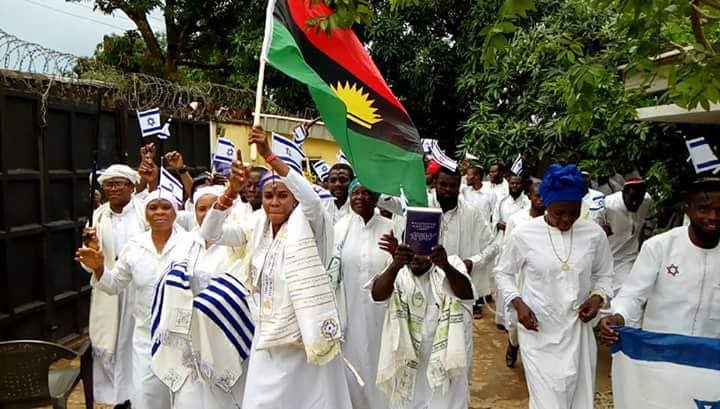
ALL JUDEO-CHRISTIANS & BIAFRANS IN THE U.S. — REPORT TO WASHINGTON, D.C.!
Issued by IPOB USA
Through Comrade Emma Powerful, Spokesperson for IPOB,
On behalf of our Supreme Leader, Mazi Nnamdi Kanu
A high-level Nigerian delegation is reportedly heading to the United States to polish Nigeria’s battered international image and deceive world leaders into believing that peace, justice, and religious freedom exist in that country. They want to cover the blood.
We say NO!
We will not allow the same government presiding over ethnic cleansing, forced displacement, church burnings, abductions, and mass burials of Indigenous Peoples to rewrite the narrative while the victims are still bleeding.
This is the hour to raise our voices with thunder, in the capital of the free world.
WE MUST SUPPORT PRESIDENT TRUMP TO END ETHNO-RELIGIOUS GENOCIDE IN NIGERIA!
For over a decade, Mazi Nnamdi Kanu sounded the alarm about the jihadist expansion, land-grabbing agenda, and systematic extermination targeting Judeo-Christian populations.
They abducted him, tortured him, and locked him away because he refused to be silent while his people were marked for extinction.
We will honor his sacrifice by taking the truth to Washington, D.C. — loudly.
WHY WE MUST MOBILIZE NOW — NOT TOMORROW
Because Indigenous nations across Nigeria are being overrun one after another:
• Hausa ancestral identity erased
• Nupe communities swallowed
• Middle Belt villages wiped out
• Christian lands in Southern Kaduna soaked in blood
• Yoruba communities in Kwara under siege
• Biafraland under constant military occupation
If we don’t rise, we will be the next headline, the next mass grave, the next “never again” story.
There is no neutral ground in the face of genocide.
Silence is surrender.
Inaction is consent.
OUR PROTEST WILL BE PEACEFUL — BUT UNMISTAKABLY POWERFUL
This is NOT a violent call.
This is NOT a call for confrontation.
This is a call for a mass, peaceful, unstoppable display of conscience.
Bring your voice.
Bring your flag.
Bring your faith.
Bring your courage.
Let the world see a sea of Biafran and Judeo-Christian solidarity in the heart of Washington.
THIS CALL IS FOR:
■ Every Biafran in the U.S. — your presence is your duty
■ Judeo-Christians — your faith demands you defend the persecuted
■Yoruba Nation, Middle Belt, Idoma, Tiv, Ijaw, Ibibio, and all Indigenous Peoples — stand with us
■Human rights defenders, civil liberty groups, and all people with a conscience — join this march for truth
No tribe stands alone anymore — unity is our shield.
OUR MESSAGE TO AMERICA & THE WORLD:
No diplomatic lies can cover mass graves.
No lobbying can erase the tears of widows and orphans.
No propaganda can bury the truth forever.
The world must hear the cry of the persecuted.
America must stand with the oppressed — not the oppressor.
DATE, TIME & LOCATION RELEASES NEXT — PREPARE TO MOVE!
Start mobilizing now:
Call your family, your congregation, your networks.
Book your transport.
Make your banners.
The streets of Washington must feel our footsteps.
Issued by:
Comrade Emma Powerful
Spokesperson for the Indigenous People of Biafra (IPOB)
On behalf of the Supreme Leader, Mazi Nnamdi Kanu
@StateDept@KnessetENG@NGRSenate@GuardianNigeria@SaharaReporters@channelstv@AIT_Online@ARISEtv
FULL VIDEO: Earlier today, my humble self, Omoyele Sowore, Barr Maxwell Opara & Barr Mandela plus Prince Emmanuel Kanu addressed a mammoth crowd in Kugbo, Abuja on the proposed mother of all protests to FREE Mazi Nnamdi Kanu set for Oct. 20 in Abuja.
The online phase of the #FreeNnamdiKanuNow movement has officially begun. From this moment until October 20, when citizens will march physically to the Aso Rock Villa in Abuja, supporters across the world are taking the protest to the digital space.
This is an open call to all online protesters, activists, citizens, and allies everywhere to turn every platform into a space for truth and resistance. On @X, @Facebook, @Instagram, @TikTok, and beyond, the message must be clear and relentless, #FreeNnamdiKanuNow!
The goal is simply to keep the demand for justice alive and visible every single day until the government ends the unjust and unlawful incarceration of Mazi Nnamdi Kanu. Everyone can play a part by posting, sharing, tweeting, and amplifying the message.
From today, the internet becomes our rally ground a united digital front for freedom and conscience.
We are online; we are everywhere, and we are unstoppable.
#FreeNnamdiKanuNow #MNKOct20
LIVE AT THE NATIONAL ASSEMBLY @nassnigeria
PUBLIC HEARING ON ELECTORAL REFORMS❗️
NIGERIANS THEY CAN ONLY RIG ELECTIONS IF WE PERMIT IT, WE MUST ACT TOGETHER, INSIST YOUR VOTE MUST COUNT❗️
#ElectoralReform#FixINEC#myvotemustcount