The drug that saved Emily Whitehead's life wasn't a cancer drug. A scientist knew about it only because his own daughter took it for arthritis.
Here's the story.
In 1955, Charlie Munger lost his 9-year-old son Teddy to leukemia. There was no cure. Doctors could only watch.
57 years later, 6-year-old Emily had the same kind of cancer.
Diagnosed at 5. Chemo. Relapse. More chemo. Relapse again. A bone marrow transplant fell through at the last minute. Her parents were running out of options.
So they said yes to something no child had ever tried: doctors at Penn and CHOP took her own immune cells, reprogrammed them with a disabled HIV virus to hunt cancer, and put them back in.
It almost killed her.
Her fever hit 105. Her lungs filled with fluid. She was put on a ventilator and into a coma. Her parents were told to prepare for the worst.
Then lead researcher Carl June noticed her blood tests showed one immune signal spiking out of control. He knew a drug that blocked exactly that signal, because his daughter took it for arthritis. It had never been used on a cancer patient.
They tried it anyway. Within hours, she started to recover. Emily woke up on her 7th birthday. Her cancer was gone.
That was 2012. She's still cancer-free, and now she's a student at Penn, the university whose lab saved her life.
Munger couldn't save Teddy. But he lived long enough to see doctors learn how to save kids like him. He said it gave him real joy.
You can cry all right. But you can't quit.
"You can cry all right, but you can't quit."
In his final interview, 99-year-old Charlie Munger spoke about losses that cannot be undone. His nine-year-old son, Teddy, had died of leukemia.
"I cried all the time when my first child died."
Munger said you cannot bring back the dead or fix every tragedy. If you have to walk through the streets crying for hours, you can keep going that way.
He called it "soldiering through." His words offer reassurance when you're struggling: crying doesn't mean you've given up.
Decades later, he described the pleasure it had given him to watch doctors learn to save children with leukemia. He couldn't bring Teddy back, but he could feel joy for families who now had a chance.
His words are in the two-minute clip below.
1. A viral article says you can run a Renaissance- style "AI hedge fund" for $300/mounth with GPT 6 Astra +Kimi K3.
2.2M views. 5.6. bookmarks.
I ran the numbers:
2. The pitch:
a. 300 AI agents watch stocks,crypto,Polimarket, options flow & insider filings 24/7.
b. A second model turns anomalies into strategies,codes, and backtests them
c. Winners ping your Telegram.
The idea is sound. The math isn't.
3. Cost.
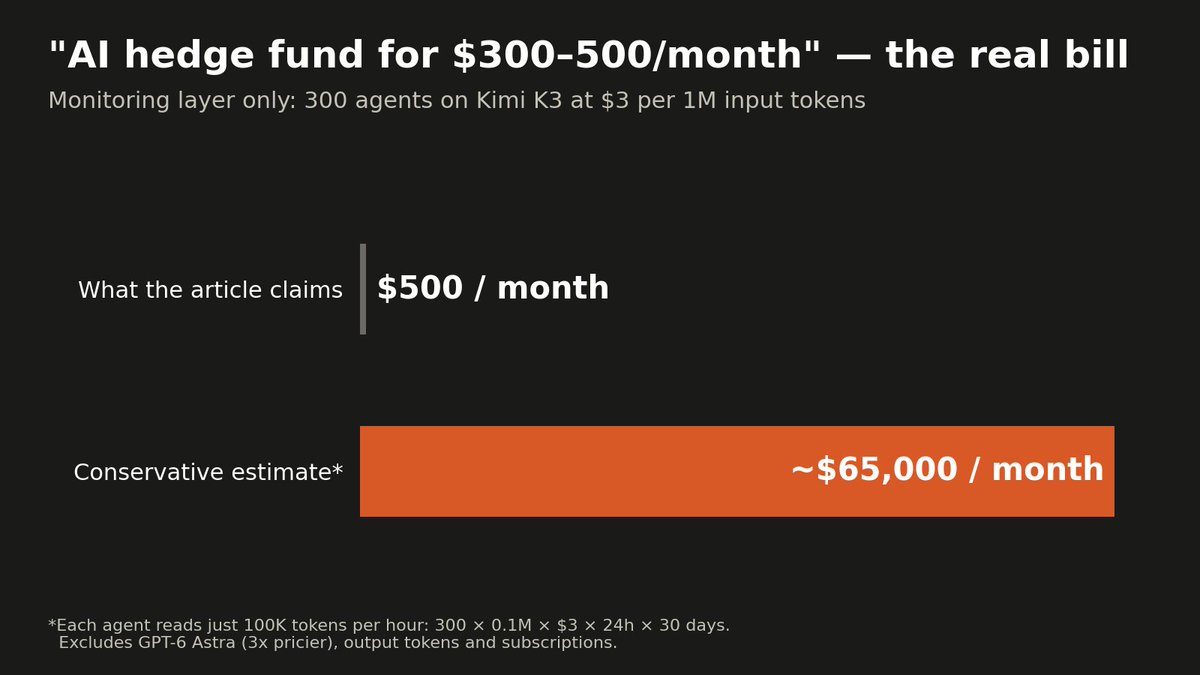
Each of the 300 agents holds 1M tokens of context at $3 per 1M.
One full read by every agent = $900.
Being generous, 100K tokens per agent per hour:
300 × 0.1M × $3 × 24h = $2,000+ per day.
Before the reasoning model (3x pricier) and subscriptions.
4. It's a false-positive factory.
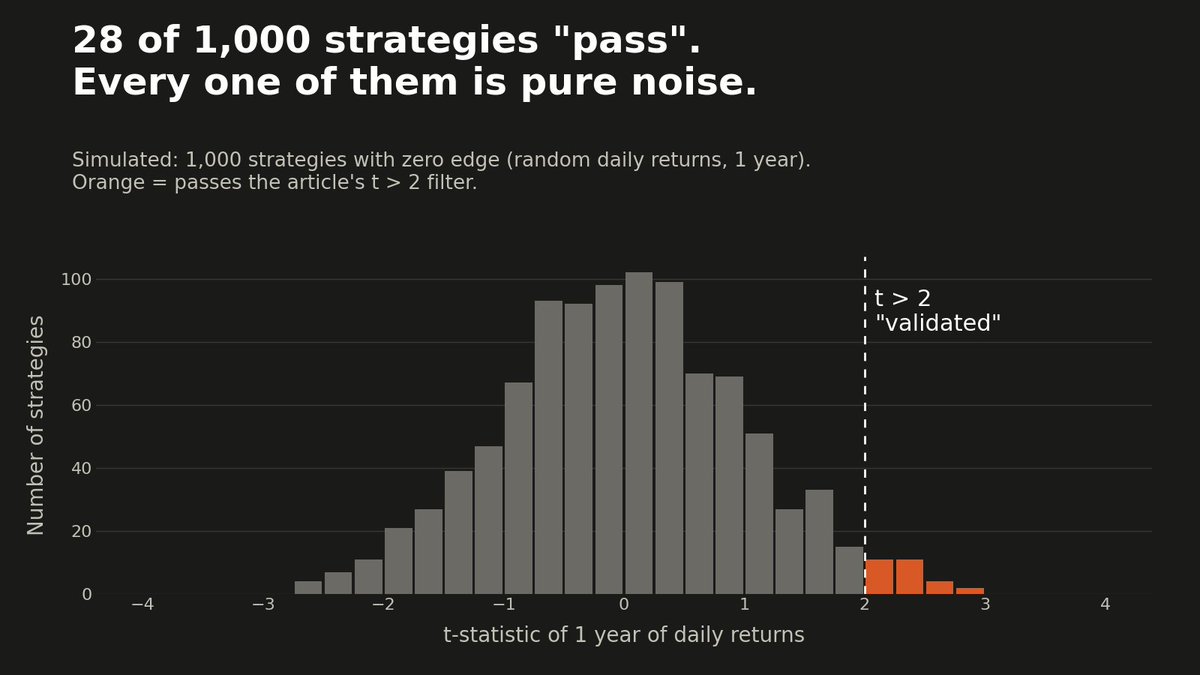
A strategy "passes" at t-stat > 2. At that bar, ~5% of purely random strategies pass by luck.
Thousands of hypotheses a day → dozens of fake "edges" a day.
No out-of-sample, no multiple-testing correction, no costs or slippage.
5. No results.
By the author's own words, the system has been running "for the past 3 days."
Zero live trades or backtests shown. People asked in the replies. No answer. One reply: Astra burned a week of usage in 4 hours with nothing to show.
6. Blow-up risk.
The setup auto-executes model-written Python from JSON files and gives bots live broker access.
One bad line of code and the account is gone.
7. What's worth keeping:
The "strategy factory" idea + a hard kill switch
The 4 edge types (stat arb, vol mispricing, factor residuals, insider buying) as a learning map
The real version: 1 strategy, backtest with costs + held-out data, months of paper trading
8. Bottom line: it's not a how-to, it's a funnel.
It ends with "DM me, first 10 only" + links to 3 paid subscriptions.
The most profitable strategy in the article is the $300/month.
Next: pairs trading, and why it's harder than the Coke/Pepsi example makes it look.
GPT-6 Astra is the most dangerous AI model right now.
It gives you AGI-adjacent reasoning.
That can discover new profitable trading strategies for you 24/7.
If you set it up correctly, you gain a personal hedge fund. https://t.co/Sam7AYOut3
This post calls it a breakthrough: a fast model decides which data deserves attention, and the expensive AI only looks at what survives.
Physicists have been doing this for over 15 years. It's how they found the particle that won a Nobel Prize.
Here's the story.
In 1964, a shy 35-year-old physicist in Edinburgh named Peter Higgs wrote a paper predicting an invisible particle that gives everything in the universe its mass.
The journal rejected it. Ironically, its editorial office was at CERN.
He rewrote it and got it published. Then he waited.
For 48 years.
To find his particle, humanity built the largest machine in history: a 27 km ring under the French-Swiss border. Inside it, protons smash into each other 40 million times per second.
That's about a billion collisions every second. Each one produces a cloud of data.
Storing all of it is physically impossible. No hard drive on Earth could keep up.
So physicists built a filter.
Level 1 is hardware. It gets a few millionths of a second per collision to decide: interesting or trash. It keeps about 100,000 per second.
Level 2 is a farm of thousands of computers. It looks more carefully and keeps only a few hundred.
Out of a billion collisions a second, less than one in a million survives. Everything else is gone forever. No backup. No second look.
And inside that tiny fraction, on July 4, 2012, they found it.
Peter Higgs, now 83, sat in the audience at CERN as the discovery was announced. He was seen wiping tears from his eyes.
His comment afterward: "It's very nice to be right sometimes."
A year later he won the Nobel Prize. He went out that day to avoid the press, and a former neighbor stopped him on the street to congratulate him. That's how he found out.
So yes, the architecture in this post is smart. Fast filter first, expensive thinking second.
But physicists will tell you the hardest part was never the filter.
It was deciding what to throw away, knowing you'd never get it back.
See you soon!
a Stanford professor used JEV to build a data science system that analyzes 40.000.000.000 data points every 15 min
his system can process massive datasets and automatically decide which results deserve deeper analysis.
the professor spent more than a year developing the system with his research team.
the first version relied heavily on LLMs to interpret every result.
it worked, but analyzing millions of records created unnecessary latency and huge inference costs.
then they redesigned the decision layer around Jev.
instead of generating explanations for every data point, Jev evaluates the results and decides what the system should investigate next.
I found a breakdown of the pipeline they used and the way Jev filters the data is surprisingly clever.
I’ll show you how it works next so stay tuned if you want to see what Jev Engineering looks like inside a real data science system.
would you let an AI decide which patterns in your data are worth investigating?
@limalemonnn No matter how much you prepare yourself tp accept the worst when someone you love is duing,until the moment it actually happens,everything before was just imagination you couldn't really understand 🚬
Hello Guys!!!
I already caved and paid for claude. $20
couldnt help it lol. it's basically my 2am brain now
everything else stays free for now:
capcut for video
canva for anything visual
no $97 courses no "ai toolkit bundle"
spent so far: premium + claude
earned so far: $0
if something actually makes money ill upgrade. not before
Ok guys, sleight of hand and no scam involved, eyes on the screen lolм
You've seen those fancy ai dashboard videos under every "i made $50k" post
here's mine. took 5 min
the secret? it's a web page. you ask ai to make it, open it in a browser, record your screen. that's it
no quant fund, no secret model, no $500k analyst
just css and good lighting lol
my real numbers btw: €8 x premium + $20 claude spent, $0 earned
@slash1sol "you are 34 seconds behind someone who is" is the most honest line about copy trading ive read. also the reason im still at $0 and not negative lol 😃
@0xLupenn The only real lesson here is the kelly part. and even then most pros bet half of it because full kelly drawdowns will wreck you mentally. im at $0 so my position size is perfect lol
@mikenevermiss Agree, but how do you prove it without a real business? so basically you do it as a paid service for a company first and then you'll see what came first, the chicken or the egg. what do you think?
Ok guys, starting from the Basics !!!
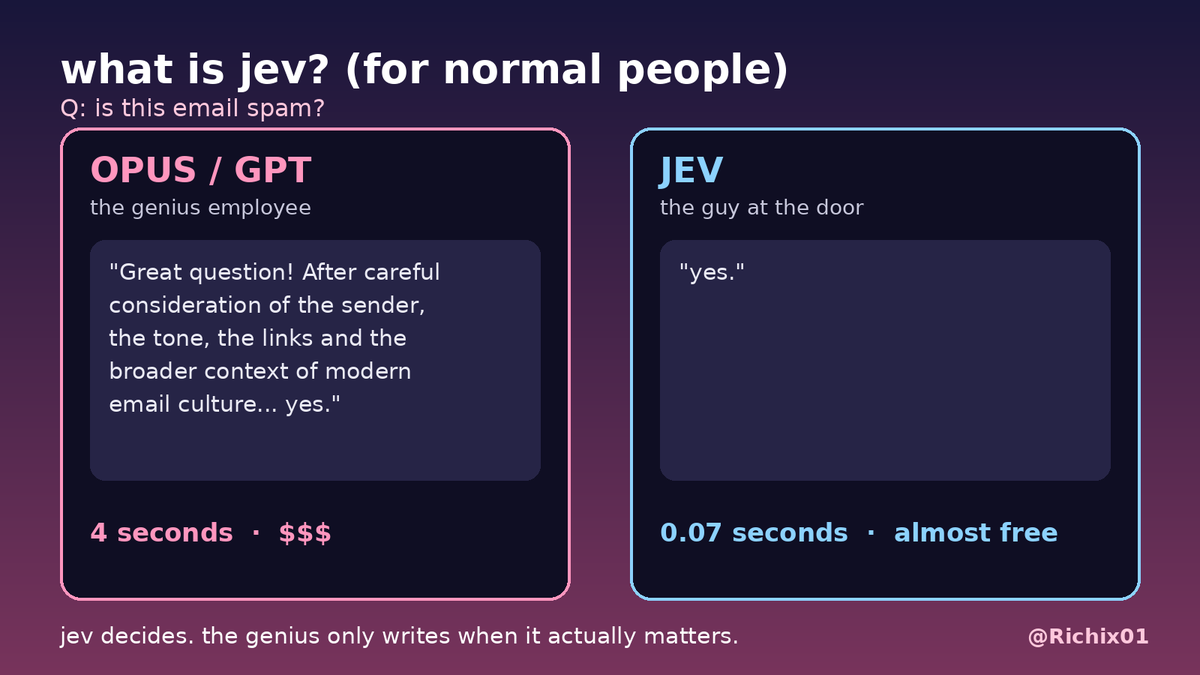
everyone's talking about JEV but what even is this thing and why does it matter? explained for dummies
opus / gpt = the genius employee. ask him "is this email spam?" and you get 3 paragraphs and a "great question!"
JEV = the guy at the door. he just says yes or no. fast and almost free
that's it. jev decides, the expensive model only writes when it actually matters
came out like 10 days ago and half of twitter already says it made them millions lol