@JamesJouissance@__Exhume__ But don’t take this as a “this means I shouldn’t explain the math at all” sort of sign. Hopefully it goes without saying that math context is far more difficult to grasp than philosophy context.
@drumm_colin@StreetliTweets It’s about the coherence of our analysis: our knowledge clearly isn’t just something thrown into an empty receptacle that is our mind. Like our limbs and organs, our mental activity has specific capacities, and are not (cannot be!) ONLY receptive.
@drumm_colin@StreetliTweets Which is to say, Kant/Piaget/Malabou are interested in the genesis of SPONTANEOUS mental activity as opposed to our mere tabula rasa constructions. As they should be, since it’s far more concrete to consider our animal abilities and not just the external forces that act on us.
@drumm_colin@StreetliTweets It’s not shocking to me that you can read enough of a text. But you’ve never publicly engaged with her (or Kant’s) position here. That’s why I was interested in the whole Piaget thing because that’s really what he is doing with “pure actions.”
@StreetliTweets@drumm_colin He overlooks the parts both in this book and in that essay you’re referencing where Malabou clearly defends Kant’s own view of the epigenetics of pure reason. I’d discuss this with him but he muted me years ago.
@die_rizzen I had some hope that the whole Piaget angle on the recent discussion would have him take this idea more seriously but he completely overlooks what Piaget means by the developmental “pure actions” of thought. I’m not sure O’Brien was direct enough in emphasizing that distinction.
@die_rizzen What’s bizarre about his reading is that he claims it’s supported by Malabou’s book and essay on Kant. He just disregards the several parts where she not only defends but textually supports the view that the categories for Kant are not mere static preconditions.
@drumm_colin@No5mallf3at There is a genetic process to the transcendental—it is proper to the transcendental as such because it involves “pure actions,” and not just receptivity taken on its own.
@noidedmoid And of course I wasn’t suggesting that my angle is truly contrary to yours. The variations only obtain their great effect through the otherwise repetitive but measured massive scale. But I’ll save the discussion proper for when I can get my writing out.
@noidedmoid One aspect of that for me is that we should also appreciate the moments in which REAL* variation in the drone works does seem to start coming to the fore. The I think third excerpt of 210: Like a Wall is quite special in this regard, providing epochal depths like nothing else.
@noidedmoid Yes. Very good. Coincidentally (or of course not) I have also started writing about them recently in my listening. While your perspective here so far is necessary and one which I’d very much like to read more of, my direction has been more pure phenomenological/ontological.
@embodyingWounds I’ve been meaning to get some good writing together to share sometime soon. As of now I’ve got nothing for you unfortunately, but I think I finally might have a substantive enough outline to be worth someone’s time. Hopefully soon.
Style is subordinate to truth because, unlike truth, style is not will. Style is itself the mediator of its subordination, prudence, but not reducibly for the will to the Idea which has the actuality of temporality and eternity on its side.
@embodyingWounds You’d probably like the heaps of (much better educated and more conceptually refined) writing I’ve done in the years since my quote of the above post.
Kant is not a skeptic. He is, of course, an empirical realist and transcendental idealist. Empirical "things themselves" are transcendentally coherent, whereas any ideal "things-in-themselves" simply have no cognitive power in their detachment from experience.
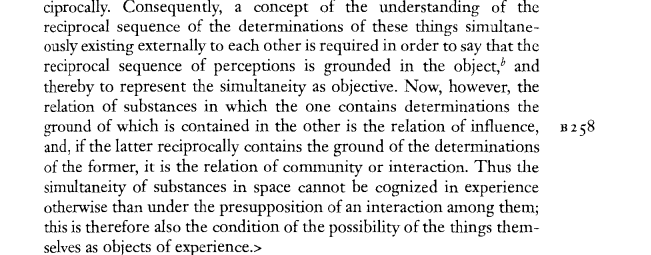
Although it's entirely possible that I am missing something here, I feel that this common reading of Kant has to reckon with the final sentence of this paragraph (a paragraph added to the third analogy of experience in the second edition).
@RltyGneMntl If by generous you mean read him as saying something he not only doesn’t say but says isn’t true then yes. He insists we have no acquaintance whatsoever with the thing in itself.