‼️ New preprint from the lab, led by co-first authors @rick_hanish and Jeffrey Zhou! @BCMNeurosurgery
120,000 patient-hours of intracranial recordings gave us a unique window into how human neural dynamics reorganize during successful DBS for OCD.
Thread below👇
New medRxiv preprint!
Chronic intracranial neural dynamics forecast treatment response and therapeutic engagement during deep brain stimulation for OCD.
Thanks to co-first author Jeffrey Zhou, my advisor @NicoleProvenza, and our collaborators.
https://t.co/Ik4Gbq7IV6 (1/11)
@NicoleProvenza We are deeply grateful to our patients, their families, our collaborators, and our funders.
Full preprint: https://t.co/Ik4Gbq7IV6 (11/11)
@NicoleProvenza Changes relative to each patient’s pre-DBS baseline were especially informative.
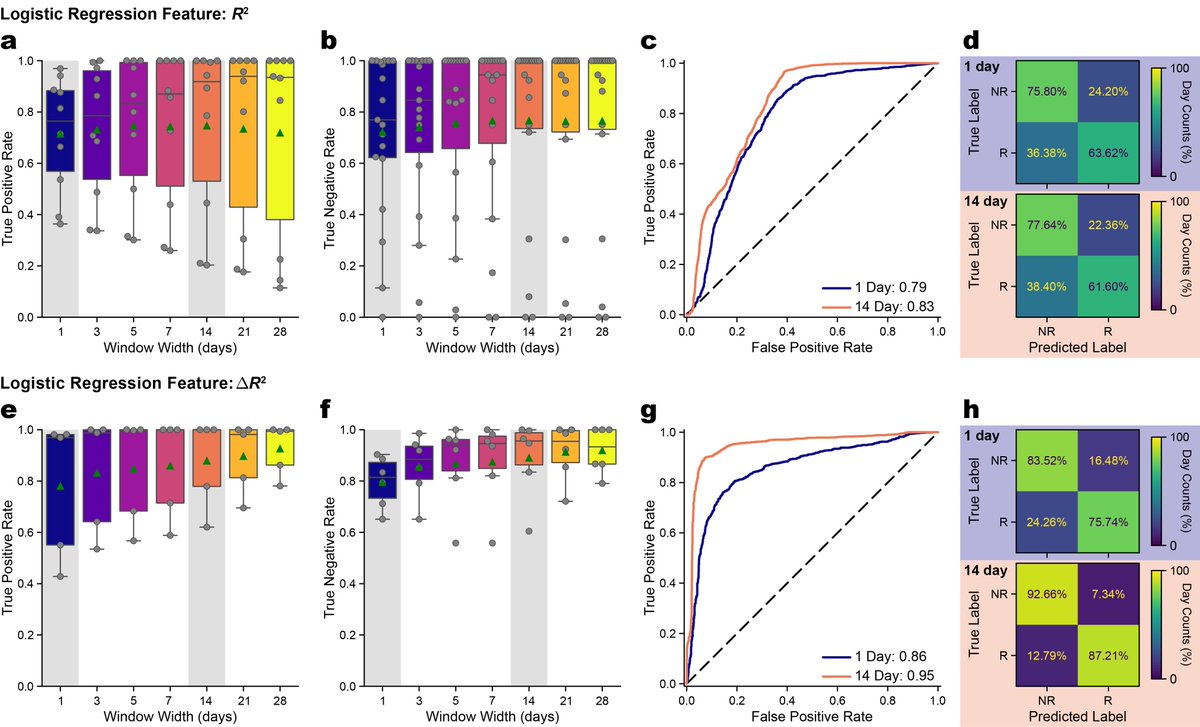
A leave-one-patient-out classifier using ΔR² distinguished daily response from non-response (AUROC=0.95), supporting neural predictability as a longitudinal biomarker of clinical state. (5/11)
@NicoleProvenza Overall, these findings suggest a framework for neural biomarkers across the arc of DBS therapy:
Before DBS: forecast eventual response
Early after activation: detect therapeutic engagement
During chronic therapy: track clinical response
(10/11)
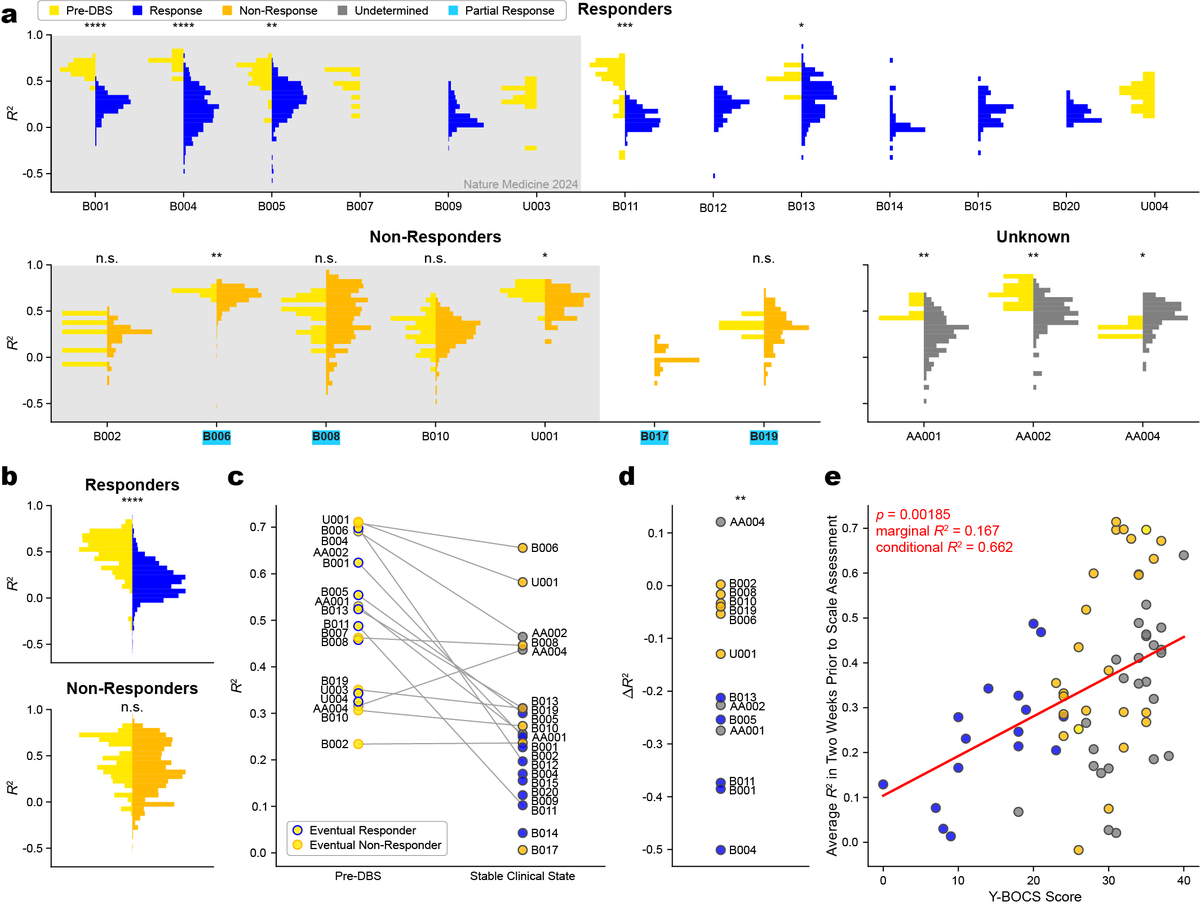
@NicoleProvenza First, we asked whether neural predictability tracks response.
Extending our prior work (Provenza et al., 2024), predictability fell from pre-DBS to stable response in responders but not non-responders. Higher predictability correlated with greater OCD symptom severity. (4/11)
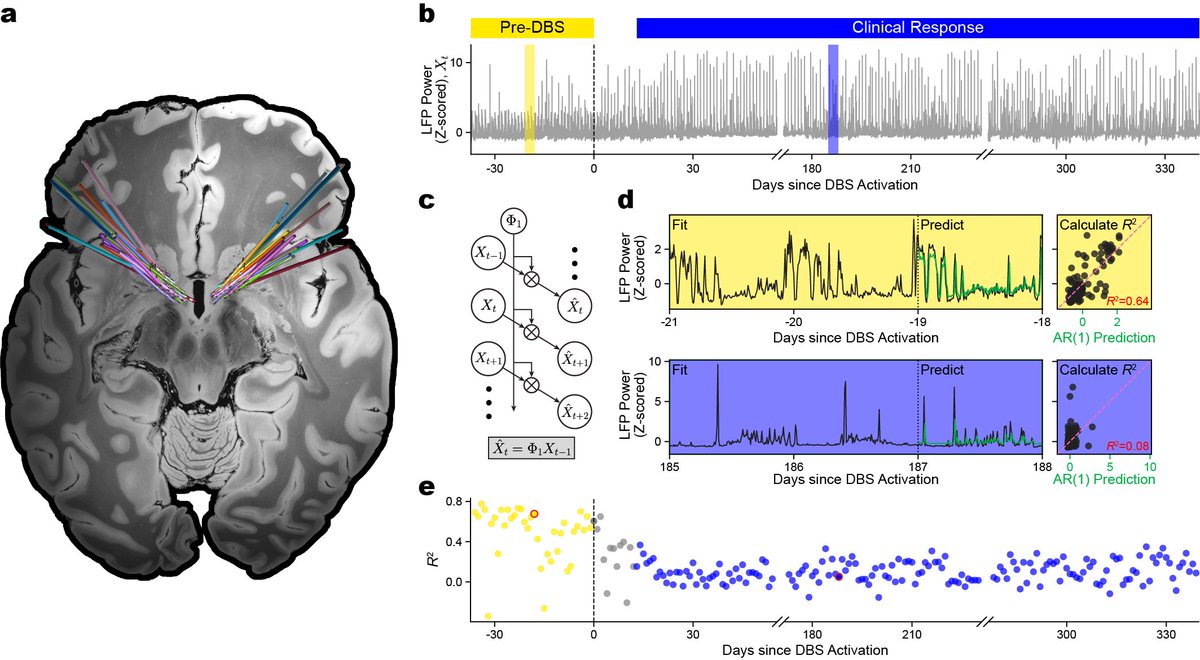
@NicoleProvenza We analyzed ~120,000 patient-hours of chronic intracranial recordings from 24 patients receiving ventral capsule DBS for treatment-resistant OCD.
From 9 Hz LFP power, we calculated a daily measure of neural predictability using a simple autoregressive model. (3/11)
@NicoleProvenza A major goal in psychiatric DBS is to develop biomarkers that can guide treatment across its full course: forecasting response before stimulation, detecting early therapeutic engagement after DBS activation, and tracking clinical response during chronic therapy. (2/11)
Excited to share my first publication from @NicoleProvenza’s lab!🎉
We identify and characterize overvoltage artifacts recorded on the Medtronic Percept DBS device and propose a best-practice strategy for mitigating them.
Read the preprint: https://t.co/Oc8Bby2y1u
#NER2025#IEEE