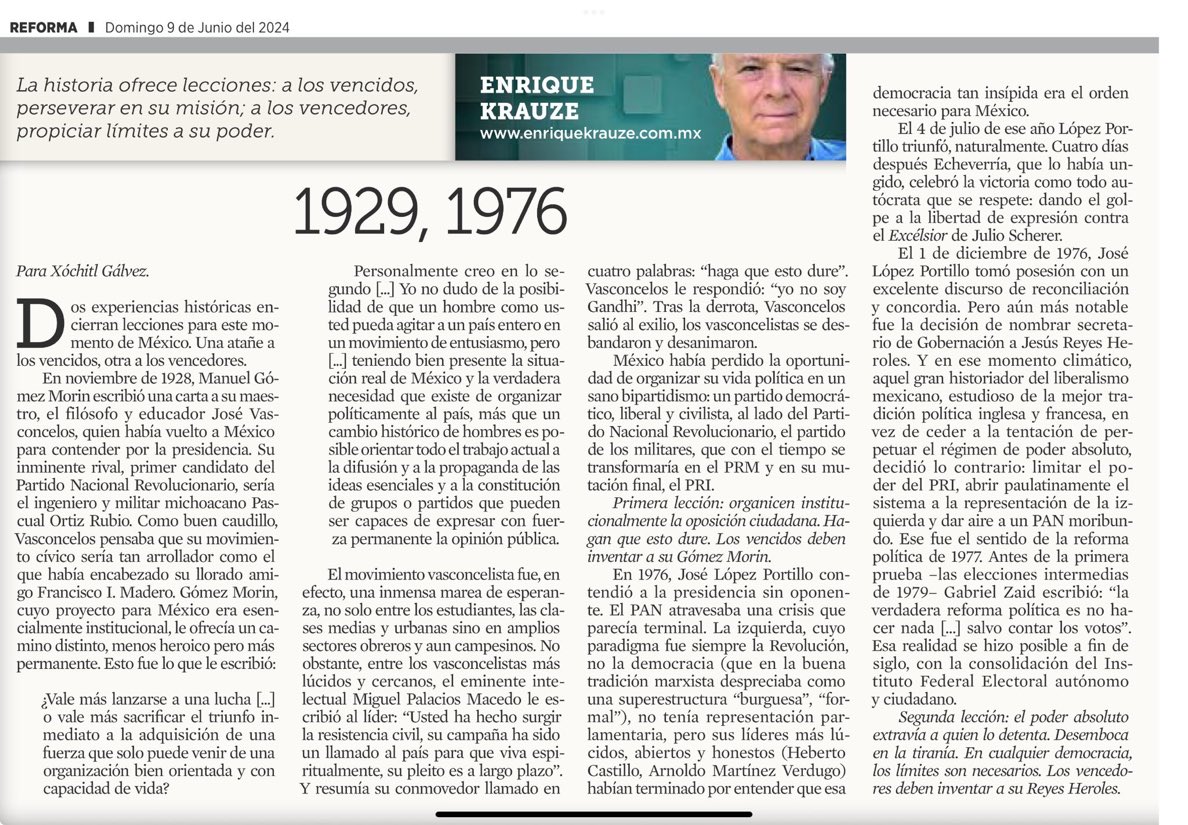
Un ciclo llega a su fin. Que los vencedores recuerden a Reyes Heroles y limiten su propio poder. Que los vencidos recuerden a Gomez Morin y perseveren en su misión.
El tono burlón y cínico de las grabaciones donde escuchamos a Amílcar Olán, amigo íntimo de Andy y Bobby López Beltrán, hijos del presidente, revelan el tamaño de la impunidad con la que se maneja. #ElClan.
#Loret en @latinus_us: https://t.co/6UdREtMCqy
Descarados. Cínicos. Escuchar estas grabaciones me dejó congelado.
Los primos de los hijos de AMLO y su amigo íntimo riéndose de que el Tren Maya se puede descarrilar porque ellos están haciendo negocio con la piedra sobre la que van las vías, y no tiene control de calidad.
“Ya cuando se descarrile el Tren, será otro pedo”, dicen entre risas.
Se saben impunes.
#ElClan
#Loret en @latinus_us: https://t.co/n1fPbwF4lq
🔴🔴🔴🔴
Hoy presentaremos las grabaciones más cínicas del sexenio. Se ríen de que son corruptos y se ríen de que puede descarrilarse el Tren Maya por su corrupción.
No se pierdan hoy #Loret en @latinus_us
¿Por qué @LopezObrador_ es tan insensible ante la tragedia de Acapulco? Porque su personalidad narcisista le impide sentir empatía por los otros y es indiferente ante el dolor ajeno. ¿Acaso hemos visto alguna foto del presidente escuchando a las víctimas del huracán? ¿lo han visto alguna vez con niños de cáncer? ¿o con madres de desaparecidos? Eso sí, muchas fotos con multitudes vitoreándolo.
What is the world's most underrated building?
One answer might be the Palacio de Bellas Artes in Mexico City.
Why? It's quite possibly the only place on earth where Beaux-Arts, Art Nouveau, and Art Deco architecture were all somehow combined into a single, spectacular building.
The Palacio de Bellas Artes was commissioned in 1900, with the intention of completing it by 1910 to mark the centenary of the Mexican War of Independence.
An Italian architect called Adamo Boari, who worked in a mixture of Neoclassical and Art Nouveau styles, was appointed to design it. But construction was delayed and then came the Mexican Revolution, which lasted from 1910 to 1920.
The Palacio was left unfinished for two decades until construction restarted in 1932, this time according to Art Deco design principles under the leadership of the Mexican architect Federico Mariscal.
The Palacio de Bellas Artes was finally completed and inaugurated in 1934, and has hosted art exhibitions and theatrical productions, including ballet and opera, ever since. It is also home to two museums dedicated to Mexican architecture and art, along with the Ballet Folklórico de México and the National Symphony Orchestra.
From outside we are treated to a building thoroughly Neoclassical in shape and design, with particular influence from the Beaux-Arts style of 19th century France — this explains the almost Baroque flair and extravagance of the exterior.
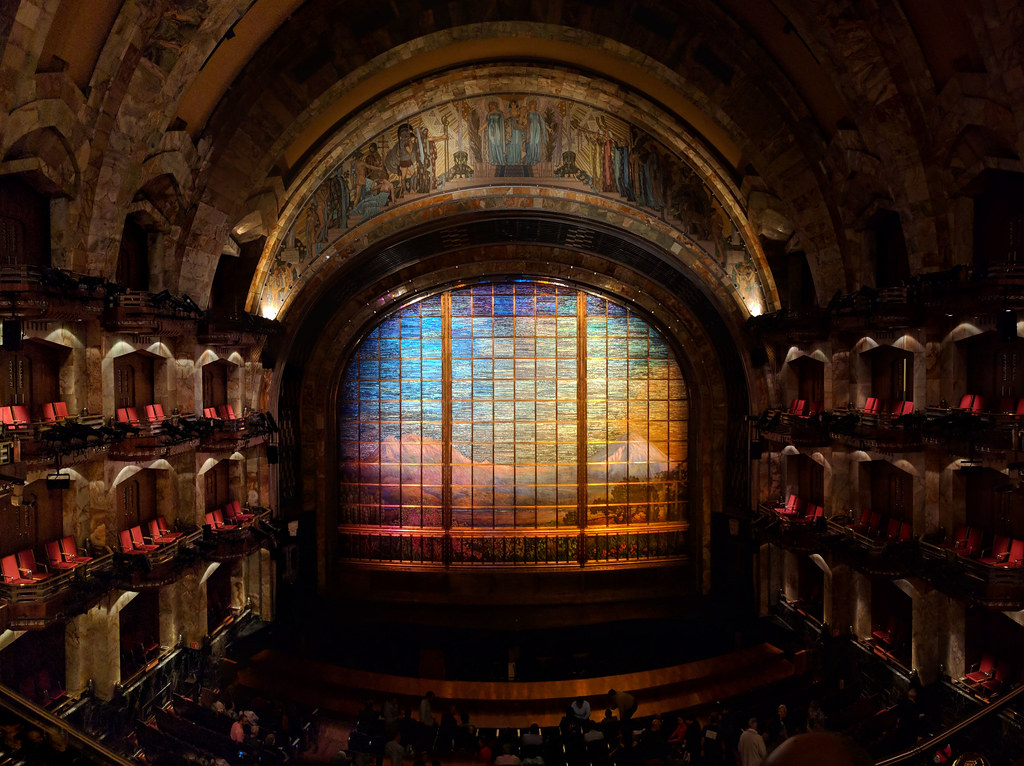
But some of the sculptural details and the huge, colourful glass domes are more Art Nouveau, and they hint at the interior of the Palacio — a concert hall like no other, built from wood, marble, and stained glass, and decorated with mosaics and paintings.
Not to forget its crowning jewel: a huge, foldable glass "curtain" produced by Tiffany's of New York. This was one of the greatest achievements of the whole Art Nouveau movement: a sensuous, shimmering wall of light and colour.
And that's not all. The main lobby, despite what the Palacio's façade suggests, is a cathedralesque chasm filled with the sharp geometry, futuristic atmosphere, and industrial decadence of Art Deco.
Amid all this the Palacio de Bellas Artes is also decorated with colossal, visually arresting murals by several of Mexico's greatest painters — Diego Rivera, Jorge González Camarena, José Clemente Orozco, and David Alfaro Siqueiros — along with sculptures of Aztec and Maya gods.
Other artists from around the world were also commissioned to work on the Palacio, such as the Italian Symbolist sculptor Leonardo Bistolfi and the Hungarian craftsman Géza Maróti.
And so the Palacio de Bellas Artes is a kaleidoscope of architecture and design. Its complicated history has produced a wholly unique fusion of different and ostensibly conflicting styles. But, somehow, Beaux-Arts Neoclassicism, Art Nouveau, and Art Deco were all integrated into one glorious cornucopia of material, form, colour, and light.
Just like the great churches of the Italian Renaissance, which exhibited the very best work of the architects, painters, and sculptors of the day, the Palacio de Bellas Artes feels like a masterpiece of the many different artistic and architectural movements of the early 20th century all at once — subsumed and transformed into something miraculous by the unique characteristics of Mexican art and culture.
Soy senador de la República por #Morena y estoy en contra de que se utilice la fuerza del Estado mexicano para difamar y perjudicar públicamente a @XochitlGalvez.
En su momento, el presidente @lopezobrador_ fue atacado desde el poder y salió victorioso.
No debemos cometer el mismo error que tanto criticamos en aquel entonces.
Les comparto mi opinión completa:
.@brozoxmiswebs y @carlosloret localizan el multimillonario complejo donde se fabrican los sabotajes, conspiraciones e intrigas que atentan contra la inmaculada 4ta Transformación.
#Latinus#InformaciónParaTi
https://t.co/UOD5JUYcie
“To be disobedient is to be a thinking person.” Watch as #PinocchioMovie filmmaker @RealGDT shares a universal truth from the film with friends and lifelong collaborators, Alejandro G. Iñárritu and @alfonsocuaron. ❤️