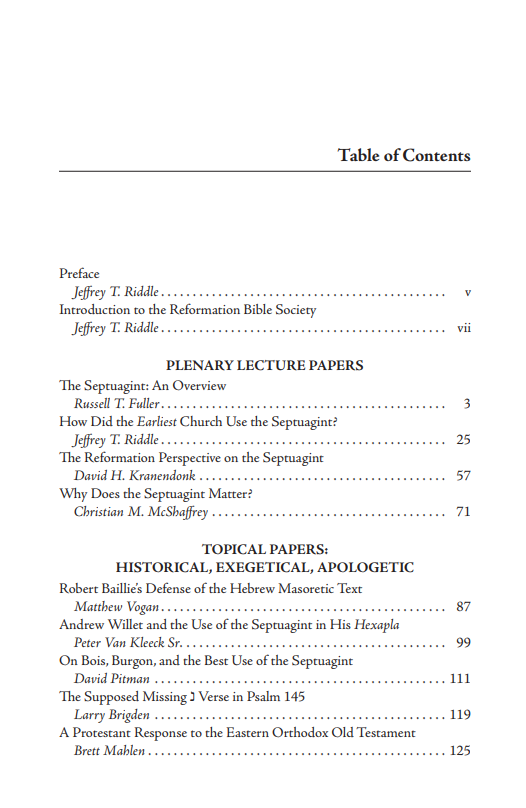
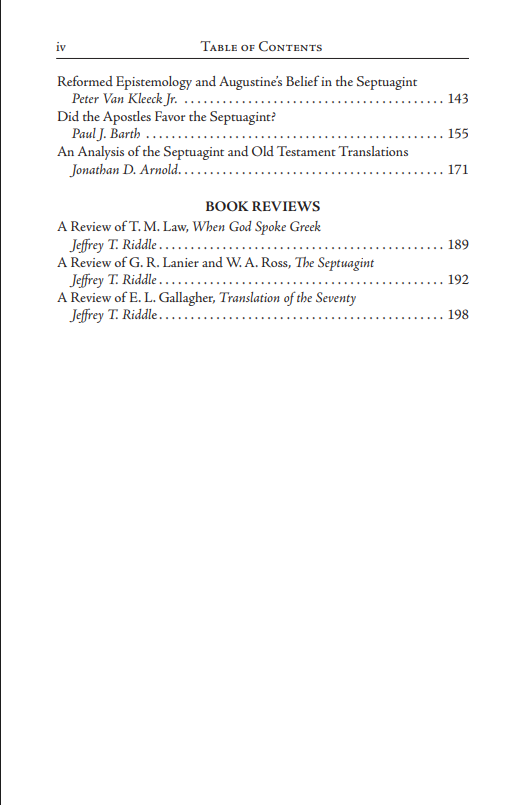
Reformation Bible Society Journal, Volume 1: The Reformation Text and the Septuagint (2025) is now available in e-book and paperback formats. Find ordering info here:
https://t.co/xsH3zLG2K4
Got this hard copy of the most recent QR in the mail this week from @tbsbibles. Always enjoy reading these and learning about the distribution of faithful Bibles around the world.
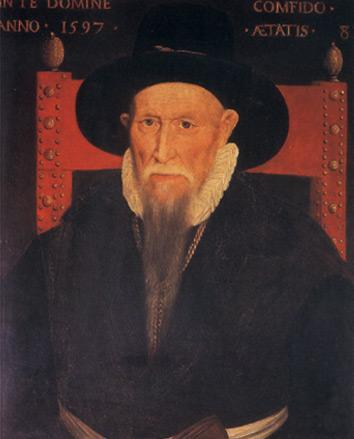
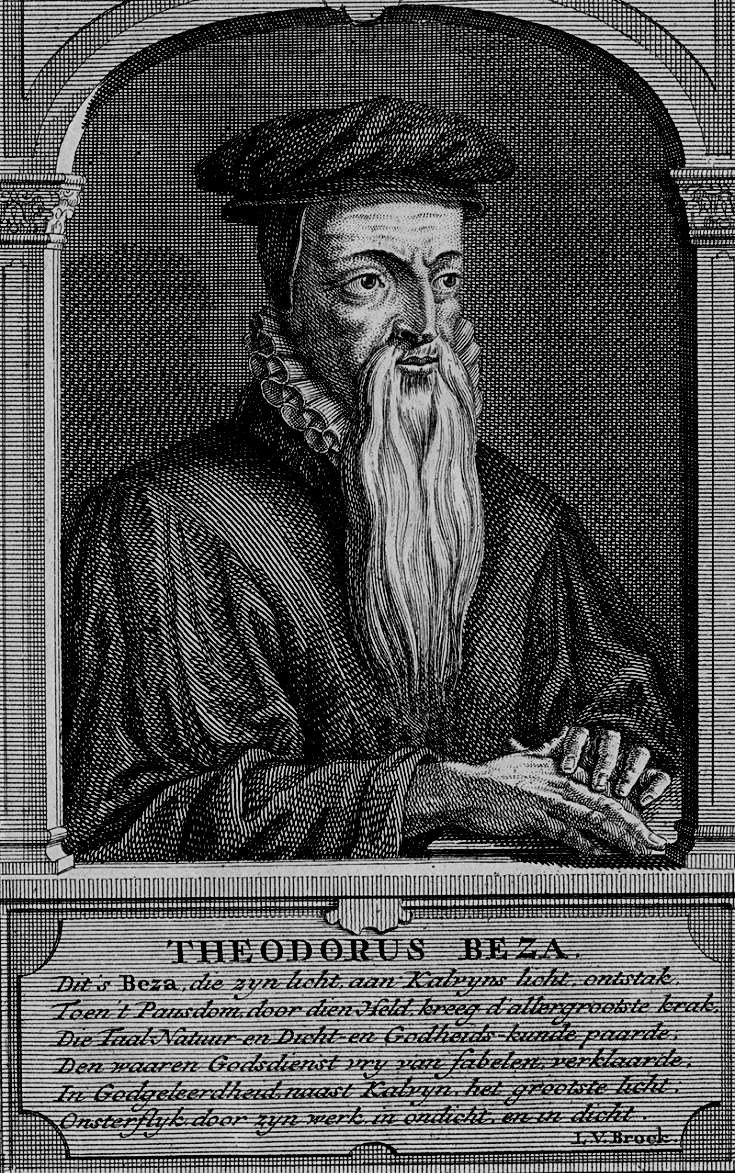
"Those who say that we find fault with good works, on the pretext that we say we are justified by Jesus Christ alone, received by faith alone, falsely slander us.... we are very far from saying that Christians must not practice good works nor abstain from bad works. On the contrary, we say that he basely lies who calls himself a Christian and does not strive to avoid the vices which God has condemned, and to follow true virtues."
-Theodore Beza (1519-1605), The Christian Faith, 22.
"The statutes of the Lord are right, and rejoice the heart: the commandment of the Lord is pure, and giveth light unto the eyes."
-Psalm 19:8, 1662 BCP, Day 4. Morning Prayer.
"Since God is righteous (Rom 3:26) and does not demand payment twice, since Jesus Christ, God and man (2 Cor 5:19), has satisfied by infinite obedience (Rom 5:19; Phil 2:8) the infinite majesty of God (Rom 8:33), it follows that my iniquities can never bring me to ruin (Col 2:14): they are already blotted out and washed out of my account by the blood of Jesus Christ who was made a curse for me (Gal 3:13), and who, righteous, died for the unrighteous (1 Pet 2:24)."
-Theodore Beza, The Christian Faith, 18.
"When, therefore, after St. Paul... we say that we are justified by faith alone, or freely, or by faith without works... we do not say that faith is a virtue which makes us righteous, in ourselves, before God. For this would be to put faith in the place of Jesus Christ who is, alone, our perfect and entire righteousness."
-Theodore Beza, The Christian Faith, 15.
"And they that know thy Name will put their trust in thee: for thou, Lord, hast never failed them that seek thee."
-Psalm 9:10, 1662 BCP, Day 2. Morning Prayer.
"It would be no more possible for us even to wish to believe than it would be for a dead man to fly (John 12:38, 39; 6:44)."
-Theodore Beza, The Christian Faith, 14.
The Vision (5.29.26) devotional article: The time is fulfilled:
Mark 1:14 Now after that John was put in prison, Jesus came into Galilee, preaching the gospel of the kingdom of God, 15 And saying, The time is fulfilled, and the kingdom of God is at hand: repent ye, and believe the gospel.
The beginning of our Lord’s public ministry followed his baptism (Mark 1:9-11) and his wilderness temptation (1:12-13).
It was initiated or triggered by the arrest of John the forerunner: “Now after that John was put in prison….” (v. 14a; cf. 6:14-29). It was an act of manly courage for our Lord to begin his public ministry at this time.
Mark continued, “Jesus came into Galilee, preaching [proclaiming] the gospel of the kingdom of God” (v. 14b).
Christ’s public ministry did not begin with miracles, feeding the masses, opening blinded eyes, raising the dead, or telling parables, but Christ came first as a Preacher.
The apostle Paul would later write, in 1 Corinthians 1:21, “it pleased God by the foolishness of preaching to save them that believe.”
The premier practitioner of this means of grace was Christ himself. Christ is the Prototypical Preacher. We merely human and very fallible preachers stumble and stammer and preach imperfectly. Christ is the Perfect Preacher.
What did he proclaim? The gospel [good news] of victory. Mark began by noting this book records, “The beginning of the gospel of Jesus Christ, the Son of God” (1:1). It will end in Mark 16:15 with the risen Lord telling his disciples, “Go ye into all the world, and preach the gospel to every creature.”
In v. 14 Mark the Evangelist describes Christ as preaching “the gospel of the kingdom of God.” This means the rule or reign of God on earth. Christ did not, in his first advent, come to establish a political kingdom. He told Pilate at his trial, “My kingdom is not of this world” (John 18:36). Here is the gaping difference between the Lord Jesus Christ and Muhammad. One conquers by the cross, and the other attempts to conquer by the sword.
In v. 15 we have Christ’s own words recorded by the evangelist. Christ said, “The time is fulfilled.” The word for time here is kairos. It refers to special time, the right moment, and not mere chronological time, chronos.
Christ recognized that in his coming and in his initiation of his public ministry he was fulfilling the plan of God that would lead to the bloody cross and the glorious resurrection, a shameful defeat and a stunning victory.
Christ declared, “the kingdom of God is at hand.” The rule and reign of God is present in Christ Himself. This happens even before the end of history. Christ comes into history and into time, and his kingdom is established, though it is not yet fully realized till he comes again with power and great glory.
He ends with two commands: “repent ye [experience a change of mind and a change of heart] and believe the gospel [the good news which is centered in the person of Christ himself].
There is a debate about the order of these two things in what is called “the order of salvation.” Do I first repent and then believe, or do I believe and then repent? Here, repent comes first in order, but it may well be that they come as contemporaneous events.
Christ has come. The time is fulfilled. Let us turn from sin in disgust and turn to Christ in faith.
Grace and peace, Pastor Jeff Riddle
Daniel B. Wallace on his rejection of WCF 1:8:
"I don't hold to the doctrine of preservation. That doctrine, first formulated in the Westminster Confession of Faith (1646), has a poor Biblical base. I do not think that the doctrine is defensible--either exegetically or empirically."
-Perspective on the Ending of Mark, p. 7.
Thoughts: Obviously, I disagree with Wallace's complete rejection of the classic Protestant view of preservation. On the other hand, however, he is a broad evangelical and not a confessional Protestant, so his rejection of WCF 1:8 is not unexpected.
In the end, I actually admire the fact that Wallace has a plain sense understanding of WCF 1:8 and that he unapologetically states his rejection of it. In this way he is like JD Hall, about whom I posted recently.
I don't know of any evangelical man who holds to the WCF or 2LBCF who has offered any rejoinder to Wallace on this. He expands on this in his 1992 article "Inspiration, Preservation, and NT Textual Criticism." But my how eager they are to reject the Confessional Text view when we affirm a plain sense reading of WCF 1:8!
I much prefer Wallace's full and forthright rejection of WCF 1:8 to the approach of those confessional men who reject the plain sense understanding of Westminster preservation and attempt instead to (re)interpret it to fit the modern eclectic method. As I wrote recently, it is like trying to force a pre-critical square peg into a modern or post-modern round hole.
Yes, I have read this. I don't recall Brash quoting or directly interacting with Wallace.
My statement was "I don't know of any evangelical man who holds to the WCF or 2LBCF who has offered any rejoinder to Wallace on this." Maybe Brash did this, and I can't remember where. Can you send me the page number in the booklet where Brash quotes Wallace and responds directly to him in this booklet? If you do, I'll be glad to add a quote from him to this post.
I see Brash's booklet as an example of what I noted in the post: a rejection of a plain sense understanding of WCF 1:8 and an attempt to (re)interpret it to fit with modern reasoned eclecticism.
I do appreciate Brash's work on the Protestant orthodox understanding of the "originals" and especially his point that for the Protestant orthodox the faithful apographa stand in "practical univocity" with the original autographa, though it's not a view he personally embraces.
Here are some of my posts on Brash:
https://t.co/UyjPOBOet1
https://t.co/G4HpFqdUtv
When you don't believe in preservation, you can entertain ideas like the original ending of Mark was lost and a spurious post-apostolic ending was created and patched onto the end. In Wallace's case, however, he simply holds that the original ended at Mark 16:8, and the church was simply wrong for the first two millennia in affirming 16:9-20 as authentic.
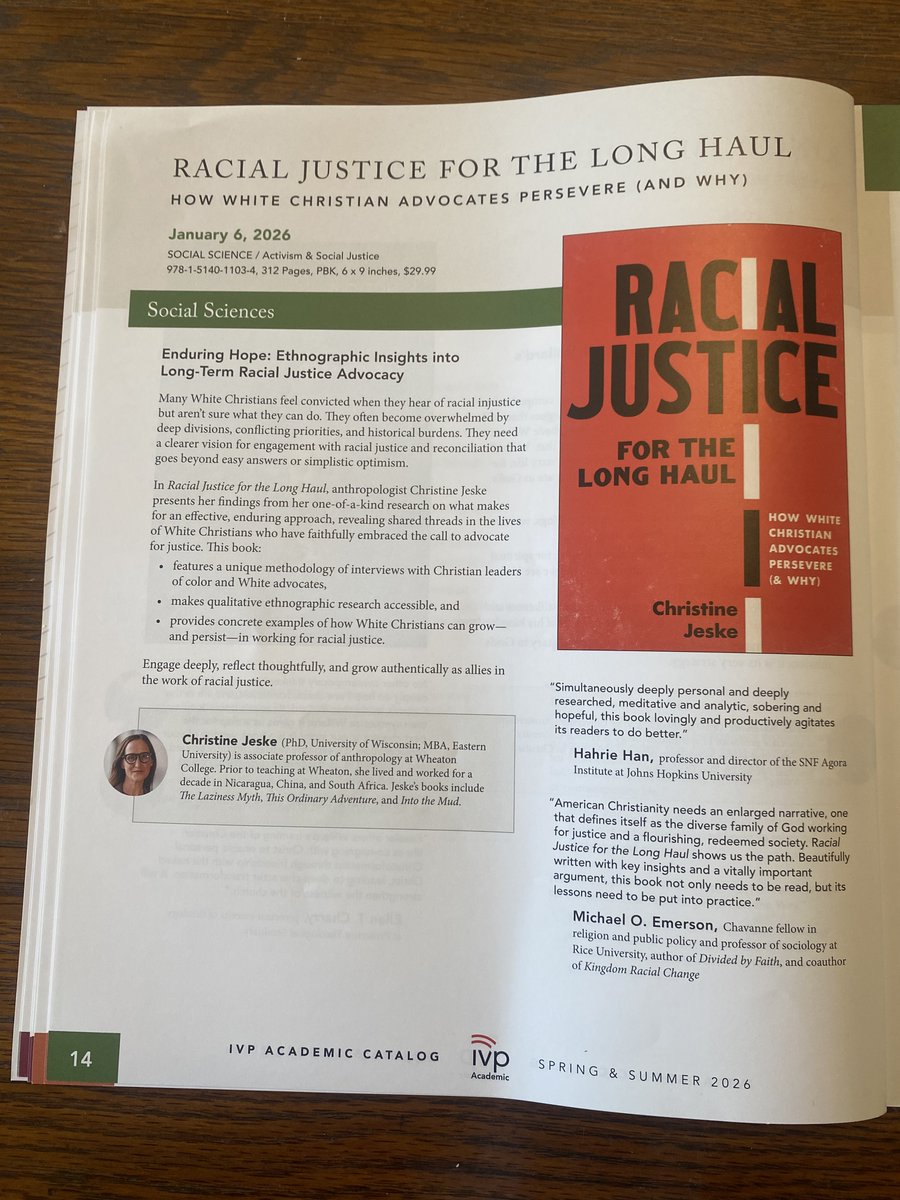
I had not looked closely at one of these catalogues in a while (they usually go straight to the circular filing cabinet) and was honestly surprised by this level of progressive advocacy in a legacy evangelical publisher. I haven't been in evangelical church circles for a while, but wondered who's buying these books. Given this is an academic catalogue I'm guessing many are being given as assigned reading in evangelical colleges and seminaries. Then we wonder about the debates in churches. It raises again questions about the lack of accountability among "evangelical" publishers. They also, of course, promote modern Bibles and modern scholarship (like the recent The Authority of the Septuagint, which included alongside evangelicals and Reformed a Roman Catholic contributor and, of course, women scholars). This is not unrelated.
Just got around this week to looking through the glossy hard copy of the Spring & Summer 2026 IVP Academic Catalogue which arrived weeks ago in my mail box at the college where I teach.
Interesting in light of debates I see here on X about women as church officers in evangelical church circles (like PCA and SBC), and other conversations about "woke-ism."
The new releases featured in the catalogue reflect not so subtle contemporary progressive cultural influences. Here are a a few:
-A Woman's Place in the Story: Seeing Women in the Biblical Narrative by Sandra Glahn of Dallas Seminary where she teaches "media arts and worship" with emphases on "first-century backgrounds related to women, culture, gender, and the arts."
-Allies in Ministry: How Men Can Support Women in God's Mission by Rob Dixon of Fuller.
As the title indicates, this is all about "Male Allyship."
-The Pastor As Midwife by Shawna Songer Gaines, "lead pastor" of Trevecca Community Church in Nashville.
This author uses her "pastoral experience" to explore "midwifery" as "a vision for pastoral leadership." It gets the privilege of being featured on the catalogue cover.
-The Catalogue also features a New Podcast titled "Hear Women," devoted to "Elevating the Voices of Christian Women."
As noted, progressive feminism is not the only focus in these new titles from IVP but also other woke themes. Here are two:
-Undoing Manifest Destiny: Settler America, Christian Colonists, and the Pursuit of Justice by L. Daniel Hawk of Ashland Seminary.
The author writes as a "descendant of White settlers and as a Biblical scholar" challenging the injustices of "settler Christians" from a "decolonizing perspective."
-Racial Justice For the Long Haul: How White Christian Advocates Persevere (And Why) by Christine Jeske, an anthropology professor at Wheaton.
This work offers "White Christians" "a clearer vision for engagement with racial justice and reconciliation" that goes beyond "easy answers or simplistic optimism."
Here is Robert Preus’s description of how the seventeenth century Lutheran dogmaticians handled textual variants:
"In their defense of the authority of Scripture the dogmaticians were obligated to enter upon an involved discussion on the authenticity of the Hebrew and Greek texts of Scripture. It was their conviction, as opposed to the Catholics and Socinians, that there had been no general corruption of the Scriptures. Not only the canonical books themselves but also the sentences and words and letters of these books are authentic. They have not been corrupted by Jews or Christians by the errors or negligence or ignorance of copyists, but by divine providence have been preserved intact and incorrupt. There are of course innumerable individual errors in the thousands of codices, just as there are in copies of other books, and these errors may even have been inserted by Jews or heretics, but there has been no general corruption of Scripture. Most of the individual errors in Scripture are variant readings of a technical nature and of little importance, such as omissions, spellings, transpositions and the like, and can be quite easily corrected. Such variations, along with diversities in pointing and accent, cannot be called corruptions. It goes without saying that the dogmaticians argue for the authenticity of only the original Greek and Hebrew texts, not for translations."
-The Inspiration of Scripture: A Study of the Theology of the 17th Century Lutheran Dogmaticians, 134-135.
At least Five Lessons:
1. The Lutheran orthodox were aware of minor textual variants in the transmission of the text of the Bible.
2. They did not see such variants (whether intentional or unintentional) as defeaters for embracing the divine preservation of Scripture without corruption, just as the English orthodox divines would say in WCF 1:8 that the Bible had been by God's singular care and providence "kept pure in all ages."
3. Canon involves not only the books but also the texts (i.e., sentences, words, and letters) of those books.
4. They held to the original Hebrew and Greek texts as authoritative and not ancient versions (Latin, LXX, etc.).
5. The Protestant view was distinct from the RCC and Socinians.










![Riddle1689's tweet photo. The Vision (5.29.26) devotional article: The time is fulfilled:
Mark 1:14 Now after that John was put in prison, Jesus came into Galilee, preaching the gospel of the kingdom of God, 15 And saying, The time is fulfilled, and the kingdom of God is at hand: repent ye, and believe the gospel.
The beginning of our Lord’s public ministry followed his baptism (Mark 1:9-11) and his wilderness temptation (1:12-13).
It was initiated or triggered by the arrest of John the forerunner: “Now after that John was put in prison….” (v. 14a; cf. 6:14-29). It was an act of manly courage for our Lord to begin his public ministry at this time.
Mark continued, “Jesus came into Galilee, preaching [proclaiming] the gospel of the kingdom of God” (v. 14b).
Christ’s public ministry did not begin with miracles, feeding the masses, opening blinded eyes, raising the dead, or telling parables, but Christ came first as a Preacher.
The apostle Paul would later write, in 1 Corinthians 1:21, “it pleased God by the foolishness of preaching to save them that believe.”
The premier practitioner of this means of grace was Christ himself. Christ is the Prototypical Preacher. We merely human and very fallible preachers stumble and stammer and preach imperfectly. Christ is the Perfect Preacher.
What did he proclaim? The gospel [good news] of victory. Mark began by noting this book records, “The beginning of the gospel of Jesus Christ, the Son of God” (1:1). It will end in Mark 16:15 with the risen Lord telling his disciples, “Go ye into all the world, and preach the gospel to every creature.”
In v. 14 Mark the Evangelist describes Christ as preaching “the gospel of the kingdom of God.” This means the rule or reign of God on earth. Christ did not, in his first advent, come to establish a political kingdom. He told Pilate at his trial, “My kingdom is not of this world” (John 18:36). Here is the gaping difference between the Lord Jesus Christ and Muhammad. One conquers by the cross, and the other attempts to conquer by the sword.
In v. 15 we have Christ’s own words recorded by the evangelist. Christ said, “The time is fulfilled.” The word for time here is kairos. It refers to special time, the right moment, and not mere chronological time, chronos.
Christ recognized that in his coming and in his initiation of his public ministry he was fulfilling the plan of God that would lead to the bloody cross and the glorious resurrection, a shameful defeat and a stunning victory.
Christ declared, “the kingdom of God is at hand.” The rule and reign of God is present in Christ Himself. This happens even before the end of history. Christ comes into history and into time, and his kingdom is established, though it is not yet fully realized till he comes again with power and great glory.
He ends with two commands: “repent ye [experience a change of mind and a change of heart] and believe the gospel [the good news which is centered in the person of Christ himself].
There is a debate about the order of these two things in what is called “the order of salvation.” Do I first repent and then believe, or do I believe and then repent? Here, repent comes first in order, but it may well be that they come as contemporaneous events.
Christ has come. The time is fulfilled. Let us turn from sin in disgust and turn to Christ in faith.
Grace and peace, Pastor Jeff Riddle](https://pbs.twimg.com/media/HJgTPF9XkAc_c1v.jpg)