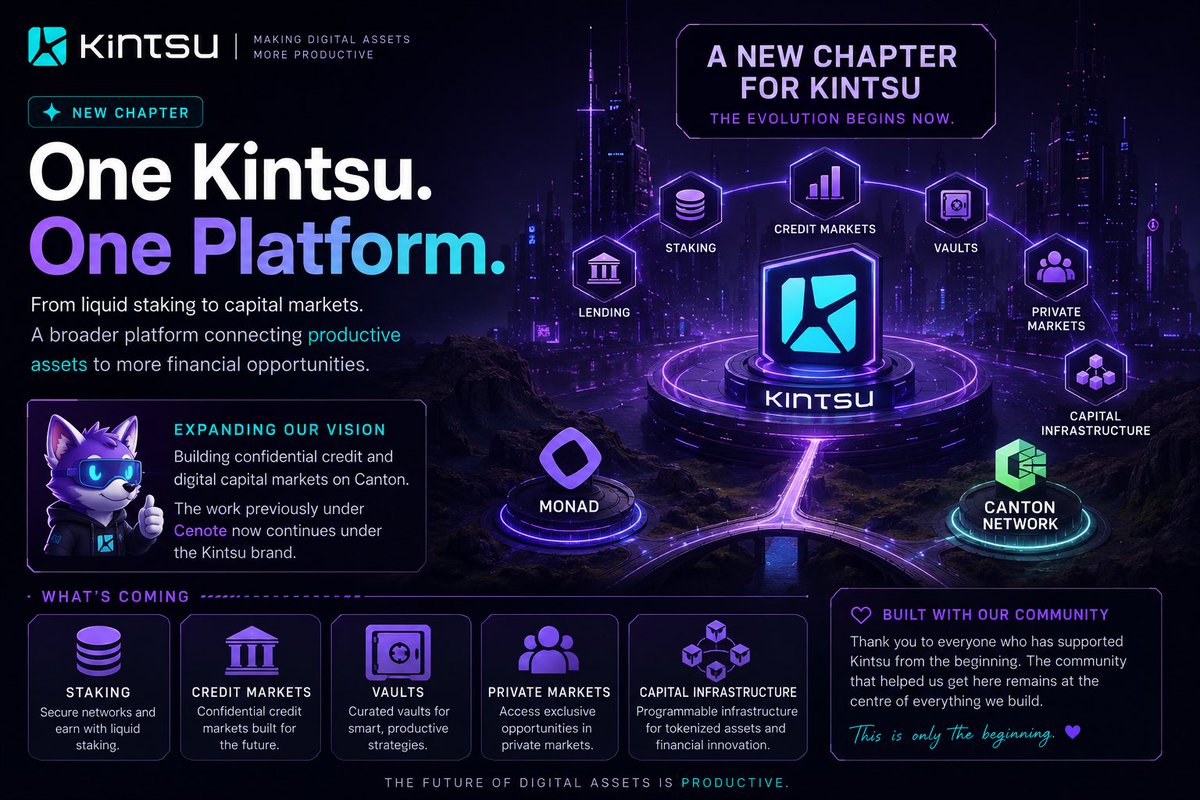
Today, we're announcing an $18 million Series Seed, led by @neo and @leftlanecap, with continued support from Paradigm, General Catalyst, and other top VC firms — bringing our total raised to over $25 million.
Kintsu began with liquid staking.
We are now expanding the platform into confidential credit and digital capital markets.
The work developed under @Cenote_network is moving under Kintsu. The Cenote brand is retiring, and the capital markets product under development will launch as Kintsu Capital Markets.
Kintsu Capital Markets is being built to support confidential credit markets, curated market structures and programmable financial infrastructure for tokenized assets on @CantonNetwork
Kintsu’s liquid staking products remain part of the broader platform.
Going forward, all capital markets research, development updates and product communication will come from Kintsu.
One Kintsu. One platform.
https://t.co/ymW2i8ObQr
Episode 2 of Doesn't Grasp is live.
Austin Brown designs motors at @BostonDynamics. He also owns a small hydroelectric dam he bought off Facebook Marketplace.
An hour with @castorhat on the constraint that binds first: heat.
Kintsu began with liquid staking.
We are now expanding the platform into confidential credit and digital capital markets.
The work developed under @Cenote_network is moving under Kintsu. The Cenote brand is retiring, and the capital markets product under development will launch as Kintsu Capital Markets.
Kintsu Capital Markets is being built to support confidential credit markets, curated market structures and programmable financial infrastructure for tokenized assets on @CantonNetwork
Kintsu’s liquid staking products remain part of the broader platform.
Going forward, all capital markets research, development updates and product communication will come from Kintsu.
One Kintsu. One platform.
https://t.co/ymW2i8ObQr
We'll be at IROS 2026 in Pittsburgh, September 28 to 30 🦾
Come find us at Booth 1122 to see what we're building and meet the team. If you're in physical AI, we'd love to hear what you're working on.
@ieeeiros#IROS2026
Kintsu is expanding. 🦊💜
Productive assets are the foundation.
Now, credit markets are the next layer — bringing lending, borrowing, vaults and markets together around collateral.
The next chapter of onchain finance is taking shape.
@Kintsu
That’s why initiatives like the Teleop World Cup matter.
While you’re controlling a real robot and having fun, you’re also helping create valuable datasets that can improve future Vision-Language-Action (VLA) models and accelerate the development of Physical AI.
Most people see a robot completing a task.
What they don’t see is the thousands of human-guided interactions behind it.
Every teleoperation session helps create the high-quality data needed to train smarter, safer, and more reliable Physical AI.
@PrismaXai
The biggest challenge in robotics isn’t just building better hardware—it’s collecting better data.
Without high-quality demonstrations, even the most advanced AI models struggle to understand how to interact with the real world.
Before a physical AI team can train anything, they need large-scale, proven data, vetted embodiments, and model training frameworks. PrismaX delivers that foundation, so our customers spend their time building the AI, not assembling what it runs on.
The hard part of physical AI isn't the model. It's collecting real-world data at scale. Our co-founder @castorhat on why that data layer has to be decentralized.
As better datasets are collected, Vision-Language-Action (VLA) models become more capable of understanding both instructions and physical actions.
Today’s teleoperation tasks may help power tomorrow’s autonomous robots—one demonstration at a time.
Behind every capable robot is thousands of successful human demonstrations.
The Teleop World Cup isn’t just about scoring goals—it’s about helping robots learn how to interact with the physical world through high-quality data.
@PrismaXai
Robots don’t automatically understand how to grasp, move, or manipulate objects.
They learn by observing high-quality demonstrations. Teleoperation allows people to remotely control robots, creating real-world examples that AI models can use for training.