To those who shared the slander of Shaykh Jamil Halim: imagine having so much hatred in your heart that you spread lies without even consulting the other party to confirm the claims.
What happened to thinking well of other Muslims and giving them the benefit of the doubt?
The ones who slander today are the same ones who were at our feet yesterday [such as @c_ahmethoca].
The very slanderer was once begging for an ijazah — and there is video evidence.
This is evidence against the supporters of slander, showing they only wish for harm and fitnah.
May Allah strengthen and bless our esteemed Shaykh Jamil Halim.
𝐁𝐢𝐝’𝐚𝐡 𝐇𝐚𝐬𝐚𝐧𝐚𝐡 𝐚𝐧𝐝 𝐭𝐡𝐞 𝐌𝐚𝐰𝐥𝐢𝐝: 𝐏𝐫𝐨𝐨𝐟 𝐟𝐫𝐨𝐦 𝐭𝐡𝐞 𝐆𝐫𝐞𝐚𝐭 𝐈𝐦𝐚𝐦𝐬
𝐈𝐦𝐚𝐦 𝐚𝐥-𝐒𝐡𝐚𝐟𝐢’𝐢:
“One of them (bid’ah) is what is introduced that contradicts the Book (Quran), Sunnah, Athar (narrations), or Ijma’ (consensus). This is the innovation of misguidance.
The second is what is introduced of goodness, with no contradiction to any of these (Quran, Sunnah, Athar, or Ijma'). This is an innovation that is not blameworthy.”
[Narrated by al-Bayhaqi with an authentic chain in his book 𝙈𝙖𝙣𝙖𝙦𝙞𝙗 𝙖𝙡-𝙎𝙝𝙖𝙛𝙞’𝙞, Vol. 1 p. 469.]
𝐇𝐚𝐟𝐢𝐝𝐡 𝐈𝐛𝐧 𝐇𝐚𝐣𝐚𝐫:
“Al-Shafi’i said: ‘Innovations are of two types: praiseworthy and blameworthy. Whatever conforms to the Sunnah is praiseworthy, and whatever contradicts it is blameworthy.’”
[𝙁𝙖𝙩𝙝 𝙖𝙡-𝘽𝙖𝙧𝙞, Kitab al-I‘tisam bil-Kitab wa’l-Sunnah]
𝐈𝐦𝐚𝐦 𝐚𝐥-𝐍𝐚𝐰𝐚𝐰𝐢:
“The innovation in the Shari'ah (Islamic law) is the introduction of something that did not exist during the time of the Messenger of Allah ﷺ. It is divided into two: good (hasanah) and evil (qabihah).”
[𝙏𝙖𝙝𝙙𝙝𝙞𝙗 𝙖𝙡-𝘼𝙨𝙢𝙖' 𝙬𝙖'𝙡-𝙇𝙪𝙜𝙝𝙖𝙩]
𝐈𝐛𝐧 𝐀𝐛𝐢𝐝𝐢𝐧 𝐚𝐥-𝐇𝐚𝐧𝐚𝐟𝐢 (a renowned Hanafi jurist):
“Innovation can be:
1. Obligatory (wajib): Establishing evidence to refute misguided sects and learning beneficial grammar for understanding the Quran and Sunnah.
2. Recommended (mandub): Introducing beneficial innovations like:
- Building ribats (border forts)
- Establishing schools
- Performing charity not present in the earliest era
3. Disliked (makruh): Extravagant decoration of mosques.
4. Permissible (mubah): Enjoying delightful food, drinks, and clothing.”
[𝙍𝙖𝙙𝙙 𝙖𝙡-𝙈𝙪𝙝𝙩𝙖𝙧 𝙖𝙡𝙖 𝙖𝙡-𝘿𝙪𝙧𝙧 𝙖𝙡-𝙈𝙪𝙠𝙝𝙩𝙖𝙧, Vol. 1 p. 376.]
My tears flowed out of longing, O my Beloved, to you
My heart overflowed with love, sending blessings upon you
My soul flew in love toward you in my dreams
All of me yearned to be near — Sayyidi, I am here at your service
اللهم صل وسلم وزد وبارك على رسول الله محمد ﷺ
To those who criticise Sufism unconditionally from among the anthropomorphists of this era — here is your foremost shaykh, Ibn Taymiyyah, praising the people of Sufism who follow the path of al-Junayd رضي الله عنه.
Ibn Taymiyyah said: “Whoever follows the path of al-Junayd, from among the people of Sufism and spiritual knowledge, has been rightly guided, saved, and attained happiness.”
[Majmu al-Fatawa, 14/355]
𝐈𝐛𝐧 𝐊𝐚𝐭𝐡𝐢𝐫 𝐀𝐭𝐭𝐫𝐢𝐛𝐮𝐭𝐞𝐬 𝐒𝐢𝐭𝐭𝐢𝐧𝐠 𝐭𝐨 𝐀𝐥𝐥𝐚𝐡 — 𝐀𝐧𝐝 𝐂𝐥𝐚𝐢𝐦𝐬 𝐭𝐡𝐞 𝐏𝐫𝐨𝐩𝐡𝐞𝐭 ﷺ 𝐚𝐧𝐝 𝐀𝐥𝐥𝐚𝐡 ﷻ 𝐒𝐚𝐢𝐝 𝐈𝐭
Ibn Kathir’s Tafsir al-Quran al-’Athim in the context of Surah Taha, specifically under the tafsir of Ayah 2, Surah Taha.
The full hadith, as cited by Ibn Kathir, is:
“The Messenger of Allah (peace and blessings be upon him) said: Allah, the Exalted, will say to the scholars on the Day of Resurrection when He sits on His Kursi to judge His servants: ‘I did not place My knowledge and wisdom in you except that I intended to forgive you for whatever you did, and I do not mind.’”
Ibn Kathir comments explicitly: “He (Allah) sits” (إذا قعد), indicating a transition from not sitting to sitting—i.e., “Allah was not sitting, then He sat on His Kursi.”
This raises a pressing theological question:
Is this not tajsim (attribution of bodily characteristics to Allah)?
Ibn Kathir’s statement is a clear affirmation of qu’ud (sitting) as a literal act, and he attributes this directly to Allah. This position mirrors the creed of his teacher, Ibn Taymiyyah, who is well known for his controversial stances on divine attributes—stances many scholars have identified as anthropomorphic.
This is his own tafsir and his own words. He did not merely narrate the report—he affirmed it.
To those who insist that “Ibn Kathir was not a mujassim,” the evidence here speaks plainly. Even if you personally reject the interpretation, you must at least acknowledge that this is what Ibn Kathir himself stated.
Not only does Ibn Kathir affirm this action, but he also attributes it directly to Allah, saying both: “The Prophet ﷺ said it,” and “Allah said it.”.
And if you haven’t come across this before, now you have.
والله أعلم
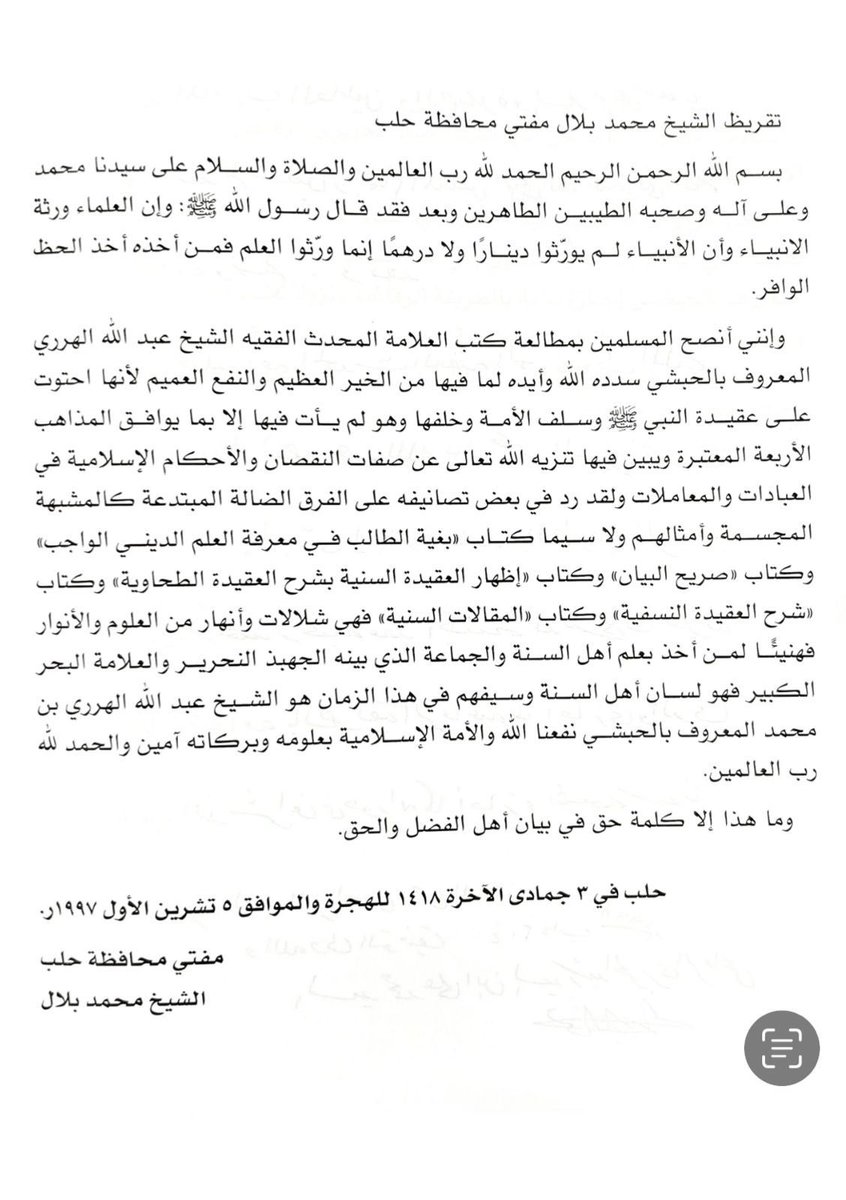
𝐄𝐧𝐝𝐨𝐫𝐬𝐞𝐦𝐞𝐧𝐭 𝐟𝐫𝐨𝐦 𝐭𝐡𝐞 𝐌𝐮𝐟𝐭𝐢 𝐨𝐟 𝐀𝐥𝐞𝐩𝐩𝐨: 𝐒𝐡𝐚𝐲𝐤𝐡 𝐀𝐛𝐝𝐮𝐥𝐥𝐚𝐡 𝐚𝐥-𝐇𝐚𝐫𝐚𝐫𝐢 𝐚𝐧𝐝 𝐭𝐡𝐞 𝐋𝐞𝐠𝐚𝐜𝐲 𝐨𝐟 𝐒𝐮𝐧𝐧𝐢 𝐒𝐜𝐡𝐨𝐥𝐚𝐫𝐬𝐡𝐢𝐩
In the name of Allah, the Most Merciful, the Most Compassionate.
All praise is due to Allah, Lord of the Worlds, and may peace and blessings be upon our Master Muhammad, and upon his pure and noble family and companions.
To proceed:
The Messenger of Allah ﷺ said:
“The scholars are the inheritors of the Prophets, and the Prophets did not leave behind dinars nor dirhams; rather, they left behind knowledge. So whoever takes it has indeed taken an abundant share.”
I advise the Muslims to study the books of the eminent scholar, the hadith master, the jurist, Shaykh Abdullah al-Harari, known as al-Habashi—may Allah guide and support him—because of the immense good and widespread benefit contained within them.
These books contain the creed (aqidah) of the Prophet ﷺ, and the creed of the pious predecessors (Salaf) and their successors (Khalaf). In them, he presents only that which aligns with the four recognised schools of jurisprudence.
In these works, he clarifies the Tanzih of Allah Most High from all attributes of imperfection, and he explains the Islamic rulings on acts of worship and transactions.
In some of his writings, he has refuted the deviant and innovated sects, such as the mujassimah and mushabbihah (those who anthropomorphise and liken Allah to creation) and others like them.
Especially worthy of mention are his books:
•“Bughyat al-Talib fi Ma’rifat al-’Ilm al-Dini al-Wajib” (The Seeker’s Desire in Knowing the Obligatory Religious Knowledge)
•“Sarih al-Bayan” (The Clear Explanation)
•“Idhhar al-Aqidah al-Sunniyyah bi-Sharh al-Aqidah al-Tahawiyyah” (Clarification of the Sunni Creed with a Commentary on al-Aqidah al-Tahawiyyah)
•“Sharh al-Aqidah al-Nasafiyyah” (Commentary on al-Aqidah al-Nasafiyyah)
•“al-Maqalat al-Sunniyyah” (The Sunni Articles)
These are streams and rivers of knowledge and light, so glad tidings to the one who takes from the knowledge of Ahl al-Sunnah wal-Jama’ah, as explained by this brilliant scholar, this great sea of knowledge, this eloquent tongue of Ahl al-Sunnah, and their sword in this time, Shaykh Abdullah al-Harari ibn Muhammad, known as al-Habashi.
May Allah benefit us and the Muslim Ummah with his knowledge and blessings. Ameen.
All praise is due to Allah, Lord of the Worlds.
This is nothing but a word of truth in describing the people of virtue and truth.
Written in Aleppo on the 3rd of Jumada al-Akhirah 1418 AH / Corresponding to October 5, 1997 CE.
Mufti of the Province of Aleppo
Shaykh Muhammad Bilal




![farouk_naj's tweet photo. 𝐁𝐢𝐝’𝐚𝐡 𝐇𝐚𝐬𝐚𝐧𝐚𝐡 𝐚𝐧𝐝 𝐭𝐡𝐞 𝐌𝐚𝐰𝐥𝐢𝐝: 𝐏𝐫𝐨𝐨𝐟 𝐟𝐫𝐨𝐦 𝐭𝐡𝐞 𝐆𝐫𝐞𝐚𝐭 𝐈𝐦𝐚𝐦𝐬
𝐈𝐦𝐚𝐦 𝐚𝐥-𝐒𝐡𝐚𝐟𝐢’𝐢:
“One of them (bid’ah) is what is introduced that contradicts the Book (Quran), Sunnah, Athar (narrations), or Ijma’ (consensus). This is the innovation of misguidance.
The second is what is introduced of goodness, with no contradiction to any of these (Quran, Sunnah, Athar, or Ijma'). This is an innovation that is not blameworthy.”
[Narrated by al-Bayhaqi with an authentic chain in his book 𝙈𝙖𝙣𝙖𝙦𝙞𝙗 𝙖𝙡-𝙎𝙝𝙖𝙛𝙞’𝙞, Vol. 1 p. 469.]
𝐇𝐚𝐟𝐢𝐝𝐡 𝐈𝐛𝐧 𝐇𝐚𝐣𝐚𝐫:
“Al-Shafi’i said: ‘Innovations are of two types: praiseworthy and blameworthy. Whatever conforms to the Sunnah is praiseworthy, and whatever contradicts it is blameworthy.’”
[𝙁𝙖𝙩𝙝 𝙖𝙡-𝘽𝙖𝙧𝙞, Kitab al-I‘tisam bil-Kitab wa’l-Sunnah]
𝐈𝐦𝐚𝐦 𝐚𝐥-𝐍𝐚𝐰𝐚𝐰𝐢:
“The innovation in the Shari'ah (Islamic law) is the introduction of something that did not exist during the time of the Messenger of Allah ﷺ. It is divided into two: good (hasanah) and evil (qabihah).”
[𝙏𝙖𝙝𝙙𝙝𝙞𝙗 𝙖𝙡-𝘼𝙨𝙢𝙖' 𝙬𝙖'𝙡-𝙇𝙪𝙜𝙝𝙖𝙩]
𝐈𝐛𝐧 𝐀𝐛𝐢𝐝𝐢𝐧 𝐚𝐥-𝐇𝐚𝐧𝐚𝐟𝐢 (a renowned Hanafi jurist):
“Innovation can be:
1. Obligatory (wajib): Establishing evidence to refute misguided sects and learning beneficial grammar for understanding the Quran and Sunnah.
2. Recommended (mandub): Introducing beneficial innovations like:
- Building ribats (border forts)
- Establishing schools
- Performing charity not present in the earliest era
3. Disliked (makruh): Extravagant decoration of mosques.
4. Permissible (mubah): Enjoying delightful food, drinks, and clothing.”
[𝙍𝙖𝙙𝙙 𝙖𝙡-𝙈𝙪𝙝𝙩𝙖𝙧 𝙖𝙡𝙖 𝙖𝙡-𝘿𝙪𝙧𝙧 𝙖𝙡-𝙈𝙪𝙠𝙝𝙩𝙖𝙧, Vol. 1 p. 376.]](https://pbs.twimg.com/media/Gy_5r6hbAAAkDKa.jpg)


![farouk_naj's tweet photo. To those who criticise Sufism unconditionally from among the anthropomorphists of this era — here is your foremost shaykh, Ibn Taymiyyah, praising the people of Sufism who follow the path of al-Junayd رضي الله عنه.
Ibn Taymiyyah said: “Whoever follows the path of al-Junayd, from among the people of Sufism and spiritual knowledge, has been rightly guided, saved, and attained happiness.”
[Majmu al-Fatawa, 14/355]](https://pbs.twimg.com/media/Gv7rL9pW0AEby_p.jpg)


