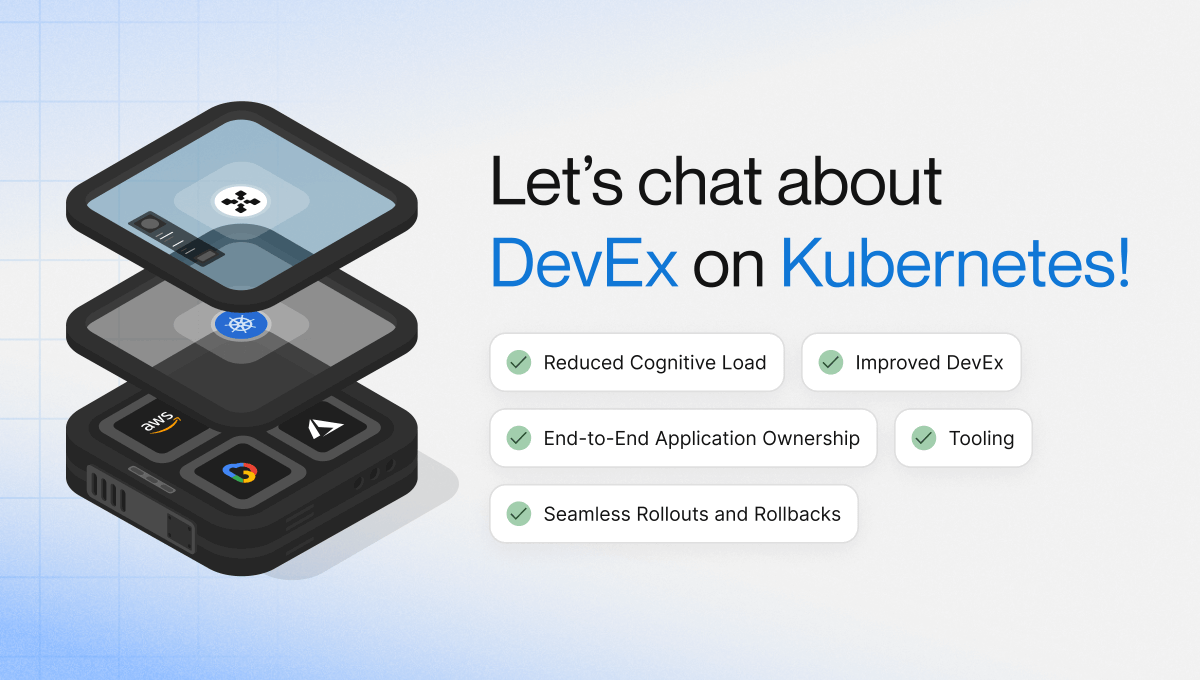
We’ve talked to 100s of Platform Engineers, DevOps Engineers, and Engineering Leaders about DevEx on Kubernetes the past year.
It’s been essential for us in building https://t.co/dImOTiF3hj, and it will remain vital as we continue to add functionalities to the platform to accommodate enterprise needs.
We love discussing Platform Engineering and Developer Experience and are thrilled every time we get to discuss it with companies.
We’re constantly looking for people who are open to chatting about how they go about platform engineering at their companies.
If you work at a company using Kubernetes, and are open to discussing developer experience and your platform engineering initiatives, reach out to @th0rchristensen or @anders_johnsen!
One of the biggest inventions in software must be the Undo button. Being able to undo an operation is what gives us comfort when taking ownership, knowing already before you begin, how to mitigate any mistake you may accidentally make.
When it comes to deploying software, it becomes even more relevant. A single character is enough to impact your environments, may it be staging or production. And not knowing what part of your change impacted the system means you have to actually understand the impact before you can mitigate it.
This is one of the reasons the Rig Platform embraces rollback as a core feature. All changes made through our tools are possible to roll back, no matter if it’s a new image, network or environment variables. Rollback is the Undo button of platform engineering!
Day 2 Operations in a DevEx setting is complicated within Platform Engineering. Introducing Kubernetes to an organization can, for many, be a big, daunting task. Once this is accomplished, a new set of challenges emerges. One of these is the cognitive overload that engineers face when dealing with their services in Kubernetes.
At https://t.co/dImOTiF3hj, we can focus solely on making Day 2 Operations on Kubernetes a seamless experience. Our platform offers a simple yet powerful feature that allows developers to confidently deploy changes to their services. They can observe the changes taking effect and oversee the process without needing to understand every Kubernetes primitive.
... and if anything goes wrong, simply do a Rollback.
This is, among other things, what enables developers to obtain end-to-end application ownership, which is how you truly become successful as a company that has committed to using Kubernetes.
Helm Charts are great for installing an application, but that is usually not the hard part; maintaining an installation and keeping it running is. For this, developers should expect a better developer experience in 2024.
We've listed three of the major pitfalls for Helm Charts in a Platform Engineering setting below:
⛔️ After a Helm chart has been executed, the abstraction of the Helm chart steps into the background until the next time the developer needs to deploy. Developers must now look in Kubernetes for the current state when continuously working with their applications. This means they will need to understand the complexity that the helm chart has abstracted away, as it only provides abstraction at the time of deployment and not at runtime.
⛔️ Kubernetes APIs combined with Helm are powerful but complex. Helm doesn't make it unnecessary to understand the Kubernetes APIs, as it only provides abstraction at deploy time. This gets even worse if you force your engineers to own their Helm charts, as they then own the abstraction. On top of that, they also need to know the Go templating language, which is used in Helm.
⛔️ As you scale, standardization and migrations can become arduous tasks, particularly if developers are tasked with managing their own Helm charts. Introducing a new Kubernetes resource alongside existing services requires either instructing developers to modify their Helm charts or, in the best-case scenario, ensuring they adopt the updated Helm chart version.
At https://t.co/dImOTiF3hj, we believe that both developers and platform engineers deserve a better abstraction ⚡️
Thinking about migrating to Kubernetes? It might seem like a massive undertaking, but trust us — it's simpler than you think!
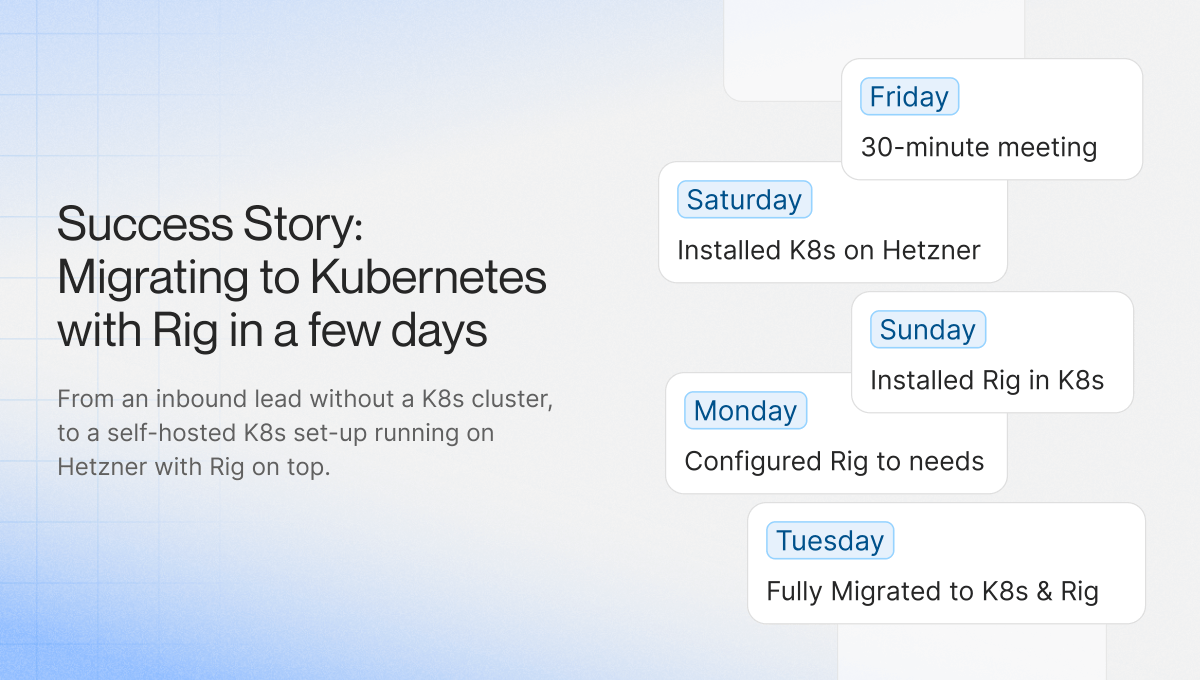
We recently got an inbound lead from a company looking to migrate to Kubernetes and wanted to evaluate Rig for their new self-hosted Kubernetes set-up on Hetzner using Rig.
We jumped on an intro call with them Friday, and they worked on setting up their Kubernetes clusters over the weekend. A few days later, they were fully migrated to Kubernetes and running in production using Rig.
If you're thinking about migrating to Kubernetes but are hesitant due to the complexity, we would love to have a chat and hopefully make it a more manageable project to embark on ⚡️
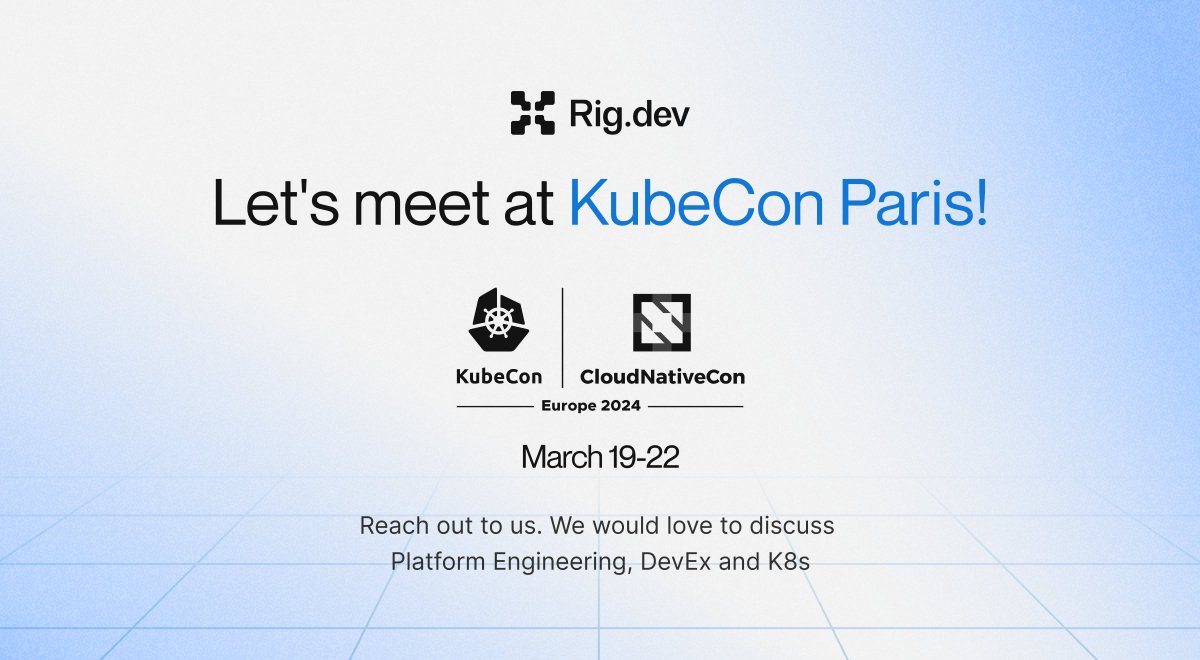
Most of our team will be at KubeCon in Paris next week, and we’re truly excited about a full week of discussing K8s, Platform Engineering and Developer Experience!
We would love to meet up to discuss best-practices and share notes on the space, so please drop us a comment or reach out directly to find some time 👋
@K8sArchitect Thanks for the shoutout @K8sArchitect 🙏
If anyone wants to take Rig for spin: https://t.co/7r7xs7OPK1
Feel free to reach out if you have any questions 🤘
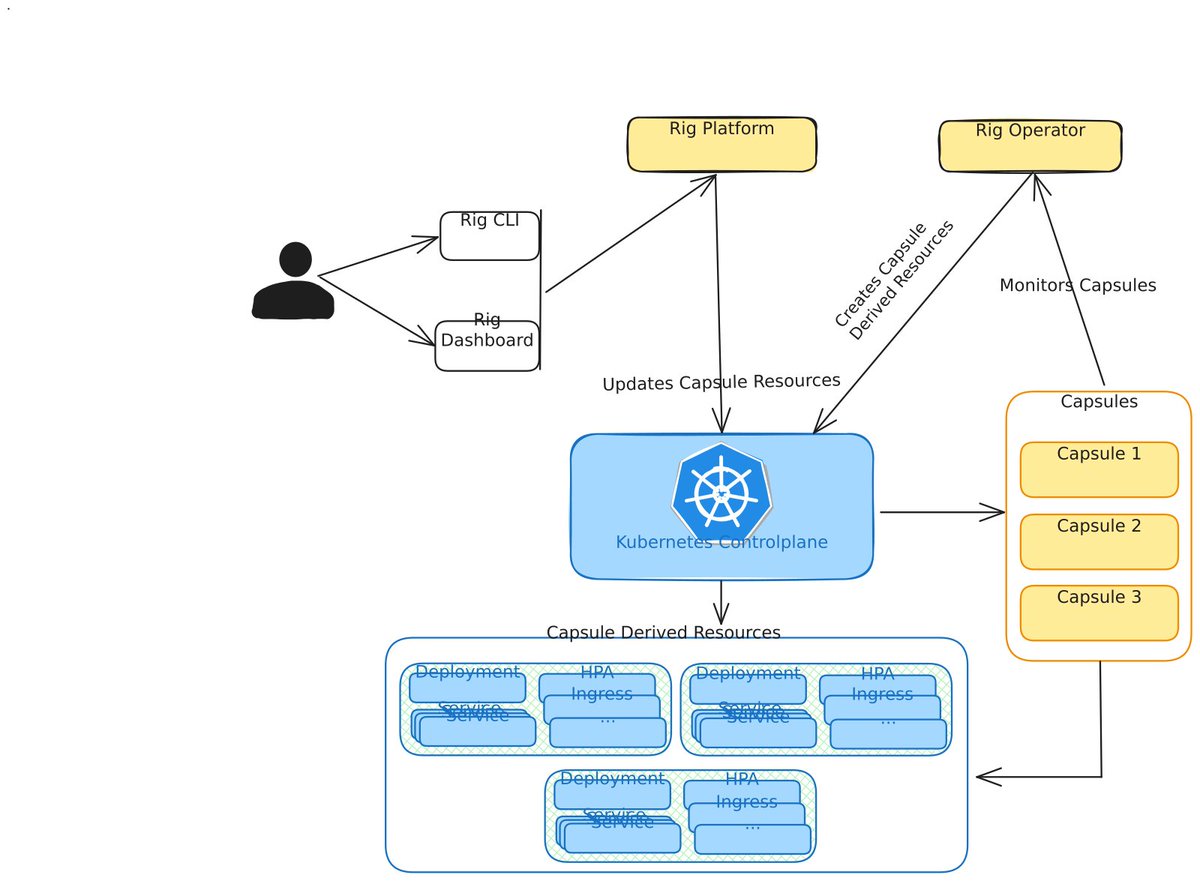
The Rig Platform offers an application platform for Kubernetes
Rig empowers developers to work in their environments with elevated application abstractions while leveraging Kubernetes's reliability, portability, and scalability
➜ https://t.co/feIfVx7wL2
When we work with companies, it's clear that GitOps has become a cornerstone in the cloud-native community.
We've worked on making the GitOps integration a seamless experience on the Rig platform.
Read our blog post on how we empower engineering teams to seamlessly integrate with Argo or Flux: https://t.co/Yv9D5xXEi2
Schedule a call with us to discuss platform engineering and developer experience: https://t.co/hRx3qhoDHJ
@EmmerichBret That doesn’t look right. Could you submit this error in our Discord channel? Then we’ll get right on it!🙌
Discord: https://t.co/ff6jT5w7pC