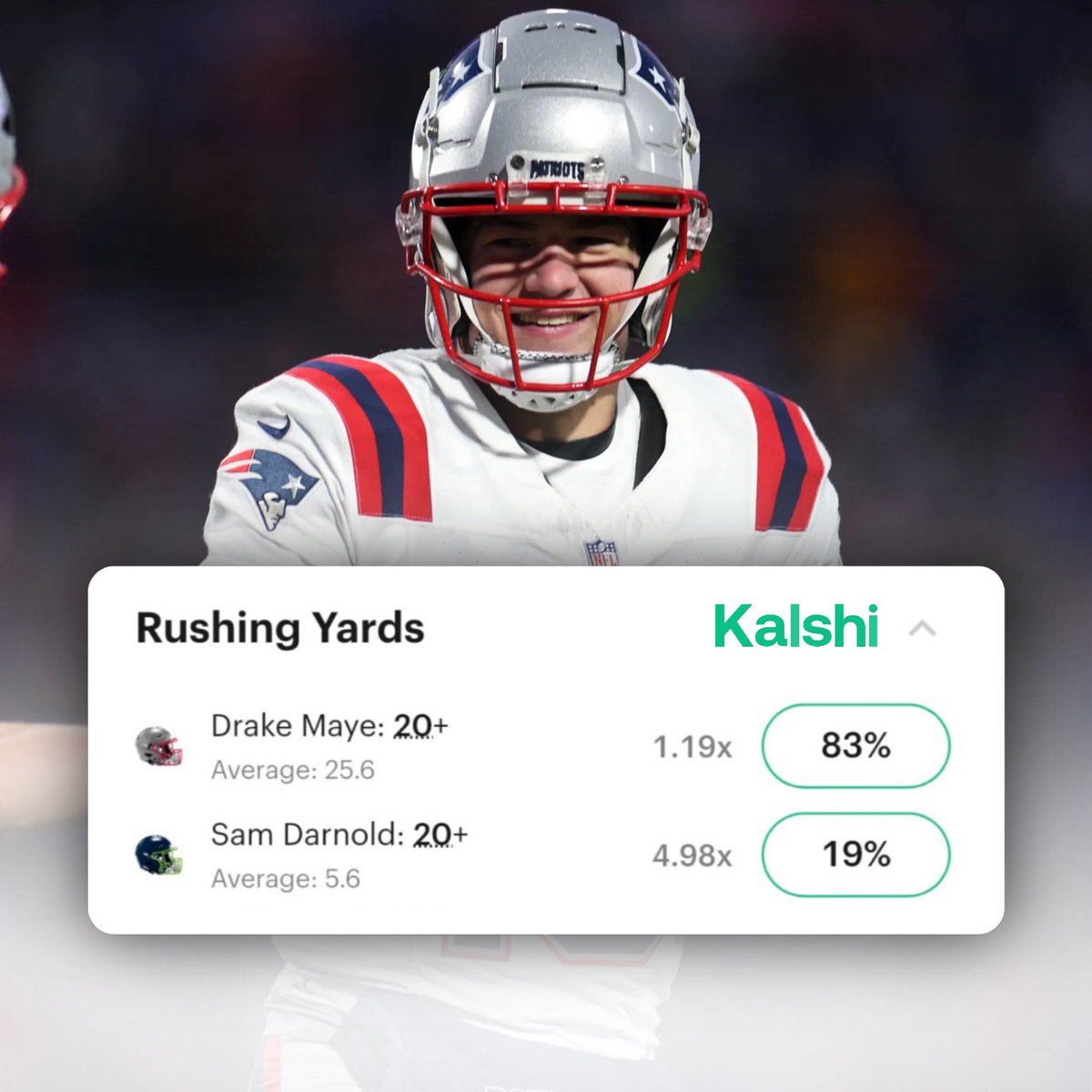
Kalshi gives Drake Maye an 83% chance to run for 20+ yards on Sunday (available in all 50 states).
What memorable QB runs have we seen in recent memory?
ONE MINUTE INTO ETERNITY
Dr. Stella Immanuel, a licensed physician and pastor, explains to Lara Logan why the greatest deception of our time is humanity’s blindness to eternity. She says if people truly understood what confronts the soul the moment after death, they would turn to Christ without hesitation.
Stella warns that fear, especially the fear of dying, is the enemy’s greatest weapon. She explains that spiritual blindness keeps people trapped, harassed, and intimidated, but that fear loses its power when someone understands who they are, whose they are, and why they were born. The safest place for anyone, she says, is in Christ, because to live is Christ and to die is gain.
In this clip, Stella reminds us that we were born to be reconciled to God, and that our purpose in this life is to bring His light into a dark world.
Watch the full episode. ⬇️
Going Rogue With Lara Logan
EPISODE 60 | HONEST MEDICINE
with Dr. Stella Immanuel
#GoingRogueWithLaraLogan #SoulfulSunday #HonestMedicine #DrStellaImmanuel #FaithOverFear
After almost twenty years of sharing the gospel in India, I have lost count of how many of my Hindu friends, relatives, and strangers have said the same thing to me. They admit openly that the idols they bow before are not real gods. They know it. They say it without hesitation. It is spoken almost the way Westerns speak about Santa later in life. Not real, but useful. A noble lie they say. Something cultural. Something emotional. Something passed down.
Scripture already told us this would happen. Romans 1:18 to 23 exposes this. It is not ignorance. IT IS SUPPRESSION. The truth about God is known, yet deliberately pushed down. Not because the evidence is lacking, but because acknowledging the true God would demand repentance and surrender.
Men do not worship idols because they think stone has life. They worship idols because idols make no moral claims. They ask for rituals, not repentance. They accept offerings, not obedience. They comfort the conscience without confronting the heart.
This is why idolatry survives even when belief collapses. It is not faith that keeps it alive. It is fear of the living God. When the true God is removed, something must take His place. And so, men exchange the glory of the incorruptible God for images that demand nothing and change nothing.
And this is where we must be honest. This problem does not end outside Christianity. We have done the very same thing within it.
Many who call themselves Christians admit something similar, though they use different language. They do not deny Jesus, but they reshape Him. They speak of a Christ who never confronts, never warns, never judges. A Jesus who exists to comfort but never to command.
Just as idols are shaped to fit human desire, we have shaped our own version of Christ. A Jesus who affirms our choices, blesses our plans, and never speaks of repentance. A Jesus who saves without lordship and loves without holiness.
Scripture warns us about this. Paul says there will come a time when people will not endure sound teaching but will gather teachers to suit their own passions in 2 Timothy 4:3. That is not paganism entering the church. That is idolatry wearing Christian language.
Even superstition has found a place among us. Crosses are treated like charms, verses are repeated like spells, prayer is reduced to technique, and worship is shaped more by atmosphere than by truth. We anoint everything with oil as though the bottle holds power, sprinkle water as though holiness can be transferred by touch, and chase methods instead of repentance. Faith is measured by outcomes rather than obedience, by results rather than surrender. What was meant to draw us to Christ has been turned into ritual without reverence, practice without truth, religion without the fear of God. And in doing so, we unknowingly replace living faith with sacred habits that demand nothing from the heart.
This is not far from what Romans 1 describes. It is still an exchange. Not of stone this time, but of truth. We exchange the real Christ for a manageable one. A Jesus who asks for admiration but not surrender.
The tragedy is not that people reject Christ openly. It is that many worship a version of Him that does not exist. And a false Christ cannot save, no matter how sincerely He is spoken about.
The living God cannot be edited. He is not a symbol. He is not an idea. He is not safe. And until He is known as He truly is, even Christianity can become another form of idol worship.
Why Natural Selection cannot build novel Proteins
The odds of finding a single functional protein - of any function - compared to the total amount of possible functional sequences, is 1 chance in 10^77 (for a short protein of just 150 amino acid sequence, most proteins are 300+ aa's).
The total amount of cells that have been estimated to have ever lived on Earth is only 10^40.
The odds are overwhelmingly prohibitive of blind chance + random mutation + natural selection stumbling across a single functional protein, let alone the thousands necessary for a single cell to survive.
But evolutionists argue that those odds are misleading, because evolution works incrementally - keeping what works and building on that slowly over lots of unobserved time.
Here is why that blind faith statement fails and is logically vacuous:
Proteins don't function until the sequence is complete. There would be no reason for natural selection to 'select' an amino acid sequence of just, say, 10 aa's, or even 20, or 50, and continue building on them, because they offer no functional benefit.
Evolutionists will say that proteins evolve one from another by slowly mutating them over time - but this assumes functional proteins already exist and that they're even capable of being mutated in such a way.
But there are many thousands of distinct protein families, with some estimates into the tens of thousands - which means they didn't evolve one from another. They are too different.
Furthermore, multiple studies show that randomly mutating amino acids in protein sequences destroys them long before they can possibly become a novel protein capable of some novel function. Most proteins can only tolerate as little as 3-10% mutations before destruction.
So no - evolutionary processes cannot just build proteins one amino acid at a time. Natural Selection only keeps what works, and proteins don't work unless they're complete.
The best explanation for how proteins and the irreducibly complex systems they create is that Life was Intelligently Created. Only intelligence is capable of producing specifically ordered, complex structures such as proteins and DNA.
Natural Selection is not Life's Savior.
There is only one Savior for Life, and that is Jesus Christ, who created you.
Matthew 2:1–12 records the arrival of Magi from the East who follow a star to worship the child Jesus. This account is not included for narrative color or devotional sentiment. Rather, Matthew presents an episode that would have been politically destabilizing, socially conspicuous, and theologically significant, announcing at the outset the arrival of a king whose claims would unsettle both earthly power and religious expectation
Who Were the Magi?
The Magi were not kings, and they were not wandering mystics. Historically, they were a learned priestly caste from the East who were trained in astronomy, astrology, dream interpretation, and sacred texts. They served royal courts as counselors, scholars, and religious specialists. In the ancient world, Magi advised kings, interpreted omens, and helped determine matters of state.
The Magi were outsiders to Israel, Gentiles by birth, but not ignorant pagans. Living in lands shaped by centuries of Jewish exile, they would have had access to Hebrew Scriptures, messianic expectations, and prophecies concerning a coming ruler associated with a star (cf. Num 24:17). When they saw an extraordinary celestial sign, they did not dismiss it. They interpreted it as the birth announcement of a king: one worthy of international homage.
Where Did They Come From—and How Long Did their journey Take?
Historians believe they most likely came from Babylon (modern day central Iraq) or Persia (modern day Iran). Their journey to Judea would have covered roughly 800–1,200 miles, depending on the route. Such a journey would not be measured in days or weeks, but months, possibly close to a year. Caravans moved slowly, carefully, and deliberately—\; and that was especially true when transporting valuable goods.
This alone helps us read Matthew more carefully. When the Magi arrive, Jesus is no longer in a manger. Matthew calls him a child (παιδίον), and he is living in a house. This is not the night of his birth. Time has passed. History is unfolding.
How Many Were There—and What Did Their Caravan Look Like?
Matthew never tells us how many Magi there were. The tradition of “three” comes from the number of gifts, not the text itself. Historically, Magi did not travel alone. They moved in large, well-protected caravans, accompanied by servants, guards, animals, and logistical support.
Whether there were three, six, or twelve Magi, the total traveling party could easily have numbered dozens or even hundreds. They were carrying gifts fit for royalty (gold, frankincense, and myrrh), items of immense value. Such a caravan would have been impossible to miss.
This explains Matthew’s striking phrase: “When King Herod heard this, he was troubled, and all Jerusalem with him.”This was not quiet curiosity. A foreign delegation of elite eastern dignitaries had arrived in the capital asking a dangerous question: “Where is he who has been born king of the Jews?” That question alone challenged Herod’s legitimacy.
Why Their Arrival Shook Jerusalem
Herod was a paranoid ruler installed by Rome. He was not of David’s line, and he knew it. He had killed rivals before: including family members. Now, learned foreigners were publicly announcing the birth of a rival king, validated not by rumor, but by a cosmic sign.
Jerusalem trembled because Jerusalem understood what this meant. When kings are announced, thrones are threatened. When heaven speaks, earthly power feels exposed.
Why Matthew Includes This Story
Matthew is doing far more than telling a Christmas story.
First, he shows that Gentiles recognize the true King while Israel’s ruler rejects him. From the beginning, the nations come to Jesus, while the establishment resists him.
Second, Matthew presents Jesus as the fulfillment of Scripture: not only for Israel, but for the entire world. The Magi’s journey echoes the prophetic hope that the nations would one day stream to Zion, bringing tribute to Israel’s God and his anointed king.
Third, the Magi expose the contrast between true worship and false power. They fall down and worship the child. Herod pretends he wants to do the same, but intends murder instead. Matthew is already preparing us for the conflict that will dominate his Gospel: the clash between the kingdom of God and the kingdoms of this world.
Finally, Matthew shows us that God’s redemptive plan has always been larger than ethnic Israel alone. From the opening genealogy to the closing Great Commission, Matthew insists that this King belongs not to one people only, but to all who will bow before him in faith.
The Scene Reconsidered
So when we picture the Magi, we should not imagine three quiet figures drifting across the desert beneath a sentimental star. We should picture a foreign caravan thundering into Jerusalem—guarded, wealthy, unmistakable—men who had traveled for months because they were convinced heaven itself had spoken.
And when they finally knelt before a child in a modest home, laying before him gifts fit for a throne, Matthew wants us to see what they saw: Not merely a baby.
But a new-born King—
recognized by the nations,
rejected by the powerful,
and appointed by God himself.
And Jerusalem trembled, because when heaven announces a King, every throne knows it will be tested.
When heaven announces a King, the response is never neutral: it's either worship or resistance. Which would Jerusalem choose today?
I went back to Luke this morning just to revisit the story of Christmas… and Luke 2:7 hit me like an arrow to the chest:
“She gave birth to her firstborn son. She wrapped him in cloths and laid him in a manger because there was no room for them in the inn.”
We romanticize that line so much that we forget how brutal it actually is. If the gospel narrative is true, then that’s not a cute nativity detail. That is the most explosive statement in human history.
The God who created galaxies entered His own creation… and there was no room for Him.
No royal welcome, no palace, no safety, no honor, not even a bed. He comes into the world He made, and the doors are closed in His face.
This is the single greatest scandal of Christianity: God doesn’t supervise salvation from a throne. He steps into it. He doesn’t arrive in glory. He arrives vulnerable. He doesn’t come intimidating humanity into submission. He comes as a child who can’t even hold His own head up. If you were inventing a religion, this is not the story you’d write.
Luke is quietly showing something staggering about God’s character:
He wins, not by force, but by love.
He saves, not by domination, but by self-giving. He comes close, not as a King demanding space, but as a Savior entering even when there is “no room.”
And that manger isn’t sentimental. It’s confrontational.
It confronts our pride, cos humanity has always had space for power, wealth, celebrity, and status… just never space for God unless He serves our plans.
It confronts our illusions of strength cos God is showing that real power isn’t the ability to crush. Real power is the courage to empty yourself for the sake of others.
It confronts religion, cos God bypassed temples and elites and arrived where animals feed… then announced His coming not to emperors, but to shepherds.
Luke 2:7 tells us who God is.
He is not distant, He is not indifferent, He is not cold sovereignty. He is the God who chooses weakness so He can stand with the weak. He is the God who walks into human pain instead of observing it from afar. He is the God who would rather be rejected with us than reign without us.
If this verse is true, Christianity isn’t just another belief system. It’s a radical claim that the deepest power in the universe is love; not might, not fear, not spectacle.
So yes… this verse broke me today.
Because if this is who God is… then hope isn’t sentimental. Grace isn’t theoretical. And Christmas isn’t “cute.”
It’s God stepping into history quietly…
exposing us gently… and saving us completely. Luke 2:7 isn’t a children’s story. It’s a revolution.
Merry Christmas 🎄❤️
At the very moment that Augustus is making decrees as the ruler of the known world, and Herod is seething in his palace, God enters stage right. Not on the clouds, asserting his power and dominance, not with all the strength and might he rightly has. But in humility. Doing so with a profound statement that he is turning all our preconceived notions completely upside down.
One of the most beautiful, yet often overlooked, components to this story is Mary’s reaction to the news of her Son. In church tradition we call her carol The Magnificat:
“My soul exalts the Lord, and my spirit has begun to rejoice in God my Savior, because he has looked upon the humble state of his servant.
For from now on all generations will call me blessed, because he who is mighty has done great things for me, and holy is his name; from generation to generation he is merciful to those who fear him.
He has demonstrated power with his arm; he has scattered those whose pride wells up from the sheer arrogance of their hearts.
He has brought down the mighty from their thrones, and has lifted up those of lowly position; he has filled the hungry with good things, and has sent the rich away empty.
He has helped his servant Israel, remembering his mercy, as he promised to our ancestors, to Abraham and to his descendants forever.” (Luke 1:46-55)
Amidst all the interpretations of Christmas that we hear at this time of year from clergy, advertisers, politicians, and journalists, we might benefit from listening to the mother who sits at the centre of it all. According to Mary, Christmas is about God scattering the proud, bringing down unjust rulers, lifting up the humble. It’s about God turning things upside down— which ironically is the right way up to begin with.
And God accomplishes all of this not “from on high,” like the decree of Augustus, or the brutality of Herod; instead, God achieves his purposes from below in the lowliness of a manger. With shepherds, livestock, and foreign magi as the first witnesses.
Christmas is about God turning things upside down—which ironically is the right way up to begin with.
Every detail about the Christmas story (and the subsequent life of Jesus as well), states that God will reverse the mess and do so by first getting his own hands dirty. God conquers by humbling himself, he will heal by being wounded, he will save us by sacrificing himself. The manger is a throne, and works as a beacon of how God intends to turn everything upside down.
Grace triumphs over dominance, mercy over force, and Mary’s song will be the world’s song. Joy will pierce through the sorrow and sadness, fully and forever.
The Bethlehem manger wasn't random; it was prophetic.
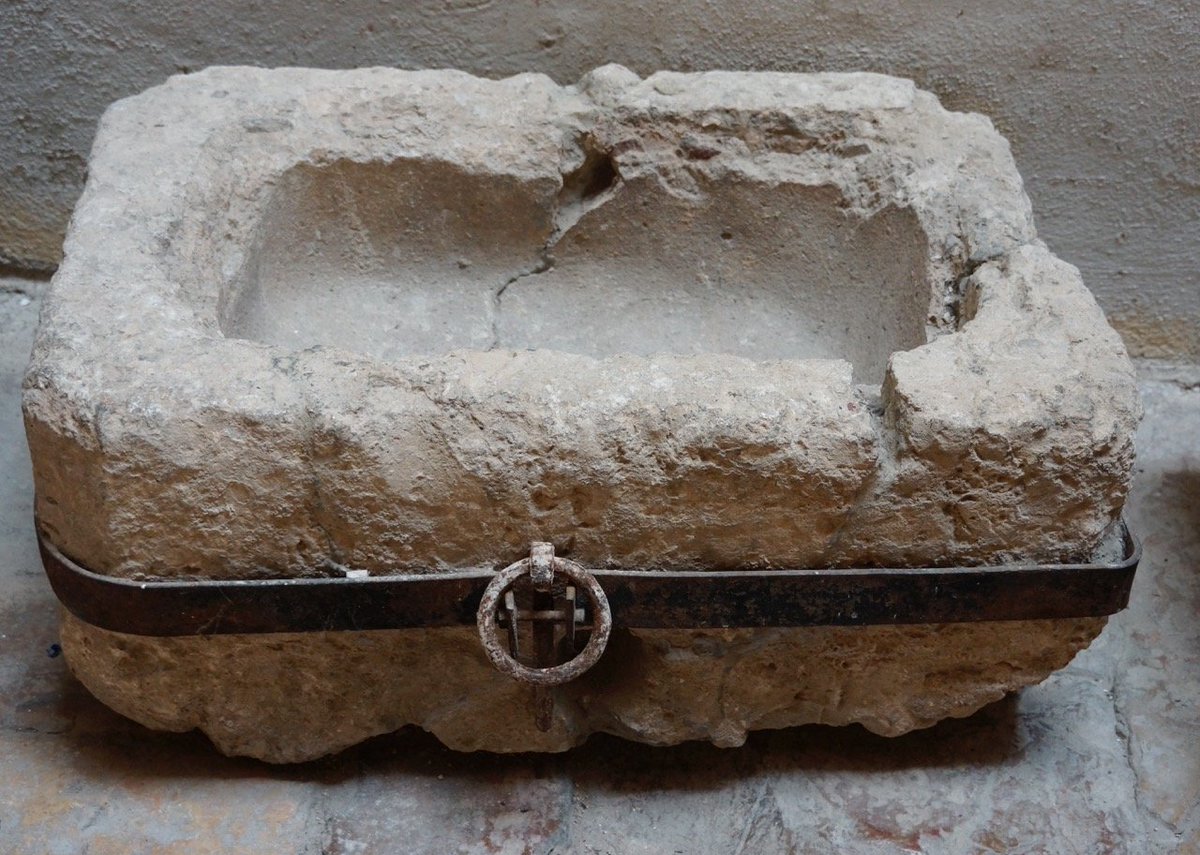
A lot of folks don't realize that when the Bible talks about Jesus being laid in a manger, the Greek word for it is "phatne," which just means a feeding trough. In Bethlehem back then, these were often carved from stone.
What's really striking about this is the shepherds around there. They raised lambs specifically for Temple sacrifices. Right after birth, they'd check each lamb for any flaws and put the perfect ones in a manger to keep them safe from getting hurt, since only spotless lambs could be used in offerings to God.
So here comes the Lamb of God himself, placed in the exact spot where those sacrificial lambs were protected.
And who do the angels tell about his birth? Not rulers or religious leaders, but these shepherds, guys who knew all about sacrifice, blood, purity, and flawless lambs.
When the angels said, "You'll find a baby wrapped in swaddling cloths and lying in a manger" (Luke 2:12), it clicked for them right away.
This wasn't some ordinary child. He was the ultimate Lamb, the one who'd remove the world's sin. From day one, Jesus was set apart for sacrifice, not by people, but by God.
"Behold, the Lamb of God, who takes away the sin of the world." (John 1:29)
*Jesus is the reason for the season.
Merry Christmas!
1907: Electric lights replace candles. Procter & Gamble's candle business collapses. They pivot to soap but animal fats are expensive.
They need cheaper alternatives. Enter cottonseed oil.
Cotton seeds contain oil, but it's toxic to humans - gossypol, a natural pesticide. The seeds are agricultural waste, fed to cattle in small amounts or discarded.
But chemically extract the oil, heat it to extreme temperatures, hydrogenate it with pressurized hydrogen gas, and you get solid white fat that looks like lard but costs pennies.
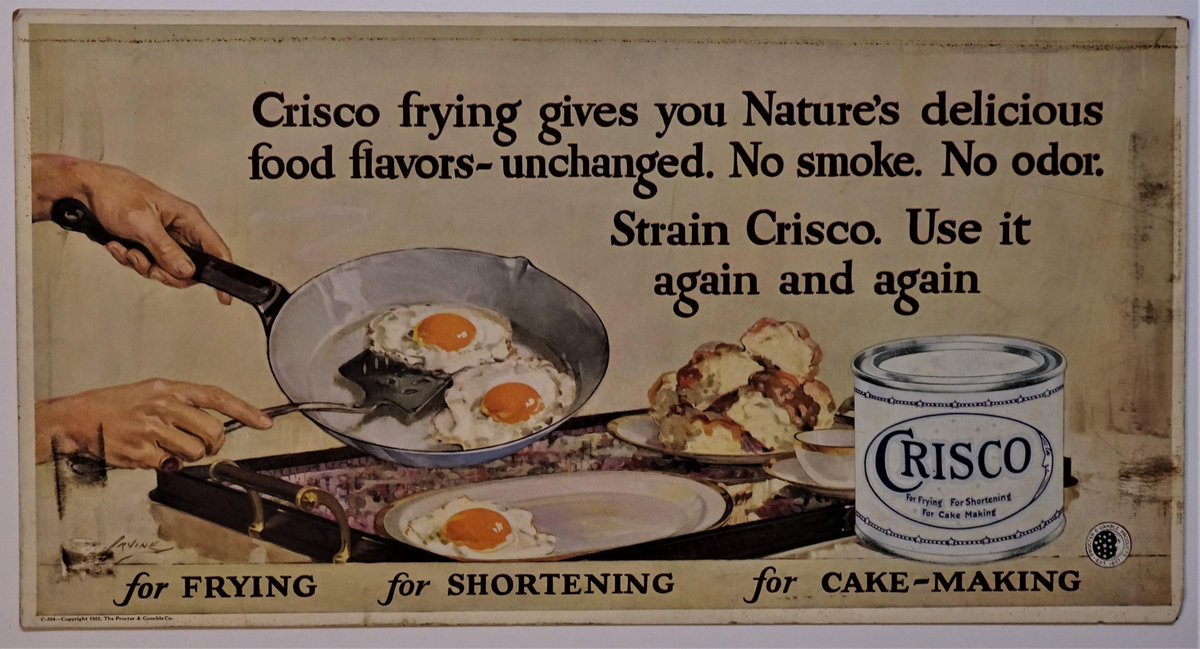
They patent it in 1907, launch Crisco in 1911. Crystallized cottonseed oil.
Industrial waste transformed into soap substitute.
Except they don't market it as soap. They market it as food.
Problem: nobody wants to eat textile manufacturing waste processed with industrial chemicals. Your grandmother cooks with lard and tallow like humans have for thousands of years.
Solution: Convince America that animal fats are killing them.
Procter & Gamble spends millions on marketing. Cookbooks, radio shows, free samples. They target Jewish communities advertising Crisco as kosher - "neither meat nor dairy!"
But the genius move: 1948. The American Heart Association has $1,700 in their budget. Procter & Gamble donates $1.7 million.
Suddenly the AHA has funding and influence. And suddenly they're very interested in dietary causes of heart disease.
1961: The AHA issues first dietary guidelines. Avoid saturated fat from animals. Replace with vegetable oils. Recommended oils: Crisco, Wesson, and other seed oils.
Who benefits: Procter & Gamble. Who funded the AHA: Procter & Gamble.
The conflict is blatant. Nobody cares.
Never mind that humans ate animal fats for millions of years without epidemic heart disease. Never mind that seed oils oxidize rapidly and integrate into cell membranes creating inflammation for years.
Industrial cottonseed waste is now "heart healthy" and butter is "artery-clogging poison."
1980s: Trans fats are discovered to be catastrophically unhealthy. They directly cause heart disease.
Procter & Gamble's response: Quietly reformulate, keep selling seed oils, never acknowledge their "heart healthy" product spent 70 years actively causing disease.
No apologies. No compensation. Just reformulate and continue.
Modern research shows seed oils cause oxidative stress, inflammatory cascades, mitochondrial dysfunction, increased cancer risk, and neurodegenerative disease.
Your body requires exactly zero grams. They didn't exist in human diets until 1911.
But Procter & Gamble needed to sell soap alternatives and accidentally created the largest dietary change in human history. We traded animal fats that built civilizations for factory waste that causes disease.
The soap company won.
"If you are pro-vaccine, you are anti-science."
Del sat down with Dr. Brandon Crawford to discuss the award-winning film "An Inconvenient Study."
Del: "There is not a single study in the entire world - not from one single health department in any nation in the world - that can show you a study that compared their vaccinated kids to their unvaccinated kids and showed that the vaccinated are the ones who have better health outcomes...
Why? Why can't anyone in the world show us a study that the vaccinated are healthier? It doesn't exist. You would think they could manipulate it. And that's why I think when you look at the Henry Ford study, you realize why they can't. The disparity between these two is so vast. There's no way to manipulate the study to somehow get the vaccinated to look like they're healthier.
And now what we're left with is a scientific body is never going to admit it was wrong because it's liable. They're liable for trillions of dollars in damages now because they made us take these products, telling us it was making us a healthier nation....
So, we're in a position now where you could sit as a parent, I'm going to have to use my own intuition now, and I'm going to have to do my own deep research, and I'm going to have to start making decisions because I don't want my child's health to be based on a coin toss. It's worse than a fifty-fifty coin toss if your child is going to be free of chronic disease or not. Much worse.."
We have accomplished more in the last few weeks than anyone expected — and now it’s real.
The American Rancher Alliance is moving REAL American beef into grocery stores as early as January.
Full transparency. Fair prices. No packer games.
We’ve talked to the retailers.
Our producers are ready.
Processors are lining up shackle space.
This movement is moving at full speed — because America needs it now.
If you finish cattle or you’re a farm-to-table producer, we need you ASAP.
If you’re cow/calf, you are the backbone of this entire supply chain — and you’re right behind them.
We are decentralizing the beef system, bringing American beef back to American consumers, and lowering grocery prices while paying producers fairly.
This is real.
This is happening.
And we are just getting started.
👉 Producers: Sign up at https://t.co/7KwykytAVF
👉 Consumers: Follow the movement and share this.
American beef. American hands. American shelves.
Let’s take it back.
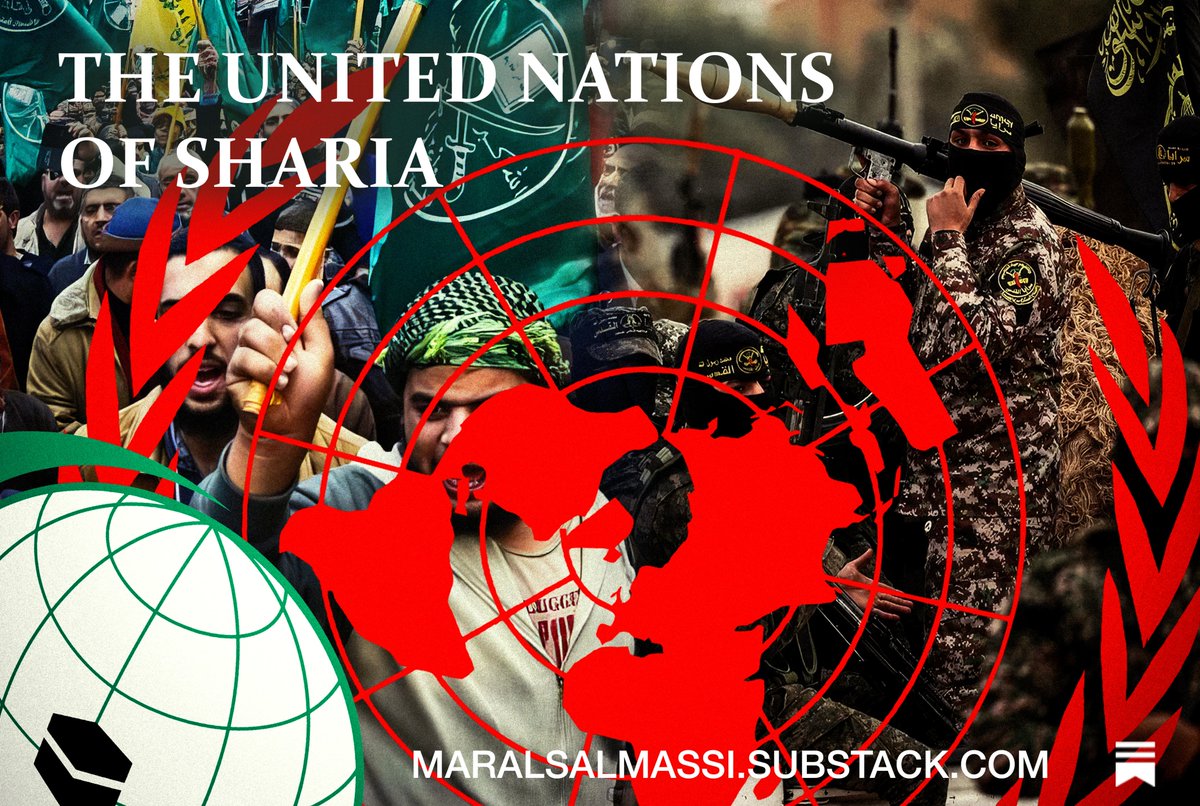
One of the most unsettling mysteries of our time is the astonishing descent of the United Nations. Established after the Second World War with the mission “to reaffirm faith in fundamental human rights, in the dignity and worth of the human person, in the equal rights of men and women and of nations large and small,” it has drifted far from these initial, honorable goals. Today, the UN primarily serves as a special-interest conglomerate for the world’s theocracies and dictatorships.
This development should surprise no one.
The architecture of the UN was built on the assumption that states — not values — are the primary actors in the international order.
If a bloc is large enough, votes in coordination, and controls key committees, its worldview becomes part of the UN system, no matter how illiberal.
So when we ask why Saudi Arabia, Iran, Pakistan, or Qatar sit on the UN Human Rights Council or the UN Disarmament Commission, the answer is simple:
Because the UN is not a moral institution, it is a geopolitical marketplace where blocs trade power, legitimacy, and silence.
To understand the UN’s spiral of decline, we must go back to 1969, when a mentally ill Australian Evangelist set fire to the Al-Aqsa Mosque in Jerusalem. Arab nationalist leaders immediately seized the incident to ignite a pan-Islamic political awakening. In September that year, twenty-four Muslim-majority countries gathered in Rabat and founded the Organization of the Islamic Conference — later renamed the Organization of Islamic Cooperation (OIC).
Today, the OIC can outvote the EU, North America, Latin America, and the Pacific combined. Its fifty-seven member states move as a unit — institutional, diplomatic, coordinated, and consistent over decades.
On 5 August 1990, the OIC adopted the Cairo Declaration on Human Rights in Islam, effectively redefining human rights not as universal and inalienable but as conditional on conformity with Islamic Sharia — a radically different foundation than the Universal Declaration of Human Rights. The signatories were the foreign ministers of forty-five Islamic states. The origins of this document are an overlooked geopolitical turning point.
From 26–28 December 1989, a “Committee of Legal Experts” met in Tehran to examine a draft and produce the report that became the basis for the Cairo Declaration. At the time, Iran had just emerged from the brutal Iran–Iraq war. Khomeini had died months earlier, and the Islamic Republic was consolidating its revolution and exporting its model of Islamic governance as a core foreign-policy objective. Hosting the drafting of the OIC’s human-rights framework on Iranian soil gave the Ayatollahs disproportionate influence over the tone, theological foundations, red lines, and the language tying rights to Sharia, as well as the document’s hostility toward Western universalism.
Iran did not “author” the Cairo Declaration, but it unmistakably shaped its intellectual frame.
However, the ideological architecture of the Cairo Declaration also reflects the Muslim Brotherhood’s long-standing project to create an “Islamic alternative” to universal human rights — including the criminalization of criticism of Islam. Brotherhood jurists spent decades pushing for blasphemy restrictions; the OIC elevated this into international policy. Another core Brotherhood doctrine — shared with the Shi’ite theocracy in Iran — is that the Palestinian cause unites the Muslim world. This doctrine is the engine behind the absurdly high number of anti-Israel resolutions issued by the OIC bloc and its authoritarian allies.
Delegitimizing Israel is the OIC’s fuel. The “Palestinian cause” is its perpetual motion machine — generating political unity, religious fervor, moral superiority, ideological identity, anti-Western sentiment, anti-Jewish conspiracy thinking, and universal justification for violence. The OIC knows that without the Palestinian issue, half its totalitarian member governments would face internal revolt tomorrow.
Yet the question no one in the West asks is this:
Why is there an Islamic Council representing fifty-seven Islamic countries at the UN — but no Buddhist, Christian, or Hindu bloc?
The answer is the core civilizational distinction that Western academics, diplomats, and journalists cowardly refuse to admit, because acknowledging it collapses the entire multicultural and postcolonial narrative.
Islam is the only major religion that is simultaneously:
-a legal system (fiqh)
-a constitutional model (Sharia governance)
-a criminal code (hudud)
-a civil-law framework (marriage, divorce, inheritance)
-a doctrine of warfare (jihad)
-a taxation system (jizya, kharaj)
-a theory of governance (caliphate, imamate)
-a theory of international relations (dar al-Islam vs. dar al-harb)
This is not “Islamophobia.”
It is simply the architecture of classical Islam.
Buddhism has no legal code.
Christianity has no unified legal system.
Hinduism has no universal state apparatus.
Judaism is a legal tradition that applies only to Jews.
Sikhism, Jainism, and Taoism are spiritual paths, not governance models.
Islam is different. It is a civilizational operating system.
And this — and only this — explains why there is an Islamic political bloc at the UN.
Thus, the OIC is not a religious council or spiritual body.
It is a geopolitical Sharia lobby whose purpose is to:
-Defend Sharia-based governance
-Protect Islamic regimes from criticism.
-Suppress free speech about Islam globally.
-Advance blasphemy norms
-Coordinate anti-Israel rhetoric
-Promote Islamic civilizational identity.
-Expand influence in UN agencies.
Enforce Muslim unity against internal dissent and external scrutiny.
It plays the same role the Caliphate once played — but modernized, bureaucratized, and absorbed into the UN system.
And the architecture of global politics makes no sense until you acknowledge this reality:
The OIC is the predictable modern expression of Islamic political theology. Through its voting power in the UN, it now exerts disproportionate influence over global norms — influence increasingly shaping Western discourse and policy.