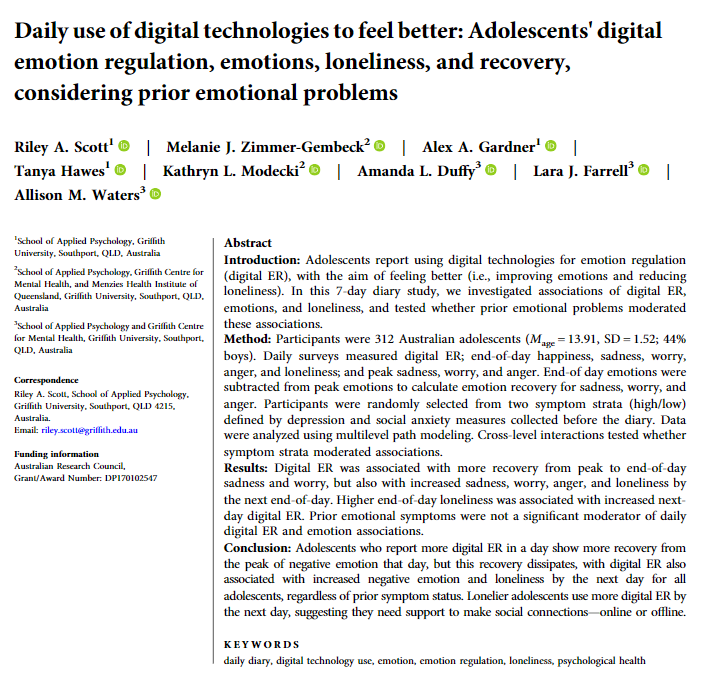
🤳Adolescents use digital technologies for emotion regulation - to improve emotions and reduce loneliness - but does it work? In our new #openaccess paper, a 7-day diary study, we tested links between digital ER, emotions, and loneliness. Check it out! https://t.co/rkhFQizVBN
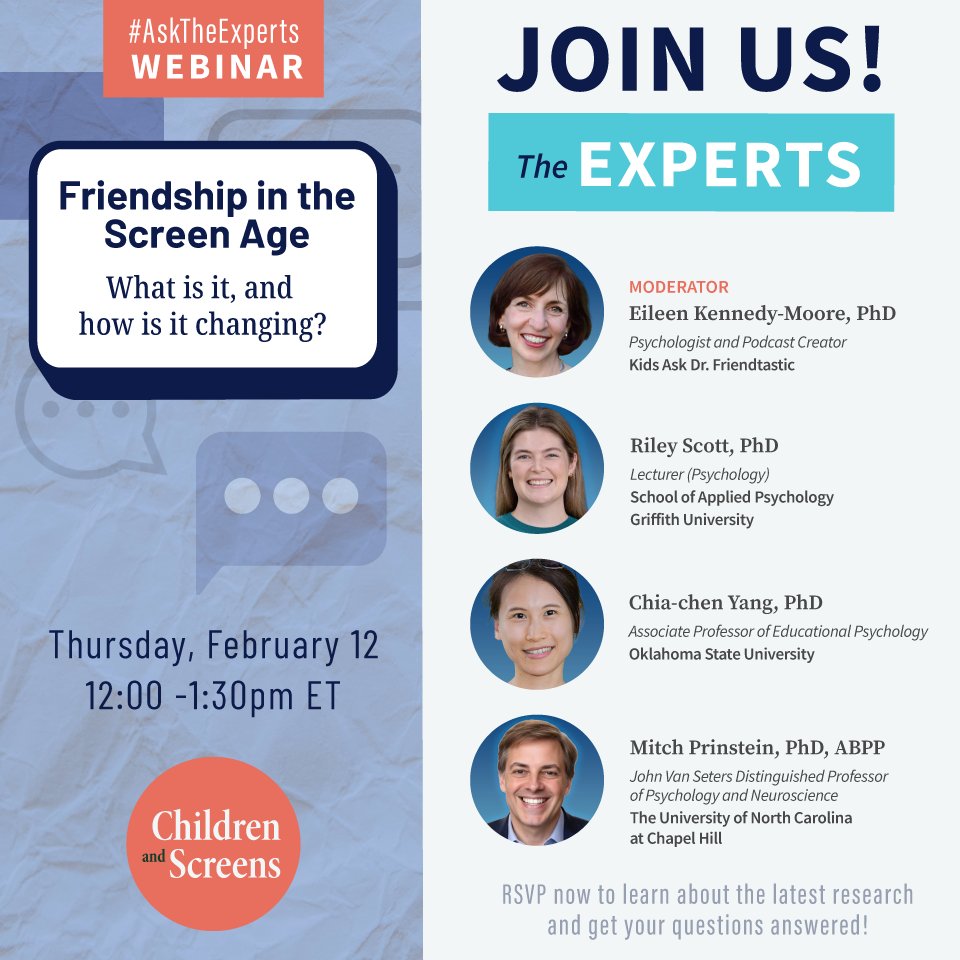
TOMORROW! Sign up now for the free #AskTheExperts webinar “Friendship in the Screen Age."
Join Children and Screens for an exploration into how technology has redefined what it means to be a friend in the #DigitalAge. Register 👉 https://t.co/Hx3b4kVr3D
Engaging and Influencing Learners in the Digital Age of Higher Education 🏫 https://t.co/OZcxlKYG9v
How can educators adapt to today’s digital-native learners? @jaimee_stuart@UNUMACAU and @RileyA_Scott@unisqaus propose in their latest @timeshighered article suggest drawing inspiration from influencer strategies to foster deeper connections in virtual learning environments.
🎯 Takeaways:
- Prioritize meaningful emotional or cognitive involvement: learning is more than logging in
- Choose tools that demonstrate clear value for connection and learning
- Make the reasoning clear behind course tools and methods
- Establish a digital social presence that extends beyond the classroom
- Avoid mirroring all social media traits: keep pedagogy at the heart of innovation
…and more
Read the full article: https://t.co/OZcxlKYG9v
Presenting yesterday at the #SRCD2025 Peers pre-conference with Prof Amy Bellmore. We talked through many positives and negatives of online engagement and social media for peer interactions, and the social media bans in Australia. Loved being part of these discussions!
The deadline to submit your abstracts for the IAIR and IACCP Conference in Brisbane has been extended to 10th January 2025!
Don’t miss this opportunity to share your research and engage with the latest developments in the field.
Submission Link: https://t.co/RHyXp45G7c
This!! Everything about this! 👏 so many of the core developmental tasks for young people are now happening online *and* offline. We must move towards educating youth and supporting their skill development and critical thinking/social media literacy rather than just restricting.
People often confuse 'safe' social media use with 'less' social media use, overlooking the need for education on skills and competencies around social media/online engagement, critical thinking, and *importantly* engaging WITH young people in decisions that affect them.
I can think of a few, like cutting off critical support and information resources and limiting opportunities for social connection and identity exploration - especially for vulnerable youth.
Still waiting to for any plans that might educate and empower youth and families online.
Yes, there are risks of social media for youth mental health and well-being. Yet a blanket ban is a simple, inadequate way to address these risks and lacks empirical support. There are also tremendous benefits that are being lost and intentionally overlooked in these proposals.
📢 Keen to join us in Brisbane next year for the first ever joint conference between IAIR and IACCP?
Please share with your networks and check out https://t.co/6YVnN5jAga for more information and to submit!
@IAIR_Official@IACCP#interculturalrelations#crossculturalpsychology
There is a new report claiming that observed declines in youth #mentalhealth since 2012 is due to the rise of #socialmedia. I don’t often criticise research online, but given the escalating policy discussions & public concern I think it’s important to unpack this further 🧵 1/9
The surgeon general has called for for a warning label saying "social media is associated with significant mental health for adolescents." But does the scientific research support that conclusion? I reached out to half a dozen prominent researchers, and here's what they said:
1/n
Have had a great week in Lisbon at #ISSBD2024 presenting, networking, and learning about new and exciting research! Thanks to those who came to our symposia for the many great discussions and questions.
New research out now! Of course, there are several risks associated with social media and internet use, but there are also many benefits that we don’t acknowledge as often. Grateful to have this spotlight shared today.
Read our open access paper here 👇
https://t.co/ntnzZqkFma
Now here's something to 'like' 📲
Dr @RileyA_Scott's new research has revealed that online interactions with friends are more frequent, sincere and fun than in person for socially anxious youth.
@sciencedirect 💛
Couldn’t agree with this more. “Online” and “offline” are not two different places… They depend on us for their safety – not by taking their spaces away but by making them better spaces” https://t.co/bq5wHZXa7e
🚨 New research out now!
In this study, led by Prof Melanie Zimmer-Gembeck, we explored risks and resources for adolescents' and young adults' online appearance preoccupation. Check it out! #openaccess@Griffith_CMH@unisqaus https://t.co/q6KCM7fMRg