Rise is the fastest and most flexible way to hire, onboard, and pay globally distributed teams in fiat, stablecoins or cryptocurrencies, all from one place.
Our new Employee Cost Calculator is now live ✅
Estimate costs for international employees in real time.
Explore country sources and build a clearer hiring budget.
See employer contributions and employee deductions side by side.
Try out the calculator today at https://t.co/Jkme3OpaKK
Cross-border payroll still often means multi-day wires and fees that quietly eat several percent of each transfer before a contractor sees the money.
Polygon's case study with Rise digs into why the rail itself matters for that problem: confirmations measured in seconds, and fee levels that do not erode wage budgets the way legacy correspondent chains do.
The useful framing is not crypto payroll as a novelty. It is matching settlement speed and cost to how global teams already work.
Full piece from Polygon:
https://t.co/xTscBqXgQF
Cross-border B2B settlement still often means multi-day wires and opaque fee stacks.
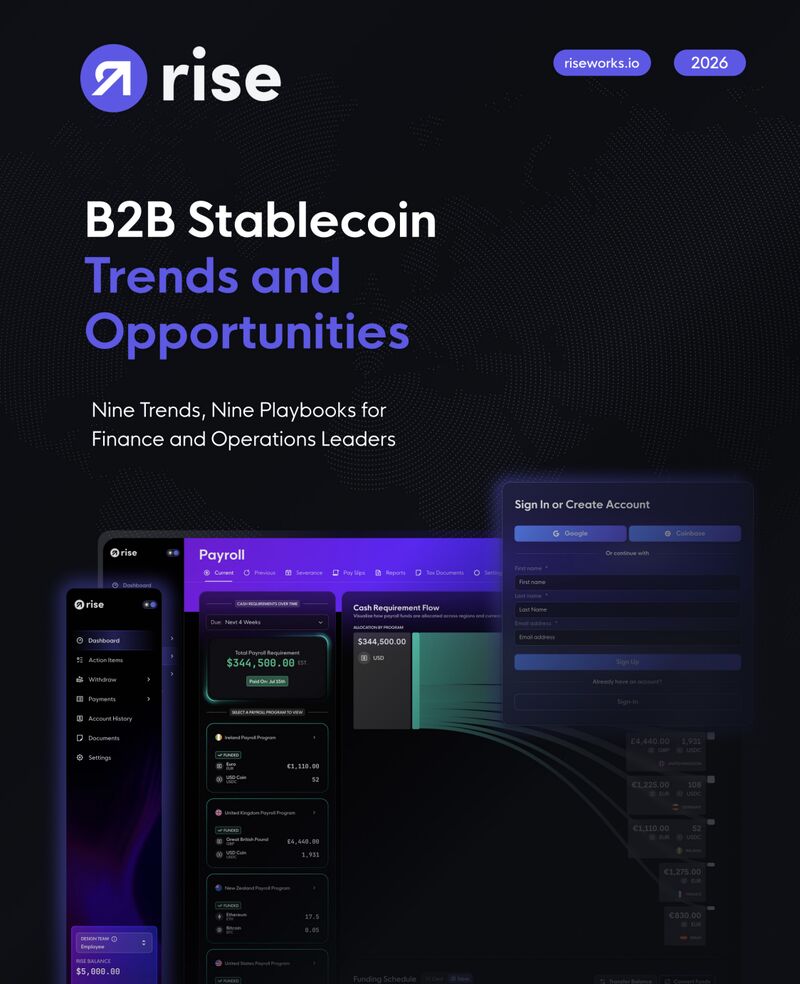
In Rise's B2B Stablecoin Trends and Opportunities 2026 report, one pattern stands out: stablecoin rails can settle cross-border in under five seconds at under 0.1% cost.
That timing gap is why more finance teams are mapping which corridors still sit on SWIFT-era pacing, and which ones can move first without breaking reconciliation.
Nine playbooks for making that shift are in the free report:
https://t.co/g8bxKnAPYf
Rise now connects to QuickBooks, Xero, Rillet, and Campfire.
Every payment you make in Rise, fiat or crypto, lands in your accounting system automatically.
No exports, no manual entries, no month-end cleanup.
Learn more at https://t.co/cXIW0HdvbJ
Your team is global, but your payroll funding is probably still stuck in one currency.
Most payroll platforms force a single path: fund in fiat, pay in fiat.
That model breaks when your treasury holds USDC and your contractors want local currency, or the reverse.
Rise removes that trade-off.
Here's how it works:
1) Fund payroll in local currency or stablecoins like USDC
2) Access 90+ fiat currencies and 100+ crypto assets
3) Team members choose their withdrawal method, fiat to a bank account or stablecoins to a wallet
Finance keeps control of how payroll is funded.
Your team keeps control of how they get paid.
Every payment runs on SOC 2 Type II security and is backed by an official Circle/USDC partnership.
Learn more about flexible payroll funding with Rise below:
https://t.co/5VHWgbgCkQ
High-volume USDC/USDT contractor payroll cares less about which wallet you open and more about which rail you settle on.
On busy days, mainnet gas and fee swings can turn a routine payday into an ops problem — especially when you’re paying many people at once.
Polygon is built for that kind of throughput: lower, more predictable costs for frequent stablecoin transfers, without changing how teams already think about USDC and USDT payroll.
More on the Polygon rail: https://t.co/c1QvoEFTWa
Annual B2B stablecoin volume reached about $226B as of early 2026.
That is still only about 0.01% of the roughly $1.6 quadrillion global B2B payments market.
Headline growth can distract from that gap. Most business-to-business money still moves on older rails.
The opportunity is not another trading narrative. It is replacing slow, expensive settlement for invoices, suppliers, and payroll corridors that already exist.
We break down where that whitespace shows up in the B2B Stablecoin Trends and Opportunities 2026 report:
https://t.co/g8bxKnBnNN
Introducing Daily Payroll from Rise.
Offer your global employees daily pay in local currency or stablecoins.
No more waiting two weeks for a paycheck. No more currency conversion headaches. No more choosing between speed and compliance.
With Rise, your team gets paid on their schedule, not your payroll cycle:
→ Daily payouts in 90+ fiat currencies or 100+ crypto assets
→ Built-in stablecoin infrastructure, not bolted on through a third party
→ SOC 2 Type II compliant
Cash flow shouldn't dictate when your people get paid.
Daily Payroll puts control back where it belongs: with your workforce.
Ready to see it in action?
Learn more here → https://t.co/ME4ITN8buX
The World Banks Remittance Prices Worldwide tracker puts the global average cost of sending $200 at 6.36% in Q3 2025.
That number is fees plus FX markup across hundreds of corridors. It is still more than double the G20 commitment to get the global average down to 3%.
For companies paying contractors and employees across borders, the same corridor friction shows up as opaque FX, multi-day settlement, and payroll teams reconciling money that arrives late and short.
The useful question is not whether cheaper rails exist. It is whether payroll and treasury can use them without running a second process beside the bank rails they already rely on.
Source: World Bank, Remittance Prices Worldwide, Issue 54 (Q3 2025)
https://t.co/GgjJJccyxL
Five years ago, paying a contractor across borders usually meant a multi-day wire, a chain of correspondent banks, and fees that could take 6% or more off the transfer.
Stablecoins changed the plumbing, not just the payroll UI.
In a March CEOColumn feature, Rise CEO Hugo Finkelstein maps how that shift moved from freelancer demand to institutional rails: workers asked for stablecoin payouts first, then regulation and treasury teams caught up.
The useful idea is hybrid payroll.
The employer runs one funding and compliance process.
Each pay cycle, the worker picks the output (local currency or a stablecoin) without rebuilding the run.
That is what collapses the old split between “traditional payroll” and “crypto payroll.”
Worth reading in full via CEOColumn:
https://t.co/5F8alZAvyW
Most people still hear “crypto payroll” and picture a volatile token on payday.
That’s not what’s actually scaling.
The rail that’s moving is dollar-stable. Employers that are not crypto companies are using it because settlement is faster than a wire, and the value doesn’t swing overnight.
The open question is no longer whether the money can move. It’s whether payroll, compliance, and how someone gets paid sit on that rail, or next to it.
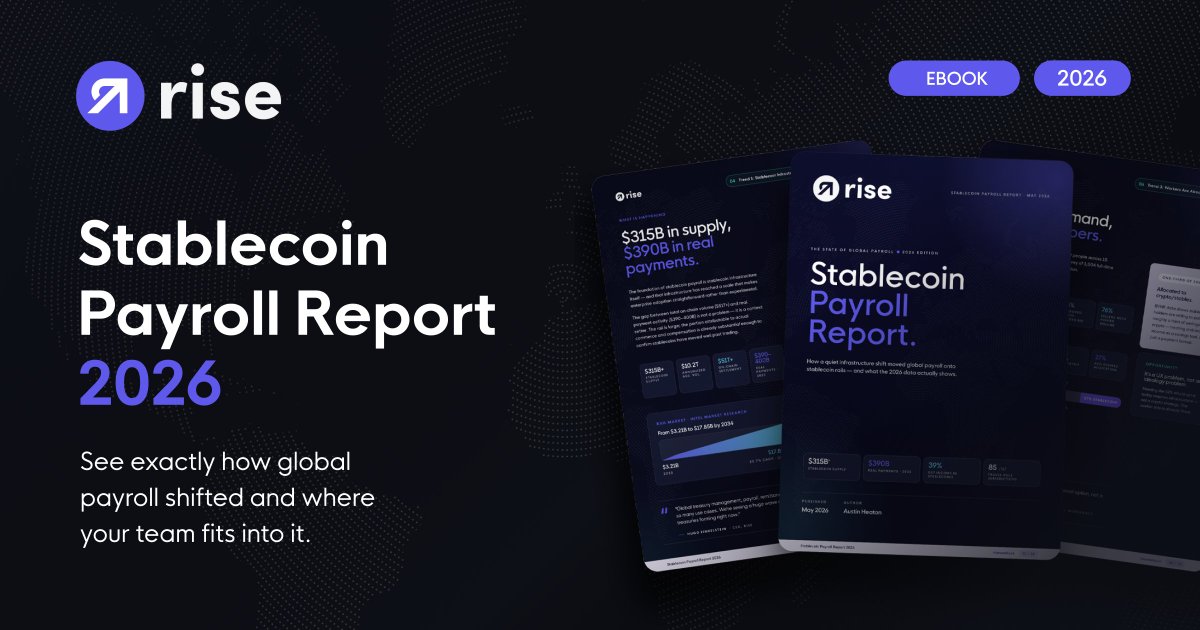
The 2026 report is the picture of that shift.
https://t.co/gf5SVwESlJ
Rise is a proud sponsor of the latest LatAm stablecoin report from @stablecoininfo in partnership with @Velafi_global, @pomelo_latam, Mandioca, and Movantis
The LatAm region is one of the fastest growing in the world when it comes to stablecoin volume, and countries like Brazil are leading the way with 90% of crypto transactions now being conducted in stablecoins.
To get an insight look at the 2026 LatAm stablecoin ecosystem, download your copy of the report below.
https://t.co/pTvErgArL0
Paying global contractors from a crypto treasury is not mainly a wallet problem.
It is a contracting and compliance problem.
Pool Maintenance Labs is a small IT shop that works under a grant from Lido DAO token holders.
Their roster changes through the year: some freelancers stay long-term, others need a statement of work written immediately for a short project.
Several of those contracts have to be paid in crypto.
What they needed was compliant onboarding, localized agreements they could customize, and payouts in the required currency, without opening a bank account in every country a contractor happened to live.
That is the process they put in place in 2022, and they have used it since launch.
As their finance manager put it: being able to sign statements of work quickly and execute invoice payments in a compliant way is a huge facilitator for doing the work.
https://t.co/EsHRFz5mxH
Most payroll products treat crypto as an add-on.
A wallet gets bolted onto a legacy stack, and settlement still waits on the same bank rails.
Mercury’s March story on Rise is a useful look at the inverse: settle on-chain first, then let local-currency withdrawals sit on top of those rails.
Hugo Finkelstein, Rise’s CEO, put the constraint simply. Paying in USDC has to feel like paying in any other currency, or finance teams will not use it.
Circle’s Jeff Lennox called that “a textbook example of how stablecoins can transform cross-border payments.”
Mercury also notes that more than half of contractors on the platform now choose a stablecoin payout.
The piece is here if you want the full arc:
https://t.co/nQPUNoolcp
Most people still hear “crypto payroll” and picture a volatile token on payday.
That’s not what’s actually scaling.
The rail that’s moving is dollar-stable. Employers that are not crypto companies are using it because settlement is faster than a wire, and the value doesn’t swing overnight.
The open question is no longer whether the money can move. It’s whether payroll, compliance, and how someone gets paid sit on that rail, or next to it.
The 2026 report is the picture of that shift.
https://t.co/gf5SVwESlJ