Many people have asked me why liquidity appears low, and why we see very little liquidity.
To put it simply, the liquidity is held in the hook contract; the small amount of liquidity visible in the pool is used to provide the band, which accounts for approximately 10% of the total liquidity.
When a swap occurs, liquidity is drawn first from the band and then from the hook.
Why store liquidity in the hook?
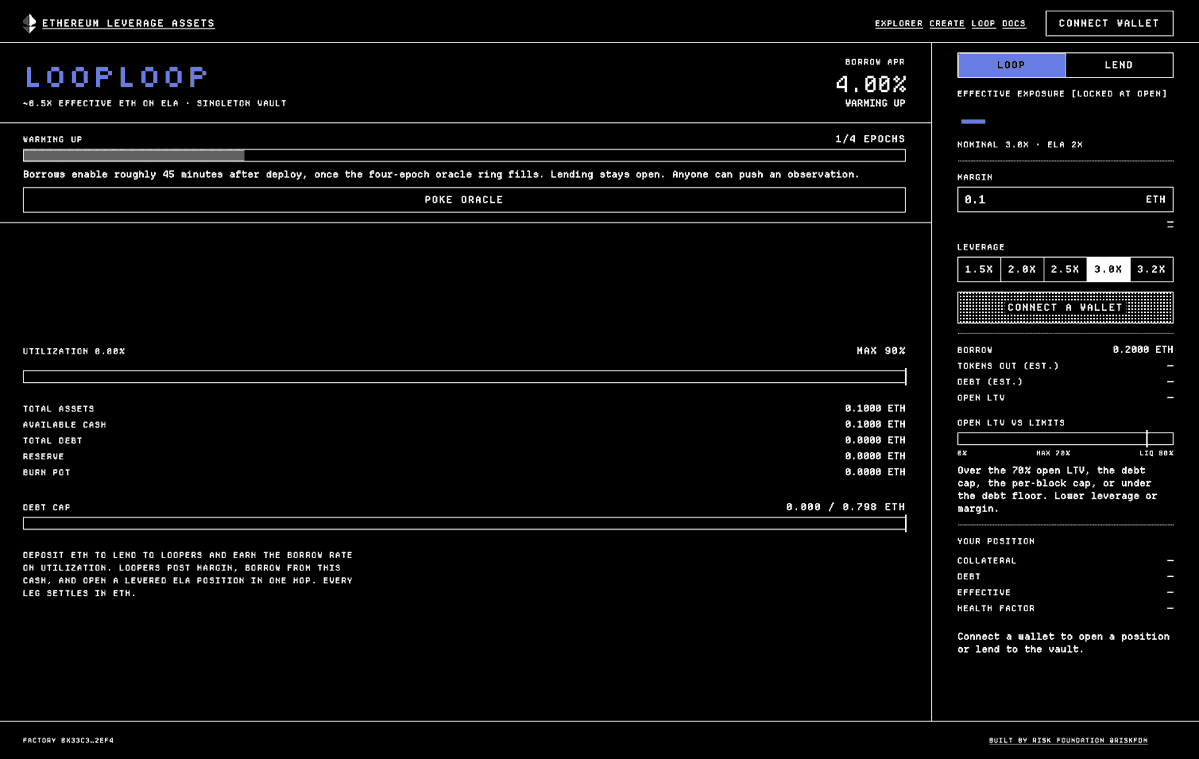
To be able to loop ETH on Aave while maintaining a native, non-synthetic asset.
Link : https://t.co/HpDlEmhVXP
Not just a leveraged asset... a V4 hook that builds the leverage for you.
Every buy loops ETH through Aave, up to 3x, locked at creation. When ethereum:native moves, ELA assets move up to 3x too.
The best place to trade is https://t.co/0ZYHbvsobO.
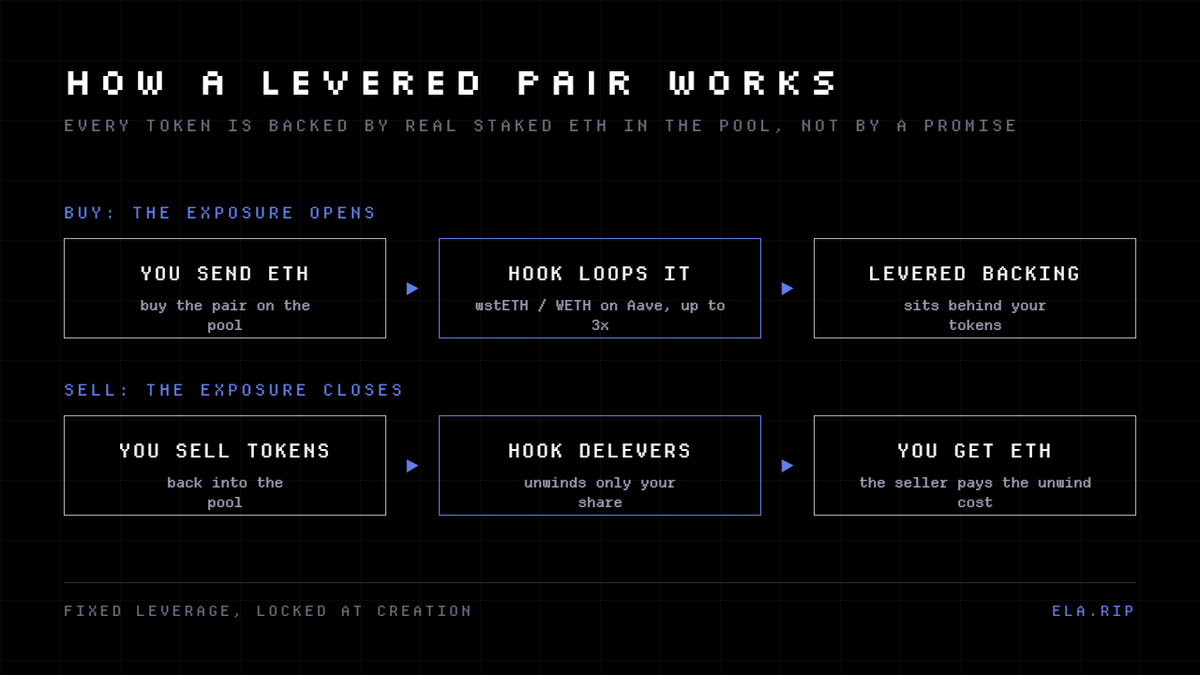
How a levered pair works:
Buy → the hook loops wstETH/WETH on Aave (up to 3x) Sell → it unwinds only your share, you pay your own exit
Real staked ETH behind every token. Leverage fixed at creation. Anyone can deploy a token on our launchpad.
The idea for Risk Labs came from a conversation @0xWasa and I had during the crypto winter.
We could have launched months ago, but we didn’t want to launch another random project just for the sake of it.
We wanted to wait until we had something that actually felt new.
ELA came from a very simple question I kept asking myself:
If I’m bullish on ETH, why can’t the token I buy also give me leveraged exposure to ETH?
Before Uniswap v4, doing this directly at the pool level wasn’t really possible. You would have needed synthetic ETH and a lot more infrastructure around it.
Then I discovered hooks. It changed everything.
Using Uniswap v4 hooks, ELA can get a leveraged eth exposure natively, directly inside the pool.
That's what I decided to build, and release, today.
This is only the first step.
We’ll share the rest as we go.
If you have any questions, just @ me or send me a DM.
The best onchain products rarely come from one person doing everything alone.
You need developers who can turn strange ideas into code, designers who can make them understandable, and builders who know how to bring them to market.
Risk Labs was created to bring those people together and help them ship things that did not exist before.
Today, the first one is live.
ELA was built by @tzv directly through the studio.
It uses Uniswap v4 hooks to offer a new way to trade on Ethereum: leveraged ETH staking exposure packaged inside a normal ERC20, with the position built and backed directly through its liquidity pool.
You hold the token. The pool handles everything underneath.
This is exactly what I want Risk Labs to be about.
Not launching the same ideas with a different name and ticker.
Finding people who still want to experiment, giving them the right people and resources, and helping them bring genuinely new ideas onchain.
ELA is the first experiment.
The idea for Risk Labs came from a conversation @0xWasa and I had during the crypto winter.
We could have launched months ago, but we didn’t want to launch another random project just for the sake of it.
We wanted to wait until we had something that actually felt new.
ELA came from a very simple question I kept asking myself:
If I’m bullish on ETH, why can’t the token I buy also give me leveraged exposure to ETH?
Before Uniswap v4, doing this directly at the pool level wasn’t really possible. You would have needed synthetic ETH and a lot more infrastructure around it.
Then I discovered hooks. It changed everything.
Using Uniswap v4 hooks, ELA can get a leveraged eth exposure natively, directly inside the pool.
That's what I decided to build, and release, today.
This is only the first step.
We’ll share the rest as we go.
If you have any questions, just @ me or send me a DM.
Introducing RISK Labs.
A collective where builders turn ideas into real Web3 products.
Builders build.
Markets follow.
This is what you were waiting for.
https://t.co/qsspSSH2pM