Happy new month everyone.
30 days has November and I’m feeling extra feisty this month so, let’s change my life.
I’ve been very interested in @Sentient for the past few months.
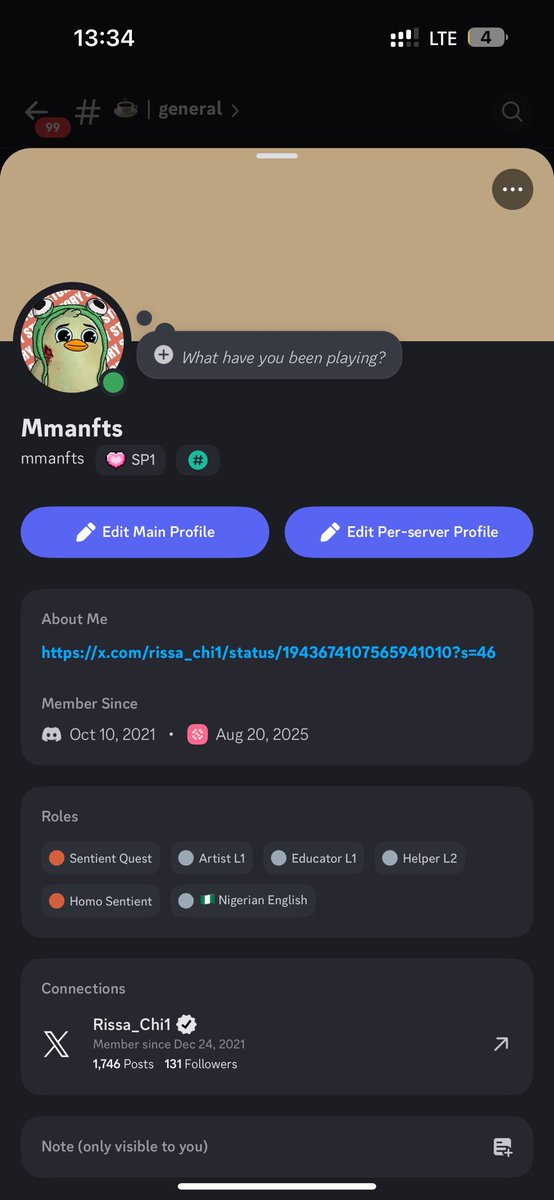
Been in the discord since August 20th and have contributed in various ways.
I’m a level 2 helper and have been contributing as an Artist with up to 12 art submissions and more in the works.
However I haven’t been as consistent or as intentional as I would want so let’s change that.
From now I will be posting at least 1 art a day for the entire month of November. There will of course be other relevant educational tweets as I go about my day as well.
I will also be incorporating my fitness journey with my @SentientAGI journey making sure I hit up to 10k steps and 100 squats a day. I will of course be posting my progress and thanking @SentientAGI for the motivation.
The year is almost over and I want to give this last run my all.
I invite you to come along as well.
My ticket is #DobbyAI
My conviction is @SentientAGI
gSenti my friends
Registered for this, top 1k gets gtd. You have 3 invites, do tasks to get points.
https://t.co/zhhPPMCb2o name of who invited you:-Rissa_chi1
Don’t miss out, muah❤️
One of the most satisfying moments I’ve had while building on GenLayer was watching a contract reject an unauthorized action.
Yes, I was actually happy it got rejected.
I was testing whether a wallet without the right permissions could perform an action it wasn’t authorised to take.
The contract blocked it, exactly as it should.
That experience reminded me of something I’ve come to appreciate while building Intelligent Contracts.
Some decisions are straightforward. A wallet either has permission or it doesn’t.
But what happens when the answer isn’t so obvious?
Imagine paying someone to create a beginner’s tutorial for your product.
They deliver on time. The video looks great, but there’s a problem. They’ve left out a crucial step that beginners need to follow.
The creator believes the job is complete. You disagree because the tutorial doesn’t fully serve its purpose.
Both sides have an argument.
So who decides whether the agreement was fulfilled?
A traditional smart contract can check deadlines and payments when the necessary information is available. But evaluating whether the actual work meets an agreement is a different challenge.
This is where @GenLayer gets interesting.
GenLayer is a blockchain designed for Intelligent Contracts that can use AI to interpret written conditions, examine real world information and evaluate outcomes that aren’t easily reduced to simple calculations.
Instead of relying on one AI model, GenLayer uses validators to independently evaluate proposed outcomes through consensus, with an appeal process for challenging decisions.
Now imagine AI agents hiring services, making payments and completing tasks on our behalf.
What happens when one agent claims a job is complete, but another disagrees?
That’s one of the problems GenLayer is addressing through Internet Court, an initiative launched with 27 founding members to establish a framework for agreements and dispute resolution between AI agents.
And honestly, this is part of why I’ve stayed interested in GenLayer.
I started out creating content and animations about the project. I never imagined I’d eventually be writing code, building Intelligent Contracts and getting excited when a contract rejected an unauthorized action.
Building has taught me that getting a transaction to execute isn’t always the difficult part.
Sometimes, the real challenge is determining whether the agreed conditions have actually been met.
And sometimes, the right outcome is NO.
Now, back to that tutorial.
If you were paying for it, would you give the creator a chance to correct the missing step or reject the work entirely?
And would your answer change if that step wasn’t explicitly included in the original agreement?
I’m curious how others would approach this.
If staking were only about earning rewards, choosing a validator would be pretty straightforward.
But would you still trust that validator with your GEN if you knew nothing about how they operate?
That’s something I think deserves more attention.
I’ve been exploring staking on @GenLayer and looking at what actually matters when choosing where to delegate.
I put together a short video explaining how staking works and the approach I’d personally consider.
Why validator choice deserves attention
GenLayer validators execute Intelligent Contracts and help the network reach consensus on their results.
Some of those decisions involve interpreting information that isn’t always straightforward.
Imagine a contract that needs to determine whether someone has fulfilled an agreement. The answer might require evaluating evidence rather than simply checking whether a payment was made.
Validators play an important role in making these kinds of decisions possible.
And that’s part of why I’d want to be careful about who I delegate to.
What I’d look for before choosing a validator
If I were choosing a validator, my first question wouldn’t be about who offers the highest rewards.
I’d want to know how consistently they participate, what their performance history looks like and whether they’ve faced penalties.
On GenLayer, repeated inactivity can lead to temporary bans, while certain violations can result in slashing, where part of the staked GEN is lost.
And that’s important because delegators can also be affected when their validator gets slashed.
I’d also want to understand how rewards are distributed and what could affect the amount I eventually receive.
A validator might look attractive on paper, but that doesn’t automatically make them a good choice.
I’d rather spend time understanding the risks than make a decision based on potential rewards alone.
Why stake distribution matters
Something else I’d pay attention to is how stake is distributed across the network.
If everyone keeps delegating to the same few validators, more stake becomes concentrated among those operators.
That might not seem important when you’re only thinking about your own rewards, but decentralization also involves how participation and influence are distributed.
I’d be open to supporting smaller, reliable validators instead of automatically choosing the most popular ones.
Of course, being smaller doesn’t automatically make a validator trustworthy either. Performance and reliability would still matter to me.
How I’d approach staking on GenLayer
Personally, I’d consider spreading my GEN across multiple reliable validators rather than depending entirely on one.
That wouldn’t eliminate the risks, but it could reduce my exposure to the problems of a single operator.
I’d also need to consider the staking requirements. GenLayer’s published documentation specifies a minimum initial delegation of 42 GEN per validator and a seven-epoch waiting period when withdrawing.
Those are details I’d check against the current network rules before committing anything.
And I wouldn’t just delegate and forget about it. I’d want to keep track of how my chosen validators are performing.
Because the way I see it, staking is about more than what you could earn.
It’s also about making informed choices that contribute to the security and decentralization of GenLayer.
If you were choosing a validator, what would matter most to you?
why did you block him ?
@Courtyard_io
he only wanted help in resolving the issue with his acccount.
he has sent mails, send dm on x, sent request on discord and no response yet he was blocked
this is so unfair.
I was going through some of my old GenLayer clips and honestly, I couldn't stop smiling. So many memories in one video.
One of my earliest memories of @GenLayer was creating an animation during the Bradbury Testnet.
Back then, I was just an artist who loved creating things and wanted to contribute in my own little way. I was still trying to understand GenLayer and everything happening around it, but I knew I wanted to be part of it.
Little did I know that I'd eventually find myself writing code and building intelligent contracts. If someone had told me that back then, I probably would have laughed and asked them to be serious.
I still remember how excited I was when I earned my Neurocreative role. Then came Brain and finally Singularity.
And please, I won't even pretend I was calm about that last one. I was genuinely so happy.
Those moments meant so much to me. Each role came with its own memories, effort and lessons. Seeing my contributions recognised gave me even more motivation to keep creating, learning and challenging myself.
And there have been so many other beautiful moments along the way.
Creating GenGrid with my friend @Lolaaa_00_ is one I'll always remember. We put our ideas together, built something for the community and got to watch people actually play and enjoy it. That feeling was really special.
From creating animations and educational content to seeing GenLayer on a billboard and eventually building my own intelligent contract projects, I've had experiences I never imagined when I first joined.
And the people I've met? Ah, that's another blessing entirely.
I've made so many meaningful friendships in the Discord server. People I can laugh with, learn from, share ideas with and sometimes disturb with my endless questions. Some have pushed me to try things I probably wouldn't have attempted on my own.
I'm genuinely grateful for every one of them.
Of course, it hasn't always been easy. There have been confusing days, frustrating moments and times when I've spent hours trying to understand something, only to realise I missed one tiny detail. Very humbling experience, I must say.
But I've learned to be patient with myself, to keep asking questions and to never be afraid of starting something unfamiliar.
I think that's one of the biggest things GenLayer has taught me. You can start with what you know and gradually discover just how much more you're capable of.
Looking at all these clips now, I see more than just my old contributions. I see the effort, the growth, the recognition, the friendships and all the little memories that have made this journey so special to me.
I'm proud of how far I've come, and I'm still very much a work in progress.
To anyone who's just discovering GenLayer, don't feel like you need to have everything figured out.
Explore the @GenLayer Portal, join a community event on Discord or contribute with something you already know how to do. There's room to learn and find your own path.
I started with art and curiosity. Now I'm out here building intelligent contracts and arguing with code that refuses to cooperate.
Who would have thought?
I'm grateful I took that first step and even more grateful for everything that came after it.