Choosing where to study abroad shouldn’t be a guessing game.
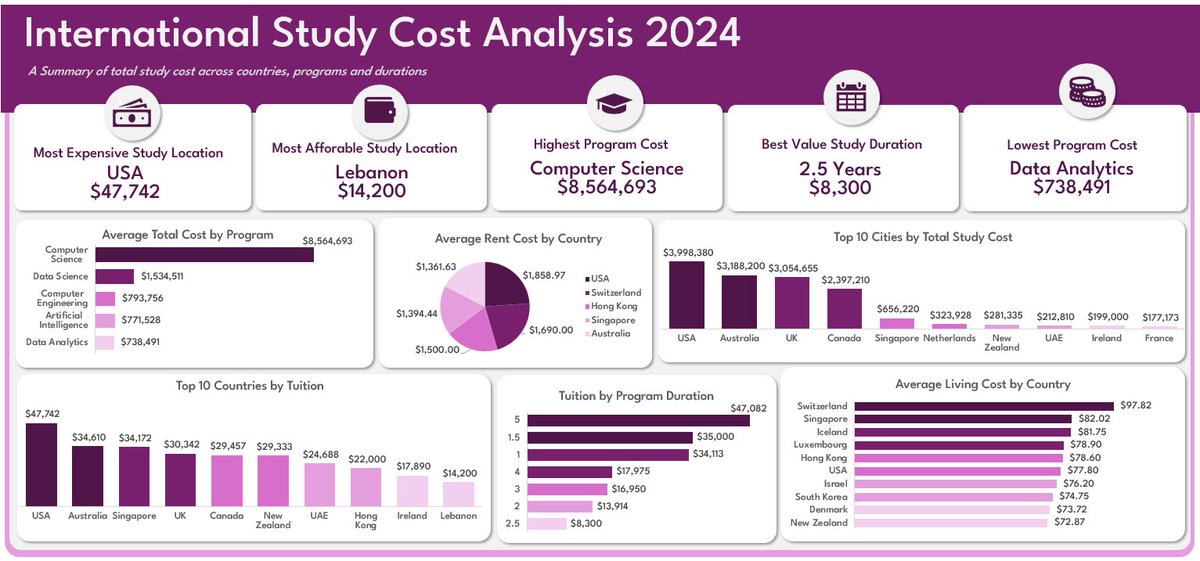
For my latest project at @VephlaUni , I analyzed education costs across 10+ countries using Excel to help future students see the full picture not just tuition, but rent, living costs, and program length too.
Here’s What I Discovered
◾ USA programs average $47,742 in tuition, nearly $13,000 more than Australia ($34,610) and Singapore ($34,172).
But here’s the twist: Australia has the lowest rent among premium destinations at $1,362/month.
The bottom line?
Looking at tuition alone doesn’t tell the whole story. Rent, living costs, and program length all play major roles in what you’ll actually spend.
◾ The USA, Australia, and UK account for over 70% of total study costs globally but countries like Ireland, France, and Singapore offer quality alternatives at significantly lower prices.
Switzerland has the highest cost of living (97.82 index), but the USA claims the priciest rent. Every destination has its own unique cost story beyond just tuition.
◾ Shorter isn’t always cheaper: 1-year programs cost $34,113 while 2.5-year programs are only $8,300. Duration and cost don’t always match up the way you’d expect.
◾ Computer Science dominates the cost landscape, representing 69% of all program expenses. If you’re budget-conscious, Data Analytics programs offer the most affordable entry into tech education.
Another project from my data analytics journey at @VephlaUni…
I recently completed a comprehensive analysis of student spending behavior across 5 academic majors, multiple age groups, and demographic segments using Excel.
💡The Impact:
Understanding these patterns can help universities create more effective support systems, optimize resource allocation, and better serve diverse student populations.
with the 24-25 age group showing the highest total spending at $1.79M.
◾ Major-specific spending trends:
Biology students account for $1.43M in total spending, followed by Economics at $1.27M and Computer Science at $1.22M.
◾ Financial aid distribution differs by major:
Averages range from $485.48 to $549.93 depending on the academic program, with Computer Science at the higher end.
◾ Age-based spending patterns emerge:
The data shows distinct spending behaviors across different age demographics
◾ Books and supplies show consistency:
Across all majors analyzed, spending ranges from $171 to $177, showing minimal variation regardless of field of study.
Insights from the Data:
◾ Housing costs vary by year:
2nd-year students spend an average of $665.90 on housing, compared to $708.96 for 4th-year students which is a notable $43 difference.
As part of my data analytics journey at @VephlaUni, I analyzed how remote work affects employee productivity and wellbeing using a dataset from Kaggle containing 1,500 employee records across 7 industries and 6 global regions.
The takeaway?
Sustainable remote work requires more than just technology and resources. It demands strategic policy decisions that balance productivity with employee wellbeing.
Full detailed analysis with visualizations and actionable recommendations available here: