@Cex_responde buenas. El viernes debía recibir un paquete que, por una incidencia logística según vuestra web, no fue entregado. A día de hoy (una semana más tarde) no hay actualización en la web.
After the final episode of “Seinfeld” in 1998, Jerry Seinfeld didn’t know what to do next with his life.
With the success of the show, he had options.
“What do I do?” he asked a friend.
“Well what’s been the best experience you’ve had so far?” the friend asked.
Seinfeld said,
Two things:
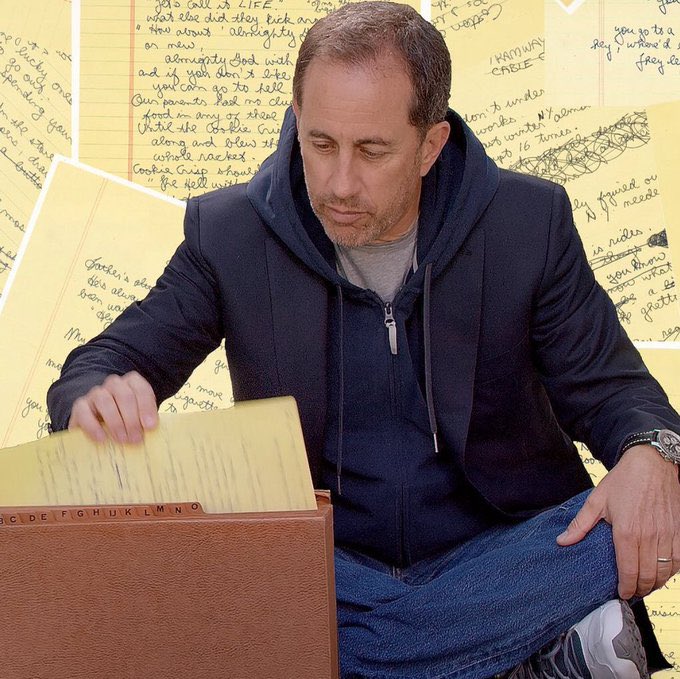
First, writing—“I just see something and I write it down—I like a big, yellow legal pad—and once I get that pad open, I can’t stop…the next thing I know, the day is gone.”
Second, performing stand-up—“I just love the life of it,” Jerry said. “I love the joy of hearing laughs and making jokes.”
So, despite the cool and lucrative opportunities to further an acting or screenwriting career in Hollywood, Seinfeld moved back to New York City where he returned to writing jokes by day and performing in comedy clubs by night.
Takeaway 1:
“For anyone trying to discern what to do with their life,” the author Amy Krouse Rosenthal said, “PAY ATTENTION TO WHAT YOU PAY ATTENTION TO. That's pretty much all the info you need.”
Pay attention to what you can pay attention to so that, as Seinfeld put it, “the next thing you know, the day is gone.”
Takeaway 2:
After investing 9 years into creating the 9 seasons of the show, Seinfeld returned to being a standup comedian.
He made an estimated $38 million from just the last season of the show—when he had a boatful of money and unlimited options, he went back to the thing he loved when he had little money and few options.
It made me think of the parable of the fisherman and the businessman:
In a small coastal village, there is a fisherman who owns a small row boat. One afternoon, after fishing all morning, he returns to shore with his boat full of fish.
A vacationing businessman sees the fisherman and is impressed, “How long does it take you to catch so many fish?”
“Oh, just a couple of hours,” the fisherman says.
The businessman immediately sees a business opportunity. He offers to invest money in the fisherman—enough to buy a bigger boat and to set up his own company supplying fish to every restaurant in the village.
Fisherman: “And then what?”
Businessman: “We’ll set up a production plant and distribute fish to restaurants around the world.”
Fisherman: “And then what?”
Businessman: “Eventually the business will be so big that we’ll sell it for a huge sum of money.”
Fisherman: “And then what?”
Businessman: “You’ll have so much money that you’ll be able to do whatever you want. You can retire, move to a house by the sea, and fish as much as you want.”
The fisherman was confused, “Isn’t that what I already do?”
It’s just a reminder: the ability to do what you want for as long as you want is priceless and, often, inexpensive.
- - -
“The highest form of wealth is the ability to wake up every morning and say, ‘I can do whatever I want today.’” — Morgan Housel
Follow @bpoppenheimer for more content like this!
@housfy_es Un año y tres meses esperando la devolución. Numerosos correos jamás contestados, numerosas llamadas sin poder hablar con nadie. Hasta cuándo?
@housfy_es buenas. Llevo 3meses esperando la devolución de unos honorarios por la firma de una hipoteca que jamás se finalizó. Vuestro agente ha desaparecido y al mail housfylegal tampoco recibo respuesta. Tengo que llevar el tema con abogados?
In 1971, Phil Knight was teaching accounting at Portland State University.
One day, he overheard a graphic design student say that she couldn’t afford to take a painting class.
Knight paid her $35 to design a logo for his start-up shoe company.
When he saw the design, he said,
“I don't know if I like it, but maybe it will grow on me.”
Knight didn’t have time to fuss over the logo. "We had a deadline," he explains. He had signed a contract with a factory to produce 3,000 pairs of Nike's first shoe. "Production was starting on the shoe that Friday."
Before then, they needed a logo.
“You don’t like it?” Knight’s chief operating officer asked of the student’s design.
“I don’t love it,” Knight said, “but we’re out of time. It’ll have to do.”
Takeaway 1:
It's said that if not for constraints and deadlines, nothing would get made.
George Lucas, for instance, worked on drafts of the first Star Wars for years. "I never arrived at a degree of satisfaction where I thought the screenplay was perfect," he said.
But then he struck a deal with a movie executive from United Artists—"At that point, it became an obligation," Lucas said.
"If I hadn't been forced to shoot the film, I would doubtless still be rewriting it now."
Takeaway 2:
At Nike's IPO in 1980, Phil Knight gave the student who designed the Swoosh 500 shares.
She never sold.
Since the IPO, there have been 7 stock splits. So those 500 shares have become 64,000 shares. At the time of this writing, Nike is at $110/share.
$110/share x 64,000 shares = $7,040,000.
It makes me think of something Robert Greene once told me:
“Above all else, focus on acquiring knowledge and skills. Knowledge and skills are like gold—a currency you will transform into something more valuable than you can imagine."
Follow @bpoppenheimer for more content like this!
@LibretaDel Hablar de "Farza" y "correr como ratas" ya deja su opinión en un grito de forofo enmascarado como reflexión moral. Se descalifica él solito
Instagram’s early popularity was less about the technology and more about the psychology—about how it made people feel. The filters made reality look like art. And then, people would start to think about their lives, themselves, and their place in society differently.—@sarahfrier
"In a world and business that is awash with data, it is tempting to use data to answer all of our questions, including creative questions. I urge all of you not to do that" @RobertIger