🤬😡 Bientôt, plus de 7000 endroits ne reprendront plus vos canettes et vos bouteilles, remplacés par les centres Consignaction.On nous a présenté ça comme une révolution écologique. Pour monsieur et madame Tout-le-Monde,c’est plutôt un méchant casse-tête. https://t.co/r0QsKu4Hdo
🇨🇺💥'VIVA TRUMP!': Rebel News goes undercover in Communist Cuba
The reality on the ground in Cuba is far more dire than the world knows. Rebel News exposes what life is really like for those living under the Communist regime in this exclusive documentary.
Just days after the U.S. arrested Venezuelan dictator Nicolás Maduro, Rebel News' Alexa Lavoie and @efloresmonsanto secretly entered one of the world’s most tightly controlled countries — posing as tourists, hiding our identities, and filming in conditions where a single mistake could have meant detention or worse.
The reality on the ground is far more dire than we expected. This isn’t the picture Cuban authorities want you to see.
The Cubans we met spoke to us at enormous personal risk — simply for telling the truth. Their faces had to be blurred for safety, but their words reveal the reality the government desperately tries to hide.
Electricity blackouts, food shortages, fear, and silence have defined life under the dictatorship for decades — we're exposing it all.
State-controlled media would never allow these voices to be heard.
This investigation was covert, dangerous, and required extraordinary precautions — for us and for the Cubans who trusted us with their stories.
If you can help ensure this report reaches as many people as possible, please click here or visit TheTruthAboutCuba dot com.
@realDonaldTrump@marcorubio@DHSgov@Rafaelpineyro@RebelNewsOnline
On es-tu bon au Québec «La taxe carbone coûte près de 1,5 million $ à l’entreprise agricole.
Sans compter les frais d’Éco Entreprises Québec (ÉEQ), qui s’élève à 1 million $. » https://t.co/qAfEpd8WJX
Vraiment tannée de ça 😡 «Anastasia Tataru, qui n’est pas citoyenne canadienne et qui n’avait aucun antécédent judiciaire, a un « statut d’immigration précaire en ce moment ».» https://t.co/6BF2mYokXD
215 'Mass Graves' at Kamloops: Zero Bodies Found After 5 Years – The Lie Exposed
In May 2021, the world was told a horror story: 215 Indigenous children found in "mass graves" at Kamloops Residential School.
Flags flew at half-mast for months. Churches were burned. Statues torn down.
Kids across Canada were taught their country was guilty of hiding murdered children.
Five years and millions of taxpayer dollars later — after endless GPR, LiDAR, cadaver dogs and scans — the same First Nation now admits: Zero graves. Zero bodies.
Zero confirmed human remains.
Only vague "signatures that resemble burials" in some spots, with other areas completely ruled out.
No excavations ever happened.
This is the story they never wanted you to hear.
Real reconciliation demands truth — not hype, not weaponized shame, not silence when the narrative collapses.
Teachers taught the nightmare. Now teach the correction.
Watch until the end. Share this. Demand accountability.
«Le gouvernement fédéral a débloqué près de 26 milliards de dollars pour l’Ukraine depuis que la Russie a lancé son invasion en 2022, un conflit qui dure désormais depuis près de 1500 jours. »
https://t.co/vGY85NHb8H
Some personal news to share.
My regular column with La Presse has been suspended indefinitely this week, after 25 years and more than 1,000 columns. This was not my decision.
The decision is linked to recent public comments I made on social media regarding the evolving media landscape in Canada, including reflections on government support for media and its potential implications. I understand that these are sensitive and complex issues, and my remarks may not have aligned with the publication’s perspective.
While I am disappointed, I fully respect their decision and remain grateful for the opportunity I’ve had to contribute over the years.
I would also like to note that my contributions were always made on a voluntary basis. I was never compensated for my columns, and have personally supported La Presse through a paid subscription throughout that time. It has truly been a privilege to write for such an important institution.
I continue to believe that open, thoughtful discussions about the future of media in Canada are both necessary and healthy.
Et il a raison! «Les Québécois seraient «très fâchés» si le gouvernement n’interdisait pas les prières de rue ou les signes religieux aux éducatrices, selon l'élu » https://t.co/qPMn2UnSnB
Pas vrai! «D’ex-ministres libérales et péquistes, des figures de QS et des groupes communautaires demandent à Québec de ne pas utiliser la clause dérogatoire pour empêcher les enfants de demandeurs d’asile d’avoir accès aux services de garde subventionnés. https://t.co/yymW1zA2uH
Bon. Ok.
Il y’a beaucoup de choses à décortiquer ici donc on prend ça point par point.
La future reine d’Angleterre qui porte un voile.
Le bonhomme islamique, un sujet du royaume, qui refuse de serrer la main d’une princesse.
Cette future reine d’Angleterre est la future reine du Canada.
Elle est donc la future reine du Québec.
La future reine des Québécois porte un voile islamique et se fait revirer de bord par un musulman à qui ELLE adresse des politesses.
Réalisez vous le monde de cinglés dans lequel on est?
To my X followers,
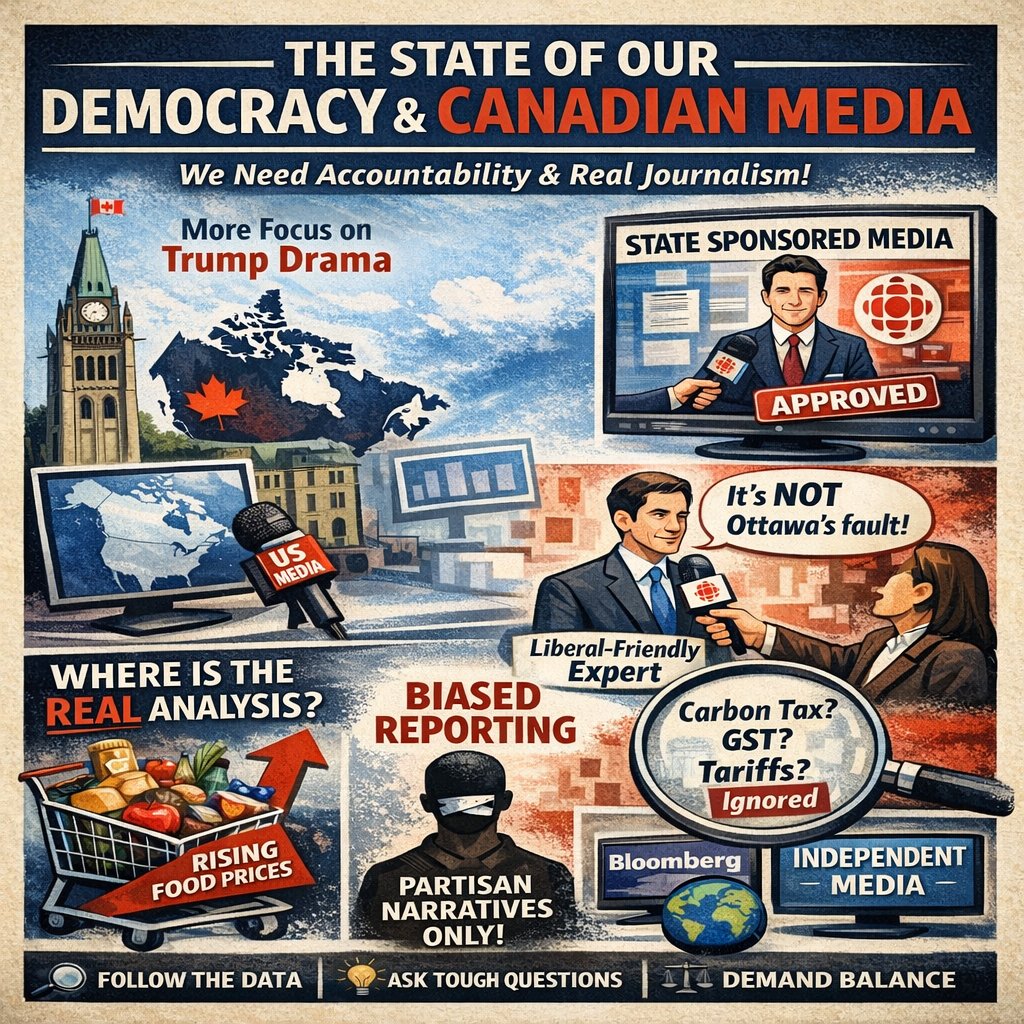
I’ve worked with the media for nearly 25 years. For most of that time, the relationship was professional and balanced. But in recent years, something has shifted.
I am increasingly concerned about the state of our democracy — particularly how media, in general, are informing Canadians about food policy, food inflation, and economic policy.
I now find myself learning more about Canada’s economy and policy changes from American outlets than from Canadian ones. Much of our national coverage feels reactive, shallow, or overly fixated on partisan narratives rather than substantive policy analysis.
What troubles me most is the lack of scrutiny applied evenly across governments and institutions.
For example, when the Bank of Canada suggested that Ottawa’s counter-tariffs contributed to food inflation, only one major outlet — Bloomberg — gave it meaningful coverage. The grocery benefit program received very little examination regarding how it would be financed. It took days before anyone pressed for clarity.
During the latest spike in food inflation, several outlets turned to the same small circle of commentators who dismissed any potential role of federal policy — carbon pricing, GST holidays, counter-tariffs — despite mounting evidence that policy decisions can and do affect food prices.
Instead of investigating structural drivers of inflation, much of the coverage focuses on fact-checking opposition rhetoric, even though the opposition has not governed since 2015. Scrutiny should be applied equally — not selectively.
Quebec media, while imperfect, appear to have maintained a broader range of debate. In much of the rest of Canada, I see increasing concentration of voices — often from the same region, Ontario, often reflecting similar policy perspectives — and less diversity of thought grounded in empirical research.
This isn’t about partisan politics. It’s about accountability, transparency, and healthy democratic discourse.
Media are under financial pressure — that’s real. But public trust depends on independence and depth. Subsidy structures, incentives, and newsroom economics all matter.
Canada deserves stronger policy journalism — especially on food affordability, supply chains, and economic resilience.
We need more data-driven analysis, more intellectual diversity, and more courage to ask uncomfortable questions — regardless of which party is in power.
Until that happens, Canadians would be wise to diversify their news sources and think critically about what they’re being told — and what they’re not.
«Aujourd’hui, pas moyen de dire quelque chose ou de faire la moindre petite blagounette sans que quelqu’un colle au plafond et qu’un organisme de défense des unijambistes albinos de la Côte-Nord dépose une plainte. » https://t.co/JovUzJXtHR
"To bring down the cost of food quickly, Ottawa could eliminate the GST on all food items, scrap the industrial carbon tax, and work with the provinces to remove interprovincial trade barriers to boost competition. Those measures alone would make a meaningful difference."