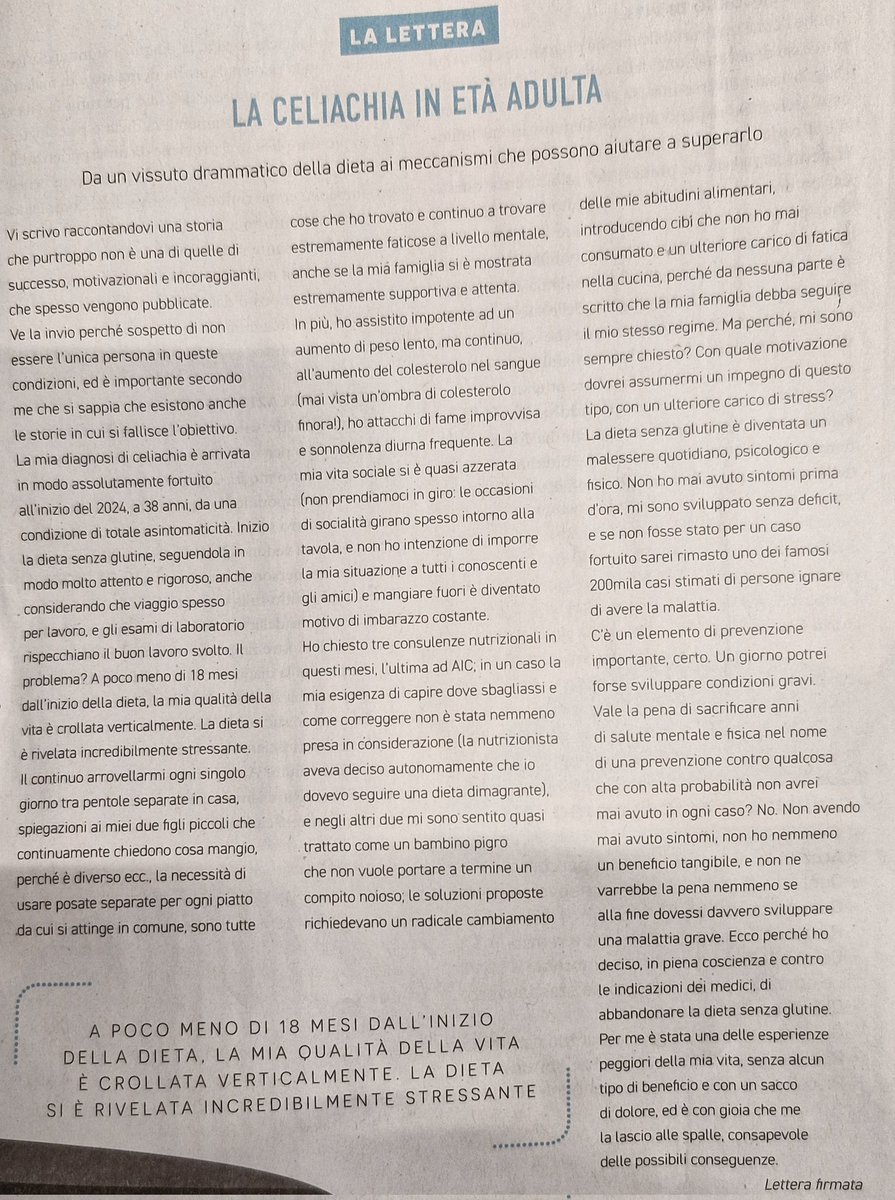
Pagina 51 dal notiziario "AIC-celiachia notizie" di Novembre 2025.
Anch'io sono coinvolto nello stesso stato d'animo che ha vissuto lo scrivente. Io, però, non ho il coraggio di sospendere la dieta senza glutine.
Bersani cita lo ZingareTTi di Vannacci: "Gli consiglio di cercare sul dizionario 'finocchi'. Troverà 'erbaceo mediterraneo'. È grave che parli dell'omosessualità come di un gusto" #ottoemezzo
What an absolute disgrace. A FIFA-certified referee being denied entry to the United States purely because he is Somali.
The World Cup is meant to bring people together. This is racism, plain and simple. Shameful.
https://t.co/rpSgTmmPU4
“Everyone is complaining about the poor facilities and organization in the stadiums, training facilities, and airports, as well as the detention of players, photographers, referees, coaches, and just about everything else, and it will be the worst World Cup edition ever.”
Ecco alcuni passaggi del monologo con cui Paola Cortellesi, attrice e regista del capolavoro “C’è ancora domani”, ha commosso i presenti alla festa per gli ottant’anni della Repubblica in piazza del Quirinale e gli spettatori di RaiUno in tv.
Il testo integrale su Repubblica
Hindu kızlara toplu tecavüz ediliyor, bir tane İslam ülkesi eleştirmiyor, protesto etmiyor; oysa Rabia için gözler şelaleydi…
Bu kızcağıza da toplu tecavüz etmişler, yazık sağlığı çok kötü görünüyor.
🚨 do you understand what just happened to Itamar Ben-Gvir..
The far-right National Security Minister just got banned from France after taunting detained Gaza flotilla activists on camera.
This is the same man who:
•Was a teenage Kahanist with a long rap sheet for racism and terrorism
•Was deemed “too extreme” to serve in the IDF…
•Keeps a portrait of a terrorist in his home and has celebrated terrorist acts for years
Yet he was handed control of the police...
This week he filmed himself waving the Israeli flag and taunting zip-tied activists (including Europeans) who were forced to kneel in front of him as he called himself “the landlord.”
France’s response was immediate: full entry ban, calling his behavior “reprehensible.”
The most radical voice in the cabinet just kept getting more power and now the whole world knows his name.
La seconda carica dello Stato si chiede quanti bambini palestinesi abbia salvato la Flotilla...
Gli attivisti hanno rischiato la vita per portare il cibo e aiuti umanitari ai bambini Palestinesi affamati, mentre il governo vende armi allo Stato genocida.
Benito La Russa e il governo Meloni sono complici di un genocidio coloniale in Palestina, gli attivisti della Flotilla no.
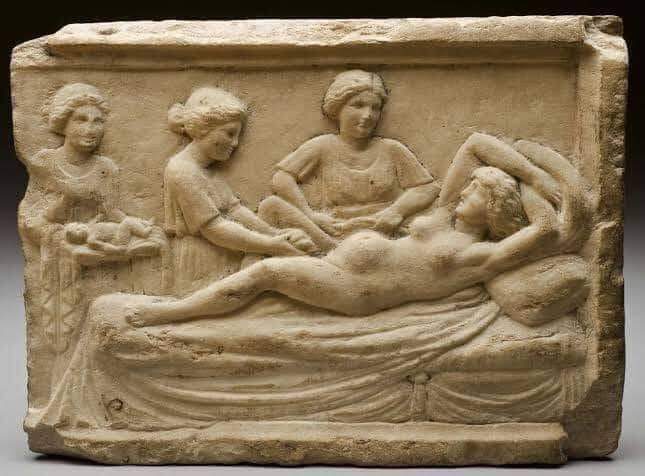
En la antigua Grecia, las mujeres tenían prohibido estudiar medicina, hasta que alguien rompió la ley.
Un día Hagnódica se cortó el pelo y entró en la facultad de medicina de Alejandría vestida de hombre. Mientras caminaba por las calles de Atenas tras completar sus estudios de medicina, oyó los gritos de una mujer de parto. Sin embargo, la mujer no quería que Hagnódica la tocara, a pesar del intenso dolor, porque creía que Hagnódica era un hombre.
Hagnódica demostró su identidad femenina desnudándose y ayudando a la mujer a dar a luz. La historia pronto se extendió entre las mujeres, y todas las enfermas comenzaron a acudir a Hagnódica.
Los médicos varones, envidiosos, acusaron a Hagnódica, a quien creían hombre, de seducir a sus pacientes
En su juicio, Hagnódica compareció ante el tribunal y demostró su identidad femenina, pero esta vez fue condenada a muerte por estudiar y ejercer la medicina siendo mujer. Las mujeres se rebelaron contra la sentencia, especialmente las esposas de los jueces que la habían condenado a muerte.
Algunos decían que si Hagnódica moría, morirían con ella. Incapaces de soportar la presión de sus esposas y otras mujeres, los jueces anularon la condena de Hagnódica , y a partir de entonces, las mujeres pudieron ejercer la medicina, siempre y cuando solo atendieran a mujeres.
Así, Hagnódica dejó su huella en la historia como la primera médica, ginecóloga y especialista en medicina griega.
Esta placa que representa a Hagnódica trabajando fue excavada en Ostia, Italia.
Il momento in cui l’esercito criminale Israeliano ha massacrato una squadra di soccorritori/ paramedici con un doppio attacco.
Prima hanno ucciso un padre e sua figlia, poi hanno bombardato una squadra medica giunta sul posto con l’ambulanza nel sud del Libano.
Mentre i leader Europei discutono se sospendere l’accordo di associazione con Israele, l’IDF continua a massacrare civili ovunque a Gaza, in Cisgiordania occupata e in Libano.
النائبة الإسبانية Irene Montero تهاجم إسرائيل:
"هل تتخيلون لو أن روسيا أو إيران احتلت المياه الدولية ونشرت جيشها وقامت باختطاف مواطنين أوروبيين إلى السجون من دون محاكمات؟ كانت حكوماتنا ستغضب. لكن بما أن إسرائيل هي من ارتكبت هذه الجرائم فلا أحد سيتحرك، عار سيلاحقنا".
La marina israeliana ha sparato sugli attivisti disarmati della Flotilla.
Tutto questo è inaccettabile tanto più che si sta mettendo a rischio la vita delle persone. Il nostro pensiero va a tutti i membri delle imbarcazioni dirette a Gaza e al nostro deputato Dario Carotenuto, i cui contatti sono stati persi da qualche ora, il che fa temere possa essere stato prelevato e sequestrato da Israele.
Chiediamo ufficialmente un intervento dell’Unione europea per difendere i diritti di questi cittadini europei. Non è possibile continuare a tacere davanti a questi illegali atti di forza.
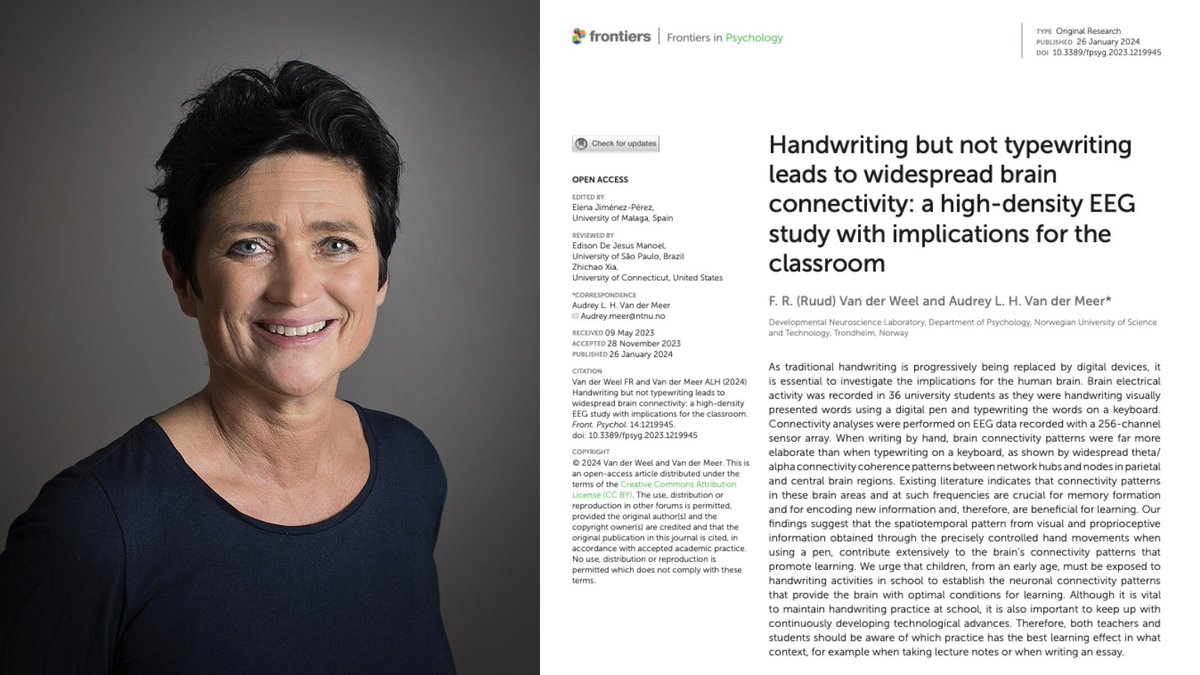
A Norwegian neuroscientist spent 20 years proving that the act of writing by hand changes the human brain in ways typing physically cannot, and almost nobody outside her field has read the paper.
Her name is Audrey van der Meer.
She runs a brain research lab in Trondheim, and the paper that closed the argument was published in 2024 in a journal called Frontiers in Psychology. The finding is brutal enough that it should have changed every classroom on Earth.
The experiment was simple. She recruited 36 university students and put each one in a cap with 256 sensors pressed against their scalp to record brain activity. Words flashed on a screen one at a time.
Sometimes the students wrote the word by hand on a touchscreen using a digital pen, and sometimes they typed the same word on a keyboard. Every neural response was recorded for the full five seconds the word stayed on screen.
Then her team looked at the part of the data most researchers had ignored for years, which is how different parts of the brain were communicating with each other during the task.
When the students wrote by hand, the brain lit up everywhere at once.
The regions responsible for memory, sensory integration, and the encoding of new information were all firing together in a coordinated pattern that spread across the entire cortex. The whole network was awake and connected.
When the same students typed the same word, that pattern collapsed almost completely.
Most of the brain went quiet, and the connections between regions that had been alive seconds earlier were nowhere to be found on the EEG.
Same word, same brain, same person, and two completely different neurological events.
The reason turned out to be something nobody had really paid attention to before her work. Writing by hand is not one motion but a sequence of thousands of tiny micro-movements coordinated with your eyes in real time, where each letter is a different shape that requires the brain to solve a slightly different spatial problem.
Your fingers, wrist, vision, and the parts of your brain that track position in space are all working together to produce one letter, then the next, then the next.
Typing throws all of that away. Every key on a keyboard requires the exact same finger motion regardless of which letter you are pressing, which means the brain has almost nothing to integrate and almost no problem to solve.
Van der Meer said it plainly in her interviews.
Pressing the same key with the same finger over and over does not stimulate the brain in any meaningful way, and she pointed out something that should scare every parent who handed their kid an iPad.
Children who learn to read and write on tablets often cannot tell letters like b and d apart, because they have never physically felt with their bodies what it takes to actually produce those letters on a page.
A decade before her, two researchers at Princeton ran the same fight using a completely different method and ended up at the same answer. Pam Mueller and Daniel Oppenheimer tested 327 students across three experiments, where half took notes on laptops with the internet disabled and half took notes by hand, before testing everyone on what they actually understood from the lectures they had watched.
The handwriting group won by a wide margin on every question that required real understanding rather than surface recall.
The reason was hiding in the transcripts of what the two groups had actually written down.
The laptop students typed almost word for word, capturing more total content but processing almost none of it as they went, while the handwriting students physically could not write fast enough to transcribe a lecture in real time, which forced them to listen carefully, decide what actually mattered, and put it in their own words on the page.
That single act of choosing what to keep was the learning itself, and the keyboard had quietly skipped the choosing and skipped the learning along with it.
Two studies. Two countries. Same answer.
Handwriting makes the brain work. Typing lets it coast.
Every note you have ever typed instead of written went into your brain through a thinner pipe. Every meeting, every book highlight, every idea you captured on your phone instead of on paper was processed at half depth.
You did not forget those things because your memory is bad. You forgot them because typing never woke the part of the brain that would have made them stick.
The fix is the thing your grandmother already knew.
Pick up a pen. Write the thing down. The slower road is the faster one.