New Anthropic Science Blog: Making Claude a chemist.
To manipulate a molecule, chemists first need to understand its structure. Their main tool is NMR spectroscopy.
We found Opus 4.7 matches—and on some tasks beats—dedicated NMR software. Read more: https://t.co/1jUvz7wdhV
Another impressive and early Claude Mythos output for y'all. 😀
I literally just told it to generate a macOS clone and to do its absolute best.
It generated 50k tokens (3k lines of code), made a fully functional browser, made a music player with generated songs and added a lot of sneaky witty details.
AND this is also LOW effort!
BREAKING: Anthropic has urged for a global pause in AI development as artificial-intelligence models are nearing capability to improve without human intervention, per WSJ
Our internal data shows Claude is accelerating AI development—a possible path to recursive self-improvement, or AI autonomously building a more capable successor.
It’s happening faster than we thought, and the implications deserve greater attention. https://t.co/OVVPJO7VQx
This Executive Order is an important step in strengthening America’s leadership in AI.
We look forward to collaborating with the White House to support its implementation.
https://t.co/ZwDimPrp3t
For every ChatGPT conversation that started as “one quick thing” and became a full on saga: table of contents is here.
Available now for chats with 5+ responses.
Before we ship a new model, these teams try to break it.
They build with it, push it to its limits, and tell us where it falls short. What they find makes the final model better.
Today we’re introducing Google AI Threat Defense - a comprehensive AI-powered cybersecurity solution designed to help continuously monitor for and stop AI-powered threats before they can impact your business. Here’s how it works:
1. AI Threat Defense uses our cybersecurity platform @wiz_io to scan and prioritize what applications and systems have the highest security risk.
2. Gemini and other frontier AI models can then autonomously perform continual deep scanning of your applications - starting with those at the highest risk - to identify security vulnerabilities.
3. The capabilities of CodeMender - a new software repair agent - are then used to verify and accelerate the patching of vulnerabilities.
4. And our @wiz_io autonomous agents continuously test your systems to find unknown vulnerabilities before adversaries do so that you can remediate them before you are attacked.
While other model providers focus on using AI to find and flag vulnerabilities, Google AI Threat Defense actively prioritizes your most critical real-world risks and accelerates their remediation using a variety of models since no single model finds a superset of the vulnerabilities found by all other models.
UltraCode is running over 100 Opus 4.8 agents right now.
This is the future of software development.
Not 5 agents. Not 10.
Over 100 working simultaneously across the entire BridgeMind ecosystem.
This is what vibe coding looks like at scale.
One person orchestrating a swarm of AI agents building, debugging, and shipping in parallel.
We are so early.
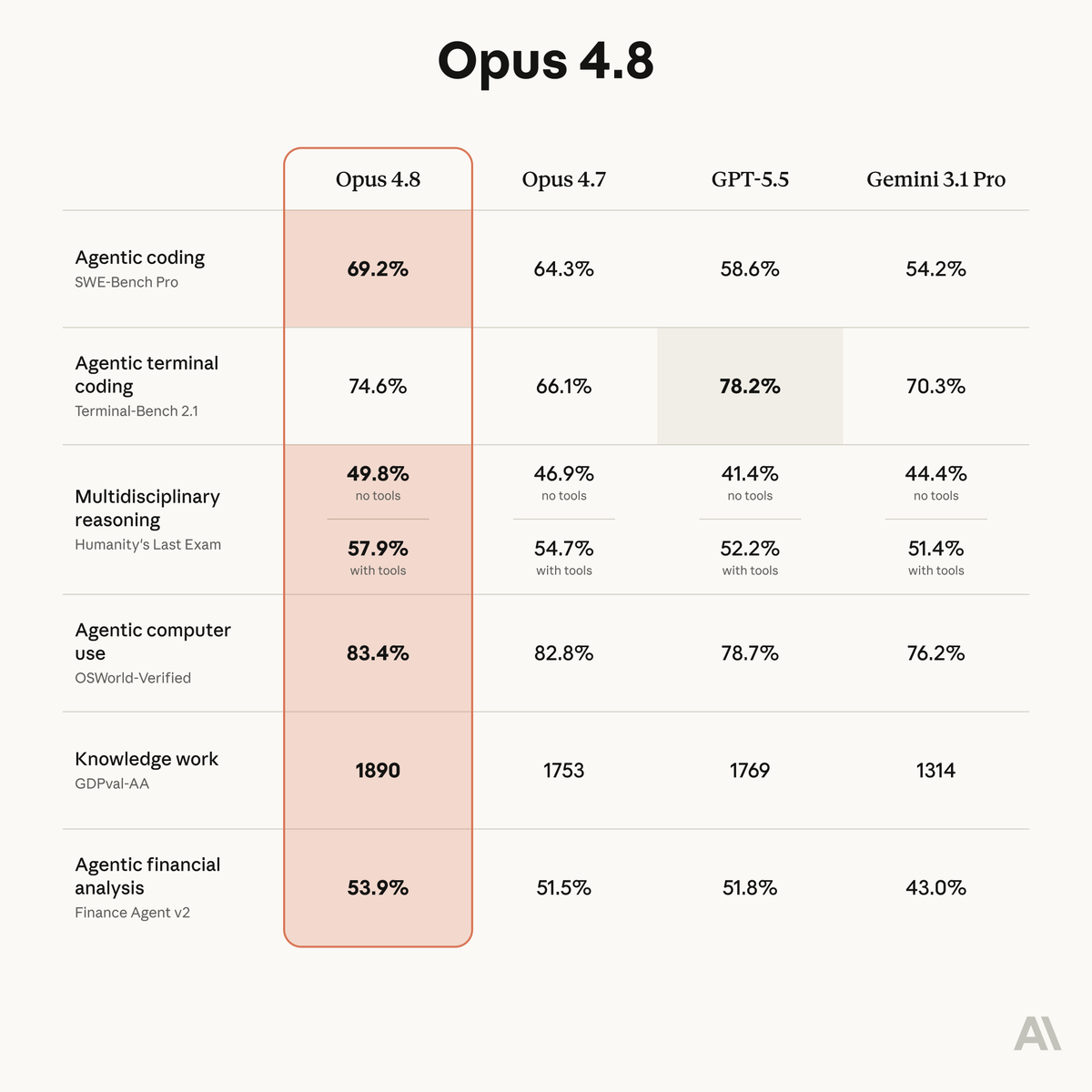
Introducing Claude Opus 4.8: it builds on Opus 4.7 with sharper judgment, more honesty about its own progress, and the ability to work independently for longer than its predecessors.
Available today at the same price.
“Once the platform works, biology becomes programmable.”
Demis Hassabis, CEO of Google DeepMind, says AI drug discovery won’t progress gradually.
It will look more like AlphaFold, years of quiet infrastructure work, then a sudden leap where the system can scale across entire disease areas.
The next phase on the lunar surface is infrastructure.
In this desert demonstration, GITAI’s centaur rover worked with another rover equipped with a robotic arm to place solar panels, support construction tasks, and handle welding work. Space will need labor that is safe, repeatable, and not priced like astronaut time.
More on GITAI’s lunar infrastructure construction work:
https://t.co/H2uepsaQDW