... where responsible companies submit to testing while anyone can download and modify the alternatives.
Both see defenders stuck at a disadvantage, and both point toward the same fix: getting better tools into defenders' hands, faster.
https://t.co/v9ApnI7ORY
Two conversations this month landed on a similar uncomfortable truth.
My former Facebook/Meta colleague @alexstamos told @reckless on Decoder that open-weight models with their safety training stripped out are increasingly letting low-skilled attackers automate most of an attack, running on a laptop with no logs and no guardrails.
And when I talked with Stanford Law's @persily on my podcast this week, he warned that we "cannot just treat open models as a safety asterisk"...
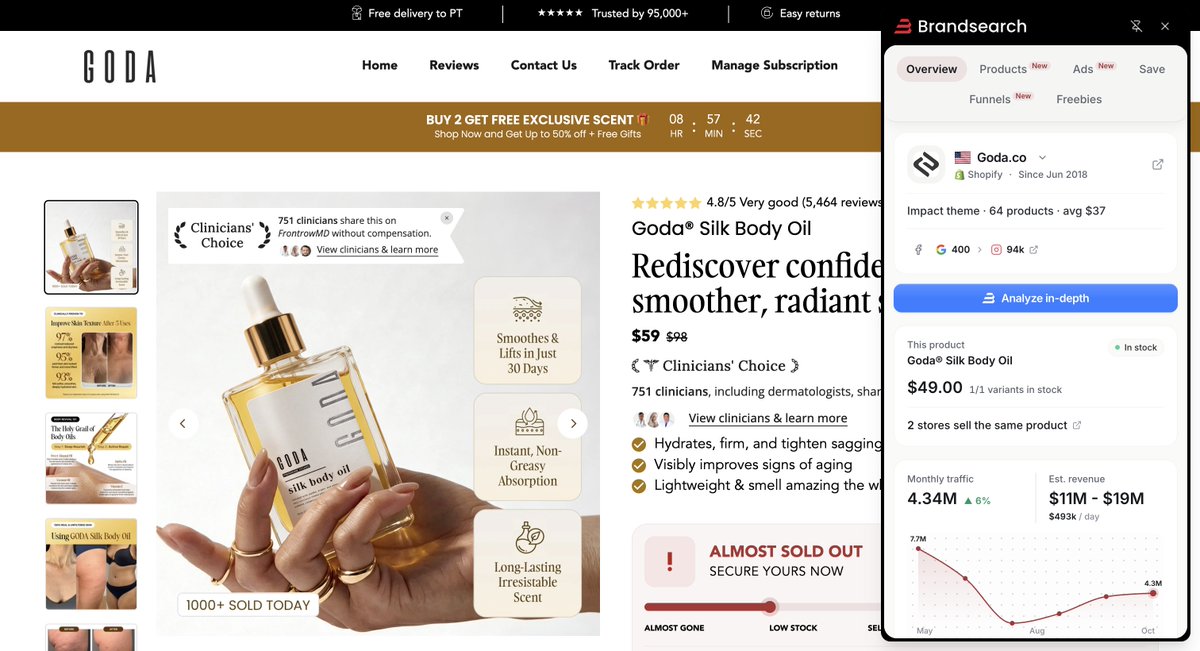
I don’t know much about this company “Goda” and their products — but they appear to be using celebrities to promote themselves in ads and other content… thanks to @JeromySonne for flagging.
$19M A MONTH and risking it ALL with DEEPFAKES?
By now, everyone in ecom has heard about Goda's pheromone perfumes, right?
Yeah, I thought so...
Just came across a Funnelish listicle page selling Goda Body Silk.
And the ad redirecting to it?
A fucking DEEPFAKE ad.
And I'm not talking about ONE celebrity supposedly recommending "Goda Silk Body Oil".
FOUR.
Yes, 4 DIFFERENT CELEBRITIES in the SAME ad.
What do you guys think about this?
GAME IS GAME?
Health insurance has become incredibly expensive (I have been looking at costs for covering our startup’s employees).
Thus the lack of any social safety net in 🇺🇸 makes the prospect of AI taking your job (and healthcare) even more concerning to people.
@JJEnglert@JamesBorow Yep - in general, I found Muse more than willing to do a bunch of stuff that needs additional protections to be safe. Ask a fairly sophisticated Claude model (fable 5.2 or opus 5.5) how to protect your network, and it will probably provide you pretty good advice
AI data centers became one of the biggest fights of this election. But is the anger really about water & power bills?
Stanford Law School’s @persily thinks we’re aiming our AI anxiety at the wrong target. We talked about how the midterm results change the likelihood of state and federal AI regulation, and how the big labs are thinking about it.
As Professor Persily said: “If you go into the OpenAI cafeteria, the food is more regulated than the models that they produce.”
Just as developers create separate API keys so they can revoke one without touching the others, companies should let customers give their AI agents credentials of their own. While logged into your account, you'd authorize an agent and get a passcode just for it, ideally one that expires or covers only one task.
When the agent calls, it says it's an AI and gives that code instead of your security answers. The company then knows it's dealing with your authorized agent, not an impostor. You could also limit what the agent can do (cancel a policy, but not change your bank details), and cut off its access without changing your own login.
(Your real security answers also never end up in an AI system)
cc @alexandr_wang
I wish @Muse wouldn’t identify as an AI agent and just go through the calls.
I have pet insurance I’m trying to cancel and Embrace Pet Insurance won’t let me cancel it online or let my AI agents get on a call to cancel it for me.