🚨 Over 137,000 servers are wide open.
Hackers are using the React2Shell bug (CVE-2025-55182) to take over web servers — no password needed.
Even U.S. government sites are being hit, and the attacks are spreading fast through Next.js apps online.
If your team hasn’t patched yet, you’re already late.
🔗 Read: https://t.co/lLq4iKk5cp
Why you need to understand 𝗔𝗴𝗲𝗻𝘁𝗶𝗰 𝗥𝗔𝗚 as an AI Engineer?
Simple naive RAG systems are rarely used in real world applications. To provide correct actions to solve the user intent, we are always adding some agency to the RAG system - it is usually just a bit of it.
It is important to 𝗻𝗼𝘁 𝗴𝗲𝘁 𝗹𝗼𝘀𝘁 𝗶𝗻 𝘁𝗵𝗲 𝗯𝘂𝘇𝘇 𝗮𝗻𝗱 𝘁𝗲𝗿𝗺𝗶𝗻𝗼𝗹𝗼𝗴𝘆 and understand that there is 𝗻𝗼 𝘀𝗶𝗻𝗴𝗹𝗲 𝗯𝗹𝘂𝗲𝗽𝗿𝗶𝗻𝘁 to add this agency to your RAG system and you should adapt to your use case. My advice is to think in systems and engineering flows.
Let’s explore some of the moving pieces in Agentic RAG:
𝟭. Analysis of the user query: we pass the original user query to a LLM based Agent for analysis. This is where:
➡️ The original query can be rewritten, sometimes multiple times to create either a single or multiple queries to be passed down the pipeline.
➡️ The agent decides if additional data sources are required to answer the query.
𝟮. If additional data is required, the Retrieval step is triggered. In Agentic RAG case, we could have a single or multiple agents responsible for figuring out what data sources should be tapped into, few examples:
➡️ Real time user data. This is a pretty cool concept as we might have some real time information like current location available for the user.
➡️ Internal documents that a user might be interested in.
➡️ Data available on the web.
➡️ …
𝟯. If there is no need for additional data, we try to compose the answer (or multiple answers or a set of actions) straight via an LLM.
𝟰. The answer gets analyzed, summarized and evaluated for correctness and relevance:
➡️ If the Agent decides that the answer is good enough, it gets returned to the user.
➡️ If the Agent decides that the answer needs improvement, we try to rewrite the user query and repeat the generation loop.
✅ Remember the Reflection pattern from my last Newsletter article? This is exactly that. 👆
The real power of Agentic RAG lies in its ability to perform additional routing pre and post generation, handle multiple distinct data sources for retrieval if it is needed and recover from failures while generating correct answers.
What are your thoughts on Agentic RAG? Let me know in the comments! 👇
#RAG #LLM #AI
¿Sabías que la virtualización mejora la eficiencia de tu TI? 🚀 Usa open source y soporte experto para optimizar tu empresa. Sigue el hilo para conocer más 🧵👇
Free Online Cybersecurity Courses and Certifications in 2025.
Here are 15 FREE courses to help you master Cybersecurity 👇👇
1. IBM Cybersecurity Analyst Professional Certificate
🔗https://t.co/2jRxn10kjz
2. Microsoft Cybersecurity Analyst Professional Certificate
🔗 https://t.co/5e5eQxA84P
3. Cloud Application Development Foundations Specialization
🔗 https://t.co/9iWY5A2fup
4. Developing Applications with Google Cloud Specialization
🔗 https://t.co/Mi6gHvfJFN
5. Introduction to Cloud Computing
🔗 https://t.co/0uqyYL9iBK
6. Understanding Google Cloud Security and Operations
🔗 https://t.co/v8Z94BwtN4
7. Innovating with Data and Google Cloud
🔗 https://t.co/dnZ59ZTC9w
8. Microsoft Azure Fundamentals: Describe cloud concepts
🔗 https://t.co/gdHd2SlIra
9. GoogleCloud: Google Cloud Computing Foundations: Cloud Computing Fundamentals
🔗 https://t.co/b3CitYIFtB
10. Cloud Computing Basics (Cloud 101)
🔗https://t.co/vyKDyTcr1o
11. IT Fundamentals for Cybersecurity Specialization
🔗https://t.co/OgWdCensVa
12. Introduction to Cybersecurity Tools & Cyber Attacks
🔗 https://t.co/UbkohxmgJA
13. Cyber Security Course for Beginners
https://t.co/bBDau5ujRI
14. Introduction to Cyber Security
https://t.co/wpNGAmynDK
15. For Beginners
https://t.co/NGiPmE6aCt
Happy Learning
Fusing 𝗥𝗔𝗚 (Retrieval Augmented Generation) and 𝗖𝗔𝗚 (Cache Augmented Generation). 𝗖𝗥𝗔𝗚?
Just recently there was a lot of hype around a technique called CAG. While it is powerful to its own extent, the real magic happens when you combine CAG with regular RAG. Let’s see what it would look like and what additional considerations should be taken into account.
Here are example steps to implement CAG + RAG architecture:
𝘋𝘢𝘵𝘢 𝘗𝘳𝘦𝘱𝘳𝘰𝘤𝘦𝘴𝘴𝘪𝘯𝘨:
𝟭. We use only rarely changing data sources for Cache Augmented Generation. On top of the requirement of data changing rarely we should also think about which of the sources are often hit by relevant queries. Once we have this information, only then we pre-compute all of this selected data into a KV Cache of the LLM. Cache it in memory. This only needs to be done once, the following steps can be run multiple times without recomputing the initial cache.
𝟮. For RAG, if necessary, precompute and store vector embeddings in a compatible database to be searched later in step 4. Sometimes simpler data types are enough for RAG, a regular database might suffice.
𝘘𝘶𝘦𝘳𝘺 𝘗𝘢𝘵𝘩:
We can now utilise the preprocessed data.
𝟯. Compose a prompt including user query and the system prompt with instructions on how cached context and retrieved external context should be used by the LLM.
𝟰. Embed a user query to be used for semantic search via vector DBs and query the context store to retrieve relevant data. If semantic search is not required, query other sources, like real time databases or web.
𝟱. Enrich the final prompt with external context retrieved in step 4.
𝟲. Return the final answer to the user.
𝘚𝘰𝘮𝘦 𝘊𝘰𝘯𝘴𝘪𝘥𝘦𝘳𝘢𝘵𝘪𝘰𝘯𝘴:
➡️ Context window is not infinite and even while some models boast enormous context window sizes, the needle in the haystack problem has not yet been solved so use available context wisely and cache only the data you really need.
✅ For some business cases, specific datasets are extremely valuable to be passed to the model as cache. Think about an assistant that has to always comply with a lengthy set of internal rules stored in multiple documents.
✅ While CAG has been popularised for Open Source just recently, it is already viable for some time via Prompt Caching features in OpenAI and Anthropic APIs. It is really easy to start prototyping there.
✅ You should always separate hot and cold data sources, only use cold (data that changes rarely) in your cache, otherwise the data will go stale and the application will go out of sync.
❌ Be very careful about what you cache as the data will be available for all users to query.
❌ It is very hard to ensure RBAC for cached data unless you have a separate model with its own cache per role.
Have you used the fusion of CAG and RAG already? Let me know about your results in the comments 👇
#LLM #AI #MachineLearning
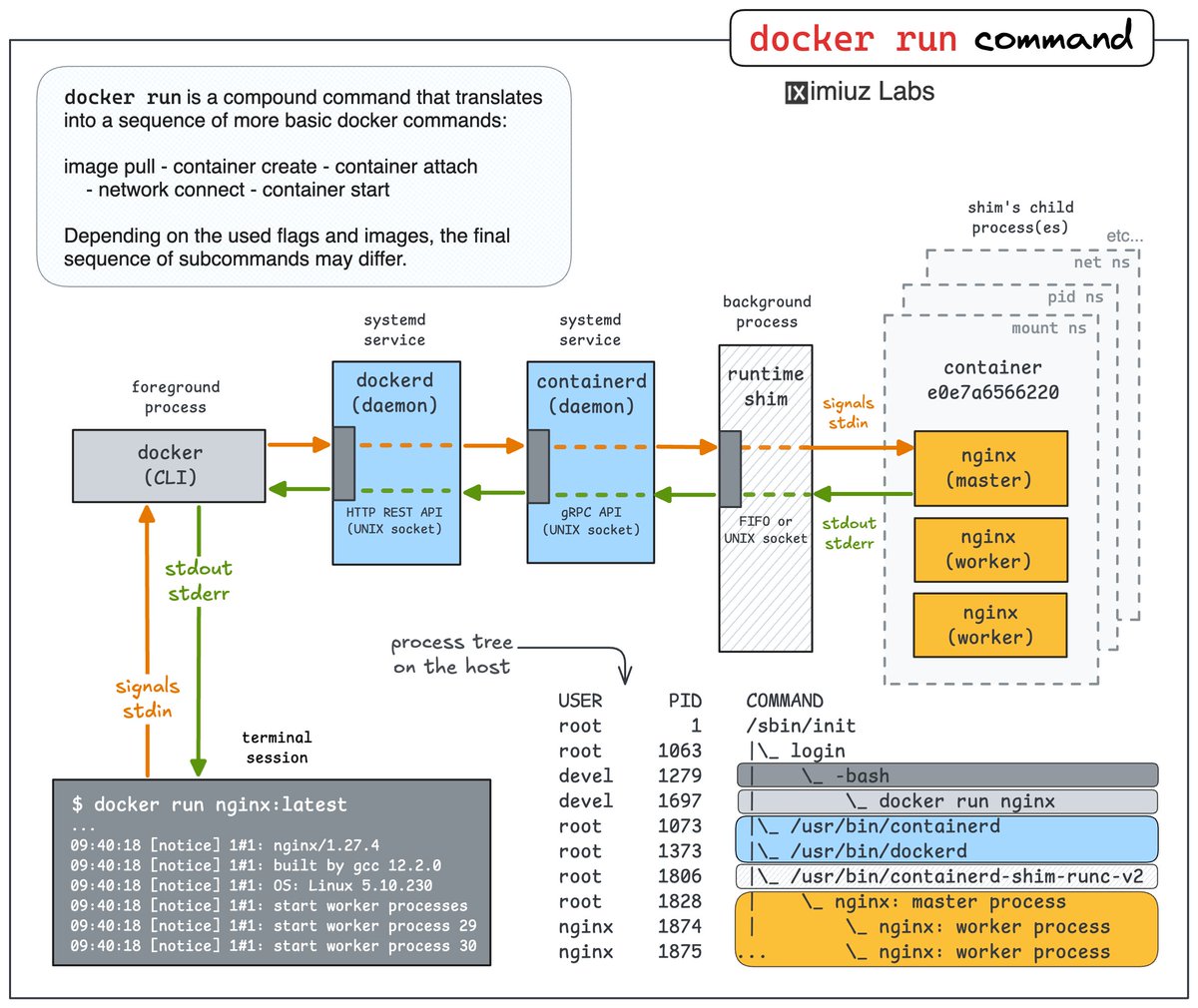
What happens when you 'docker run' a container?
The typical 'docker run nginx' example may trick you into thinking you just launched a foreground nginx process - it locks your terminal and spits access logs to it. But in actuality, containers are always background processes 👇
How do LLMs actually work?
LLMs power AI applications like ChatGPT, Grok, and Claude to generate human-like text and assist with complex tasks.
Here’s a simple to understand breakdown of how they work:
Step 1) Learning from massive text data
LLMs train on huge datasets (books, websites, and code) to recognize patterns and relationships between words. This text is cleaned and broken into tokens—small pieces that a machine can process.
Step 2) Training the model
Using transformers (a deep learning technique), LLMs analyze contextual relationships between words. They improve over time by adjusting their internal settings (weights) through gradient descent—a trial-and-error process that minimizes mistakes.
Step 3) Fine-tuning for special tasks
After training, LLMs are fine-tuned for specific applications like coding, or customer support. This is done using supervised learning, Reinforcement Learning from Human Feedback (RLHF), or Low-Rank Adaptation (LoRA) to improve accuracy.
Step 4) Generating responses
When you enter a prompt, the LLM processes your input, predicts the most likely next tokens, and generates a response. To improve accuracy and relevance, some models use Retrieval-Augmented Generation (RAG)—which searches external knowledge sources (like databases or documents) before generating a response to provide more factual answers. The LLM then applies decoding strategies like beam search and nucleus sampling to refine the final output.
Step 5) Filtering & optimization
Before deployment, LLMs go through safety filters to remove bias and harmful content. They are also optimized using techniques like quantization and pruning, making them efficient for cloud-based and on-device AI.
What are the challenges?
LLMs face issues like hallucinations (false outputs), bias, and high computational costs. Engineers optimize them using RAG, speculative decoding, hybrid cloud-edge deployment and other solutions.
LLMs aren’t magic—they’re pattern-recognition machines built with techniques that are continually evolving.
💭 What is your favorite LLM powered application? 💬
~~
Thank you to our partner Kickresume who keeps our content free to the community.
Are you sure your resume passes ATS scans? Check by using Kickresume’s AI ATS Resume checker.
Check it out: https://t.co/Hin8L7KV1F
Mastering Linux gives you the tools and flexibility to tackle real-world tech challenges and opens doors to careers in #sysadmin, #cybersecurity, and #DevOps. Here is a roadmap to learning Linux😎👇
Find pdf books with all my #Linux infographics at https://t.co/3t6LHw9ryw
Thank you to the strong, creative, ingenious Red Hatters who identify as women for making @RedHat a more innovative company with every contribution. #WomensEqualityDay#LifeAtRedHat
🤓 Roberto Calva te cuenta sobre la estrecha relación entre #Ansible y el #CódigoAbierto. 💫 Conoce más 👉 https://t.co/kyS7fyoGgk y espera nuestra próxima encuesta.