@DevorahLeah The combo of third and fourth letters and eliminated vowels narrowed things way down after guess 2. From there I leaned on a list of past solutions for eliminating things.
Wordle 1,808 3/6*
⬛⬛⬛⬛⬛
⬛⬛🟩🟩⬛
🟩🟩🟩🟩🟩
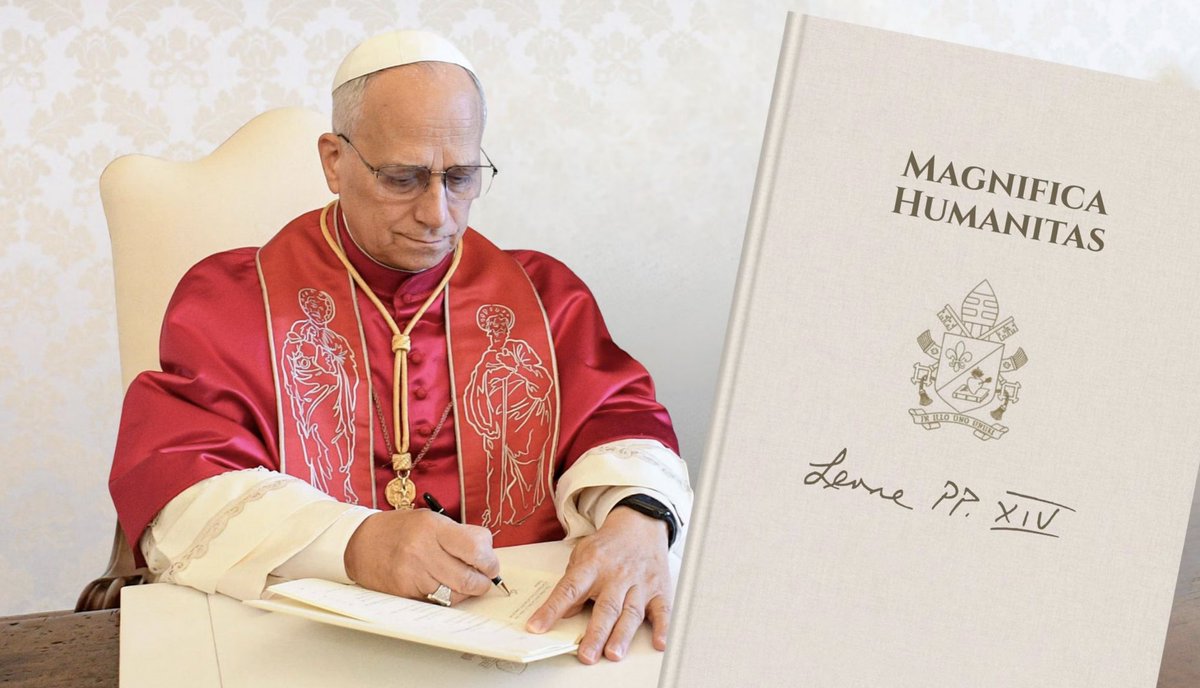
In the era of #ArtificialIntelligence, when human dignity is threatened by new forms of dehumanization, ours is the pressing duty to remain profoundly human. We must lovingly safeguard the grandeur of humanity bestowed upon us and revealed in its fullness in Christ, the splendor of which no machine can ever replace. #MagnificaHumanitas
https://t.co/6i9MWs6LJl
@DevorahLeah Was worried after guess 2 that there were too many options left, but then the right one just sort of happened. I'll take it! Have a great Wednesday everyone.
Wordle 1,796 3/6*
⬛⬛⬛🟨🟨
⬛⬛⬛🟨🟨
🟩🟩🟩🟩🟩
JUST IN: Vatican announces that Pope Leo XIV’s first encyclical — titled Magnifica Humanitas, on the safeguarding of the human person in the age of AI — will be presented at 11:30am on Monday, May 25, in the Vaticanʼs Synod Hall, in the presence of the Holy Father.
Speakers at the presentation will include:
Cardinal Víctor Manuel Fernández, Prefect of the Dicastery for the Doctrine of the Faith;
Cardinal Michael Czerny, Prefect of the Dicastery for the Service of Integral Human Development;
Professor Anna Rowlands, Political Theology, including Catholic Social Teaching, and theological ethics of human migration, Department of Theology and Religion, Durham University, United Kingdom;
Christopher Olah, co-founder of Anthropic (USA) and head of interpretability research for artificial intelligence;
Dr. Leocadie Lushombo, Political Theology and Catholic Social Thought, Jesuit School of Theology / Santa Clara University, California.
Concluding remarks will be delivered by thel Secretary of State, Cardinal Pietro Parolin.
The presentation will also include an address by Pope Leo XIV.
Magnifica Humanitas was signed and dated on May 15, the 135th anniversary of the promulgation of Pope Leo XIII’s Encyclical Letter Rerum Novarum.
I'm speaking to a group at the University of Michigan on Thursday about alternative grading and, since U-M plays an outsized role in the history of grading, I thought I'd add a few U-M specific tidbits to the talk. One of these, is the following quote from President Erastus Haven in 1866:
"[U-M students are] competent and inclined to perform their duties without an appeal to the puerile ambition engendered by rank in classes and prizes and medals… It is doubtful whether these even promote good scholarship… and it is certain that they engender strife and envy, if not hatred… The proper stimulants to study are not medals, or position in class, or prizes, but the gratification produced by an enlarged acquaintance with truth, and by the greater influence for good thereby produced.”
U-M would remain gradeless except for the overall marks of "pass", "fail", and "conditional" until 1912, when the establishment of a Phi Beta Kappa chapter drove the adoption of an institution-wide letter grade system.
Remember: Grades are not some ancient artifact of the very DNA of higher education. In fact the historical precedent is to have no grades. Grades are relatively new and we can all do something different than traditional systems if we want.
Source: This incredible short article on grading at U-M. https://t.co/KHTC3Db6Fu