¿Por qué la #IA falla menos en Low Code que en Python? 🤔 Porque generar configuración declarativa es más preciso que escribir código desde cero. La programación asistida por agentes abre la puerta a que cualquiera pueda crear soluciones complejas 👇
🤖📚 ¿Te interesa la #IAGenerativa y el #PromptEngineering? Hemos creado un ebook con técnicas aplicadas, estructura, casos de uso y recomendaciones para llevar tus aplicaciones de IA al siguiente nivel. ¡Descárgatelo ya! 👇
¿#MCP vs. #A2A? La pregunta no es qué protocolo es mejor, sino cómo se unen. No son excluyentes: MPC (Anthropic) es para la conexión con servicios y A2A (Google) para la comunicación y coordinación entre IAs 🎬 Te contamos en 2 minutos las ventajas que tienen trabajando juntos 👇
¿Quién es capaz de evaluar mejor un #LLM? ¿Un humano u otro LLM? En este post vemos cómo usar LLMs para evaluar otros y garantizar la calidad en su desarrollo. Puedes echarle un vistazo aquí mismo 🧐
¿Cómo establecer una estructura sólida para el desarrollo de aplicaciones con LLMs? #LangChain es una librería para #Python que nos permite conseguirlo. Te explicamos cómo funciona este framework y cómo sacarle partido 🚀
If you spend much time on AI twitter, you might have seen this tentacle monster hanging around. But what is it, and what does it have to do with ChatGPT?
It's kind of a long story. But it's worth it! It even ends with cake 🍰
THREAD:
TL;DR:
Tabular: XGBoost/LightGBM/RF
Time series: XGBoost/LightGBM/RF
Image: ResNet/EffNet
Text: RoBERTa
Audio: ResNet/EffNet
Your best bet is usually to start with these and then experiment from there.
Nothing in ML is an end-all-be-all!
Most AI researchers hide human knowledge from models, so the model is a tabula rasa to learn from data
What about this: Try to embed as much human knowledge as possible. Then learn from data on top of that
It's less focused on "AGI" and more focused on solving problems well
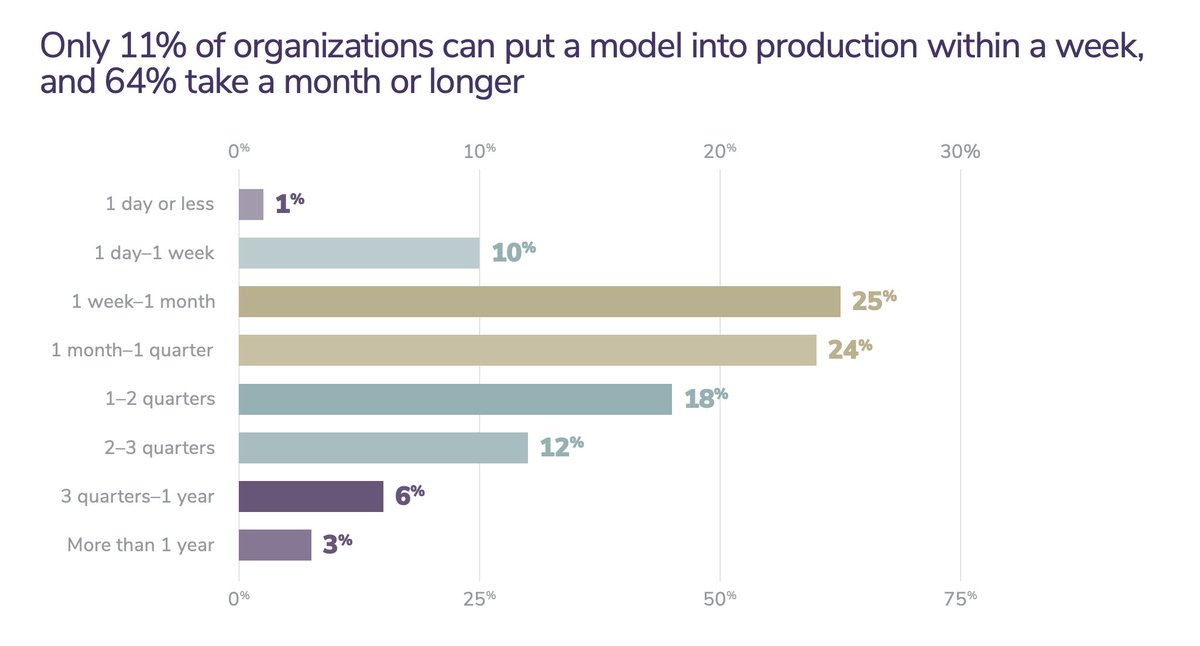
I've read a few blog posts & articles now that imply that MLOps success = maximizing the % of ML models that make it to production. Why is this the north star? IMO the goal is to maximize the % of data science projects that yield business value. Small nit but big difference
A machine learning workflow:
1. Define the problem
2. Assemble a dataset
3. Determine success metrics
4. Decide on evaluation method
5. Prepare the data
6. Establish a baseline
7. Develop a model that beats the baseline
8. Overfit model
9. Regularize model
10. Tune model
Not only data technologies, products and services are evolving much faster than regulations, but also, they are quicker than citizens awareness of their privacy risks. Both must be strengthened to be able to benefit from the potential of data while minimising its risks. (4/4)
Are European citizens willing to renounce to platforms like Facebook to keep their privacy?
Facebook is threatening to leave European Union, if (according to the EU regulation) they are forced not to share European user data with the United States of America. (1/4)
It is difficult to ask users to renounce to an extremely popular service, because they are not aware of the implied privacy issues or they do not care. (3/4)
Saying that bias in AI applications is "just because of the datasets" is like saying the 2008 crisis was "just because of subprime mortgages".
Technically, it's true. But it's singling out the last link in the causality chain while ignoring the entire system around it.