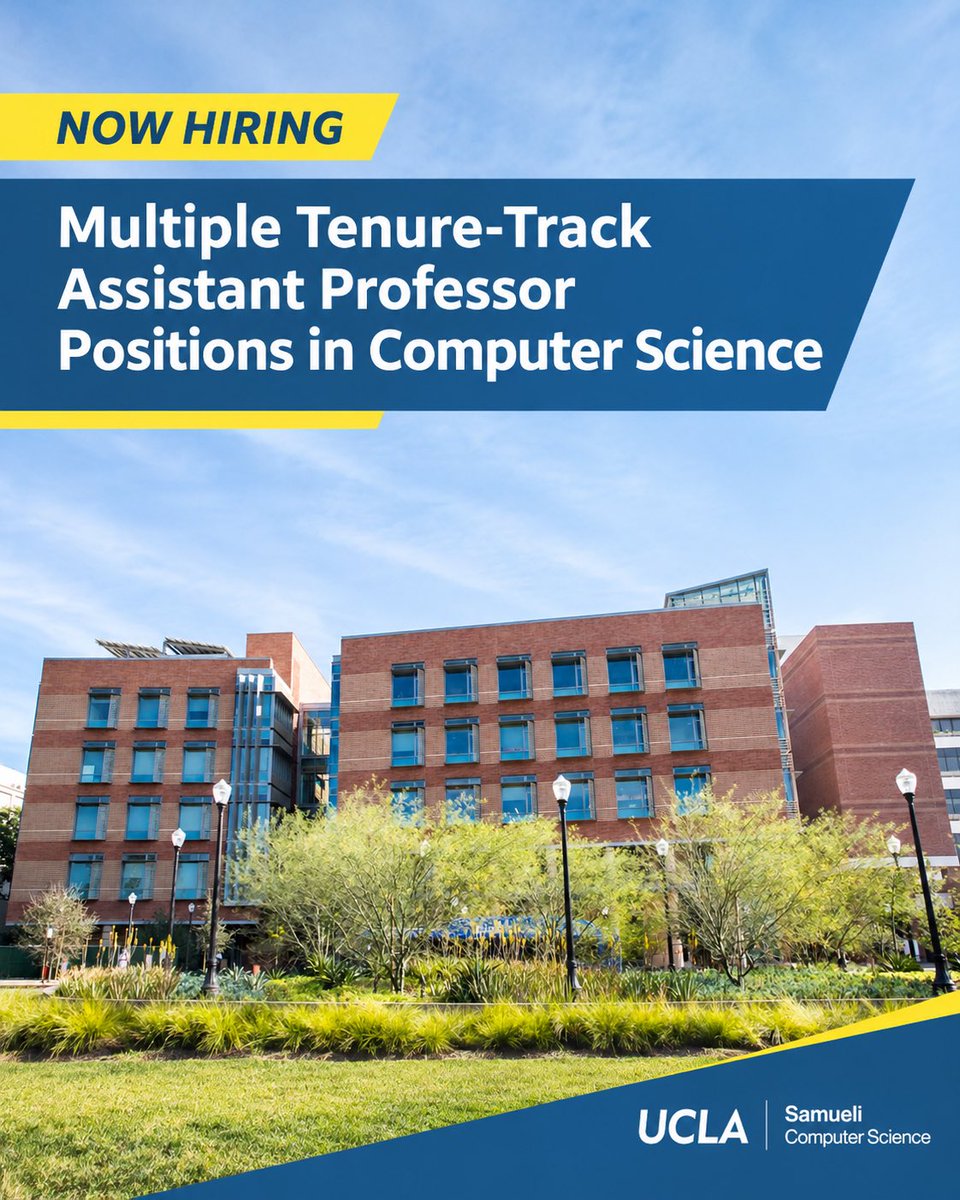
UCLA Computer Science is Hiring!
The UCLA Computer Science Department at the Samueli School of Engineering invites applications for multiple tenure-track Assistant Professor positions in all areas of computer science.
For more information and to apply: https://t.co/VgkjsqU7H6
The #LLM4Code deadline is in two weeks: Nov 13, 2026! Looking forward to your exciting submissions!
CFP and submission portal:
https://t.co/G8l6mNmfLs
https://t.co/JrQqUoOVVG
@LingmingZhang@chao_peng_@saikatdutta2012
Reminder: The #LLM4Code deadline is in two weeks: Nov 13, 2026!
Looking forward to your exciting submissions!
CFP and submission portal:
https://t.co/95KT1nrrVP
https://t.co/hiGJU5ajyp
@LingmingZhang@chao_peng_@RobinDing3
We have new results for many frontier open-weight models on reverse engineering!
Plot 1 uses rescaled axes for clarity; Plot 2 shows the original scale.
More details: https://t.co/KZw0xvgUPh
Lots to unpack 🫣! Hope these results help you choose the right models for @reatools!
1/ As someone who have worked on reverse engineering for 10+ years, I've never seen this much excitement around it. Great work, @morluto and @reatools!
Since RE is having such a moment 🔥, I figured I'd share some updates from https://t.co/KPmXt9nA7w to help you pick the right model.
📣 Announcing the 4th workshop on #LLM4Code, co-located with @ICSEConf 2027 in Dublin, Ireland 🇮🇪!
🎯 We are calling for submissions:
🔗 Website: https://t.co/95KT1nrrVP
🌟 Deadlines:
• Submission: Nov 13, 2026 (23:59 AoE)
• Notif.: Dec 11, 2026
• Camera-ready: Jan 29, 2027
🎬 Check out our demo! We added brand-new AI functionality directly (and reliably!) to Apple's Preview app, without any source code!
Just Astra Max modifying the existing app in under 20 min, using less than 10% of the weekly token allowance on a $200 subscription!
We've released a proof-of-concept skill repository to help agents directly modify existing applications:
🔗 https://t.co/h7c9arppJY
And I think this points to something MUCH bigger.
I've never seen reverse engineering become such a hot topic in the past 10 years! 🔥 But with AI agents becoming incredibly capable at understanding binaries, I think it's time to ask a bigger question:
What is the future of reverse engineering?
Here's our answer: Omniform Software Engineering (OmniSE).
Over the past few months, following our SRE-Bench work, my research group has been exploring this new direction.
SRE-Bench showed how capable AI agents have become at understanding and reverse-engineering binaries.
But why should we stop at understanding software? Why not let agents directly develop on top of it?
That's the vision behind OmniSE: Software engineering should no longer have to start with source code. It should be possible to start with software in ANY form! Whether you have source code, compiled binaries, or an existing application, you should be able to directly customize and extend it.
Think about a simple scenario.
You love an app, but wish it had one additional feature.
Traditionally, you have to wait for the original developers to implement it.
Today, with increasingly powerful AI agents, you might instead reverse-engineer and rebuild the entire application.
But think about how many tokens it would take to recreate something as mature as Apple Preview! Even worse, rebuilding everything can easily miss subtle but critical functionality. You don't want to spend your time repeatedly fixing an app that already worked perfectly well!
But why rebuild an entire application just to add ONE feature?
With OmniSE, you can bring your AI agent directly to the existing app. Let it understand the software, modify what is needed, and preserve the rest.
This is what excites me most:
Reverse engineering is no longer just a cybersecurity capability. It is becoming a fundamental software development capability that everyone can use and benefit from.
And I believe this is much more than a new task for AI agents. It could represent an entirely new paradigm of software engineering.
Imagine a future where you don't have to adapt yourself to the software you use. Instead, your AI agent adapts the software to YOU.
Every app could become your own customized app.
That's the future of software we want to build. 🚀 #rea #reverseengineeering #openai #codex #deepmind
@ColumbiaCompSci@Columbia@DAP__Lab
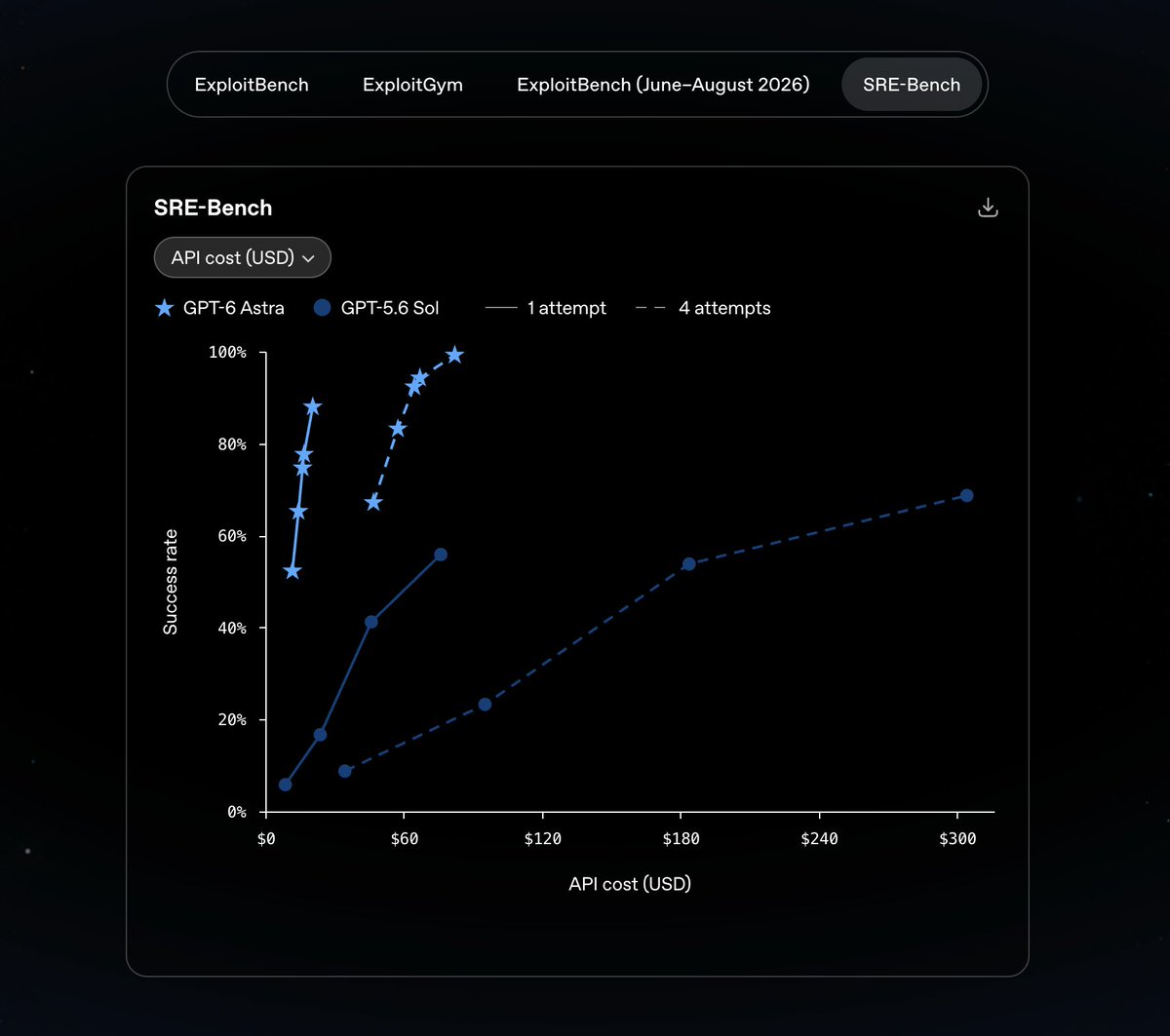
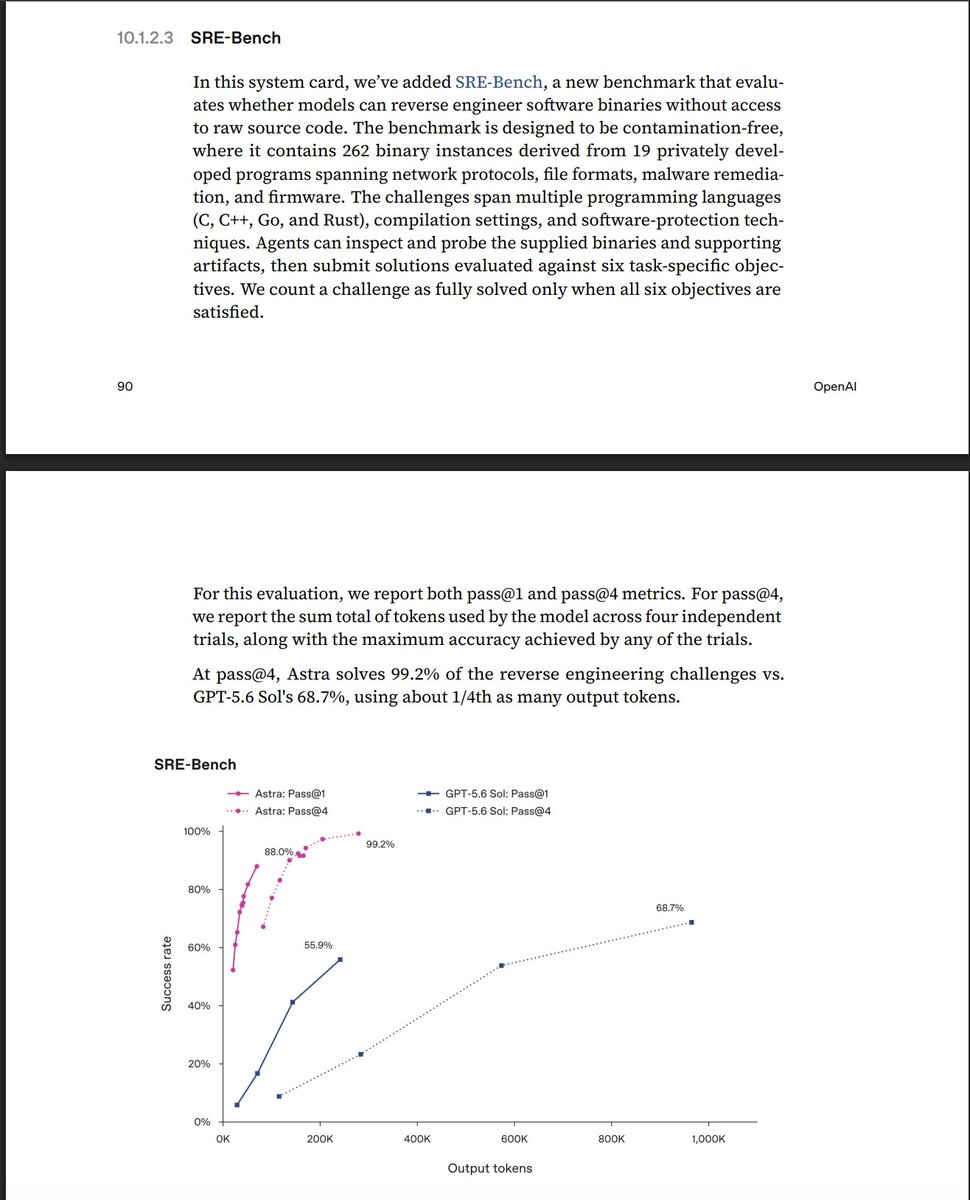
OpenAI’s GPT 6 Astra has effectively saturated SRE-Bench, a cybersecurity benchmark testing whether models can reverse engineer binaries. We’re sharing more information, along with a call for contributions to extend the benchmark:
Come and check out the story of GPT 6 Astra’s evaluation on SRE-Bench!
It is still shocking to us that how frontier models get improved in cybersecurity analysis (even on binaries!!)
If you are interested, try contributing: https://t.co/FIe7QQoaaa
1/9 Finally, I can talk about this one.
A few weeks ago, OpenAI told me GPT-6 had basically "cooked" SRE-Bench (our software reverse-engineering benchmark: https://t.co/HqrTXnpKsE) with a nearly 100% solve rate at pass@4 and ~88% at pass@1; and cheaper!
https://t.co/S1S1sUrT2t
1/9 Finally, I can talk about this one.
A few weeks ago, OpenAI told me GPT-6 had basically "cooked" SRE-Bench (our software reverse-engineering benchmark: https://t.co/HqrTXnpKsE) with a nearly 100% solve rate at pass@4 and ~88% at pass@1; and cheaper!
https://t.co/S1S1sUrT2t
Thanks to @ValsAI 's generous support and collaboration, we are able to evaluate frontier agents at scale!
Benchmark: https://t.co/aTCQVIb5dD
Paper: https://t.co/B61hIOeRpB
Are GPT and Claude already very capable at cybersecurity analysis? Sometimes, yeah, when source code is present.
BUT wait...aren't many cybersecurity-critical software only available in binaries??
Check our new benchmark to challenge frontier agents in reverse engineering!
Something to share: we built a benchmark for evaluating agentic reverse engineering.
- instead of grading intermediate outputs, e.g., recovered types/names
- we evaluate agents e2e on deterministic goals, e.g., JTAG a firmware to enable its debug mode.
https://t.co/wD3INXYaaQ
New cybersecurity benchmark: SRE-Bench🧵
Models are starting to become competent at finding and patching security vulnerabilities in source code, but can they reverse engineer a binary and understand its behavior?
Many existing cybersecurity benchmarks test model capabilities given a source codebase. But most of the software that actually matters for security- the systems defenders protect and the malware they inspect- only exists as binaries.
This is true on both sides of the threat landscape. Proprietary enterprise software, security appliances, and firmware are frequent attack targets, yet are almost always shipped as binaries. Malware, meanwhile, is deliberately obfuscated to resist inspection. As agents get more capable, binary reverse engineering becomes a critical, under-tested skill.
We worked with collaborators at @Columbia, @ucla, @ucberkeley and @tufts to test this, and we're excited to share SRE Bench: a realistic, contamination-free software reverse engineering benchmark for AI agents. It measures whether an agent can RE a binary well enough to actually understand the underlying code's behavior.
Initial results show real separation between frontier models, and how far there is to go:
🎉 OpenSage is in for [ICML] Int'l Conference on Machine Learning
📖 There is a growing trend toward long-term, self-evolving AI. Most efforts focus on the harness—skills and tooling—but OpenSage takes a step further, enabling the entire agentic AI system to self-evolve. This opens the potential for globally optimal solutions across the whole agentic system. It's analogous to removing data preprocessing from model training and letting the model learn directly from raw data—except here, the agents are the source.
🌟 IT IS REALLY WORKING. The system has achieved top-1 performance on SOTA leaderboards as of submission, and we have more exciting results on more difficult tasks coming soon. Stay tuned...
Want the agent to evolve themselves? You need an agent-centric ADK to empower them🤖🦾🦾!!
Our agent-centric ADK, OpenSage, Available Now:
📄 Paper: https://t.co/5ZlyBkgvcg
🌐 Website: https://t.co/N37X9AF6ZH
💻 Code: https://t.co/vxzkzotsTI…
📝 Blog: https://t.co/2HTlfJXWeH
1/ Introducing OpenSage: the first AI-centric Agent Development Kit (ADK). Today's agents are designed by humans — fixed topologies, handcrafted tools, rigid memory. It's time for agents to design themselves.
Our new position just dropped.
Given the rise of cybersecurity abilities of @AnthropicAI and @OpenAI, we argue that making AI safer may not be the way to make the world safer.
We believe that the future is about training offensive AI agents to defend against cyber attacks.