@ytekedejong@VVD@MinPres Zolang ze in de publiciteit het altijd hebben over 'we gaan alleen de aller rijksten belasten over hun vermogen' zijn het voor mij oplichters zolang er een belastingvrije voet is van minder dan € 60.000.
Zwei Kollegen. Gleiches Gehalt.
Einer spart 20 Jahre jeden Monat 250 €.
Der andere keinen Cent.
Nach 20 Jahren:
60.000 € vs. 0 €.
Beide verlieren ihren Job.
Gleich viel in die Arbeitslosenversicherung eingezahlt.
15 Monate bekommen beide Arbeitslosengeld.
Danach Grundsicherung.
Jetzt wird es bitter.
Der mit 0 € kann sofort Leistungen bekommen.
Der Sparer?
60.000 € Vermögen.
20.000 € geschützt.
40.000 € muss er grundsätzlich erst selbst einsetzen.
Gleich verdient.
Gleich eingezahlt.
Gleich arbeitslos.
Nur einer hat 20 Jahre vorgesorgt.
Und genau deshalb muss er jetzt länger selbst für sich zahlen.
Seine Vorsorge entlastet am Ende vor allem den Staat. ✒️
@TheoBuysStocks Die waren ook al voor die geweldige nieuwe wet toekomst pensioenen. Vakbonden willen vooral arme werknemers die hulp nodig hebben. Dus word vooral niet te onafhankelijk van overheid en dus ook van de vakbond.
Berenberg Initiates $ASTS at Buy, PT $92 (65% upside)
Analyst comments: "AST SpaceMobile is the only company to have demonstrated true cellular broadband from space to unmodified smartphones.
It approaches commercial operations in 2027 with pieces its competitors lack, including 60+ mobile network operator (MNO) partnerships covering c3bn subscribers, premium lowband access plus owned L-band and S-band spectrum, and a growing government/defence franchise.
The key to the story is that ASTS complements rather than competes with carriers like AT&T, Verizon, Vodafone and Rakuten.
We see asymmetric risk-reward, with rapid revenue growth at extraordinary margins once continuous service launches in 2027 and multiple catalysts along the way. We initiate with a Buy rating and $92 price target."
Analyst: Michael Filatov
$ASTS: ☕️ Grab a coffee and take 10 minutes to read this report by German investment bank Berenberg. This is probably the best AST SpaceMobile initiation of coverage research I've read. It's very clear this analyst has done their homework and understands the thesis very well. Their Blue Sky scenario is $242 per share.
@trias_politica Als kamerleden niet even kijken naar de impact van de box3 plannen voor gewone kleine beleggers, dus zonder zelf even na te denken. Creëren ze een vijandbeeld naar de overheid en iedereen die ervan leeft.
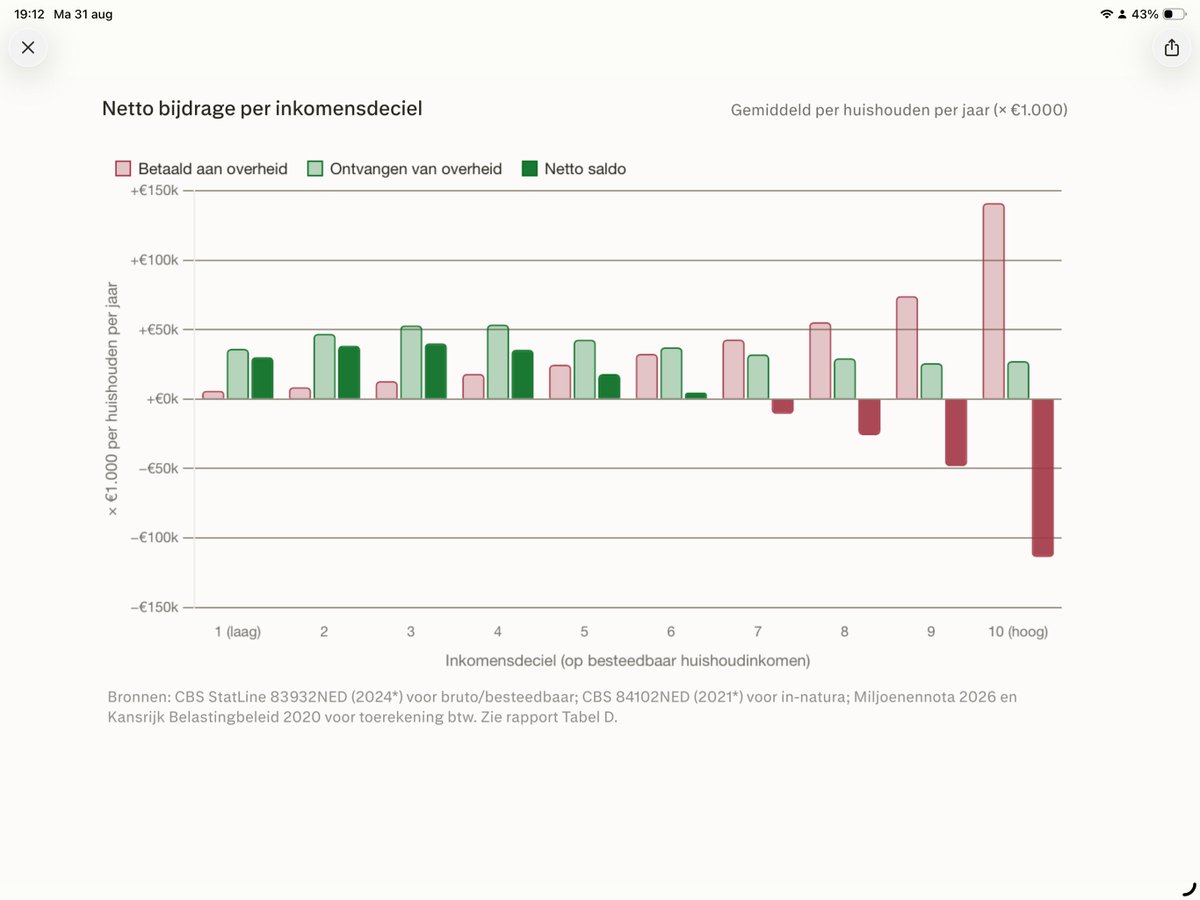
6 op de 10 Nederlandse huishoudens ontvangen per saldo méér van de overheid dan zij betalen.
1 op de 10 draagt €114.000 netto per jaar af.
De rest zit ertussenin.
Elke discussie over “eerlijker verdelen” gaat feitelijk over die ene op de tien nóg harder aanslaan. Zeg dat dan gewoon.
@ItoIian@beursanalist Een verlies van 50% goedmaken.
Bij 36% belasting over de 'winst' moet je 156,25% rendement maken om weer op je oorspronkelijke vermogen uit te komen.
Voorbeeld: €100 → €50
€50 + 156,25% = €128,13
Belasting: €28,13
Netto: €100
Here's the mustread if you want to understand this insanity, by investigative journalist Jesse Frederik (in Dutch): https://t.co/0NMK18zfQ2.
Short summary:
1. Drilling for gas caused (by international standards) minor earthquakes. The damage to some houses in the epicentre area was real. And the state and the gas company handled it badly. Corporate lawyers, denial, etc.
2. Things became super political. The need to establish cause was removed. You can now claim mining damage anywhere the ground has ever moved more than 0.55 mm per second. That's a basketball bouncing on a floor. (For most of the province it was a single tremor back in 2012).
3. Then the investigating stopped too. 'Victims' first got €5,000. Then €10,000. Then up to €60,000 of repairs with no investigation into what caused them.
4. Claims exploded. 2024 was the mildest seismic year in two decades, but there were 42,790 damage claims. Over 70% of claims now come from zip codes where the strongest ground motion was about what a truck going over a speed bump produces.
5. Total compensation: €3.9 billion. 56% of all addresses in the 'earthquake zone' have been compensated at least once (including a rich town where the strongest tremor expected was equivalent to a passing train), and where an engineer puts the odds of a quake-caused crack in an undamaged brick wall at 1 in 20,000. The town has collected €65 million, plus another €14.5 million in green-energy subsidies for earthquake 'victims'.
6. Meanwhile the gas company spent €200 MILLION on research - Groningen became the global centre of seismological research (even though people in - for example - Italy would find it funny that we call these tremors 'earthquakes'). The whole provinces was wired with sensors.
7. All the research was ignored though. The political debate was dominated by a form of science denial, but this time mainly coming from the left. One international expert called the parliamentary inquiry's account of the physics 'misinformation on a very serious scale'.
8. The gas field is now being filled with cement. Around 550 billion cubic metres is still down there (roughly 18 years of Dutch consumption), but the Netherlands now imports most of what it burns. Experts asked to keep some wells intact as an emergency reserve. Parliament said no.
9. End result: we spent insane amounts of money, are much more dependent on foreign autocrats for our energy (with higher greenhouse gas emissions), misinformation is everywhere, and citizens in Groningen are still angry.
@beleggen_com Een verlies van 50% goedmaken.
Bij 36% belasting over de 'winst' moet je 156,25% rendement maken om weer op je oorspronkelijke vermogen uit te komen.
Voorbeeld: €100 → €50
€50 + 156,25% = €128,13
Belasting: €28,13
Netto: €100
"Mijn man werkt fulltime als manager bij de overheid, hij verdient 7500 euro netto."
Hier gaan we als land aan kapot. Geen enkele omzetverantwoordelijkheid dragen. Geen ondernemersrisico.
En maar vergaderen.
https://t.co/CpSy2k85oW