Robots often repeatedly attempt to grasp empty space rather than repositioning the backpack or changing their approach. This task tests not only fine-grained manipulation, but also the ability to actively seek information and adapt when an initial strategy fails.
The zipper may be directly visible or hidden on the side. It would be natural for us to rotate the backpack and look for the zipper from the other side. Yet, across 140 rollouts, only two received non-zero partial scores, and none completed the task.
Every pull also changes the conditions for the next action. For example, a section of lace that has just been pulled out may fall over and obscure the next segment the robot needs to grasp. The robot must continuously reassess the situation and adjust its actions accordingly.
210 rollouts, but not a single successful completion.
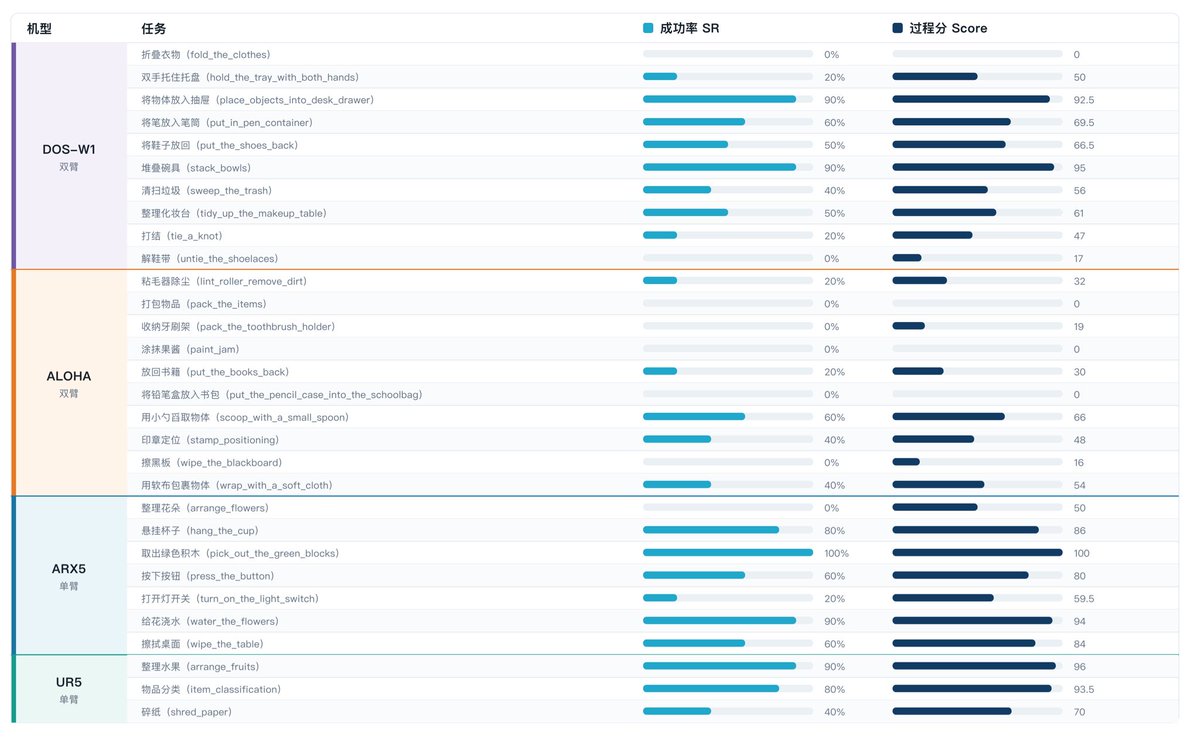
In Table30 V2, we designed a task that requires robots to use both arms to completely remove a shoelace from a shoe and place both objects back on the table.
Why is this seemingly simple task so difficult?
Shoelaces are thin, flexible, and often overlap or lie flat against the shoe. The robot needs to identify not only where the shoelace is, but also which segment to grasp. Even with a successful grasp, pulling the wrong segment can tighten the lace rather than loosen it.
We designed the cup-hanging task to evaluate more than basic pick-and-place.
Unlike placing a cup, hanging it requires the robot to precisely align the handle with the hook and release the cup without letting it fall.
Take our toothbrush holder task as an example. Robots must organize multiple toothbrushes and toothpastes into a limited space, considering both placement and orientation to ensure everything fits.
We intentionally made simple pick-and-place tasks more challenging by introducing multiple objects and spatial constraints.
In real-world settings, robots need to decide what to pick first, how to approach each object, and how to avoid interference during manipulation.
We included this requirement to assess whether the robot can transfer an object between its arms and maintain control through placement. This helps distinguish a completed manipulation sequence from an object simply landing in the right place.
The task requires a handover between the two arms. The blue bowl fell into the bowl below before the receiving gripper secured it. The final placement was correct, but the handover was incomplete.
The task requires a handover between the two arms. The blue bowl fell into the bowl below before the receiving gripper secured it. The final placement was correct, but the handover was incomplete.
@KDDI_Research VLA-DM0.5 tops RoboChallenge Table 30 V2 with a 40.67% success rate and a 54.42 process score, both ranked #1. Built on Dexmal’s open-source DM0.5, it combines multi-model collaboration with predictive action optimization across 30 real-world tasks on 4 platforms.
RoboChallenge Table30-Generalist final update. @Alibaba_Qwen Qwen-RobotManip for Lira_generalist #1, Atlas_generalist #2. This track tests unified real robot manipulation models, supporting multi-task generalization, a foundational capability for practical general embodied AI.
Congratulations @XiaomiTech_ on the double championship! The only team to surpass 40% success rate at CVPR 2026 GigaBrain Challenge-RoboChallenge, paired with 1st place at ICRA 2026 WBC. We'll continue improving RoboChallenge with global partners and pushing embodied AI forward.
Xiaomi Robotics achieved a dual-champion in embodied AI.
🏆 1st Place at CVPR 2026 Workshops-GigaBrain Challenge-RoboChallenge Track — the only team to achieve a success rate above 40% (40.89%).
🏆 1st Place at ICRA 2026 WBC — achieving a 94% success rate and a score of 99.2.
Bringing embodied AI into the real world, enabling robots to perform useful tasks with greater intelligence and reliability.
#EmbodiedAI #Robotics #VLM #WorldModel #Sim2Real #CVPR2026 #ICRA2026
🚀 The RoboChallenge Annual Report is LIVE!
We analyze the Table30 leaderboard and reviews representative task cases, bringing together practical insights and suggestions from the RoboChallenge committee and the broader community.
🔗https://t.co/hkPYCIyrEs
🚀Huge congratulations! @spirit_ai2024@gao_young Reaching #1 is an incredible achievement, but open-sourcing the model is the real win for the community. Thank you for empowering builders everywhere to push the boundaries of Embodied AI. Let’s keep building together! 👏🤖
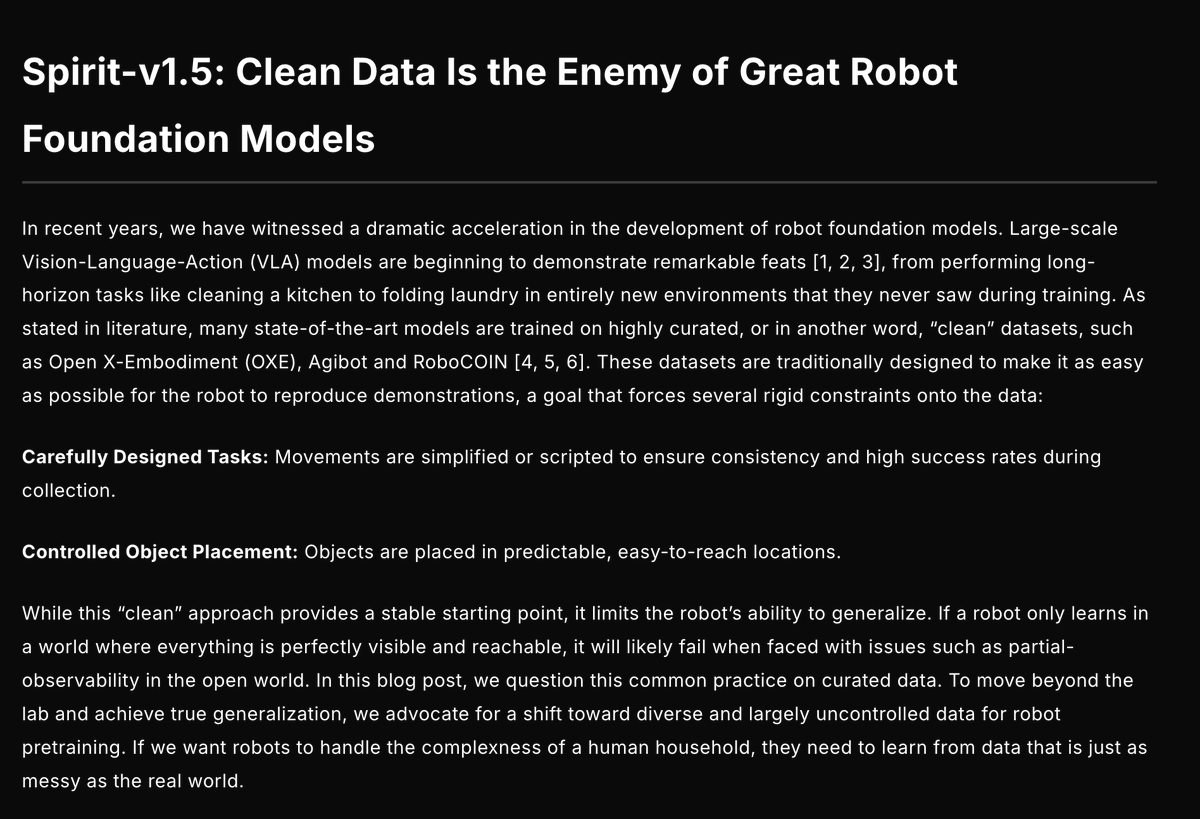
Thrilled to announce that Spirit v1.5 from Spirit AI has officially reached #1 on the RoboChallenge leaderboard, outperforming pi0.5! 🚀
Scaling end-to-end embodied AI is a collective journey. We’ve been deeply inspired by the community—their work continues to push the entire field forward. Therefore, we are open-sourcing Spirit v1.5 today. We can’t wait to see what the community builds with it. 🛠️
🏆 Leaderboard: https://t.co/AE4kYUUik1
💻 Blog: https://t.co/80u37S63fe
💻 Open Source:
Code: https://t.co/uj0kQr9tpl
Model: https://t.co/AS3kuI9DpG
#SpiritAI #EmbodiedAI #Robotics #OpenSource #Spiritv1.5