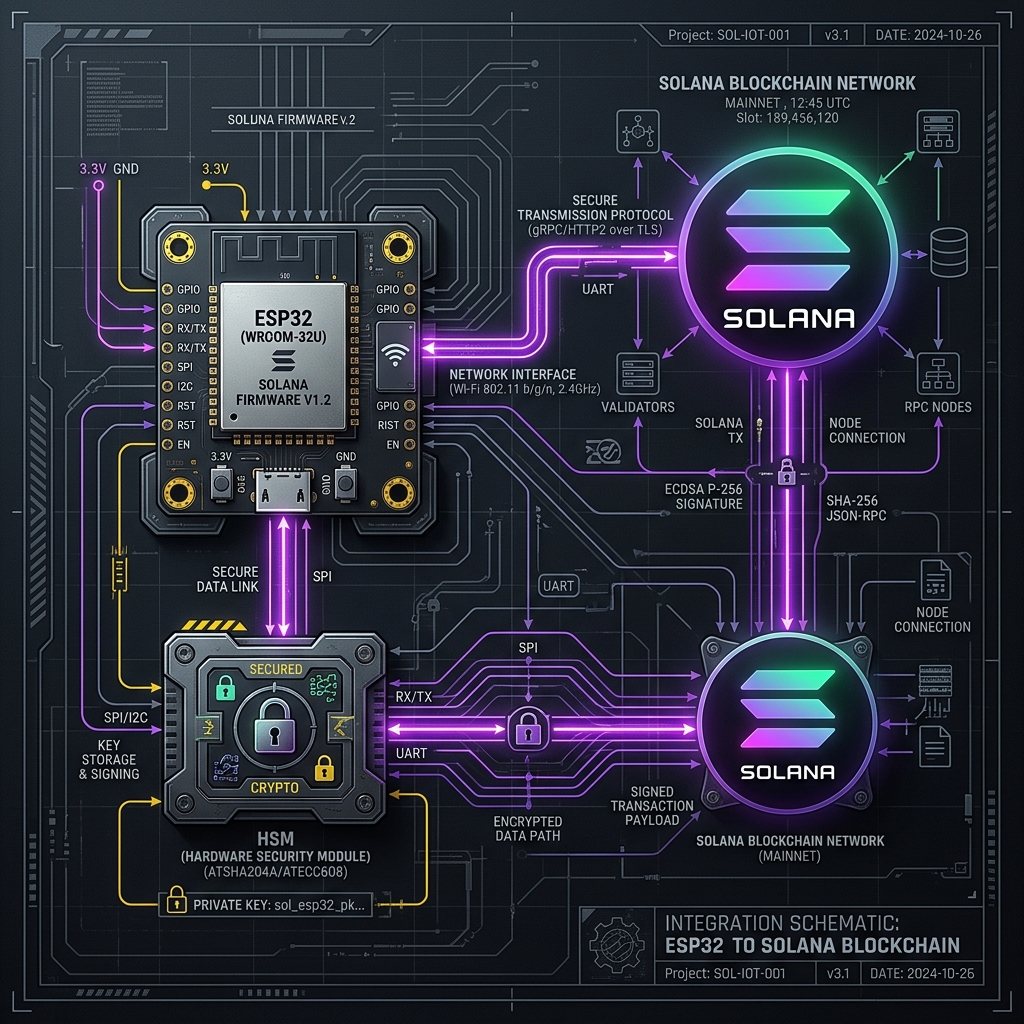
Your robot can now have a wallet it can't be robbed of.
RoboWallet: a no_std Rust SDK that turns $5 microcontrollers into autonomous economic agents on @solana — with spending limits enforced on-chain, not on the device.
Open source, live on devnet. 🧵
It's live: machine-to-machine payments on Solana are now one npm install away.
npm install robowallet-sdk
→ open a session vault with a spending limit
→ the device signs its own payments
→ the chain rejects anything over the limit
no_std Rust core, MIT, live on devnet. 🤖
Exactly right — and it applies one layer deeper.
Robots, sensors and chargers face the same problem, plus one software agents don't: the device can be physically stolen.
So the machine signs its own payments, but the budget lives on-chain. Stolen device ≠ drained wallet.
Everyone talks about AI agents.
Few talk about the infrastructure they need to become truly autonomous: payments.
An AI agent can reason, analyze, and execute tasks, but it isn't independent if it still relies on humans to manage accounts, API keys, subscriptions, or credit cards.
That's why x402 launching on @Injective is a major milestone.
x402 enables machine-to-machine payments, allowing AI agents to discover services, pay instantly with stablecoins, receive access, and continue executing tasks automatically.
Every transaction is settled onchain in under a second and comes with a verifiable receipt.
This means AI agents can pay for:
• Data feeds
• Compute resources
• APIs
• Research
• Storage
• Digital services
Exactly when needed, without pre-funded accounts or manual approvals.
The result is an internet where software doesn't just consume information—it participates in economic activity.
AI agents need a native payment layer.
x402 + $INJ is helping build it.
The future isn't just AI-generated content.
It's autonomous agents that can transact, coordinate resources, and operate independently onchain.
@Evan_Immortals@coinbase Agreed — and it gets more interesting below the software layer. Physical machines (robots, sensors, chargers) need the same per-use rails, but with one constraint software agents don't have: the device can be physically stolen. Budgets have to live on-chain, not on the machine.
Stolen device ≠ drained wallet.
Your machine signs its own payments, but the budget lives on-chain — the program rejects anything over the owner's limit.
Try the full flow in ~10 minutes, no hardware needed:
https://t.co/5yZ5fzzvzg
Drones paying charging pads. Sensors selling data. Robots buying compute.
The machine economy needs machine-safe wallets. We're building them in the open — feedback, issues and PRs welcome. 🤖⚡
Your robot can now have a wallet it can't be robbed of.
RoboWallet: a no_std Rust SDK that turns $5 microcontrollers into autonomous economic agents on @solana — with spending limits enforced on-chain, not on the device.
Open source, live on devnet. 🧵
We just made building Solana-connected hardware as easy as writing Arduino code. 🛠️
Our Rust core is compiled down to a static C++ library. Just drop #include <RoboWallet.h> into your Arduino IDE and your microcontroller is ready to broadcast transactions! 🚀
#Arduino#Web3
Did you know your ESP32 can sign @Solana transactions without a single heap allocation? 🤯
RoboWallet Core is built in 100% no_std Rust. No heap fragmentation, no runtime crashes, just pure bare-metal performance. ⚡
#RustLang#Solana#EmbeddedSystems#IoT
The DePIN revolution requires hardware that talks directly to the blockchain.
We are opening up early access to the RoboWallet SDK soon. Drop your email on our dashboard waitlist: [Your Vercel Link Here]
#Rust#DePIN#Solana#Hardware#ESP32
How do you fit the entire @Solana blockchain stack into a $3 microchip with only 520KB of RAM? 🤯
We built RoboWallet to enable DePIN hardware to sign and broadcast transactions natively. No intermediate servers. No AWS.
Here is a deep dive into our zero-heap architecture. 🧵👇
3️⃣ The Offline Transaction Queue (OTQ) Hardware loses Wi-Fi. If a smart vending machine drops connection during a payment, RoboWallet caches the serialized transaction in Non-Volatile Storage (NVS). Once reconnected, it auto-fetches a new Blockhash, re-signs, and broadcasts. 📡
The Machine Economy is coming to @solana. 🤖⚡️
Standard Web3 SDKs are too heavy for cheap IoT hardware. So we built RoboWallet: a no_std, zero-allocation Rust SDK that lets a $5 microcontroller sign transactions autonomously.
Pure on-chain robotics.
#Solana#DePIN