@socal_dodgers @BethMalanMerkl @chrissyteigen The Bible was quoted over and over again to justify Apartheid. This is nothing new to people who lived through that. We just can't believe we're seeing this shit again in OUR lifetime.
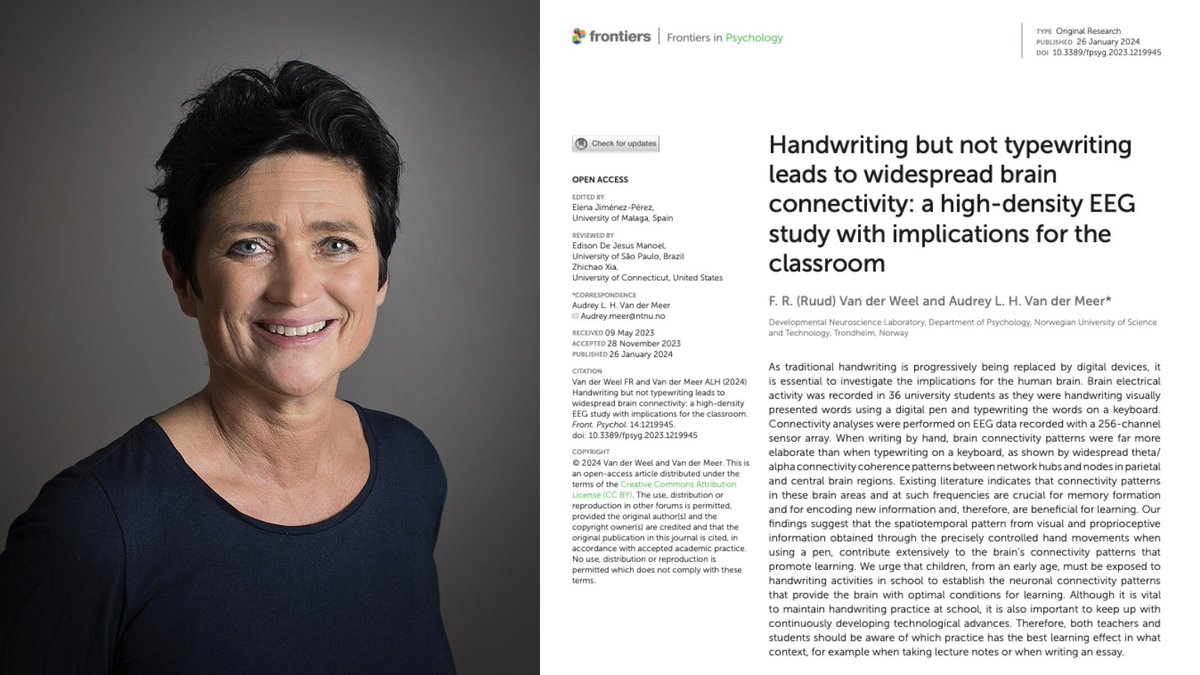
A Norwegian neuroscientist spent 20 years proving that the act of writing by hand changes the human brain in ways typing physically cannot, and almost nobody outside her field has read the paper.
Her name is Audrey van der Meer.
She runs a brain research lab in Trondheim, and the paper that closed the argument was published in 2024 in a journal called Frontiers in Psychology. The finding is brutal enough that it should have changed every classroom on Earth.
The experiment was simple. She recruited 36 university students and put each one in a cap with 256 sensors pressed against their scalp to record brain activity. Words flashed on a screen one at a time.
Sometimes the students wrote the word by hand on a touchscreen using a digital pen, and sometimes they typed the same word on a keyboard. Every neural response was recorded for the full five seconds the word stayed on screen.
Then her team looked at the part of the data most researchers had ignored for years, which is how different parts of the brain were communicating with each other during the task.
When the students wrote by hand, the brain lit up everywhere at once.
The regions responsible for memory, sensory integration, and the encoding of new information were all firing together in a coordinated pattern that spread across the entire cortex. The whole network was awake and connected.
When the same students typed the same word, that pattern collapsed almost completely.
Most of the brain went quiet, and the connections between regions that had been alive seconds earlier were nowhere to be found on the EEG.
Same word, same brain, same person, and two completely different neurological events.
The reason turned out to be something nobody had really paid attention to before her work. Writing by hand is not one motion but a sequence of thousands of tiny micro-movements coordinated with your eyes in real time, where each letter is a different shape that requires the brain to solve a slightly different spatial problem.
Your fingers, wrist, vision, and the parts of your brain that track position in space are all working together to produce one letter, then the next, then the next.
Typing throws all of that away. Every key on a keyboard requires the exact same finger motion regardless of which letter you are pressing, which means the brain has almost nothing to integrate and almost no problem to solve.
Van der Meer said it plainly in her interviews.
Pressing the same key with the same finger over and over does not stimulate the brain in any meaningful way, and she pointed out something that should scare every parent who handed their kid an iPad.
Children who learn to read and write on tablets often cannot tell letters like b and d apart, because they have never physically felt with their bodies what it takes to actually produce those letters on a page.
A decade before her, two researchers at Princeton ran the same fight using a completely different method and ended up at the same answer. Pam Mueller and Daniel Oppenheimer tested 327 students across three experiments, where half took notes on laptops with the internet disabled and half took notes by hand, before testing everyone on what they actually understood from the lectures they had watched.
The handwriting group won by a wide margin on every question that required real understanding rather than surface recall.
The reason was hiding in the transcripts of what the two groups had actually written down.
The laptop students typed almost word for word, capturing more total content but processing almost none of it as they went, while the handwriting students physically could not write fast enough to transcribe a lecture in real time, which forced them to listen carefully, decide what actually mattered, and put it in their own words on the page.
That single act of choosing what to keep was the learning itself, and the keyboard had quietly skipped the choosing and skipped the learning along with it.
Two studies. Two countries. Same answer.
Handwriting makes the brain work. Typing lets it coast.
Every note you have ever typed instead of written went into your brain through a thinner pipe. Every meeting, every book highlight, every idea you captured on your phone instead of on paper was processed at half depth.
You did not forget those things because your memory is bad. You forgot them because typing never woke the part of the brain that would have made them stick.
The fix is the thing your grandmother already knew.
Pick up a pen. Write the thing down. The slower road is the faster one.
Japanese actor Hiroyuki Sanada spoke about the contradictions of human nature:
“Some people dream of having a swimming pool at home, while those who have one hardly ever use it. Those who have lost a loved one feel a profound sense of loss, while others often complain about their living relatives. Those without a partner long for one, while those who have one often don't appreciate it. The hungry would give anything for a meal, while the satiated complain about the taste of their food. Those without a car dream of owning one, while those who have a car are always looking for a better one.”
The key to happiness is gratitude: truly seeing and appreciating what we already have, and understanding that somewhere, someone would give anything for what we take for granted.
"Why does our top performer get the worst reviews?" the boss asked.
I was reviewing their annual performance data.
"Show me," I said.
She pulled up the ratings.
Diana: 2.8 out of 5.
Below average on "collaboration."
Low marks for "team player."
"What's her actual performance?" I asked.
"Exceeded every target.
Landed our biggest client.
Trained three new hires."
"So why the low scores?"
"Her peer reviews are dragging her down."
I scanned the comments.
"Too direct."
"Challenges ideas too much."
"Not supportive enough."
"Let me talk to Diana," I said.
"I used to give honest feedback," Diana told me.
"Said our pricing model was broken.
Got dinged for 'negativity.'"
"What happened with the pricing?"
"They finally fixed it six months later.
After we lost two major accounts."
"What else?"
"I questioned why we needed
eleven approvals for a simple contract change.
Manager said I wasn't being collaborative."
"Are you still giving feedback?"
"No. I learned my lesson.
Now I smile. Nod. Say everything's great.
My reviews are improving."
"But nothing's actually improving?"
"We're making the same mistakes.
Just with better vibes." She chuckled.
I went back to the boss.
"Your review system doesn't measure performance," I said.
"It measures compliance."
"That's not true."
"When was the last time someone
got promoted for challenging bad ideas?"
Silence.
"When did someone get rewarded for preventing a mistake?"
More silence.
"You've trained your best people to stay quiet.
And your mediocre people to stay nice."
A few months later, they redesigned the system.
Added a category: "Constructive Challenge."
Points for identifying problems early.
Rewards for preventing costly mistakes.
Diana got promoted.
"What changed?" I asked the boss.
"We stopped confusing agreement with alignment.
Stopped mistaking silence for harmony."
"And?"
"Turns out our 'difficult' people
were our most valuable.
They actually cared enough to speak up."
Here's the truth about performance reviews:
Most companies don't reward performance.
They reward performance theater.
The person who says the meeting was great
beats the person who says it wasted an hour.
The person who agrees with bad ideas
beats the person who prevents disasters.
You think you're measuring contribution.
You're measuring conformity.
And your best people?
They've already figured out the game.
They're just deciding whether to play it
or find somewhere that values truth over comfort.
Not that anybody asked, but If you accumulated all the flora, fauna, and metal that your True Love gives you each day in the “Twelve Days of Christmas” song, you would own 12 Trees, 40 Gold Rings, 140 Humans, and 185 Birds of 6 different species.
The patriarchy is to blame for men having poor emotional regulation since the only emotion not considered "feminine" & thus undesirable is anger. It is not women who built those walls, it's other men. Yes, be authentically you, but also recognize these truths.
Many women don't mind if a man is broke, IF they see that he has drive, ambition & working to move upward. No man has EVER been shamed for earning more. If a man's relationship status is mocked, it's not by women. 1/2
Dear men, remember this:
The world shames you for being broke, then judges you when you earn more.
Mocks you for being single, questions you if you marry—too early or too late.
Calls you weak for showing emotion, toxic for staying silent.
No matter what you do, someone will judge.
Not one man is spared.
So live for yourself.
Protect your peace.
The German company that built the forklift used in the Louvre robbery uses a photo of the heist to advertise itself: “When things need to be done quickly.”
😂😂😂
@OneLuckyGirl_28 Financial abundance
Joyfully abundance
Peaceful abundance
Love In abundance
To be free from negative aura/energy and vibes.
To attract positive aura/energy and vibes
An abundance of
Health
Financial wealth
Spiritual wealth
Good health
Debt free
I’d rather shit in both hands and clap, than let someone who makes $700,000 a minute, convince me that people who make $7.25 an hour is the reason we’re all struggling.
Wake the fuck up.
WHEN ITS A FREE TRIAL FOR A PRODUCT, LET IT ACTUALLY BE A FREE TRIAL. DONT FORCE ME TO ENTER MY CREDIT CARD INFO SO YOU HOPE I FORGET AND TAKE MY MONEY.