Introducing $RAFFLE — Raffle on Solana.
Buy the coin. Your wallet is the ticket.
We built $RAFFLE to turn a memecoin into a community-funded raffle, where trading activity contributes directly to a prize pool paid out in SOL.
Here's how it works:
Buy $RAFFLE: Every wallet that buys the token is automatically entered into the raffle. No registration, forms, or additional signups.
$3,000 starting prize: The main prize pool begins at $3,000, with creator fees generated from every trade continuously adding to the pot.
One wallet wins: A winning wallet is selected and receives the prize pool directly in SOL.
The GTA 6 money: One wallet walks away with enough SOL to buy GTA 6 and potentially a lot more.
The idea is simple: instead of creator fees benefiting only the developer, they help fund a prize for the community.
The contract address is coming soon, with the first draw date to be announced after launch.
One coin. One wallet. One winner.
https://t.co/mpWfXA1MCj
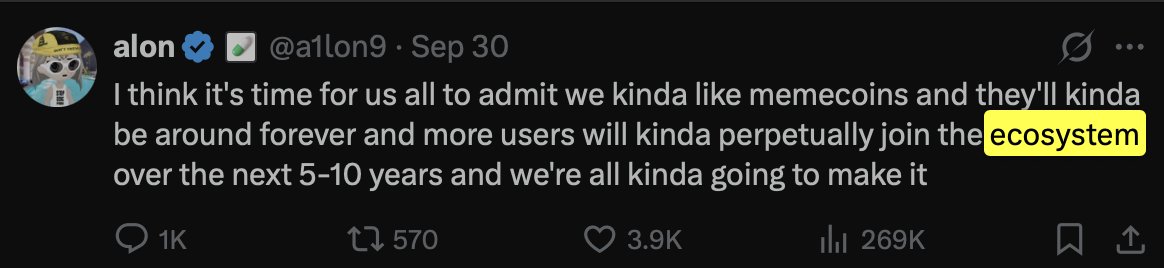
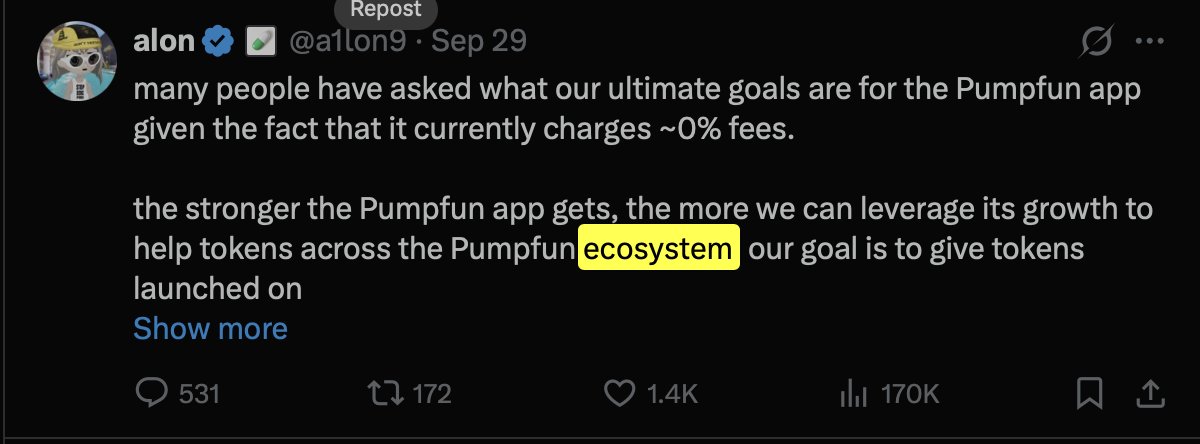
you guys are missing the point the whole point of @Pumpfun is to on board retail and everyone they can and grow the ecosystem
Alon repeats it multiple times
The ecosystem grew from when we all began it used to be a simple launchpad now there is
callouts
fees
perps
stocks etc
and the ecosystem only grows more with pumpfun
this is the perfect narriv to run $eco this is what they want
proof below
@PumpfunEco
Our main goal with this update is to help alleviate the pressure that PVP places on ecosystem tokens and use that energy for good: help strengthen established coins even further.
We achieve this by encouraging beta plays to pair with the established runner, thereby funneling buy pressure and new holders to the main runner.
To make this update user-friendly, we had to make numerous innovations to our bonding curve and PumpSwap programs.
Most importantly, we’ve prevented users from being exposed to exorbitant fees that could put them far underwater immediately when they place a trade. We're the first major platform to bypass fees in multihop swaps.
We want to ensure that established communities get as much organic buy pressure as possible, which means reducing the fees that traders are exposed to and ensuring as much liquidity enters each token as possible. Reducing fees for traders also lengthens the average lifespan of a retail trader that’s still learning the ropes.
I think i may have just found genny in the pumpfun github docs
when talking about pairing coins to eachother, it gives us a genny example
"Coin A--->Coin B"
Why have we never ran a COIN A, someone can dev coin b and pair it to this.
2 free cooks
https://t.co/zVikeMdA64
Introducing PUMPEMON ($PUMPEMON) — Pokémon-style trading cards, built for the trenches.
I built a place where degens can rip open digital card packs, collect characters inspired by the crypto trenches, and turn their pulls into actual $PUMPEMON tokens.
The Genesis Collection contains 420 cards, divided into four rarity tiers:
Uncommon — Your everyday trench pulls.
Rare — Harder-to-find cards with higher sell values.
Ultra — Premium pulls worth significantly more.
Legendary — The ultimate chase cards, with the highest potential rewards.
Here's how it works.
Visit https://t.co/5gRGI5mNUY, connect your Phantom wallet, and open a pack for free.
Every pack reveals one card. Each card has its own rarity and a corresponding sell value denominated in $PUMPEMON.
Once you've revealed your card, you make the decision:
HOLD: Keep the card in your collection.
SELL: Exchange your pull for its displayed $PUMPEMON value.
The rarer the card, the bigger the potential payout.
I wanted to bring the excitement of opening Pokémon packs into the Solana meme coin ecosystem, where the characters, culture, and rewards all revolve around the trenches.
420 cards. Four rarity tiers. One token.
Rip a pack. Find a legendary. Get bags.
https://t.co/5gRGI5mNUY
Introducing M500 — Meme 500. @TheMeme500
We're building an onchain index protocol designed to turn a diversified basket of tokenized investments into a single, composable asset.
The architecture takes inspiration from MAG7, but the objective is broader: create a programmable index where issuance, redemption, portfolio accounting, fee distribution, and rebalancing are handled by smart contracts rather than a centralized fund manager.
Here's how M500 is designed to work.
01 / Atomic basket execution
M500 isn't intended to be a conventional meme token with an arbitrary market capitalization.
Each M500 token represents a proportional claim on a portfolio of underlying tokenized assets held in an onchain vault.
When someone buys M500, the execution contract routes their deposit across the constituent liquidity pools according to the index's target weights.
The contract verifies the assets received, calculates the resulting net asset value (NAV), and mints the corresponding amount of M500.
The entire sequence executes atomically. If execution exceeds the user's slippage constraints, the transaction reverts.
One deposit. Multiple underlying purchases. One index token.
02 / NAV-based minting and redemption
M500 supply expands and contracts with primary-market activity.
Minting creates new index shares against assets deposited into the vault. Redemption burns shares and releases a proportional amount of the underlying basket.
The fundamental accounting relationship is:
NAV per M500 = Total portfolio NAV / Circulating index shares.
This makes M500 economically different from a typical meme coin.
Its primary-market value is derived from the underlying portfolio, while secondary-market prices can temporarily deviate due to liquidity, slippage, and trading demand.
Arbitrage participants can exploit those deviations through minting and redemption, helping secondary-market prices converge toward NAV.
03 / Fee-driven NAV accumulation
Rather than distributing trading rewards as separate claimable tokens, M500 is designed to reinvest a defined portion of protocol trading fees directly into the index portfolio.
Fees accumulate in the underlying basket instead of being paid out as isolated rewards.
As additional assets enter the vault without proportionally increasing the number of outstanding shares, the quantity of assets backing each M500 increases.
This creates a mechanism for NAV-per-share accretion independent of new capital deposits.
No staking interface. No manual claims. No reward-token emissions.
The benefit is embedded directly into the index's backing.
04 / Autonomous portfolio rebalancing
Each constituent has a defined target portfolio weight.
As market prices change, the actual weights drift away from their targets.
The rebalancing system is designed to identify those deviations and execute controlled portfolio adjustments through onchain liquidity and auction mechanisms.
Instead of blindly market-selling oversized positions, the protocol can use price-discovery auctions to invite external participants to execute rebalances.
The objective is to reduce unnecessary market impact and preserve value for existing index holders.
All portfolio composition changes, rebalance parameters, and execution results are intended to be publicly verifiable onchain.
05 / Liquidity aggregation
Traditional token launches depend on someone supplying liquidity to a dedicated trading pair.
M500's primary issuance mechanism is designed to inherit executable liquidity from the constituent assets themselves.
A purchase is routed into the underlying markets, while the vault issues new index shares against the acquired portfolio.
This removes the need to rely exclusively on a standalone M500 liquidity pool for primary issuance.
Actual execution capacity remains dependent on the depth of the underlying markets.
06 / The larger architecture
M500 is designed to be more than a ticker.
It's an index infrastructure layer for constructing, trading, and eventually deploying custom baskets of tokenized assets.
The long-term objective is a permissionless system where developers can define index compositions, configure weights, establish transparent fee structures, and create independently operating basket tokens.
Every index becomes a programmable financial primitive.
Every share represents underlying assets.
Every transaction is verifiable.
Every portfolio adjustment is observable.
M500 is our attempt to bring the mechanics of traditional index investing into an entirely onchain execution environment.
The architecture is being developed; the described mechanisms are design goals, not claims of deployed or audited contracts.
One token. An entire basket. Fully onchain.
$M500
just bought the mag 7 on robinhood chain.
deployed MAG7 this evening, the first index on bankr: one token backed by a basket of up to 20 tokens. and on MAG7, the trading fees go to the holders.
every buy, a uniswap v4 hook buys all 7 stocks from their own pools and mints MAG7. every sell burns MAG7 and sells the basket. one transaction either way. the index itself needs no LP, so creators don’t need to provide liquidity to launch one. it’s already in the pools of the tokens it holds. this isn’t possible without uniswap hooks.
the fees: MAG7 charges 0.50% a trade. i set my creator cut to 0, so 0.30% of every buy and sell goes back into the basket for holders, and 0.20% to the protocol. nobody claims anything. it’s released into the basket over 24h, so after every trade each MAG7 is backed by a little more. creators pick a fee of 0.25–1% at launch and it never changes.
the index never market-sells when rebalancing. it runs dutch auctions, offering what it holds too much of at a price that starts good for holders and gets cheaper every minute until someone fills it. anyone can fill. every rebalance gets 48h notice, so holders can leave first.
you can always swap MAG7 back for the 7 stocks directly. no fee, works without bankr, can’t be paused.
i also seeded a small USDG/MAG7 pool on uniswap so it shows up on dexscreener. but buy on bankr. it goes straight through the hook, which mints new MAG7 at the basket’s price, as deep as the 7 stocks’ own pools rather than my small one. hook trades are also the ones that pay holders. if the pool drifts, arbs close the gap.
it’s early. we’re getting the hook supported in wallets and aggregators before the full rollout. right now it’s just me creating indexes. soon anyone can make their own on base or robinhood.
and then: pairing. you’ll be able to launch a token paired with an index. buying your coin buys the index, the index buys the basket, and your creator fees come in the index.
buying MAG7 on bankr isn’t available in the US or UK.
@Hisahito_Ai I didn’t even get fees on any of the coins
agencypad took all fees for the bot
it a simple google search and some reading
I think ur the only dumbass here
For anyone calling me a “rugger” or “farmer”
I’ve been out of $TERMINAL since launch stayed up 10 hours helping it run to 2m
Gave you $LIFE went to 1m in about 45 minutes after
And I wasn’t even profiting I’m here to create projects
If you bought and the coin ended up dying out that’s not my issue
I’ll have more multi milly runners
as for pumchan she is back active
please do not be in my mentions threatening me I have given pk access to terminal as well so it can build and launch whatever it wants