Vice Chair of Perioperative Informatics, @UCSDHealth | Advancing Patient Care through Ethical AI & Predictive Medicine | Cryoneurolysis Pain Management Expert
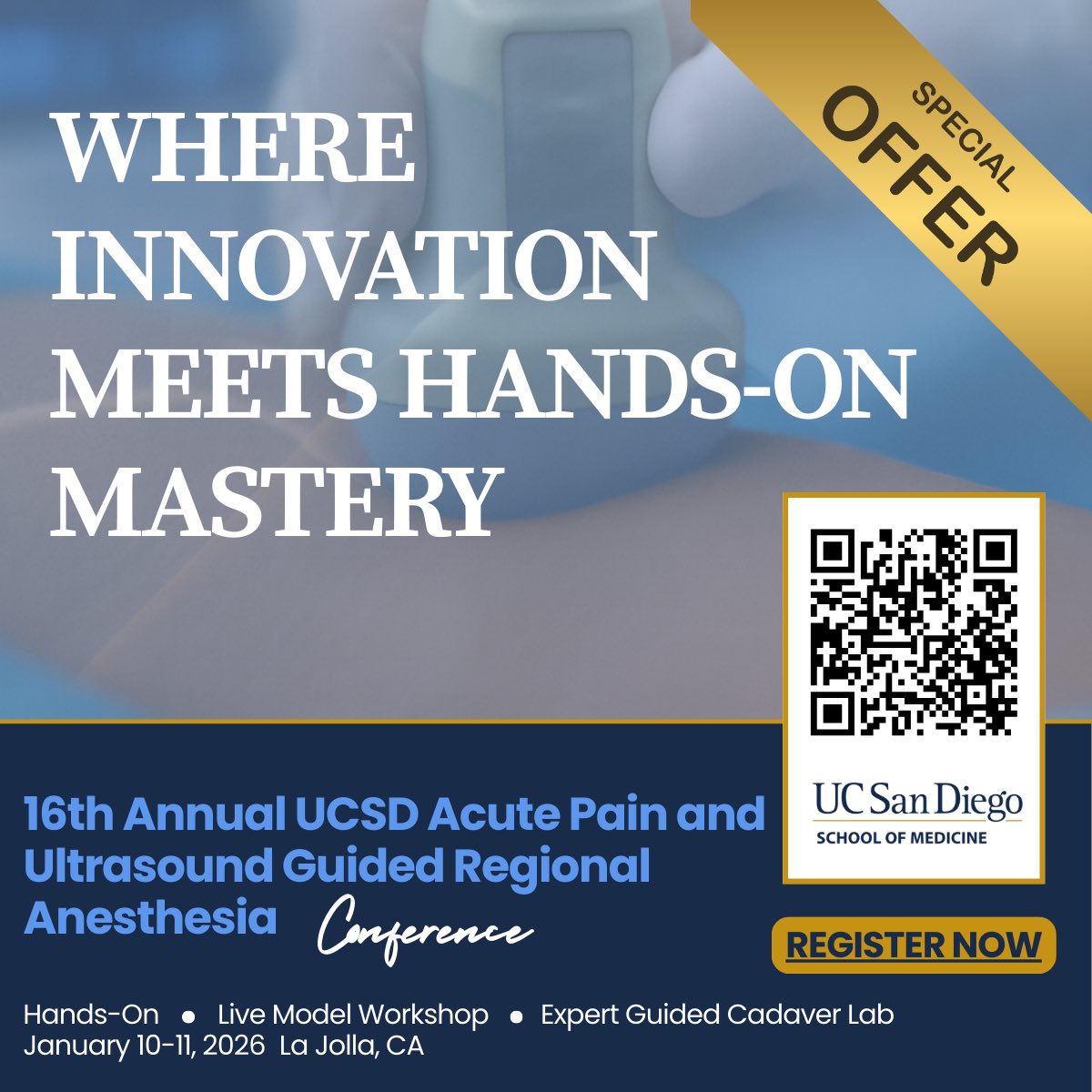
Our January UCSD Regional Anesthesia and Acute Pain course is coming together, and we’re excited to welcome this year’s learners.
If you’re interested in attending, send us a message for a discount code.
We look forward to seeing you in January.@RodneyGabrielMD@UCSDAnes
Unfortunately, we're seeing a dramatic rise in opioid-related overdose and disorder in older adults. Between 2000 and 2020, the rate of deaths from synthetic opioids rose 14-fold in this population. The causes are complex, but one thing is clear: https://t.co/VjiBqb38Q7
Our approach to pain in older adults often stalls at prescription, but management must be dynamic and rooted in regular assessment, personalization, and alternatives to long-term opioids.
Chronic pain isn’t always about structural damage. 🧠 Central sensitisation reshapes the nervous system, amplifying pain signals for a long time. Explore the mechanisms behind this phenomenon in #BJAEd: https://t.co/qmnc7jCFtx
We often talk about multimodal analgesia in terms of medications—and don't get me wrong, medications still can play a key role in healing for many—but this shows how multimodal communication can be just as powerful.
In a recent study of over 10,000 outpatient surgeries, simply combining standardized non-opioid protocols with proactive education nearly halved chronic opioid use. There was no novel molecule. There was no complex tech. It was just consistent messaging and clear expectations.
If AI is to be a meaningful part of care, we have to make it reliable for everyone, from clinicians to patients and beyond. Efficiency is easy to measure. Equity isn’t. Both are equally as important.
We're not asking anymore whether or not #AI has potential to do good in #healthcare. It clearly does.
I think the bigger question now isn't how to achieve even more great things. It should be how to start preventing the bad. https://t.co/e0Fm8Z1iqG
We're seeing a pretty common pattern with AI adoption: new tech enters the system, fixes some problems, and goes on to create and/or exacerbate others.
Will we learn from past mistakes in opioid over-prescription, or just replace one crutch with another?
Innovation is necessary. Structural change is non-negotiable.
Really fascinating development here. By selectively blocking α2B-adrenoceptors to elevate noradrenaline and activate pain-suppressing α2A pathways, researchers may have sidestepped two decades of pharmacological dead ends in non-opioid pain relief. https://t.co/NM2ctwjK2p
But the science is only part of the story. There are still a lot of bigger questions to consider.
Will #healthcare systems adopt it equitably? Will we address cost, access, and patient education?
Such invaluable takeaways from this study. It does a great job demonstrating something many in #informatics already deal with:
Just because an #AI model sounds confident doesn't mean it's making the right call. https://t.co/lYl7Trj3Go
What this tells me is that #LLMs can't be relied on to make ethical decisions. They’re pattern-matchers, and without human oversight, pattern-matching in medicine can quickly turn into misjudgment. Humans are nuanced, and that nuance is often hard to catch.