Our Actively Managed Exchange Traded Fund (AMETF) market continues to gain momentum, bringing more choice and differentiated investment approaches to investors. The MitonOptimal EasyETFs SA Protected Equity AMETF joins our market today, adding an actively managed approach designed to capture the long-term growth potential of South African equities while keeping risk management firmly in focus. Read more here: https://t.co/NsC6gk0BPh
Join us in welcoming the MitonOptimal EasyETFs SA Protected Equity Actively Managed Exchange Traded Fund (AMETF) to our Main Board this morning. Designed to capture the long-term growth potential of South African equities while limiting the impact of market downturns, the fund brings investors another innovative, professionally managed investment solution on our Exchange.
Read more here: https://t.co/NsC6gk0BPh
.@CitywireSA's 2025 Star Selector report is out, sharing the insights & strategies of SA's top #fundselectors.
The report shares how they adapted to a changing #investment environment. Access the report here.
#investmentinsight#financenews
https://t.co/l8YHka9Yxv
Have a great Finance ministry, improved DTI, police and transport industries, amongst others, and 12 opposition party cabinet ministers. Large improvement and 100 days of no load-shedding, go SA. 100 days ago we wouldn’t have dreamt up such a positive outcome🇿🇦🇿🇦🌈🌈
"Commodities protect against structurally higher inflation and diversify better than bonds. A portfolio with 40% exposure to commodities outperformed a traditional 60/40 mix with less downside risk."
- BofA
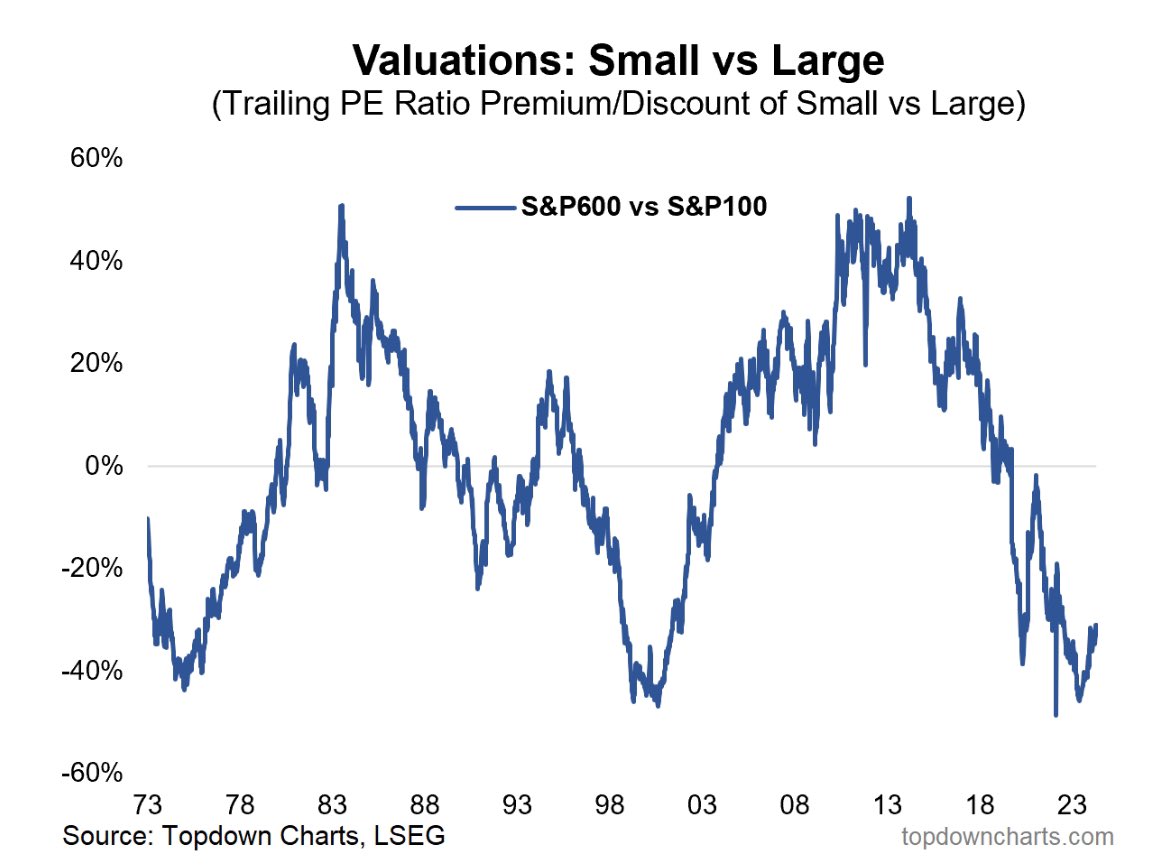
Small-cap stocks are currently trading at their lowest valuations compared to larger companies since the early 2000s and 1970s.
It's not coincidental that commodities, emerging markets, value stocks, and small-cap equities typically excel during a secular bull market in gold.
We are likely experiencing another significant inflection point where small caps are deeply undervalued and positioned for strong performance in the next decade.
H/t @dailychartbook & @topdowncharts
Although $NVDA often dominates the headlines in the semiconductor space during this AI boom -- many other companies also hold monopolistic positions in the new digital economy.
Here's a cheat sheet for the top 10 companies with monopolies 👇
1. $ASML | ASML Holding
• They hold a monopoly in lithography machines, which are essential for enabling the mass production of ultra-small, efficient chips crucial for AI applications. Their technology is foundational in pushing the boundaries of miniaturization and performance in semiconductor manufacturing.
2. $TSM | Taiwan Semiconductor Manufacturing
• They remain the world’s largest dedicated independent semiconductor foundry, with unmatched capabilities in manufacturing advanced chips that are crucial for AI technologies. They are the only manufacturer with sufficiently advanced technology to produce the most sophisticated AI chips.
3. $KLAC | KLA Corporation
• They specialize in process control and yield management solutions. Their equipment and services are essential for the semiconductor manufacturing industry, ensuring the production of high-quality chip performance at micro and nano-levels, which is critical for the reliable operation of AI systems.
4. $AMAT | Applied Materials
• They excel in materials engineering solutions used to produce virtually every new chip and advanced display in the world. Their innovations in metal deposition and etch systems are essential for creating smaller, faster, and more reliable electronic devices needed in AI applications.
5. $LRCX | Lam Research
• They are pivotal in the semiconductor fabrication process, providing advanced wafer fabrication equipment and services. Their technology is crucial for the production of highly sophisticated semiconductor devices, making them indispensable for manufacturers aiming to meet the increasing demands for more powerful and efficient AI chips.
6. $MU | Micron
• They are leaders in providing memory and storage solutions crucial for AI data processing. Their competitive advantage comes from their cutting-edge DRAM and NAND technologies, which significantly enhance the speed and capacity of AI systems.
7. $AVGO | Broadcom
• Their range of semiconductor devices supports robust data center networking and broadband capabilities, crucial for AI ecosystems. Their broad product line and innovation in 5G technology position them as a key infrastructure provider in the rapidly expanding AI market.
8. $WDC | Western Digital
• They offer high-capacity, efficient storage technologies that are crucial for handling the vast data volumes generated by AI applications. Their leadership in storage technology provides a competitive edge in data centers and computing architectures.
9. $MRVL | Marvell Technology
• Their technology excels in creating solutions that enhance data center performance and capacity, critical for AI data handling. Their specialized chipsets for cloud and enterprise applications position them as leaders in the data infrastructure market.
10. $TXN | Texas Instruments
• They specialize in analog ICs and embedded processors, used extensively in automated applications and smart devices, pivotal for modern industrial applications.
“I don’t mind at all under current conditions building the cash position. When I look at what’s available in equity markets and the composition of what’s going on in the world, we find it quite attractive." - Warren Buffett
Video: https://t.co/0YIzDe2QhQ
This is absolutely insane:
Nvidia, $NVDA, the 4th largest public company in the world, has posted 265% revenue growth in ONE YEAR.
AI is changing the world.
Growth vs Value
The recent divergence between Growth and Value stocks is the most significant in the past 30 years. The accompanying graph compares the performance of the Russell Growth Index versus the S&P 500 (represented in blue) against the performance of the Russell Value Index versus the S&P 500 (represented in red). From 1993 to 2017, Growth, Value, and the S&P 500 indices all delivered similar returns. This period included variations due to the rise of the internet, the dot-com bubble, and the housing bubble. However, since 2017, Growth stocks have outperformed the S&P 500 by more than 30%, while Value stocks have significantly underperformed the S&P 500 by a similar margin.
The gap between Growth and Value stocks over the past seven years has been largely influenced by a consumer shift towards online services, propelled by government-imposed lockdowns, simultaneous economic stimulus packages, and recent advancements in Artificial Intelligence (AI). This raises the question of whether we are currently experiencing a bubble.
When examining the top five stocks in the Russell Growth Index (Microsoft, Apple, Nvidia, Amazon, and Meta), which constitute 39.7% of the index, they are trading at a weighted average P/E ratio of 47.7x times. In contrast, the top five stocks in the Russell Value Index (Berkshire Hathaway, JP Morgan, Exxon, Johnson & Johnson, and Procter & Gamble), making up 11.4% of the index, are trading at a weighted average P/E ratio of 16.3x times.
I’m ringing the bell for a switch to value.
If someone can use facts and data (but not feelings) to show us why what he said was incorrect then I’m sure an apology will ensue. I’ll be waiting right here with the rest of the nation 😂
A-rated PM shares his key investment lessons. ‘If you’re buying something #cheap, but if it’s not good #quality, you’ve lost your money.’ @Granate_AM's Paul Bosman believes in buying #cheap stocks demonstrating #quality, @JustinBrownSA writes. @bosman_paul
https://t.co/ui6Uk23RhQ