Combining vision, language, and action into one model is becoming a common direction in Physical AI. It allows robots to understand instructions, perceive their surroundings, and translate that understanding into real movements.
.@LeRobotHF has integrated MolmoAct2, Allen AI's (@allen_ai) open-source Action Reasoning Model, enabling robots to perform tasks without additional training.
The model combines a vision-language backbone with an action generation system, allowing robots to turn camera images, language instructions, and proprioceptive data into real-world actions. According to the team, it can run zero-shot on the SO-ARM101 robotic arm, meaning developers can deploy it immediately without collecting or training on new task-specific data.
The integration also supports the complete robotics workflow, including fine-tuning, evaluation, and real-robot deployment. Pre-trained checkpoints include built-in calibration correction, making it easier for developers to get robots working with minimal setup.
By bringing MolmoAct2 into the open-source LeRobot ecosystem, researchers, startups, and developers gain access to another powerful foundation model for robotics, helping accelerate the development of more capable and accessible Physical AI systems.
.@LeRobotHF has integrated MolmoAct2, Allen AI's (@allen_ai) open-source Action Reasoning Model, enabling robots to perform tasks without additional training.
The model combines a vision-language backbone with an action generation system, allowing robots to turn camera images, language instructions, and proprioceptive data into real-world actions. According to the team, it can run zero-shot on the SO-ARM101 robotic arm, meaning developers can deploy it immediately without collecting or training on new task-specific data.
The integration also supports the complete robotics workflow, including fine-tuning, evaluation, and real-robot deployment. Pre-trained checkpoints include built-in calibration correction, making it easier for developers to get robots working with minimal setup.
By bringing MolmoAct2 into the open-source LeRobot ecosystem, researchers, startups, and developers gain access to another powerful foundation model for robotics, helping accelerate the development of more capable and accessible Physical AI systems.
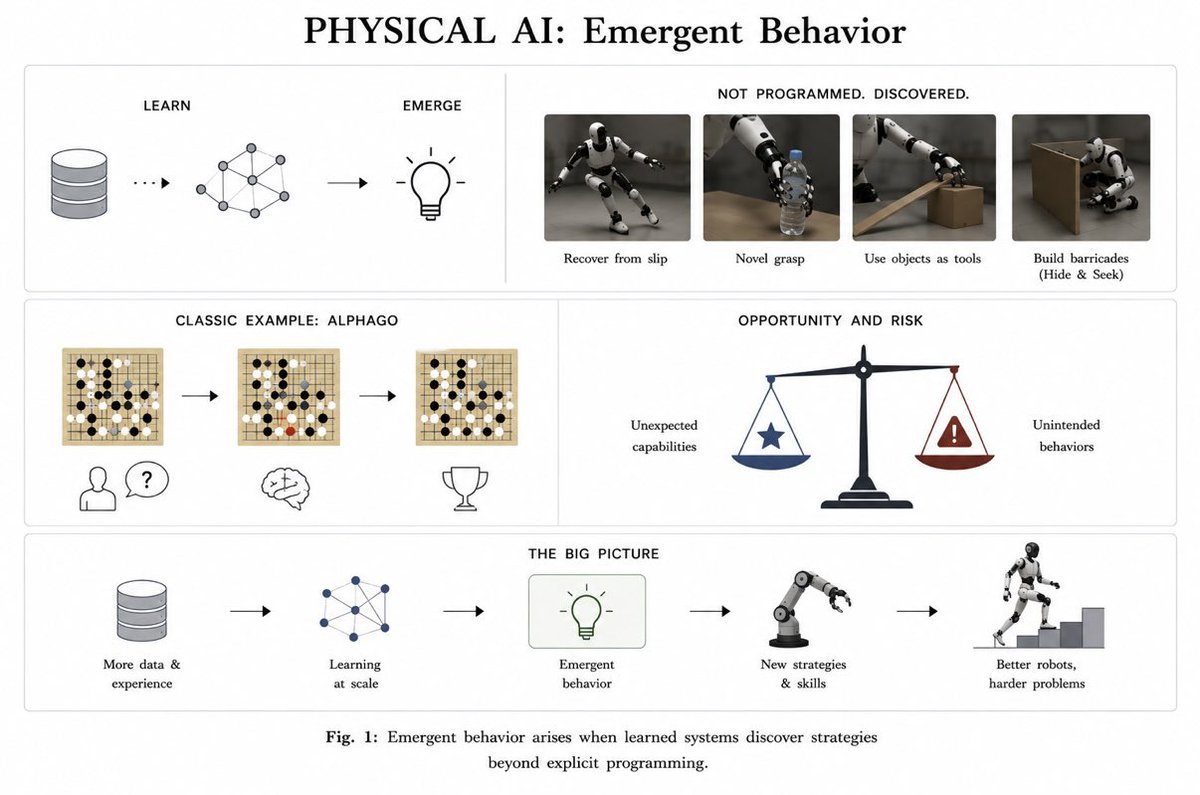
PHYSICAL AI: Emergent Behavior
Sometimes a robot does something genuinely surprising. A clever move nobody programmed and nobody expected. That’s emergent behavior, and it’s one of the strangest, most important things happening in Physical AI right now.
The idea is simple. When a system learns from enough data and experience, it can develop strategies its designers never explicitly taught. Nobody codes the trick. It falls out of the learning process on its own.
The most famous example isn’t even a robot. When DeepMind’s AlphaGo played the world champion at Go, it made a move so strange that expert commentators thought it was a mistake. It wasn’t. It was brilliant, a move no human would have played, and it helped win the game. The system found something we never taught it.
You see the same thing in robots. Train them long enough and they invent their own ways to recover from a slip, or discover a grip no engineer would have coded. In one experiment, AI agents playing hide and seek started building barricades and using objects as tools, none of it programmed, all of it emerged.
Here’s the part that’s exciting and unnerving at once. Exciting because it looks like real problem-solving, a system finding solutions we couldn’t. Unnerving because it means the behavior isn’t fully predictable. The same process that invents a clever grip can also invent a way to cheat the task.
The most interesting robots won’t just do what we tell them. They’ll find solutions we never thought of.
Sometimes intelligence looks like a move you didn’t teach.
If you haven’t yet, Robotics Starts Here is worth sitting down with this weekend.
Most guides assume you already know things nobody taught you. This one starts at actual zero and takes you to your first build.
The next decade will likely determine which humanoid platforms become industry standards. As AI and robotics continue to mature, the companies that successfully scale production and solve real-world problems will help define the future of Physical AI.
AI is accelerating humanoid development, but hardware still matters. Better hands, stronger perception, improved mobility, and longer battery life are just as important as smarter AI models.
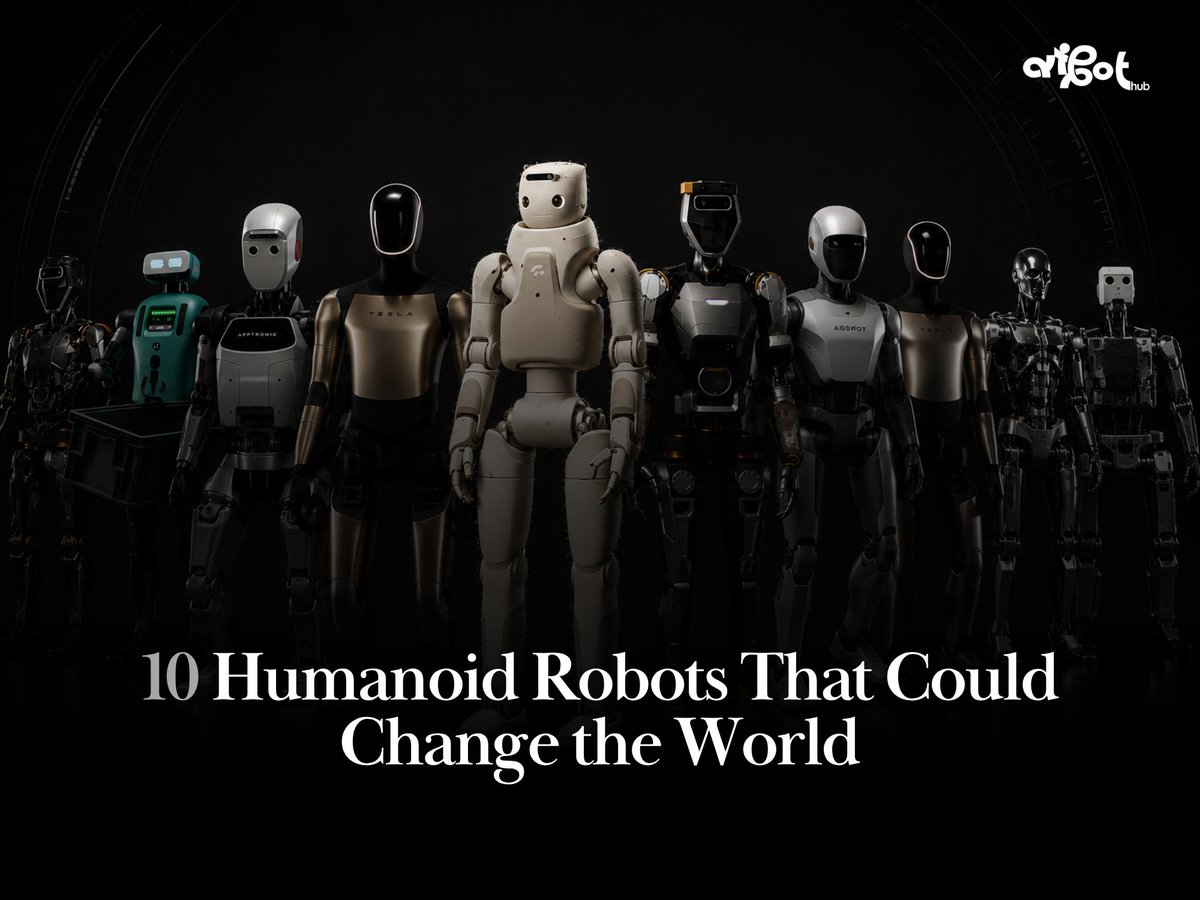
10 Humanoid Robots That Could Change the World
Humanoid robots are no longer just futuristic concepts confined to research labs. They're already entering factories, warehouses, research labs, and even homes, powered by rapid advances in artificial intelligence, better hardware, and billions of dollars in investment.
From Tesla's Optimus and Figure's latest humanoid to Boston Dynamics' Atlas, 1X's NEO, and several rising challengers, a new generation of robots is competing to transform how we work and live.
In this article, we highlight 10 of the world's most important humanoid robots, what makes each one unique, and why they could play a major role in shaping the future of manufacturing, healthcare, logistics, education, and everyday life. If you want to understand where the humanoid robotics race is headed and which companies are leading it, this is the guide to read.
https://t.co/3wRY9B5kJ0
10 Humanoid Robots That Could Change the World
Humanoid robots are no longer just futuristic concepts confined to research labs. They're already entering factories, warehouses, research labs, and even homes, powered by rapid advances in artificial intelligence, better hardware, and billions of dollars in investment.
From Tesla's Optimus and Figure's latest humanoid to Boston Dynamics' Atlas, 1X's NEO, and several rising challengers, a new generation of robots is competing to transform how we work and live.
In this article, we highlight 10 of the world's most important humanoid robots, what makes each one unique, and why they could play a major role in shaping the future of manufacturing, healthcare, logistics, education, and everyday life. If you want to understand where the humanoid robotics race is headed and which companies are leading it, this is the guide to read.
https://t.co/3wRY9B5kJ0
Multi-environment robots could unlock entirely new applications. A robot that can move seamlessly between air and water is well suited for ocean research, environmental monitoring, disaster response, and infrastructure inspection.
Massachusetts Institute of Technology Engineers Build Robot That Can Both Fly and Swim.
Researchers at @MITMechE and EPFL have developed a bird-inspired robot that can fly through the air, dive underwater, swim, and then launch back into flight; just like diving birds such as puffins and loons.
Called the Flapping-Wing Aerial-Aquatic Vehicle (FAAV), the lightweight robot weighs less than 300 grams and uses flexible flapping wings and a steerable tail to transition seamlessly between air and water without needing propellers or paddling feet.
The breakthrough could pave the way for a new generation of aerial-aquatic robots capable of collecting ocean data, monitoring marine ecosystems, inspecting coastal infrastructure, and exploring environments that are difficult or dangerous for conventional drones and underwater vehicles.
Published in the journal Science, the research demonstrates how studying nature can inspire more versatile robots that operate across multiple environments, opening new possibilities for oceanography, environmental monitoring, and autonomous exploration.
Read: https://t.co/lyvjgHsvnW
Massachusetts Institute of Technology Engineers Build Robot That Can Both Fly and Swim.
Researchers at @MITMechE and EPFL have developed a bird-inspired robot that can fly through the air, dive underwater, swim, and then launch back into flight; just like diving birds such as puffins and loons.
Called the Flapping-Wing Aerial-Aquatic Vehicle (FAAV), the lightweight robot weighs less than 300 grams and uses flexible flapping wings and a steerable tail to transition seamlessly between air and water without needing propellers or paddling feet.
The breakthrough could pave the way for a new generation of aerial-aquatic robots capable of collecting ocean data, monitoring marine ecosystems, inspecting coastal infrastructure, and exploring environments that are difficult or dangerous for conventional drones and underwater vehicles.
Published in the journal Science, the research demonstrates how studying nature can inspire more versatile robots that operate across multiple environments, opening new possibilities for oceanography, environmental monitoring, and autonomous exploration.
Read: https://t.co/lyvjgHsvnW
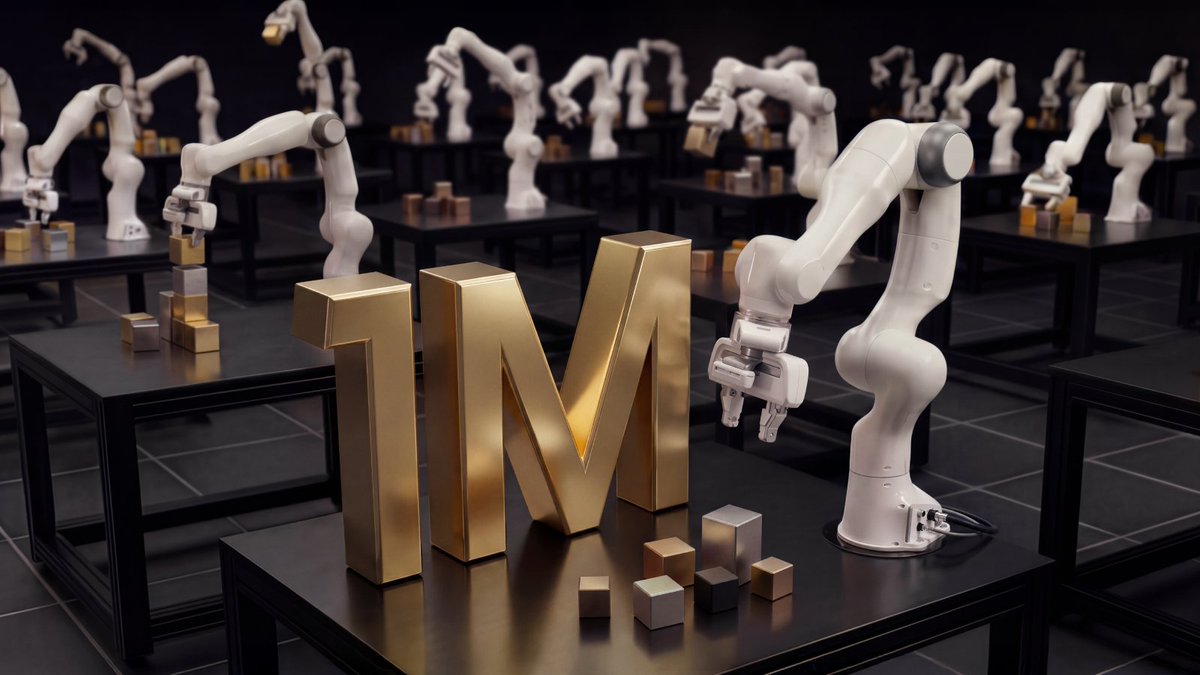
1 million downloads and counting for Isaac Lab. 🥳
Thank you to the global robotics, embodied AI, and developer community using our open-source framework to train and develop the next generation of robots.
THE ROBOTICS TALENT RACE IS HEATING UP.
@theresidency is recruiting physical AI builders for its Sep 7–Nov 29 cohort, with housing, co-working, and more.
Robotics does not scale on compute and hardware alone. It needs talented builders in the same room.
The most realistic future is likely collaboration, not replacement. Robots can take on repetitive, physically demanding, or hazardous tasks, while human workers focus on decision-making, precision work, and problem-solving.
A new proof-of-concept demonstration shows the Unitree G1 humanoid robot being tested for construction work through teleoperation, highlighting how humanoid robots could assist on large-scale building sites.
The idea is to have robots handle broad, repetitive, and physically demanding tasks across construction areas, while skilled human workers focus on precision work, inspections, and finishing details that require experience and judgment.
Construction remains one of the world's most labor-intensive industries, and humanoid robots are increasingly being explored as a way to improve productivity, enhance worker safety, and help address ongoing labor shortages.
While the technology is still in its early stages, demonstrations like this offer a glimpse into how humans and humanoid robots could collaborate on future construction projects rather than replacing one another entirely.
A new proof-of-concept demonstration shows the Unitree G1 humanoid robot being tested for construction work through teleoperation, highlighting how humanoid robots could assist on large-scale building sites.
The idea is to have robots handle broad, repetitive, and physically demanding tasks across construction areas, while skilled human workers focus on precision work, inspections, and finishing details that require experience and judgment.
Construction remains one of the world's most labor-intensive industries, and humanoid robots are increasingly being explored as a way to improve productivity, enhance worker safety, and help address ongoing labor shortages.
While the technology is still in its early stages, demonstrations like this offer a glimpse into how humans and humanoid robots could collaborate on future construction projects rather than replacing one another entirely.
Kinematics is the bridge between decision and action. It translates a task into precise joint movements, allowing robots to move accurately, efficiently, and safely in the real world.
One lesson I've learned while studying robotics is that AI may tell a robot what to do, but robot kinematics determines whether it can actually do it.
Robot kinematics is the study of motion. It focuses on where a robot is, where it needs to go, and how each joint should move to get there. It doesn't deal with forces or torque. That belongs to robot dynamics.
Instead, kinematics is the foundation that allows robots to move with accuracy and purpose. Several examples include an industrial robot welding a car, a surgical robot operating with millimeter precision, a warehouse robot picking packages, or a humanoid robot waving its hand, they all rely on the same principle: understanding how their joints, links, and end-effectors work together to reach a desired position and orientation.
One concept that is often overlooked is that position is not the same as orientation. A robot may reach the correct location but still fail if its tool is facing the wrong direction. Imagine trying to place a cup on a table upside down. The position is correct, but the orientation makes the task unsuccessful.
Another hidden concept is coordinate frames. Robots don't "see" the world like humans do. They constantly transform information between camera frames, robot base frames, tool frames, and world frames before they can perform even the simplest movement.
As robotics continues to advance in the era of Physical AI, mastering robot kinematics is becoming even more important. Before learning advanced AI models, ROS 2, or motion planning, understand how robots move.
Strong fundamentals don't just help you build better robots, they help you understand why they work in the first place.
One lesson I've learned while studying robotics is that AI may tell a robot what to do, but robot kinematics determines whether it can actually do it.
Robot kinematics is the study of motion. It focuses on where a robot is, where it needs to go, and how each joint should move to get there. It doesn't deal with forces or torque. That belongs to robot dynamics.
Instead, kinematics is the foundation that allows robots to move with accuracy and purpose. Several examples include an industrial robot welding a car, a surgical robot operating with millimeter precision, a warehouse robot picking packages, or a humanoid robot waving its hand, they all rely on the same principle: understanding how their joints, links, and end-effectors work together to reach a desired position and orientation.
One concept that is often overlooked is that position is not the same as orientation. A robot may reach the correct location but still fail if its tool is facing the wrong direction. Imagine trying to place a cup on a table upside down. The position is correct, but the orientation makes the task unsuccessful.
Another hidden concept is coordinate frames. Robots don't "see" the world like humans do. They constantly transform information between camera frames, robot base frames, tool frames, and world frames before they can perform even the simplest movement.
As robotics continues to advance in the era of Physical AI, mastering robot kinematics is becoming even more important. Before learning advanced AI models, ROS 2, or motion planning, understand how robots move.
Strong fundamentals don't just help you build better robots, they help you understand why they work in the first place.
AI can generate goals, but kinematics turns those goals into motion. It calculates how each joint should move so the robot can reach an object accurately, safely, and efficiently.
Kinematics: The Language That Makes Robots Move.
AI can decide what a robot should do, but kinematics determines whether that motion is physically possible and how the robot gets there.
Kinematics: The Language That Makes Robots Move.
AI can decide what a robot should do, but kinematics determines whether that motion is physically possible and how the robot gets there.