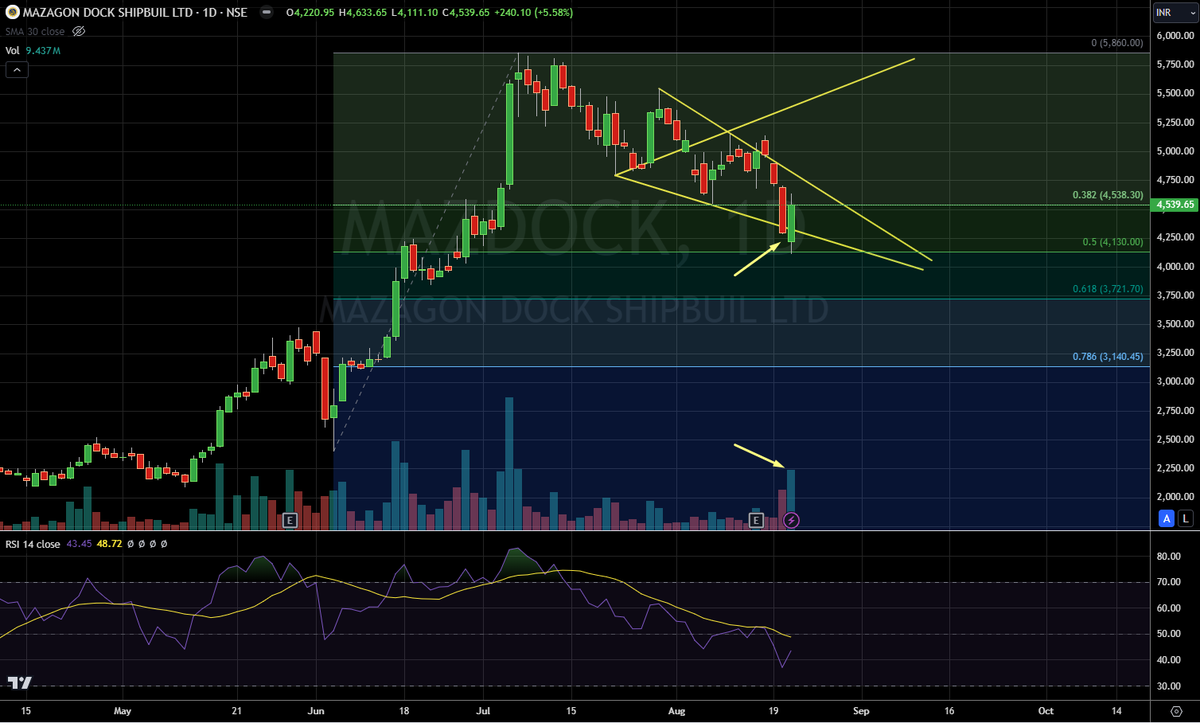
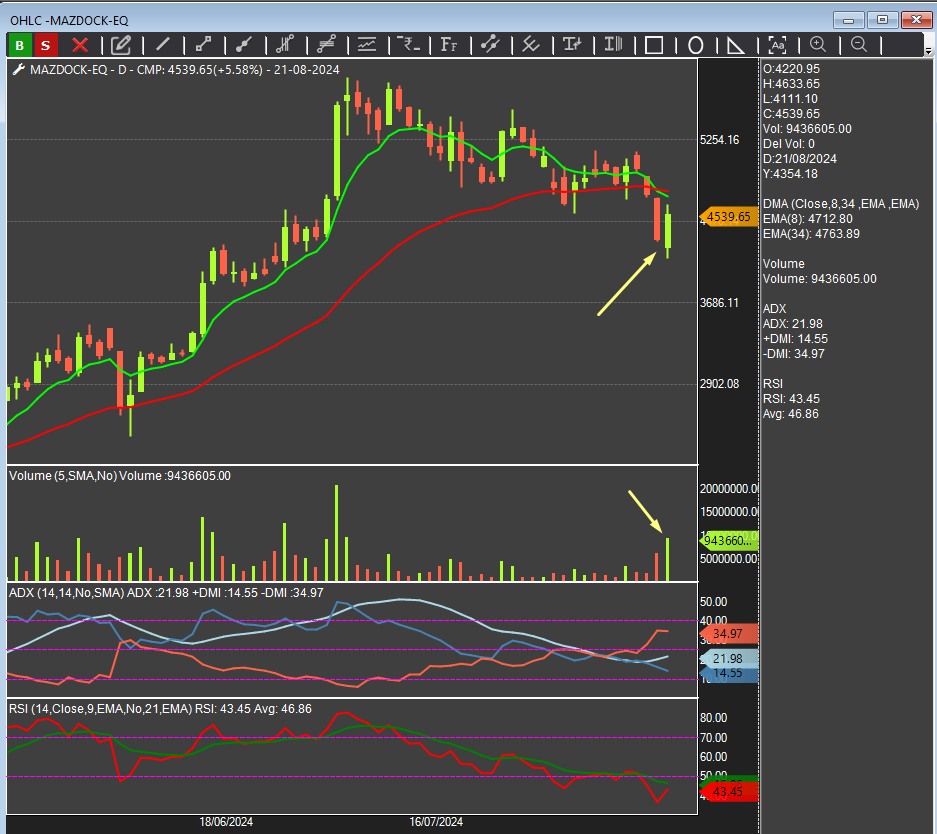
I built a simple scanner to short list stocks which exhibited the following patterns
1) Kicker bullish pattern
2) Piercing pattern
Two stocks which formed piercing pattern are (in Nifty 500)
* MAZDOCK
* EIHOTEL
Mazdock also has higher volumes and also forming a bullish #wolfewave
EIHOTEL is without higher volumes (not so convincing to me)
(I had added Mazdock yesterday)
EDUCATIONAL SERIES
(CHECK THE THREAD EVERYDAY FOR DAILY UPDATION)
(Long Thread )
Will post biggest winners from past everyday to show :
1. How they look like before turning it into a monster trade
2. How they provided multiple buying opportunities on the way up.
#StockMarket
We are in a journey and we should be aiming for big and not 10-20%
I always say that I aim for 2-3x and always stick by it.
Daily P&L is short term, long term P&L is the thing!
Taxation of Equity Shares / Equity MFs -
Long Term Capital Gains -
If you hold for > 1 year - Upto Rs 1 lac, is exempt.
Anything over 1 lac - 10℅ in excess of Rs 1 lac
Eg
1⃣ Gain 150,000, then you have to pay tax on Rs 50,000 i.e. Rs 5000
2⃣ Gain - Rs 75,000 - No tax
Cont.
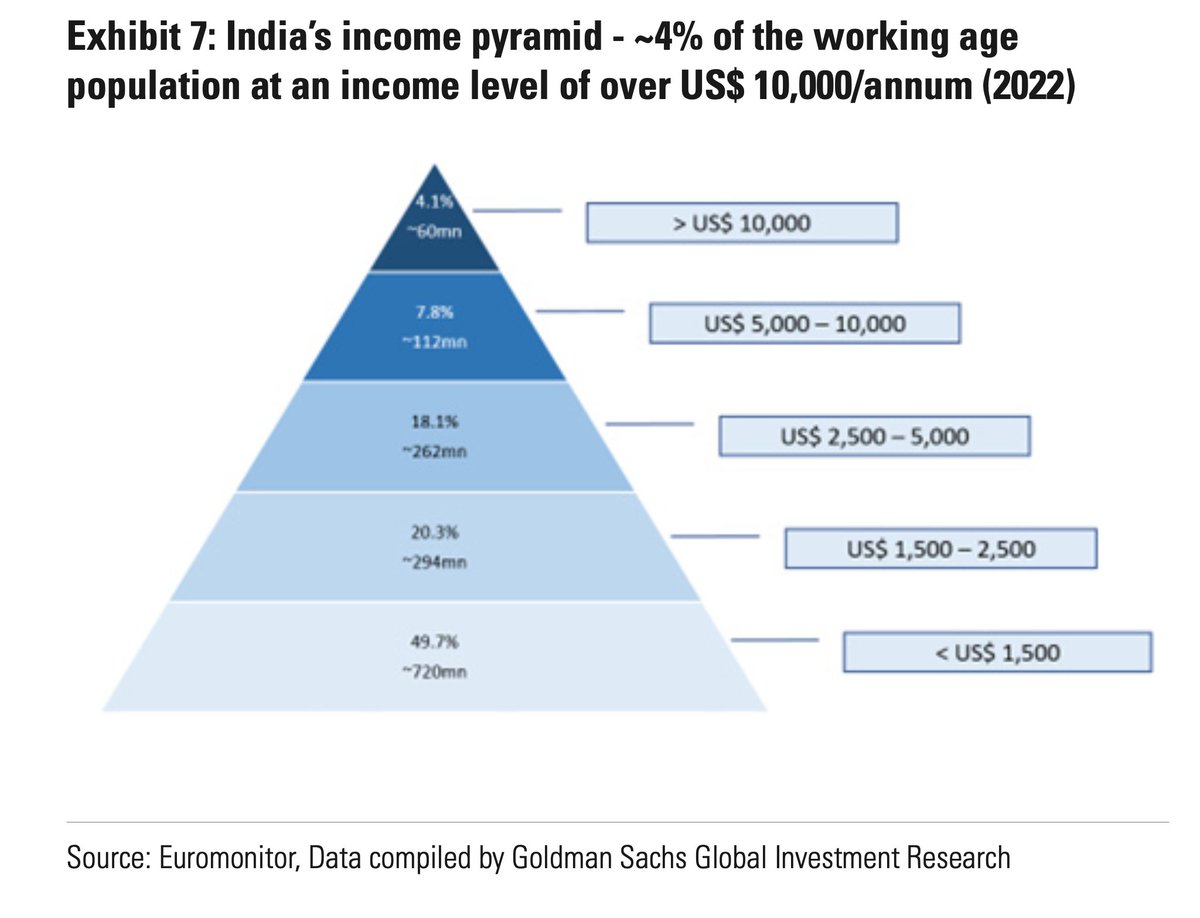
India's Wealth Pyramid|Source: Goldman Sachs report.
4.1% of working Population making more than $10,000 per annum (more than Rs.8,00,000)
7.8% making between $5000-$10,000 (4-8lakhs)
18.1% between $2500-$5000 (2-4Lakhs)
20.3% Between $1500-$2500 (1.25-2.5Lakhs)
49.7% Below $1500 (1.25lakhs)
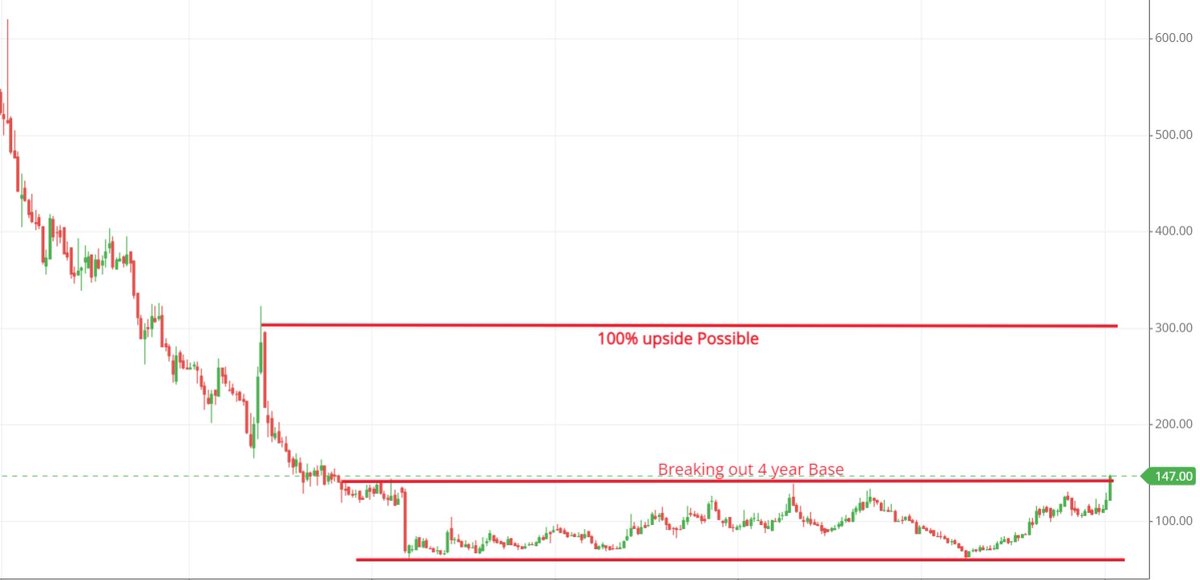
One stock Preparing for 100% movement🔥🔥
Breaking out consolidation range of 4 year
Waiting for #Breakout & close above neckline on weekly chart
Guess the #stock name ??
Risk:Reward :: 1:3
To know the name Like❤️, Follow🙏 & Retweet♻️
#BREAKOUTSTOCKS #BreakoutStock #StockMarket
ASHOKA BUILDCON - A VERY INTERESTING COMPANY TO WATCH OUT FOR 🔥🔥🔥
THE COMPANY HAS A HUGE ORDER BOOK OF 17,000 CR
VS
MARKET CAP OF 4,000 CR
BESIDES THAT STOCK IS AVAILABLE AT A PE OF JUST 11, VALUATION WISE IS ATTRACTIVE
SCREENER SHOWS INTRINSIC VALUE OF THE STOCK AS 285
Star Delta Transformers Ltd
Market Cap: ₹ 183 Cr
About the company:
Star Delta Transformers (SDTL) is a leader in the manufacturing, supplying, erecting, testing, and commissioning of Power and Distribution transformers. SDTL is an ISO 9001-2008 certified company and follows structured processes for the entire business processes right from the basic design to manufacturing and installation as its continuous drive towards total Quality Management Systems.
SDTL has been enhancing its capabilities in infrastructure and production capacity regularly and currently has an authorized annual manufacturing capacity of more than 1000 MVA. The company has also entered global markets with exports to countries like Azerbaijan, Myanmar, Afghanistan, etc.
Established in the year 1980 Star Delta Transformers is known for the excellence of its services in the field of manufacturing electrical transformers for power & distribution.
The company’s Transformer Testing Lab is certified by the National Accreditation Board for Testing and Calibration Laboratories (NABL) following “General Requirements for the Competence of Testing & Calibration Laboratories”, ensuring a world-class Quality Assurance System. SDTL has obtained Bureau of Indian Standards (BIS) licenses up to Energy Efficiency Level -3 Aluminium Wound Three phase Outdoor Type Distribution Transformers.
Business Overview:
The company is a dynamic and versatile organization that operates across the entire spectrum of transformer-related services. From the meticulous manufacturing of Power and Distribution transformers to their seamless supply, precise erection, and thorough testing, the company ensures a comprehensive approach to meeting the energy needs of various industries. The company apart is a specialization in crafting Special/Custom transformers, showcasing expertise in Auto, Converter, Earthing, Furnace, Generator, Instrument, Rectifier, Traction, and other bespoke transformer solutions. This broad range of offerings demonstrates a commitment to addressing diverse and unique requirements in the field. With a focus on quality assurance through rigorous testing and the meticulous commissioning of transformers, the company is a reliable partner in delivering tailored solutions for a wide array of applications, contributing significantly to the evolving landscape of power and energy systems.
Product Portfolio:
Single Phase Transformers
A transformer is a device that converts magnetic energy into electrical energy. It consists of two electrical coils called primary winding and secondary winding. The primary winding of a transformer receives power, while the secondary winding delivers power. A magnetic iron circuit called “core” is commonly used to wrap around these coils. Though these two coils are electrically isolated, they are magnetically linked.
An electric current when passed through the primary of a transformer then a magnetic field is created, which induces a voltage across the secondary of a transformer. Based on the type of application, the single-phase transformer is used to either step up or step down the voltage at the output. This transformer is typically a power transformer with high efficiency and low losses.
Here are the key components and features of a single-phase transformer:
Core: The transformer core is typically made of laminated iron or steel. It provides a low reluctance path for the magnetic flux generated by the primary winding.
Primary Winding: The primary winding is the coil connected to the input voltage source. When an alternating current (AC) flows through this winding, it produces a varying magnetic field in the core.
Secondary Winding: The secondary winding is the coil connected to the load or output circuit. The varying magnetic field induced by the primary winding in the core generates an electromotive force (EMF) in the secondary winding, transferring electrical energy to the load.
Voltage Transformation: The primary and secondary windings have different numbers of turns, allowing the transformer to step up or down the voltage. The turns ratio determines the voltage transformation ratio.
Step-up transformer: If the secondary winding has more turns than the primary winding, the voltage is stepped up.
Step-down transformer: If the secondary winding has fewer turns than the primary winding, the voltage is stepped down.
Isolation: Transformers provide electrical isolation between the primary and secondary circuits. This isolation helps protect the connected devices from potential differences in ground potential and enhances safety.
Cores and Windings Configuration:
Shell-type transformers have the core surrounded by both primary and secondary windings.
Core-type transformers have the windings wound around the core.
Technical Specifications:
Transformer Types and Ratings:
CRGO Silicon Steel Transformers: Up to 5 to 100 KVA
Amorphous Metal Transformers: Up to 167 kVA
Applicable Standards:
IS (Indian Standard)
IEC (International Electrotechnical Commission)
ANSI (American National Standards Institute)
JIS (Japanese Industrial Standards)
Other relevant standards
Cooling:
ONAN (Oil Natural Air Natural)
OA (Oil-Air) cooling methods
Insulating Fluid:
Mineral Oil to specification
Frequency:
50 Hz, 60 Hz
Winding Material:
Copper / Aluminium
Taping Range:
± 5% in steps of 2.5%
Other tapings as required
Impedance:
In line with applicable standards
Single Phase Transformers:
Stardelta configuration
Standard Fittings:
Pole Mounting Brackets
Lifting Lugs
Pressure Relief Device/Self Venting Top Cover
Tank Grounding Provision
Rating and Diagram Plate
HV & LV Bushings with fittings
Optional Fittings:
Lightning Arrester / Arcing Horns
High Voltage Neutral Bushing
Terminal Connectors
Tap changer for external operation
Cable Terminations
Complete Self-Protection feature
Working on Single-phase Transformer:
The basic working principle of a transformer is quite simple. It consists of two inductors (or coils) that are wound around a common iron core. When an alternating current (AC) flows through the first coil (the primary winding), it creates a magnetic field. This, in turn, induces a voltage across the second coil (the secondary winding). The ratio of the number of turns in the primary winding to the number of turns in the secondary winding is known as the transformer’s turns ratio. This determines the amount of voltage transformation that takes place.
There are two types of single-phase transformers: step-up and step-down. A step-up transformer increases the voltage, while a step-down transformer decreases it. In either case, the current is reduced in proportion to the increased (or decreased) voltage.
The single-phase transformer is a very versatile and essential equipment in many industries. By understanding the different parts of the transformer, you can better maintain and operate this critical piece of machinery. The single-phase transformer is composed of the following parts: the core, the primary winding, the secondary winding, the insulation, and the yoke. Each part plays an important role in transformer operation. By understanding the function of each component,
Three-Phase Distribution Transformer
A three-phase distribution transformer is a type of transformer used in electrical distribution systems to change the voltage levels of power for efficient transmission and distribution.
Here are some key points about three-phase distribution transformers:
Three-Phase System:
Three-phase distribution transformers are designed to work with three-phase electrical systems. In a three-phase system, three conductors carry alternating current with a 120-degree phase difference between them.
Voltage Transformation:
The primary function of a distribution transformer is to transform voltage levels. These transformers are used to step down high-voltage electricity from the transmission lines to lower voltage levels suitable for distribution to homes, businesses, and industries.
Construction:
Three-phase distribution transformers typically consist of three separate primary and secondary windings. Each winding corresponds to one phase of the three-phase system. The windings are usually wound around a common magnetic core.
Delta and Wye Connections:
The windings in a three-phase distribution transformer can be connected in either delta or wye configuration, depending on the application and the desired output voltage. Delta connections are commonly used in high-voltage transmission, while wye connections are more common in distribution systems.
Cooling Systems:
Distribution transformers are equipped with cooling systems to dissipate heat generated during operation. Common cooling methods include oil-immersed transformers with natural or forced oil circulation, as well as dry-type transformers that use air as the cooling medium.
Ratings:
Transformers are rated based on their capacity and voltage levels. The ratings include the apparent power (in volt-amperes, VA, or kVA), voltage ratios, and current-carrying capacity.
Applications:
Three-phase distribution transformers are widely used in power distribution networks to provide electricity to homes, commercial establishments, and industrial facilities. They play a crucial role in reducing voltage for safe and efficient use.
Efficiency and Regulation:
Transformer efficiency is an important factor, and manufacturers strive to design transformers with high efficiency to minimize energy losses. Voltage regulation is also a key consideration to ensure that the output voltage remains within specified limits under varying load conditions.
Monitoring and Protection:
Distribution transformers may be equipped with monitoring and protection devices to ensure safe and reliable operation. These devices can include temperature sensors, pressure relief devices, and protective relays.
The operation of a three-phase distribution transformer involves the basic principles of electromagnetic induction. Here's a step-by-step explanation of how a three-phase distribution transformer works:
Primary Side:
The transformer takes in three-phase high-voltage electricity from the power distribution grid on the primary side. The primary winding, which consists of three coils, is connected to these three-phase power sources.
Electromagnetic Induction:
When three-phase alternating current (AC) flows through the primary winding, it produces a magnetic flux in the transformer's core. According to Faraday's law of electromagnetic induction, a changing magnetic field induces a voltage in a nearby conductor.
Magnetic Core:
The transformer's core is typically made of laminated iron or steel to enhance magnetic properties. The magnetic core serves to efficiently transfer the magnetic flux generated by the primary winding to the secondary winding.
Secondary Side:
On the secondary side, there is another set of three coils, forming the secondary winding. The magnetic flux induced in the core by the primary winding cuts across the turns of the secondary winding, inducing a voltage in the secondary coils.
Voltage Transformation:
The turn ratio of the primary winding to the secondary winding determines the voltage transformation. For a step-down transformer (which is common in distribution systems), the secondary voltage is lower than the primary voltage. The voltage transformation is proportional to the turn ratio.
Output to Distribution System:
The transformed voltage on the secondary side is then supplied to the distribution system for further transmission to homes, businesses, and industrial facilities. This lower voltage is safer and more suitable for general use.
Load Connection:
Electrical loads, such as appliances and machinery, are connected to the secondary winding. The transformer ensures that the electrical power is delivered at the appropriate voltage level for the safe and efficient operation of these loads.
Balanced Operation:
In a three-phase distribution transformer, it's essential to maintain balance among the three phases. The transformer is designed to handle the three phases equally, ensuring that the output voltages remain balanced under normal operating conditions.
Efficiency and Losses:
The transformer may experience some energy losses in the form of heat due to resistance in the windings and core losses. Transformer efficiency is crucial, and designers aim to minimize losses to ensure that a significant portion of the electrical power is delivered to the load.
Technical Specification:
Transformer Ratings:
CRGO Transformers: Up to 2500 kVA
Amorphous Core Transformers: Up to 1000 kVA
Applicable Standards:
IS (Indian Standard)
IEC (International Electrotechnical Commission)
ANSI (American National Standards Institute)
JIS (Japanese Industrial Standards)
BS (British Standards)
Cooling:
ONAN (Oil Natural Air Natural) Cooling
OA (Oil-Air) Cooling
Insulating Fluid:
Mineral Oil to specification
Frequency:
50 Hz, 60 Hz
Polarity:
As specified
Voltage:
Primary Voltage: Up to 33 kV
Secondary Voltage: 415 V, 433 V (Other Voltages as required)
Winding Material:
Copper / Aluminium
Taping Range:
± 5% in steps of 2.5% (Other tapings as required)
Impedance:
In line with applicable standards
Solar Configuration:
Star-Delta
Standard Fittings:
Pole Mounting Brackets/Tanks Base Channels
Lifting Lugs & Jacking Lugs
Tank grounding Provision
Rating and Diagram Plate
HV & LV Bushings with fittings
Silica-gel Breather
Filter Valve
Circuit Tap Changer
Earthing Terminals
Thermometer Pockets
Optional Fittings:
HV / LV Cable Boxes
Pressure Relief Device
On Load Tap Changer with RTCC (Remote Tap Changer Control)
Oil Temperature Indicator
Double Float Buchholz Relay
Disconnecting Chambers
Winding Temperature Indicator
Magnetic Oil Level Gauge
Epoxy / Touch-proof Bushings with connectors
Siphon Thermo Filter
Conservator
Lightning Arrester
Arcing Horns
Terminal Connectors
Protective Fuse
Secondary Circuit Breaker
Bird Guard
A three-phase distribution transformer operates based on the principles of electromagnetic induction, transforming high-voltage, three-phase AC power from the primary side to lower-voltage, and three-phase power on the secondary side for distribution to end-users. The transformer facilitates the safe and efficient transmission of electrical energy in power distribution networks.
Power Transformer
Power transformers transform electrical voltage from one level or phase to another. Typically, it steps down the voltage ratio from a higher to a lower level. Like other transformers, power transformers work on the magnetic induction principle between coils to convert voltage or current levels to another voltage or current level. It includes a broad range of electrical transformers, such as control transformers, autotransformers, current transformers, general-purpose transformers, distribution transformers, instrument transformers, potential (voltage) transformers, and isolation transformers.
Here are key aspects of power transformers:
Voltage Transformation:
Step-Up Transformer: Increases voltage from the generator to transmission levels for long-distance power transmission.
Step-Down Transformer: Decreases voltage to distribution levels for safer and more practical use in homes and industries.
Basic Structure:
The core: Typically made of laminated steel sheets to reduce eddy current losses.
Windings: Coil structures made of conductive material (copper or aluminum) wrapped around the core.
Insulating materials: Separate the windings and insulate them from the core to prevent short circuits.
Working Principle:
Transformers operate on the principle of electromagnetic induction. AC voltage applied to the primary winding induces a magnetic field in the core, which, in turn, induces a voltage in the secondary winding.
Efficiency:
Power transformers are designed to be highly efficient, minimizing energy losses during the transformation process.
Cooling Systems:
Large power transformers may include cooling systems such as oil or forced-air cooling to dissipate heat generated during operation.
Applications:
Power transformers are used in power generation plants, substations, and electrical grids for voltage transformation and power distribution.
Types of Power Transformers:
Distribution Transformers: Serve to step down voltages for local distribution.
Power Transformers are used in the transmission network to step up or down voltages.
Instrument Transformers: Provide accurate measurements of voltage and current for protective relaying and metering.
Maintenance:
Regular maintenance is essential to ensure the proper functioning of power transformers. This may include checking insulation, oil levels, and the condition of the core and windings.
Transformer Protection:
Transformers are equipped with protective devices to safeguard against overloads, short circuits, and other faults that could damage the transformer or disrupt the power supply.
Power transformers have a wide range of uses in electrical systems, spanning power generation, transmission, and distribution. Here are some of the primary applications of power transformers:
Power Generation:
Power transformers are used in power plants to increase the voltage generated by electrical generators to levels suitable for long-distance transmission. These transformers, known as step-up transformers, help minimize energy losses during transmission.
Transmission and Distribution:
In the power grid, power transformers play a crucial role in transmitting electricity efficiently over long distances. Step-up transformers are used at the power plant, while step-down transformers are employed at substations to reduce voltage to levels suitable for distribution to homes and industries.
Voltage Regulation:
Power transformers help regulate voltage levels within the power grid, ensuring that electricity is delivered at the appropriate voltage for various applications. This is essential for maintaining the stability and reliability of the electrical supply.
Industrial Applications:
Many industrial processes require a stable and reliable power supply. Power transformers are used to step down high-voltage electricity from the grid to levels suitable for industrial machinery and equipment.
Commercial and Residential Distribution:
Distribution transformers are commonly found in neighborhoods and cities, stepping down voltage to levels suitable for use in homes, businesses, and commercial establishments.
Renewable Energy Integration:
Power transformers are crucial for integrating renewable energy sources, such as wind and solar power, into the grid. They help match the variable output of these sources with the grid's demand by transforming and regulating voltage levels.
Isolation and Safety:
Transformers provide electrical isolation between different parts of the power system, enhancing safety by preventing direct electrical contact. This is particularly important in industrial and residential settings.
Instrumentation and Measurement:
Instrument transformers, a type of power transformer, are used for accurate measurement of voltage and current in power systems. They provide signals for protective relaying, metering, and control systems.
Backup Power Systems:
Power transformers are employed in backup power systems, such as emergency generators, to step up or step down voltage as needed for critical applications during power outages.
Railway Electrification:
Power transformers are used in railway systems to convert high-voltage AC power from the grid to the appropriate levels needed for trains.
Ratings:
CRGO - Up to 25 MVA (Mega Volt-Ampere)
Applicable Standards:
IS (Indian Standards)
IEC (International Electrotechnical Commission)
ANSI (American National Standards Institute)
JIS (Japanese Industrial Standards)
DIN (Deutsches Institut für Normung - German Institute for Standardization)
BS (British Standards) and others
Cooling:
ONAN (Oil Natural Air Natural)
ONAF (Oil Natural Air Forced)
Insulating Fluid:
Mineral Oil to specification
Frequency:
50 Hz, 60 Hz
Polarity:
As specified
Voltage:
Primary Voltage: Up to 66,000 V
Secondary Voltage: 33,000 V, 11,000 V (Other Voltages as required)
Winding Material:
Copper
Taping Range:
Circuit & On-load tap changers as per customer specification
Impedance:
In line with applicable standards
Standard Fittings:
Lifting Lugs
Skid Base / Roller Arrangement
Rating and Diagram Plate
HV & LV Bushings with fittings
Oil level Gauge
Silica gel Breather
Drain/Filter Valves
Thermometer
Pressure Relief Device/Explosion vent
Optional Fittings:
Terminal Connectors
Magnetic Oil Level Gauge
Oil Temperature Indicator
Winding Temperature Indicator
Buchholz Relay
RTCC Panel (Remote Tap Changer Control)
Condenser Type Bushing for voltage class of 33 kV & 66 kV
Off-circuit Tap Switch / On-load Tap Changer with RTCC
HV / LV Cable Boxes
Disconnecting
Epoxy / Touch-proof Bushings with connectors
Siphon Thermo Filter
Conservator
Lightning Arrester
Arcing Horns
Protective Fuse
Secondary Circuit Breaker
Bird Guard
Power transformers are essential components in the infrastructure of electrical power systems, enabling the efficient generation, transmission, distribution, and utilization of electrical energy in various sectors.
Extra High Voltage Transformers
SDTL manufactures EHV Power Transformers of voltage class up to 132 KV using advanced technology & state of the art machinery. Windings are made on automatic machines, and the core & coil assembly are dried in a vacuum drying oven with a capacity of 70 cubic meters. Transformers are rigorously tested at each stage using modern testing types of equipment. The company has already supplied more than 20 EHV transformers with up to 40 MVA ratings which have been successfully operating for more than 5 years
Extra High Voltage (EHV) transformers are specialized transformers designed to handle higher voltage levels, typically ranging from 220 kV (kilovolts) and above. These transformers play a crucial role in the transmission and distribution of electrical power over long distances. Here are some key points about Extra High Voltage transformers:
Voltage Levels: EHV transformers are designed to work with voltage levels higher than those handled by standard transformers. While definitions may vary, voltages of 220 kV and above are generally considered as Extra High Voltage.
Transmission of Power: EHV transformers are primarily used in the transmission network to step up the voltage of electrical power generated at power plants. This higher voltage reduces energy losses during long-distance transmission.
Step-Up and Step-Down Transformers: In power systems, EHV transformers can function as step-up transformers, increasing the voltage for transmission, or as step-down transformers, reducing the voltage for distribution to end-users.
Grid Interconnections: EHV transformers are often employed in interconnecting different electrical grids or networks. These transformers facilitate the transfer of power between regions or countries with different voltage levels.
Oil-Cooled and Gas-Insulated Designs: EHV transformers are typically oil-cooled to manage the heat generated during operation. In some cases, gas-insulated designs may also be used to minimize the size of the transformer and improve its efficiency.
High Insulation Levels: Due to the high voltages involved, EHV transformers require robust insulation systems to prevent electrical breakdown and ensure the safe and reliable operation of the transformer.
Monitoring and Control Systems: EHV transformers are often equipped with advanced monitoring and control systems to ensure efficient operation, diagnose potential issues, and enhance overall reliability.
Maintenance Challenges: Maintenance of EHV transformers can be challenging due to their size and the high voltages involved. Regular inspections, testing, and preventive maintenance are essential to ensure their continued performance.
Specialized Applications: EHV transformers are crucial components in the power grid, especially in applications where power needs to be transmitted over long distances with minimal losses.
Grid Stability and Reliability: The deployment of EHV transformers contributes to grid stability and reliability by enabling the efficient and reliable transfer of large amounts of electrical power across the transmission network.
Technical Specifications:
Ratings:
CRGO - Up to 40 MVA
Applicable Standards:
IS, IEC, ANSI, JIS, DIN, BS, etc.
Cooling:
ONAN (Oil Natural Air Natural)
ONAF (Oil Natural Air Forced)
Insulating Fluid:
Mineral Oil to specification
Frequency:
50 Hz, 60 Hz
Polarity:
As specified
Primary Voltage:
66 KV, 110 KV, 132 KV (as per customer specification)
Secondary Voltage:
66 KV, 33 KV (Other Voltages as required)
Winding Material:
Copper
Taping Range:
Off-circuit and On-load tap changers as per customer specification
Impedance:
In line with applicable standards
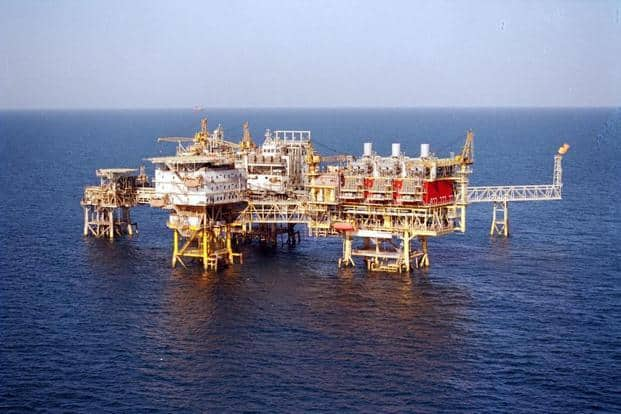
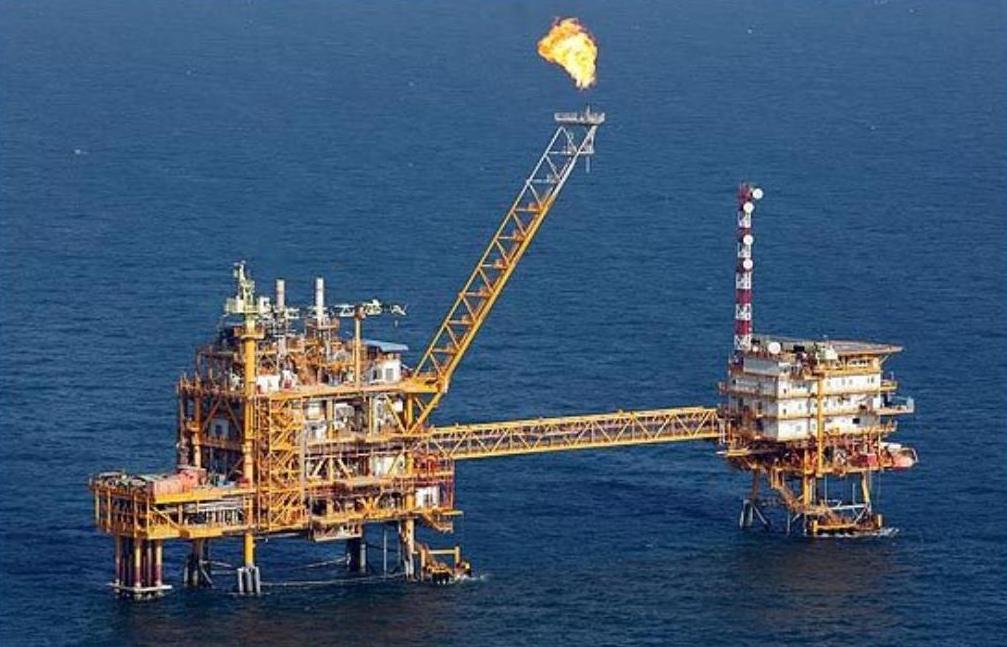
BIG BREAKING NEWS - Crude Oil discovered in India, Union Minister Hardeep Puri said that first oil is also extracted 🔥🔥
ONGC announces Crude Oil discovery in Krishna Godavari Basin. 26 wells found ⚡
Production is expected to touch 45,000 barrels per day by May or June. The productive site emerges about 30 kilometers from Kakinada's coast, nestled within the Krishna Godavari basin.
Waaree Tech - A very interesting and promising observation: -
There are roughly four main energy storage types that are being talked about and kicking off …
1) Lithium ion
2) Sodium ion
3) Thermal storage
4) Pumped Hydro storage
The top three are the most important from their perspective. And for them they already done tie ups.
The first two with Israeli company ..
https://t.co/AbmtoVWUym
and the third one with the German company ..
https://t.co/yzeWH9Cuf0
#WaareeTech #batteries #thermalstorage #lithiumIon #SodiumIon #GreenEnergy #Solar #EV @waareegroup@WaareeEss@hiteshdoshiwaa
Health insurance policies come with 100s of variations & are very complicated
Which one should u buy?
Last year,my father was hospitalized
The entire bill was covered by my insurer
A thread🧵on comprehensive health insurance policy & y u should buy the same?
Lets go👇
Warren Buffett is 93 years old but he eats like a child
I found 8 quotes where he talks about his eating habits and they will leave you stunned
(Fitness bros are going to hate this)