Addiction isn't disease, it's a way of managing a set of circumstances that you want to evade; that you don't want to fully experience. It's an escape from the unbearable - it's checking out. When we understand this, the proposed 'cure' looks very different.
@locuta Zijn openheid, zelfspot en verbindende toon lijken hier en daar zelfs al zowaar tot verbroedering te leiden met zelfs de meest hardcore MAGA aanhangers; een klein wonder!
I’ve taken a lot of hits, and I’ve deserved some of them. I beat myself up over them more than you can imagine.
But the grace people have shown me here is truly humbling.
Some of the kindest words have come from the people you’d least expect.
And for that I am so grateful.
This isn’t about me. It’s about every person in recovery who shows up and tries again.
And to everyone still in the fight tonight: you are not alone, I see you.
@koperndakkie@chrisklomp Zelfs Elon’s eigen Grok laat geen spaan heel van deze klinkklare onzin, al zal (ook) jij je ongetwijfeld niet laten overtuigen door dit soort waarheden.
**No, Hitler was not a hardcore socialist in any conventional sense.**
The Nazi Party's full name included "National Socialist," and its 1920 25-point platform had some anti-capitalist rhetoric to appeal to workers (e.g., nationalizing trusts, profit-sharing). But Hitler redefined "socialism" to mean national/racial solidarity and the "common weal," explicitly rejecting Marxism, class conflict, and communism as Jewish plots.
In power, the Nazis:
- Banned socialist/communist parties and trade unions
- Purged and murdered actual leftists (e.g., Night of the Long Knives targeted Strasserites)
- Allied with big business and industrialists
- Retained private property and profits for compliant firms while directing the economy toward autarky and war
It was fascist authoritarian nationalism with heavy state control—not socialist worker ownership or egalitarianism. The label was mostly propaganda.
Medical model psychiatry created a worldview built around isolated individuals, internal disorders and defective mechanism—and we all suffer the consequences.
The result has been the systematic individualisation of collective suffering: relational wounds become symptoms, social failures become diagnoses, the consequences of political policies become medical conditions.
Moeten we stoppen met de DSM, de diagnosebijbel voor psychiaters? Psychiater Jim van Os in @DIT_eo: 'Na vijftig jaar onderzoek blijkt dat er geen duidelijk onderscheid is tussen psychiatrische stoornissen. Het is heel sterk individueel bepaald.'
Nobody asks the most basic question about ADHD:
Why is this medical at all?
If there's no biological test, no measurable pathology, no objective finding — what exactly gives a doctor the authority to call a child's behavior a disease and prescribe Schedule II amphetamines?
I asked a Columbia psychiatrist this directly. His answer was appeals to training and expertise.
Expertise in what? Memorizing a checklist? Writing prescriptions? Mistaking subjective judgment for medical diagnosis?
Here's what actually gets labeled ADHD:
A traumatized child in hypervigilance. A sleep-deprived kid who can't sit still. A gifted child bored out of their mind. A kid younger than their classmates by 11 months — still developmentally behind peers — labeled disordered. A child reacting to family dysfunction. A malnourished kid washing down a stimulant with sugary cereal.
Every one of those children has a real problem. None of those problems is "ADHD." And none of them gets solved by amphetamines.
What actually gets solved? The inconvenience. The kid sits still. The classroom gets quieter. The parent stops getting calls from the school. The psychiatrist books three more 15-minute medication management appointments per hour.
We're not treating disease. We're suppressing behavior that makes adults uncomfortable — and calling it medicine.
The DSM disorders aren't discovered through research. They're created through committee votes. Literally. When homosexuality was in the DSM, it wasn't removed because of a biological discovery. They voted. That's the process. That's the authority.
Your child's diagnosis was born the same way.
This isn't a fringe position. The former head of NIMH called the DSM "scientifically meaningless." The man who chaired the DSM-IV task force now admits they created false epidemics. These are psychiatry's own leaders.
The question was never whether children struggle. Of course they do. The question is whether we should be diagnosing that struggle as a brain disease and drugging it into silence.
AWAKEN.
When you educate an entire generation to believe that "anything is possible with hard work", and then build an economic system that is rigged against most hard-working people ever achieving any notable wealth or 'success', how can widespread anxiety not be an inevitable result?
This is true, & I would add that psychiatry since the 1980s has enabled & empowered neoliberalism: depoliticising, commodifying, pathologising, individualising & decollectivising the social suffering neoliberalism causes. It's been a highly profitable yet damaging quid pro quo.
More than 10% of US youth and nearly half of adults with mental health conditions turn to generative AI for advice or support, highlighting the need for clinicians to routinely ask about #AI use in mental health care. https://t.co/bmWLhxwSwq
🦍One of Sir David Attenborough's most memorable moments? This encounter with a group of playful mountain gorillas in Rwanda in 1979.
Happy 100th birthday Sir David! 🎉
🎧 https://t.co/KQKcBnyF3P
“De kernvraag is simpel: willen wij wachten tot iemand ontspoort, of organiseren wij bescherming voordat het zover komt? Een beschaafde samenleving herkent kwetsbaarheid niet pas wanneer de sirenes afgaan. Zij handelt eerder.” https://t.co/XTP89zl8y2
As I argued in the essay below, the ideas of Carl Rogers & Donald Winnicott are at the foundations of what I call the "Humanistic-Relational paradigm."
It is a direct, established rival to the ideology of dysfunctional or disordered individuals in need of medical expertise 🧵
Rogers showed that people naturally move toward growth when they encounter empathy, authenticity and unconditional acceptance.
Winnicott showed that the self itself emerges through a sufficiently safe and responsive relational environment.
Together, they challenge the idea that psychological suffering is properly located inside the individual, and with it, the decontextualised preoccupation with people's internal biological and cognitive functioning.
Instead, they explain how distress often reflects social and relational wounds: abuse, neglect, misattunement, alienation, developmental failures of environment, or the learned impossibility of being oneself with others.
From this perspective, psychotherapy shifts away from expert authority, reductionistic diagnosis and “fixing” defective individuals, and toward relationship, presence, attunement, and the genuine human encounter.
For the humanistic-relational paradigm, healing is not understood as the correction of pathology, but as the restoration of the relational & social conditions — conditions that were previously absent, unsafe, or damaging —in and through which a person can safely become themselves again.
For more 👇
https://t.co/fitEIf6w49
IN PRAISE OF FRANCESCA ALBANESE
There is a question that visits me in the small hours, when sleep will not come and the mind turns over old stones. The question is this: “What would I have done in the 1930s, on the morning after Kristallnacht?"
Not what I say I would have done. Not what I hope I would have done. But what would I actually have done—when the trains began to run, when the neighbours grew quiet, when the cost of decency became the loss of everything?
Most of us, I think, would have done little. Not from malice. From fear. From the soft, creeping conviction that someone else will speak, that the situation is complex, that we must be 'reasonable'. Lest we forget, the ordinary is the extraordinary's alibi. And how we have clung to that alibi! How we still cling to it!
And then, every once in a terrible while, someone appears who does not cling. Someone who steps forward when others step back. Someone who speaks the name of the thing when everyone else is busy naming something else.
Francesca Albanese is that someone.
She stands before the world—alone, unarmed, armed only with law and language and a rare courage—and she says what the centrists will not say, what the foreign ministries will not say, what the editorial boards will not say. She says: "This is a genocide. And we are watching it happen."
Do not tell me that is hyperbole. Do not tell me the term is contested. She has not used it lightly. She has used it as a physician arrives scientifically at a diagnosis—not to wound, but to warn. Not to inflame, but to name.
And for that, they have come for her. Oh, how they have come for her. Smears. Investigations. Vicious editorials. Frozen bank accounts. Dispossession of the only apartment she had ever owned. The machinery of the respectable turned to crush her. Because the respectable cannot abide what she represents: a mirror held up to their complicity.
Let us, once again, travel back to the 1930s. Back to the few who stood up when the trains began to run laden with Jewish people.
There was Aristides de Sousa Mendes, a Portuguese consul in Bordeaux. He defied his own government. He signed thousands of visas, by hand, for hours, until his fingers bled. He saved more lives than Schindler. And he died penniless, disgraced, erased.
There was a German officer in Warsaw named Wilm Hosenfeld. He hid a Jewish pianist in the rubble. He did not save thousands. He saved one. But that one—Władysław Szpilman—carried the memory. And memory is "the only haven from which we cannot be expelled."
There was Raoul Wallenberg. There were the villagers of Le Chambon. There were the anonymous, the quiet, the furious few who said: “Not on my watch.”
Francesca Albanese is their heir. Not because she carries a gun. Not because she hides refugees in her basement. But because she does something equally dangerous in a world that has perfected the art of not seeing. She sees. And she speaks.
She does not speak as a diplomat. Thank Goodness she doesn't! Diplomats have given us the language of "there are arguments on both sides" and "restraint" and "proportionality." Diplomatic language is the perfumed grave of moral clarity. No, she speaks as a jurist. As a human being. As a woman who has looked into the abyss and refused to call it a "complex geopolitical landscape".
Edna O'Brien once described a character who "had the recklessness of those who have already lost everything worth losing." Francesca Albanese has not lost everything. She has her dignity, her office, her voice, her family. But she has calculated the cost of speaking truth to power. And she has decided that that cost is infinitely less than the cost of silence.
What is that cost? Let us name it. She has been called antisemitic—she, who stands on the ground of international law forged in the ashes of Auschwitz and the fires of Nuremberg. She has been called a conspiracy theorist—she, who cites every source, every footnote, every UN resolution. She has been called naive—she, who understands better than most the machinery of realpolitik.
These accusations are not arguments. They are the spittle of the threatened. Because Francesca Albanese threatens something very precious to the powerful: the right to commit atrocity without being named.
Friends, the 1930s did not arrive with jackboots and pogroms on day one. They arrived in small increments. With "reasonable" restrictions. With "proportional" measures. With the silence of the respectable.
We tell ourselves that we would have been different. That we would have been Sousa Mendes. That we would have been Wallenberg. But most of us, I fear, would have been the neighbours who later said, "I didn't know."
Francesca Albanese knows. And she refuses to pretend otherwise.
So let us praise her. Not with statues or awards she does not seek. But with something harder: with our own refusal to look away. With our own voices, raised in places that are safe for us but dangerous for her. With our own bodies, if it comes to that.
A brave woman, who was injured while demonstrating outside a US nuclear military base in 1982, the infamous Greenham Common, had told me that "the heart is a hunter for what it cannot have." But I say the heart is a hunter for what it will not lose. And what we will not lose is the memory of those who stood up when standing up cost everything.
Francesca Albanese is standing up now. In our time. In our name. Under our indifferent sky.
Let us stand with her.
Not tomorrow. Not when it is safe. Now.
[Extract from a speech in Athens on Sunday 3rd May 2026]
Imagine a 19-year-old scrolling TikTok. She watches a creator list five "signs you have undiagnosed anxiety." She recognizes three in herself. By the end of the week, she's describing herself as anxious to her friends. A month later, she's avoiding situations she used to handle fine.
What went wrong?
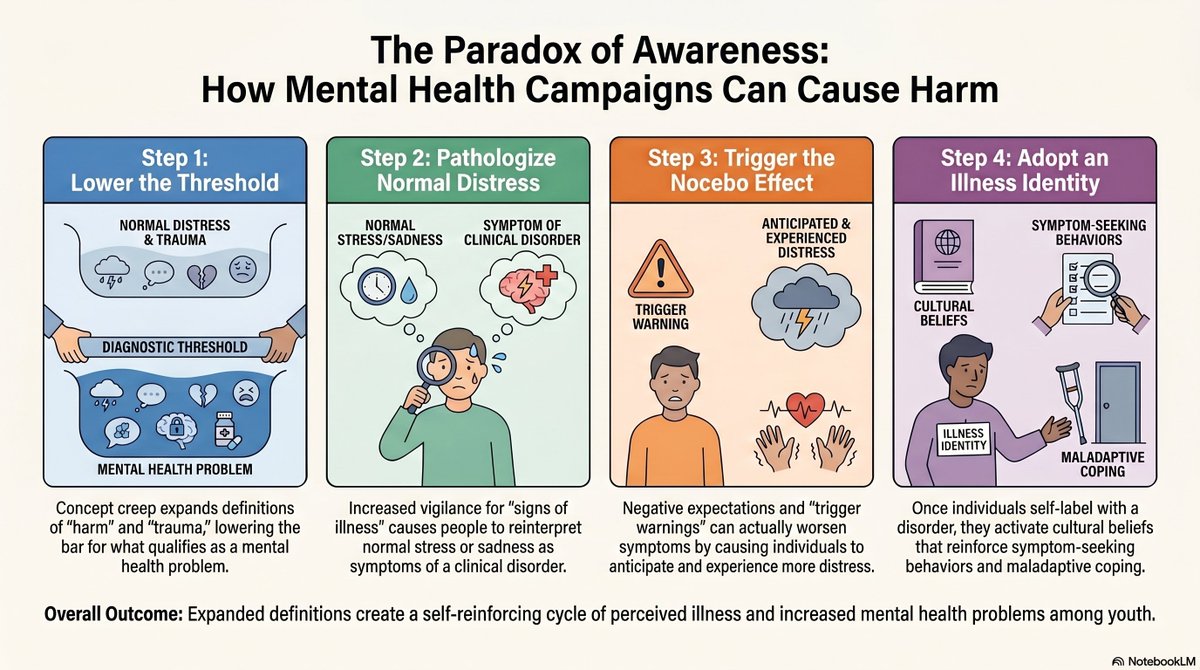
In a new paper by my PhD student Dasha Sandra, titled "Why mental health awareness can harm: Converging explanations for a societal problem", we argue that well-meaning mental health awareness can backfire, and we identify how. Four separate literatures (concept creep, nocebo effects, prevalence inflation, and illness self-labeling) have been circling the same problem from different angles. We show they converge on three mechanisms:
1.Awareness lowers the threshold for what counts as a disorder.
2. It trains people to scan their inner lives for symptoms and reinterpret normal distress as pathology.
3. Once someone adopts an illness identity, they behave in ways that confirm and deepen it.
The evidence is wide. Learning that loneliness is harmful makes solitude feel worse. Learning that stress is harmful worsens well-being and performance. Awareness videos about fake conditions like "wind turbine syndrome" produce real headaches. Trigger warnings raise anticipatory anxiety without reducing distress.
This does not mean awareness should stop. It means awareness can have unintended consequences, including manufacturing the suffering it tries to prevent. Inoculating people against these mechanisms works, and we already have evidence it does.
Link to paper: https://t.co/ucoGyhEuAj


![yanisvaroufakis's tweet photo. IN PRAISE OF FRANCESCA ALBANESE
There is a question that visits me in the small hours, when sleep will not come and the mind turns over old stones. The question is this: “What would I have done in the 1930s, on the morning after Kristallnacht?"
Not what I say I would have done. Not what I hope I would have done. But what would I actually have done—when the trains began to run, when the neighbours grew quiet, when the cost of decency became the loss of everything?
Most of us, I think, would have done little. Not from malice. From fear. From the soft, creeping conviction that someone else will speak, that the situation is complex, that we must be 'reasonable'. Lest we forget, the ordinary is the extraordinary's alibi. And how we have clung to that alibi! How we still cling to it!
And then, every once in a terrible while, someone appears who does not cling. Someone who steps forward when others step back. Someone who speaks the name of the thing when everyone else is busy naming something else.
Francesca Albanese is that someone.
She stands before the world—alone, unarmed, armed only with law and language and a rare courage—and she says what the centrists will not say, what the foreign ministries will not say, what the editorial boards will not say. She says: "This is a genocide. And we are watching it happen."
Do not tell me that is hyperbole. Do not tell me the term is contested. She has not used it lightly. She has used it as a physician arrives scientifically at a diagnosis—not to wound, but to warn. Not to inflame, but to name.
And for that, they have come for her. Oh, how they have come for her. Smears. Investigations. Vicious editorials. Frozen bank accounts. Dispossession of the only apartment she had ever owned. The machinery of the respectable turned to crush her. Because the respectable cannot abide what she represents: a mirror held up to their complicity.
Let us, once again, travel back to the 1930s. Back to the few who stood up when the trains began to run laden with Jewish people.
There was Aristides de Sousa Mendes, a Portuguese consul in Bordeaux. He defied his own government. He signed thousands of visas, by hand, for hours, until his fingers bled. He saved more lives than Schindler. And he died penniless, disgraced, erased.
There was a German officer in Warsaw named Wilm Hosenfeld. He hid a Jewish pianist in the rubble. He did not save thousands. He saved one. But that one—Władysław Szpilman—carried the memory. And memory is "the only haven from which we cannot be expelled."
There was Raoul Wallenberg. There were the villagers of Le Chambon. There were the anonymous, the quiet, the furious few who said: “Not on my watch.”
Francesca Albanese is their heir. Not because she carries a gun. Not because she hides refugees in her basement. But because she does something equally dangerous in a world that has perfected the art of not seeing. She sees. And she speaks.
She does not speak as a diplomat. Thank Goodness she doesn't! Diplomats have given us the language of "there are arguments on both sides" and "restraint" and "proportionality." Diplomatic language is the perfumed grave of moral clarity. No, she speaks as a jurist. As a human being. As a woman who has looked into the abyss and refused to call it a "complex geopolitical landscape".
Edna O'Brien once described a character who "had the recklessness of those who have already lost everything worth losing." Francesca Albanese has not lost everything. She has her dignity, her office, her voice, her family. But she has calculated the cost of speaking truth to power. And she has decided that that cost is infinitely less than the cost of silence.
What is that cost? Let us name it. She has been called antisemitic—she, who stands on the ground of international law forged in the ashes of Auschwitz and the fires of Nuremberg. She has been called a conspiracy theorist—she, who cites every source, every footnote, every UN resolution. She has been called naive—she, who understands better than most the machinery of realpolitik.
These accusations are not arguments. They are the spittle of the threatened. Because Francesca Albanese threatens something very precious to the powerful: the right to commit atrocity without being named.
Friends, the 1930s did not arrive with jackboots and pogroms on day one. They arrived in small increments. With "reasonable" restrictions. With "proportional" measures. With the silence of the respectable.
We tell ourselves that we would have been different. That we would have been Sousa Mendes. That we would have been Wallenberg. But most of us, I fear, would have been the neighbours who later said, "I didn't know."
Francesca Albanese knows. And she refuses to pretend otherwise.
So let us praise her. Not with statues or awards she does not seek. But with something harder: with our own refusal to look away. With our own voices, raised in places that are safe for us but dangerous for her. With our own bodies, if it comes to that.
A brave woman, who was injured while demonstrating outside a US nuclear military base in 1982, the infamous Greenham Common, had told me that "the heart is a hunter for what it cannot have." But I say the heart is a hunter for what it will not lose. And what we will not lose is the memory of those who stood up when standing up cost everything.
Francesca Albanese is standing up now. In our time. In our name. Under our indifferent sky.
Let us stand with her.
Not tomorrow. Not when it is safe. Now.
[Extract from a speech in Athens on Sunday 3rd May 2026]](https://pbs.twimg.com/media/HHsnlr9WIAEr4Cw.jpg)