@kawal279 Jisko MDR milega voh toh ye bolega hi na. Loss is to the consumers/merchants and the larger economy at the expense of these payment apps. Most of them make money regardless.
Lobbyists are posting every 30 minutes to say UPI MDR is the best thing since sliced bread. Lobbyists are paid for stooges.
Read this story to appreciate why the broking industry can't work with UPI MDR. https://t.co/lC43VJ7vTz
A UPI transaction is a digital transaction-just like email.
Imagine if I had charged one cent for every email sent through Hotmail.
The internet scaled because digital transactions became virtually free. UPI should follow the same principle.
UPI should be treated as public infrastructure, not just another commercial payment product.
For decades, the government paid to print, transport, secure and replace currency notes because the ability to make payments is a basic public good. Nobody suggested recovering the cost of printing a ₹500 note by charging the shopkeeper every time it changed hands.
UPI is the digital evolution of that same infrastructure. It reduces dependence on cash, lowers cash-handling costs for banks, improves transparency, encourages formalisation and makes the entire economy more efficient.
Of course UPI costs money to operate. So did cash. The question is who pays.
If the government could fund physical currency as essential infrastructure, it can fund the digital payment rails too. Keep UPI payments free. The economic benefits of frictionless digital payments are worth far more than the cost of running the system.
It’s a public good. We pay much more for things that hardly benefit us. It costs far less than printing and managing physical currency. We did one thing right in the public sector, and now we want to mess it up for the benefit of private banks, not to mention Visa and Mastercard.
@SridharanAnand Oh but C is involved and profiting from the transaction between a and b who would otherwise use cash and throw out C. D is the app that enables it and cribs.
@SridharanAnand It's paid for by the banks who have got float and less cash mgmt charges. They should be forced to pay apps, maybe a flat fee, not the merchants who keep money in current accounts.
@GabbbarSingh Cash has a cost too, it’s just less visible: handling, counting, reconciliation, transportation, ATM infrastructure, security and leakage.
Applying an MDR is theoretically correct. There is a cost for all the financial plumbing. It’s like paying a toll for using an expressway.
Applying an MDR in practicality is a different ball game. It pushes you to use cards. But they have a higher MDR. So the alternative is cash. Do we want more transactions to move towards cash? Merchants will love it. More tax evasion. They are forced to put UPI QR codes coz the customers demand it. Else sales will move to the other shop.
Reforms are most difficult in a low-trust Democracy like ours.
Yes taxpayers should ! It’s a public good/service. Negates the need for printing loads of cash which taxpayers pay lots for anyways. It’s entire success was based on replacing cash.
UPI WAS NEVER FREE. YOU WERE PAYING.
UPI was free at the point of use. But running the UPI ecosystem costs money.
Banks, payment infrastructure, cybersecurity, technology and network operations all have to be paid for. A significant part of that cost has been supported through government incentives, ultimately funded by taxpayers. BY US. The government has been providing incentives to sustain zero-MDR UPI, including a 0.15% incentive on eligible small-merchant transactions up to ₹2,000. But, consider the scale UPI has reached now. In AUGUST 2026 there were around 24 billion UPI transactions at a value of around $311 billion. That's a gigantic proportioned digital payment system. It is critical financial infrastructure.
SHOULD TAX PAYERS KEEP SUBSIDISING IT?
ASK THE RIGHT QUESTION.
DMart did ~4.3% net margin in FY26. Plenty of retail businesses operate on thin single-digit margins.
The jewellery industry too for that matter. But I’m sure they’ll be happy going back to cash.
Oh bhai yeh kaunsa retailer hai jo 5% net kamaata hai? Bhai kuch bhi mat bolo. The problem is that this new system is complicated. Baaki kuch nahin hai.
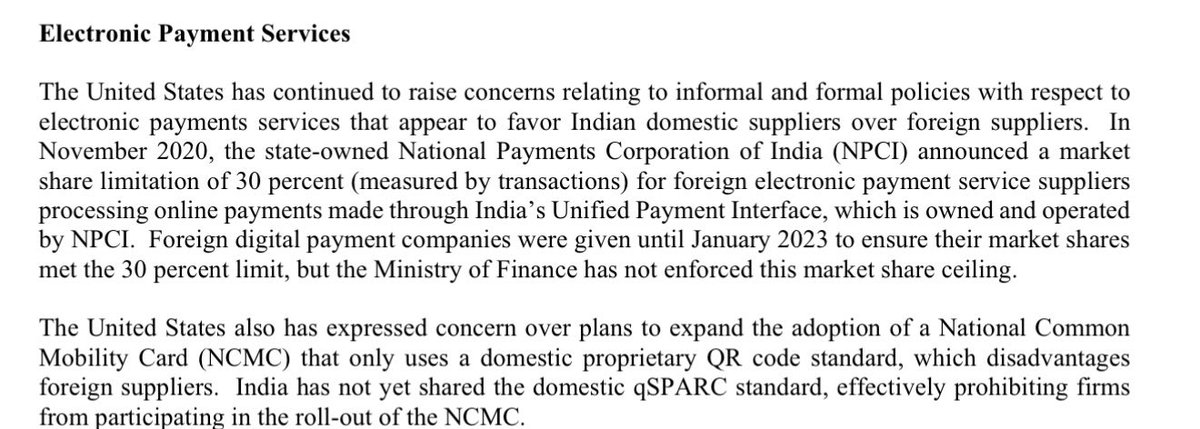
UPI was sore point in USTR Report of 2025 on India (Page 205). VISA & Mastercard have been complaining that India has been subsidising its own fintech platforms detrimental to American players. They are against RuPay cards as well.
Calling 0.4% “negligible” confuses revenue with profit. A retailer making a 5% net margin loses the equivalent of 8% of that profit to a 0.4% charge on affected sales. At a 2% margin, it’s 20%. The fact that cards already impose a larger cost isn’t an argument for adding one to UPI.
It was public policy designed to move India away from cash, and banks benefited from that transition too. The Government itself previously argued that banks could absorb digital-payment costs from savings generated by handling less cash.
Really sad to see investors pouring thousands of crores in Sip after listening to podcasts of wealth managers, financial planners etc.
There are here to make commissions. Period.
Don't get inspired by post covid bullrun returns. That is not going to happen again anytime soon.
Few people get this but young people should be happy when the stock market is cheap or falling. It’s an opportunity to acquire more. SIP at consistently high valuations isn’t good for you. You’re paying for other people’s retirements.